NEWTON IsaacABAA

709 résultats
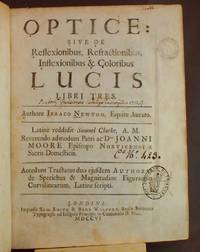
17045582London: Sam. Smith and Benj. Walford Printers to the Royal Society 1704. Hardcover. Near Fine. 4to. 24.2 x 18.8 cm. 2 ff. 144 pp. 211 pp 1 pp. with 19 folding engraved plates. Bound in contemporary English paneled calf. Minor ribbing to binding. Only very minor marginal traces of use. Very genuine. Excellent. First edition first issue of this landmark in science by Sir Isaac Newton 1642-1727 here in a remarkably well preserved unrestored example. "The work summarized Newton's discoveries and theories concerning light and color: the spectrum of the sunlight the degrees of refraction associated with different colors the color circle the first in the history of color theory the invention of the reflecting telescope the first workable theory of the rainbow and experiments on what would later be called 'interference effects' in conjunction with Newton's rings . . . The first edition of the Opticks ends with two mathematical treatises in Latin written to establish his priority over Leibnitz in the invention of the calculus" Norman 1588. Babson 132; Dibner 148; Horblit 79b; PMM 172; Norman 1588; Wallis 174. <br/> <br/> Sam. Smith and Benj. Walford, Printers to the Royal Society hardcover books
1704157612London: Smith & Walford 1704. First. hardcover. very good. Also Two Treatises of the Species and Magnitude of Curvilinear Figures. 4 parts in 1 volume. Title page printed in red & black within a double-ruled border. Illustrated with 19 folding copperplate engravings.4 144 211 1pp. In the second sequence p. 120 is marked 112 and there are blank pages between 137-8 and 138-9. Thick 4to contemporary blind-tooled panelled calf expertly rebacked in matching leather contemporary signature on title dated 1704; last several pages have marginal dampstains otherwise a remarkably clean crisp copy. London: Smith & Walford 1704.<br/><br/> First edition first issue - with the author not named on title page. The work contains: The First Book of Opticks The Second Book of Opticks The Thrid Book of Opticks Tertii Ordinis: Enumeratio Linearum Tractatus de Quadratura Curvarum. The main work is in English the 2 treatises pages 138-211 are in Latin. Babson 132; Gray 174; Horblit 79b; PMM 172; Norman 1588; Dibner 148; Wallis 174.<br/><br/> Smith & Walford unknown books
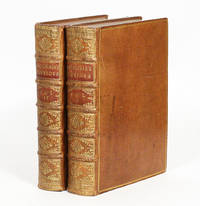
16932188Oxford: Oxford University Press 1693. First collected edition. Contemporary calf. Very Good. SCARCE FIRST EDITION OF THE COLLECTED WORKS of one of Newton's most important precursors John Wallis Savilian Professor 1649-1703 containing the first printed appearance of Newton's ideas on fluxions. A staunch promoter of English mathematicians Wallis repeatedly urged Newton to publish his theories before others laid claim to he work for the sake of "your Reputation & that of the nation" Gjertsen Newton Handbook 605. While Newton resisted for many years in 1693 Wallis published several letters from Newton in Vol. II of his Opera thereby introducing the concept of fluxional notation-pricked and dotted letters. In the preface to Vol. I 1695 Wallis refers briefly to Newton's claim to the discovery of Fluxions while Vol II 1693 has the first full account of Newton's invention of calculus. The third volume of Wallis's Opera contains previously unpublished correspondence between Newton and Leibniz the most important items of which are Newton's Epistola prior and Epistola posterior. "These two lengthy letters were sent to Leibniz in 1676 to acquaint him with the main lines of Newton's mathematical development. Epistola prior beginning with the binomial theorem went on to describe Newton's work on series. The second letter also contains much discussion on infinite series. It is best known however for Newton's reference to powerful and general methods he had developed for the drawing of tangents the determination of maxima and minima and the quadrature of curves. These he added he preferred to conceal within a quite insoluble anagram. A second and even longer anagram concealed Newton's claim to be able to solve fluxional equations. The solutions to both were publicly disclosed by Wallis 1699" ibid 189. Vol. 2 of the Opera also contains pp. 669-78 De Postulato Quinto; et Definitione Quinta; Lib. 6. Euclidis; disputatio geometrica Wallis's important attempt to prove the parallel postulate of Euclid also published here for the first time. "John Wallis gave a lecture on this topic. on the evening of 11 July 1663. He had been inspired by Nasr-Eddin's attempt on it which he referred to in his lecture to examine the question himself and his analysis is remarkable both for its originality and its caution. Indeed his view of the matter was to be much more profound than many a later writer's" Fauvel & Gray The History of Mathematics 510. This magnificent and comprehensive edition of Wallis's collected works was financed by and printed at Oxford University. In addition to several 'firsts' including those described above these volumes contain reprints of virtually all of Wallis's great books including the Arithmetica infinitorum and Mechanica Vol. 1 an augmented Latin edition of the Treatise of Algebra Vol. II and bilingual editions of a number of ancient Greek texts including Ptolemy's Harmonics Aristarchus's On the magnitudes and distances of the sun and moon and Archimedes's Sand-reckoner Vol. III. In addition to numerous other mathematical works the four volumes include his most popular work Grammaticae lingua anglicanae his "Treatise of Speech which formed a useful theoretical foundation for his pioneering attempts to teach deaf-mutes how to speak" DSB as well as an important tract on cryptography in which he records the methods he developed while deciphering for Cromwell the coded messages of Charles I. Wing W596 W566 W597. Babson 184. Roberts and Trent 345. see J.F. Scott The Mathematical Work of John Wallis London 1938; M. Baron The Origins of the Infinitesmal Calculus Oxford 1969 205-213; Richard Westfall The Life of Isaac Newton Cambridge 1993 207-209ff. Opera Mathematica. Volumen primum -Tertium - Opera quaedam miscellanea. Oxford: Sheldonian Theatre University Press 1695 1693 1699. Four volumes bound in three. Folio contemporary full paneled calf rebacked to style. Complete with four engravings on three leaves and three portraits Vols. I & II with the same portrait by Loggan dated 1678 and engraved by Burghers; Vol 3 by Sonmans dated 1698 and engraved by Burghers. With large bookplate inside each front cover reading "The Gift of Mr. Thomas Heatley Citizen and Iron-monger of London to the Mathematical School in Christ's Hospital Anno Dom. 1700". A very clean copy with only occasional light browning and foxing very handsomely bound. ONE OF THE MONUMENTS IN THE HISTORY OF MATHEMATICS. RARE. . Oxford University Press unknown books
1830124608London: Newton Son & Berry c. 1830-1836. Fine pair of rare early 19th century celestial and terrestrial table globes published by Newton Son & Berry. Both the celestial and terrestrial globe measure 12 inches in diameter with a calibrated brass meridian ring and 19 inch mahogany horizon ring decorated with mounted hand colored decorations. Mounted on ebonized oak stands. Each globe is comprised of 12 richly detailed hand-colored gores with polar calottes the terrestrial globe detailing the earth's landmasses major countries and cities and the celestial showing the major stars in various sizes related to their brightness displayed with a table of magnitudes. Major constellations and all twelve zodiac signs are illustrated with detailed hand-colored drawings. The cartouche on the celestial globe is inscribed "Newton's New & Improved Celestial Globe On which all the Stars Nebulae & Clusters contained in the extensive Catalogue of the late E. Wollaston E.R.S. are accurately laid down their Right Ascensions and Declinations having been recalculated for the Year 1830 by W. Newton. Manufactured by Newton Son & Berry Chancery Lane London Published 1836." In near fine condition with some light restoration. Each globe measures 19 inches tall. The sphericity of the Earth was established by Greek astronomers in the 3rd century BC with the earliest terrestrial globe appearing during that period. The earliest known globe was constructed by Crates of Mallus in Cilicia now Cukurova in modern-day Turkey in the mid-2nd century B.C.E. Now known as the Erdapfel the earliest extant terrestrial globe was produced in 1492 by German mapmaker navigator and merchant Martin Behaim in Nuremberg Germany. Traditionally globes were manufactured by gluing a printed paper map onto a sphere often made from wood. Newton, Son & Berry unknown books
17262210London: Guil. & Joh. Innys Regiae Societatis typographos 1726. Third Edition. contemporary full vellum. RARE 1726 THIRD EDITION OF NEWTON'S PRINCIPIA THE LAST EDITION EDITED BY NEWTON AND THE BASIS FOR ALL SUBSEQUENT EDITIONS. ONE OF ONLY 1250 COPIES PRINTED. "The Principia is generally described as the greatest work in the history of science. Copernicus Galileo and Kepler had certainly shown the way; but where they described the phenomena they observed Newton explained the underlying universal laws. The Principia provided the great synthesis of the cosmos proving finally its physical unity. Newton showed that the important and dramatic aspects of nature that were subject to the universal law of gravitation could be explained in mathematical terms within a single physical theory. With him the separation of natural and supernatural of sublunar and superlunar worlds disappeared. The same laws of gravitation and motion rule everywhere; for the first time a single mathematical law could explain the motion of objects on earth as well as the phenomena of the heavens. The whole cosmos is composed of inter-connecting parts influencing each other according to these laws. It was this grand conception that produced a general revolution in human thought equalled perhaps only by that following Darwin's Origin of Species. It was the final irrevocable break with a medieval conception based on Greek and Roman cosmology and a scholastic system derived from the medieval interpretation of Aristotle. Newton's universe almost independent of the spiritual order ushered in the age of rationalism scientific determinism and the acceptance of a mechanistic view of nature" Printing and the Mind of Man 161. On the history and importance of the third edition: Towards the end of his life Newton "gave one last effort to the Principia. It is clear that he regarded the Principia rather than the Opticks as his masterwork. He worked over the Principia without end to hone its language to a perfect expression of his ideas. Perhaps the appearance of a reprint of the second edition in Amsterdam in 1723 stimulated Newton to put his plan for a new edition into action. Perhaps a serious illness in 1722 reminded him that he could not delay forever. We know only that printing of an edition more sumptuous than either of the others began in the fall of 1723. As editor Newton had the services of a young member of the Royal Society Henry Pemberton. In the fall of 1723 Pemberton addressed to him the first of thirty-one communications which stretched over the following two-and-a-half years while the edition passed through the press. Through 1724 and 1725 the edition made its slow but steady progress toward completion with none of the delays that stopped the press during the second edition. Newton dated the preface 12 January 1726. It was the last day of March when Martin Folkes presented a copy 'richly Bound in morocco Leather' to the Royal Society in Newton's name. In all 1250 copies were printed." Westfall The Life of Isaac Newton. The third edition "contains a new preface by Newton and a large number of alterations" Babson 13. With portrait engraving by Vertue bound before first text leaf and numerous illustrations in text. Complete with the privilege leaf half-title dedication leaf index and ad leaf. London: Guil. & Joh. Innys Regiae Societatis typographos 1726. Quarto 186x241 mm contemporary full Dutch vellum; custom half-leather box. Unidentified early signatures on front pastedown half-title and ad leaf verso. Mild scuffing to binding boards a little bowed. Text with occasional light soiling and scattered foxing but generally clean. A beautiful copy. SCARCE IN AN UNRESTORED CONTEMPORARY BINDING. Guil. & Joh. Innys, Regiae Societatis typographos unknown books
18481803065Daniel Adee 1848. 1st Edition. Hardcover. Near Fine/No Jacket. Near fine TRUE first American edition 1st issue as stated on the title page. Some water stains on page edges. Previous owner's bookplate on front pastedown. Rubbing on outside spine and corners and at bottom of spine. Tape at endpapers and pastedowns along gutters. Housed in custom-made slip case. Daniel Adee hardcover books
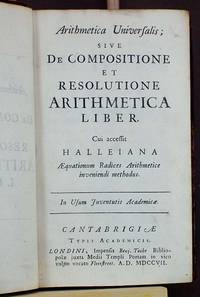
17076325Cambridge and London: Typis Academicis; Benj. Tooke 1707. First edition. Very Good/William Whiston the successor to Newton's chair at Cambridge "extracted from Newton a somewhat reluctant permission to print" this remarkable "schoolbook" based on Newton's lecture notes Babson Catalogue. So reluctant in fact that Newton kept his name out of it and supposedly considered purchasing the press run in order to destroy it! He later republished it himself. Several new theorems are laid out including a formula to determine the number of imaginary roots of any equation. The rule is complicated and is offered without proof. Yet 180 years later the rule was proven by rigorous analysis. The text also includes Edmond Halley's "Aequationum radices arithmetice inveniendi methodus. Octavo 19cm; 8 343 1 pages the last page blank . Figure and diagrams in text. Running-title: Algebrae elementa. Editor's preface signed: G.W. i.e. William Whiston. In contemporary paneled calf rebacked with new burgundy morocco spine label. Edges of boards rubbed. Early ink ownership inscriptions on blank endleaves the contemporary autograph of Edward Harington and the 19th-century mathematician William Fleetwood Sheppard. Half-title present. References: Babson Newton Collection; 199; ESTC; T018645; Bowes and Bowes 277. Typis Academicis; Benj. Tooke hardcover books
1803122898London: Printed for H.D. Symonds 1803. First complete edition in English of Sir Isaac Newton's Principia the greatest work of physics in the exceedingly rare original boards. Octavo 3 volumes bound in original boards uncut 54 folding copper-engraved plates of diagrams and figures all but one folding; 2 folding tables. with 22 folding. In near fine condition with light toning to the text. An exceptional example rare and desirable in the original boards. Housed in a custom clamshell box. "Newtons Principia is generally described as the greatest work in the history of science. Copernicus Galileo and Kepler had certainly shown the way; but where they described the phenomena they observed Newton explained the underlying universal laws. The Principia provided the greatest synthesis of the cosmos proving finally its physical unity. Newton showed that the important and dramatic aspects of nature that were subject to the universal law of gravitation could be explained in mathematical terms with a single physical theory. With him the separation of the natural and supernatural of sublunar and superlunar worlds disappeared. The same laws of gravitation and motion rule everywhere; for the first time a single mathematical law could explain the motion of objects on earth as well as the phenomena of the heavens. The whole cosmos is composed of inter-connecting parts influencing each other according to these laws. It was this grand conception that produced a general revolution in human thought equaled perhaps only by that following Darwins Origin of Species Newton is generally regarded as one of the greatest mathematicians of all time and the founder of mathematical physics" PMM 161. "It is perhaps the greatest intellectual stride that it has ever been granted to any man to make" Einstein. Printed for H.D. Symonds hardcover books
174595840London: Printed by James Bettenham for the Society for the Encouragement of Learning 1745. First edition in English of the mathematical appendixes to <span class="match">Newton</span>'s fundamental 1704 Opticks one of the greatest works of science ever published. Translated from the Latin by James Bettenham Professor of Mathematics at the University of Aberdeen. Quarto bound in contemporary calf gilt titles to the spine burgundy morocco spine label rebacked woodcut diagrams throughout the text engraved tailpiece. In very good condition with some light wear and browning to the text with wide margined text. Exceptionally rare and desirable first editions are scarce with only four appearing at auction in the last 90 years. English mathematician astronomer theologian author and physicist Sir Isaac Newton is widely considered one of the most influential scientists of all time and a key figure in the scientific revolution. In one of his most important works Philosophiae Naturalis Principia Mathematica Newton formulated the the laws of motion and universal gravitation that formed the dominant scientific viewpoint until being superseded by the theory of relativity. Considered one of the greatest works of science ever published Newton's second major book Opticks analyzes the fundamental nature of light by means of the refraction of light with prisms and lenses the diffraction of light by closely spaced sheets of glass and the behavior of color mixtures with spectral lights or pigment powders. Printed by James Bettenham for the Society for the Encouragement of Learning unknown books
17422085Edinburgh: T.W. and T. Ruddimans 1742. First edition. Contemporary calf gilt. Fine. FIRST EDITION of MacLaurin's most important work including a strong defense of Isaac Newton and the first full presentation and development of Newton's calculus. The William Jones- Macclesfield copy. "Colin MacLaurin was a younger contemporary and to some extent a protégé of Isaac Newton and he wrote the first thorough systematic axiomatic development of the method of fluxions the Newtonian version of the calculus. MacLaurin's magnum opus the Treatise of Fluxions published in 1742 was begun as a response to Berkeley's Analyst. MacLaurin founded the method of fluxions on a limit concept drawn from the method of exhaustions in classical geometry avoiding the use of infinitesimals infinite processes and actually infinite quantities and avoiding any shifting of the hypothesis. In addition he went on in this treatise of over 760 pages to demonstrate that the method so founded would support the entire received structure of fluxions and the calculus and could deal effectively with all of the challenge problems then being exchanged between British and continental mathematicians" Oxford National Biography. Provenance: Williams Jones the great mathematician and champion and publisher of Newton with his signed manuscript note on p. 621: "His collection of some 15000 books was considered to be the most valuable mathematical library in England and was bequeathed to George Parker the second earl of Macclesfield." The Macclesfield copy with Macclesfield bookplates and embossed stamps in each volume. Edinburgh: T.W. and T. Ruddimans 1742. Quarto 234x175mm contemporary full calf with elaborately gilt-decorated spines. With half-title in volume 1. A little worming in lower margins of first few leaves of volume 2. An outstanding set with a distinguished provenance. T.W. and T. Ruddimans unknown books
198718974EMunich: Schirmer / Mosel 1987. First Edition. From the library of the great film director and art collector Billy Wilder signed and inscribed by the author / photographer Helmut Newton to Mr. Wilder and his wife Audrey. Inscribed on the title page: “For Billy and Audrey with love from Helmut. See page 147 for the only interesting photo in this book. Berlin 25.5.1987.†And on the front flyleaf Newton writes to the Wilders: “Fur der Herr und Frau Professor.†Newton’s inscription about page 147 refers to his black & white portrait of Billy and Audrey Wilder taken in Los Angeles in 1985 showing Billy reclining on a chaise looking into the camera and playfully pulling down a long double strand of pearls which Audrey is wearing as she stands next to the chaise looking down at Billy. Oversize art book format. Text in German. Fine copy in a fine dust jacket. A collection of provocative photographs of film celebrities and art social music and literary personalities and self-portraits by Helmut Newton in full-color and in black & white. With terrific images of Andy Warhol Salvador Dali David Hockney Jeanne Moreau Karl Lagerfeld Catharine Deneuve including the cover photo Paloma Picasso David Bowie Sting Marianne Faithful Mick Jagger Raquel Welch Jacqueline Bisset Veruschka Jack Nicholson Mickey Rourke Debra Winger Timothy Leary Julian Schnabel Anjelica Huston John Huston Darryl Hannah and more. Billy Wilder’s legendary status in Hollywood as a director screenwriter and producer includes such classic films as Ninotchka Sunset Boulevard Double Indemnity The Lost Weekend Stalag 17 Some Like it Hot The Seven Year Itch The Apartment and The Fortune Cookie. Schirmer / Mosel unknown books
1220Twelve folding engraved plates. 4 p.l. 382 pp. one leaf of ads. 8vo cont. calf small portions of ends of spine & one corner carefully repaired spine gilt red morocco lettering piece on spine. London: W. Innys 1730. Fourth edition and the final edition to be revised by Newton of this great classic. It contains the complete set of 31 Queries which reveal some of Newton's most influential and speculative writing. Fine crisp copy. Contemporary armorial bookplate of Edward Powell. ❧ Babson 136. unknown books
17066324London: Samuel Smith & Benjamin Walford 1706. First Latin edition. Very Good/The Latin edition of Newton's 1704 Opticks was intended for the broader pan-European "Republic of Letters" and it was the first printing to carry Newton's name on the title. This is the edition that inspired Emelie du Chatelet and Voltaire and through them the whole of Europe. It is a compendium of Newton's main discoveries concerning light and color including the spectrum of sunlight the color circle the reflecting telescope and interference effects that is the so-called 'Newton's rings'. In expansion of the 1704 English text the Latin edition presents seven added "Quaestiones" which are partly devoted to Newton's support for the "corpuscular" or particle theory of light. The collation of this copy corresponds to the copy in the Babson Collection catalogue with "Pp" consisting of a single leaf and with pages 21-24 repeated in the Tractatus. . Quarto 26 cm; 14 348 2 24 2 24 21-43 1 pages 19 folded leaves of engraved plates with errata corrigenda and addenda. Ss1 a cancel. In original calf with blind-ruled border rebacked with corners built up. Spine with gilding and leather title label. Speckled edges. Old library stamps on title page along with early ownership inscriptions. References: Bowes and Bowes #179; Babson Collection 137; Norman 1589. Samuel Smith & Benjamin Walford, hardcover books
1209Twelve folding engraved plates. 1 leaf of ads 1 p.l. xi 1 415 pp. 1 p. of ads. 8vo 18th-cent. speckled calf carefully rebacked by Aquarius double gilt fillet round sides spine richly gilt red morocco lettering piece on spine. London: G. & J. Innys 1719. Second edition in Latin and an influential book on the Continent. Newton published this edition in Latin to reach the Continental audience which had been little influenced by his optical experiments. The edition served its purpose and caused numerous demonstrations of his theory of colors to be performed in Paris. Newton's optical theories began to spread significantly outside Great Britain as a result of this book. See Westfall's Never at Rest pp. 794-95. A very good copy with the signature dated 14 Mar. 1822 of Stephen Peter Rigaud 1774-1839 historian of science astronomer and Savilian professor of geometry at Oxford. Stamp of the Radcliffe Observatory on verso of title. With the bookplate of William A. Cole the distinguished collector and bibliographer of chemistry. ❧ Babson 138. unknown books
1870110127New York: Robert Carter and Brothers 1870. Rare early edition of this work by Newton. Octavo original cloth illustrated. Presentation copy inscribed by Moody on the front free endpaper "To John Syme D.L. Moody My dear Brother be useful be earnest be fruitful and the blessing of God will rest on you." In good condition. Signatures of the legendary evangelist are rare especially with such a lengthy inscription. Dwight Lyman Moody also known as D. L. Moody was an evangelist and publisher connected with the Holiness Movement who founded the Moody Church Northfield School and Mount Hermon School in Massachusetts Moody Bible Institute and Moody Publishers. One of his most famous quotes was "Faith makes all things possible. Love makes all things easy." Moody gave up his lucrative boot and shoe business to devote his life to revivalism working first in the Civil War with union troops through YMCA in the United States Christian commission. In Chicago he built one of the major evangelical centers in the nation which it is still active. Working with singer Ira Sankey he toured the country and Britain Europe drawing large crowds with a dynamic speaking style that preached God's love and friendship kindness and forgiveness rather than hellfire and condemnation. Robert Carter and Brothers hardcover books
1744109523Lausanne and Geneva: Aoud Marcum-Michaelem Bousquet & Socios 1744. First edition of the first collected edition of <span class="match">Newton</span>'s writings which has been hailed as "a fine piece of bookmaking" Babson. Quarto bound in contemporary velum contains 64 folding engraved plates; 2 folding letterpress tables. In very good condition. Small stamps to the spine and title pages. Rare in contemporary binding. English mathematician astronomer theologian author and physicist Sir Isaac Newton is widely considered one of the most influential scientists of all time and a key figure in the scientific revolution. In one of his most important works Philosophiae Naturalis Principia Mathematica Newton formulated the the laws of motion and universal gravitation that formed the dominant scientific viewpoint until being superseded by the theory of relativity. Aoud Marcum-Michaelem Bousquet & Socios unknown books
198418973ENew York: Xavier Moreau 1984. First Edition. From the library of the great film director and art collector Billy Wilder signed and inscribed by the author / photographer Helmut Newton to Mr. Wilder and his wife Audrey. Inscribed on the title page: “For Billy and Audrey Wilder in admiration. Helmut Newton Hollywood 6.2.1985.†Oversize art book format. Fine copy in a fine dust jacket. A collection of sexy and provocative fashion photographs by Helmut Newton in full-color and in black & white. Accompanied by a chronological journal of text by Newton in which he describes the photo shoot’s setting the models the highs and the lows and his creative impressions. Billy Wilder’s legendary status in Hollywood as a director screenwriter and producer includes such classic films as Ninotchka Sunset Boulevard Double Indemnity The Lost Weekend Stalag 17 Some Like it Hot The Seven Year Itch The Apartment and The Fortune Cookie. The Newtons and the Wilders were close friends. Besides being one of the greatest film directors Wilder was one of the great collectors of modern art. In 1989 Wilder decided to auction a portion of his art collection which brought 32.6 million dollars. Xavier Moreau unknown books
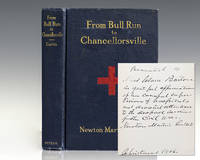
1906122593New York & London: G. P. Putnam's Sons 1906. First edition of Union Major-General Newton Martin Curtis's memoirs; lengthily inscribed by him to American Civil War nursing pioneer Clara Barton. Octavo original cloth with gilt titles to the spine and front panel illustrated with four tissue-guarded engraved portraits including frontispiece of Major-General Curtis. Association copy inscribed by the author on the front free endpaper "Presented to Miss Clara Barton in grateful appreciation of her careful supervision of hospitals and devoted attention to the disabled soldiers of the Civil War. Newton Marin Curtis Christmas 1906." The recipient Clara Barton took the lead in developing a program to care for soldiers wounded in the American Civil War. At the time of the inscription Barton had just resigned from her position as president of the American Red Cross and was working on her autobiography The Story of My Childhood which was published in 1907. An exceptional association. Newton Martin Curtis was a Union officer during the American Civil War and a member of the United States House of Representatives from New York. On May 15 1861 Curtis volunteered in the Union Army as a captain in Company G of the 16th New York Infantry. He fought in the Peninsula Campaign and was wounded in a minor engagement at West Point Virginia. On October 23 1862 he transferred to the 142nd New York Volunteer Infantry serving as lieutenant colonel until his promotion to colonel on January 21 1865. As commander of the 142nd New York Infantry he fought in the Bermuda Hundred Campaign of May 1864. He took command of the 1st Brigade 2nd Division X Corps during the Siege of Petersburg. Curtis received a brevet promotion to brigadier general on October 28 1864 for his actions at the Battle of New Market Heights. G. P. Putnam's Sons hardcover books
174492332Lausanne and Geneva: Aoud Marcum-Michaelem Bousquet & Socios 1744. First edition of the first collected edition of <span class="match">Newton</span>'s writings which has been hailed as "a fine piece of bookmaking" Babson. Quarto bound in contemporary velum contains 64 folding engraved plates; 2 folding letterpress tables. In very good condition wide margins. Rare in contemporary binding. English mathematician astronomer theologian author and physicist Sir Isaac Newton is widely considered one of the most influential scientists of all time and a key figure in the scientific revolution. In one of his most important works Philosophiae Naturalis Principia Mathematica Newton formulated the the laws of motion and universal gravitation that formed the dominant scientific viewpoint until being superseded by the theory of relativity. Aoud Marcum-Michaelem Bousquet & Socios unknown books
1831254561London 1831. Miniature globe in turned walnut case with domed lid. 1.5 inch diameter. 12 hand colored globe gores with original varnish and metal pins at each pole which enable the globe to spin in the case. Cartouche set in north Pacific. Stains along the equator in the Pacific.<br/><br/> This terrestrial globe is the smallest version made by Newton and Berry Sumira p. 189. Wonderful detail included for such a small globe. The track of Captain Cook's final voyage of 1776 is shown when Captain Clarke and Gore sail to the Bering Sea after Cook is murdered. John Newton 1759-1844 is the founding member of this family firm. Miles Berry joined the firm in 1803. They also made planetaria and mechanical models. An excellent example of a pocket globe.<br/><br/> unknown books
1719SS13189London:: Printed for B. Creake . . . J. Sackfield . . .; And sold by W. Mears . . . 1719. 1719. Sm. 4to. xxii 201 5 pp. 10 folding engraved copperplates 5 figs. pp. 24 54 75 112 half-title is a publisher's ad for Boerhaave rear publisher's ads 2 ff. head and tail-pieces; title edges chipped. With errata. Title p.101 perforated stamp and with a rubber stamp on verso of the John Crerar Library eight plates with the ex-library rubber stamp on versos; waterstained throughout. WITH FREQUENT EARLY INK CORRECTIONAL NOTES. Modern half blind-stamped dark calf gilt spine title raised bands marbled paper over boards new endleaves bindery ticket at rear: Pat M. Bruno. Inscription on recto of front blank verso is ad for Boerhaave book "W. --- 1720 Power." SPURIOUS EDITION OF DESAGULIERS' FAMOUS PRIVATE LECTURES CONTAINING NOTES ON BOYLE'S AIR PUMP AND NEWTON ON COLOR THEORY. FIRST ENLARGED EDITION early issue without "All carefully Examined and Corrected by Mr. Desaguliers" on title which otherwise is re-titled "Lectures of Experimental Philosophy". Includes: Sir Isaac Newton's Colours. Proposition. Lights which differ in Colour differ also in Degrees of Refrangibility. Initially published without the author's permission and then by evidence of the printed Preface agreed to issue the book with an erratum. / There are multiple forms of this edition as different copies collate differently Andrade Kenney Honeyman copies. The Honeyman copy called a second edition has two title-pages and the Preface by Desaguliers with an imprint of 1719. There are also differences in the title-pages. The fiasco of the unauthorized edition is the cause of the various issue differences. "Perhaps Dawson hoped . . . to ingratiate himself with his patron but instead he incurred the wrath of the lecturer. Immediately Desaguliers became aware of the book which he called 'ill put together sadly transcrib'd and worse corrected' he approached the booksellers. He found that two-thirds of the imprint had already been sold by Messrs Mears Creake and Sackfield but they paid him ten guineas 'to pacifie me'. They also promised to insert into all remaining copies a preface that Desaguliers would write together with a substantial errata. The preface follows the Dawson dedication in some copies of the book entitled A System of Experimental Philosophy but precedes it in another version called Lectures in Experimental Philosophy." See: Carpenter pp. 34-5 119. / Contents: Mechanical experiments Mechanical powers & definitions; How to make a heavy Body seem to rise it self; gravity balance leaver pulley wheel axle wedge screw laws of nature hydrostatics; Description of Robert Boyle's Air-Pump uses & experiments; How to make an air vacuum; Barometers Thermometers Hydrometers; Catoptrichs; Dioptrichs; Sir Isaac Newton's Colours; Condensing Engine; "Rowley's Horary being a machine to represent the Motion of the Moon about the Earth and the Earth Venus and Mercury about the Sun." / The preface written by Desaguliers himself explains that this volume of lectures was released "before I designed to publish them." He then retells how Paul Dawson "took a copy of the lectures . . . that they may be service to him when he went thro' my courses and they were afterwards sold and published without my knowledge." He obtained a copy of the text and made numerous corrections :: thus the micro-print 1 ½ page errata. The he invites the owner to annotate the book throughout "before he begins to read the lectures." And indeed the owner named Powers did annotate this copy :: clear evidence he read that Preface. A2-3. / The DNB asserts that Desaguliers "held in great esteem by Sir Isaac Newton" "is said to have been the first to deliver learned lectures to general audiences. Lectures by him at his London house were widely attended and were made attractive by experiments." In addition it mentions that Paul Dawson was responsible for the work and that Desaguliers himself "disavowed" himself of the edition. :: DNB pp. 850-1. / Nicholas A Hans describes the types of persons attending Desaguliers' lectures: "merchants craftsmen and clerks and his private audiences consisted of gentlemen and courtiers and included ladies as well." :: Nicholas A Hans New Trends in Education in the Eighteenth Century 1951 p. 141. / Westfall says of Desaguliers he "became a fixture at the meetings of the Royal Society where he carried out sets of experiments intimately related to various aspects of Newtonian natural philosophy. Some of his experiments such as the transmission of heat through a vacuum influenced Newton's views and other found their way into the third edition of the Principia." :: Never at Rest pp. 685-6. / Writing for the DSB A. Rupert Hall points out that Desaguliers did not produce his own version of these lectures until 1734 "when he took occasion to denounce this unauthorized version. . ." :: DSB IV pp. 43-6. / John Theophilus Desaguliers 1683-1744 born at La Rochelle emigrated to England in 1685 as a Huguenot refugee hidden in a tub at 2-years of age studied at Oxford he became a Fellow of the Royal Society in 1714. As the Society's experimenter and a close friend of Newton he often verified Newton's theories through experimentation. "In 1717 he published Physico-Mechanical Lectures an eighty-page abstract of the twenty-two lectures of his course. Although not authorized by Desaguliers the present work is the first full account of his lectures edited by his student Paul Dawson. Primarily of interest as a textbook of Newtonian physics many chemical topics are included. The first issue appeared with the title A System of Experimental Philosophy." / REFERENCES: Bakken title: "Lectures of experimental philosophy . . . 1719" pp. 52-3; Goodison English Barometers 1680-1860 p. 369; Keynes Boyle 366 pp. 122-9; Roy G. Neville I p. 354 second issue; Poggendorff I 554; Wellcome II p. 451; Wheeler 249. Not in Babson Barchas Gray or Verne L. Roberts catalogues. See: DSB IV p. 45; Taylor Mathematical Practitioners 1714-1840 35; Audrey T. Carpenter John Theophilus Desaguliers: A Natural Philosopher Engineer and Freemason in Newtonian England Bloomsbury Academic 2011. FULL TITLE: A System of Experimental Philosophy Prov'd by Mechanicks wherein the principles and laws of Physicks Mechanicks Hydrostaticks and Opticks are demonstrated and explained at large by a great number of curious experiments. . . To which is added Sir Isaac Newton's colours: the description of the condensing engine with its apparatus: and Rowley's Horary; a machine representing the motion of the Moon about the Earth; Venus and Mercury about the Sun according to the Copernican System. Printed for B. Creake, . . . J. Sackfield . . .; And sold by W. Mears, . . . 1719. hardcover books
1968List905Emoryville: Black Panther Party for Self Defence 1968. First Edition. 23 x 35 inches linen backed. A particularly nice example professionally mounted. Fine. In one of the Black Panthers' most iconic images Minister of Culture Huey Newton sits in a chair with a shotgun and a spear a pile of spent shotgun cartridges on a zebra skin rug beneath him. The image is credited to Blair Stapp and was composed by Eldridge Cleaver. The full text on the lower left margin reads "'The racist dog policemen must withdraw immediately from our communities cease their wanton murder and brutality and torture of black people or face the wrath of the armed people.' / Huey P. Newton Minister of Defence.". Black Panther Party for Self Defence unknown books
199319117EMunich: Schirmer / Mosel 1993. First Edition - Paperbound. From the library of the great film director and art collector Billy Wilder signed and inscribed by the author / photographer Helmut Newton to Mr. Wilder. Inscribed on the title page: “For Billy with love and admiration. Helmut. 4.1.1996.†An illustrated catalogue issued to accompany an exhibit of color and black & white photographs by Helmut Newton focused mainly on his fashion and nude photography as well as portraits cityscapes night scenes and ballet images. Including photographs of Darryl Hannah Anita Ekberg Leni Riefenstahl Francois Sagan Karl Lagerfeld Grace Jones Catherine Deneuve Jodie Foster Princess Caroline of Monaco Birgit Nielsen etc. Fine bright copy in printed wrappers. Billy Wilder’s legendary status in Hollywood as a director screenwriter and producer includes such classic films as Ninotchka Sunset Boulevard Double Indemnity The Lost Weekend Stalag 17 Some Like it Hot The Seven Year Itch The Apartment and The Fortune Cookie. Schirmer / Mosel unknown books
2305Engraved vignette on title & 13 folding engraved plates. Title printed in red & black. 4 p.l. 344 pp. Large 4to cont. Dutch vellum over boards lower cover a little soiled final ten leaves with faint marginal dampstain panelled in blind central panel of each cover with large arabesque stamped in blind. Leyden: J. & H. Verbeek 1732. The Leyden edition the first to be edited by 'Gravesande and with additional treatises by Halley Colson DeMoivre Maclaurin and Campbell. There is also an Appendix "De Solutione et Constructione Aequationum Scripta Varia" excerpted from the Phil. Trans. Fine copy. Bookplate and signature of Karen Figala the historian of science. ❧ Babson 204. hardcover books
1679241546London: Passinger 1679. hardcover. very good. 14 folding plates. Rubricated title small 8vo contemporary blindruled calf rebacked. London: Thomas Passinger 1679. First Edition. A very good copy.<br/><br/> John Newton 1622-1678 was a mathematics teacher and rector of the mathematuics school at Ross Herefordshire. His Work includes sections on surveying measuring solids astronomy and geography. The preface stresses the need for mathematics as part of general education. From the library of Harrison D. Horblitt with his bookplate. Wing N-1055.<br/><br/> Passinger unknown books