MULLER, Johannnes VonBiblio.com

23 résultats
1788000482Leipzig: Weidmannischen Buchhandlung 1788. Second Edition. . Hardcover. See Description. 8vo. pp. 6 309 1. Bound in modern blue cloth. Faint institutional stamps on outer edges of book block. Institutional book plate on inside front cover. A short name is written in an early hand on the title page near the edition statement; the second page has a shelf number stamped in the bottom margin. Interior contains mild scattered foxing / staining. A 35 mm. tear and a couple of tiny holes are present at the bottom of two leaves pp. 13-16. The tears are carefully sealed but with some soiling discoloration and a few letters obstructed. An influential political tract first printed anonymously in 1787 by the renowned Swiss historian Johannes von Müller 1752-1809. This is the second "improved" edition. <br/> <br/> Weidmannischen Buchhandlung hardcover
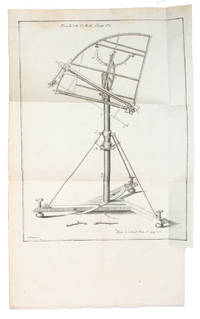
175142770Berlin Haude et Spener 1751. 4to. No wrappers as issued in "Mémoires de l'Academie Royale des Sciences et Belles-Lettres" tome V Année 1749 pp. 339-372 1 folded geometrical plate to the first paper and 3 fine double-page folded engraved plates showing the quadrant. <br/><br/><em>Kies was one of the first to propagate Newton's discoveries in Germany and dedicated two of his works to the Englishman. The crater Kies on the Moon is named after him.The paper on the instrument describes and depicts the large quadrant in the Berlin observatory invented by Hadley described in Transactions of the Royal Society in 1732."From 1742 to 1754 at the recommendation of the mathematician Leonhard Euler he Kies was made professor of mathematics at Berlin's Academy of Sciences and astronomer at its observatory. His reports from this time include De la Situation la plus avantageuse des planètes pour découvrir les irrégularités de leurs mouvemens Sur les Éclipses des étoiles fixes par la lune and Description d'un instrument qui se trouve ." </em> unknown
175946432Berlin Haude et Spener 1759. 4to. No wrappers as issued in "Mémoires de L'Academie Royale des Sciences et belles-Lettres" tome XIII 1757. With titlepage to the year 1757 with engraved titlevignette and pp. 125-159 and 1 folded engraved plate. A Stamp to titlepage. <br/><br/><em>First appearance of this paper which expands his prize-winning memoir from the Petersbourg Academy. He is now convinced by Aepinus of the importence of Franklin's distinction between positive and negative electricity. He elaborates his theory of the identity of the electrical fluid with the ether. </em> unknown
176948878Berlin Haude et Spener 1769. 4to. No wrappers as issued in "Memoires de l'Academie Royale des Sciences et Belles Lettres". tome XVIII 1762. With halftitle "Classe de Mathematique" 2 pp. pp. 117-142. Clean and fine. <br/><br/><em>An original paper first printing by Euler dealing with the mathematics of problems in the manufacturing of lenses.Enestroem: E 376. </em> unknown
176949807Berlin Haude et Spener 1769. 4to. No wrappers as issued in "Mémoires de l'Academie Royale des Sciences et Belles Lettres" Année 1767 tome XXIII pp. 131-164 a. 1 engraved plate. <br/><br/><em>First printing dealing with compound lenses for making telescopes and the mathematical theory.Enestroem: E 383. </em> unknown
176945125Berlin Haude et Spener 1769. 4to. No wrappers as issued in "Mémoires de l'Academie Royale des Sciences et Belles Lettres" Année 1767 tome XXIII pp. 131-164 a. 1 engraved plate. <br/><br/><em>First printing dealing with compound lenses for making telescopes and the mathematical theory.Enestroem: E 383. </em> unknown
177244755Berlin C.F. Voss 1772. 4to. Without wrappers as extracted from "Nouveaux Mémoires de l'Academie Royale des Sciences et Belles-Lettres" Annee 1770. With titlepage to 1770 with engraved vignette. Pp. 327-342. <br/><br/><em>First appearance of this importent paper in which Lambert established a mathematical theory of order in all sorts of classifications. He treats the problem of order and its measures not only in relation to natural history or any domain of particulars but abstractly as a problem of epistemology in general. He attempts to create a new mathematics of ordered systems and to measure by a fraction the elements to which any collection of items departed from the ordered system and he carries his mathematical ideal even into taxonomy and systematics. </em> unknown
179148147Paris 1791. Contemp. hcalf. Gilt spine. Spine a bit rubbed. Wear to top of spine. A dampstain to lower right corners on the first 15 leaves of the volume. Stamps to verso of titlepage. In: "Annales de Chimie ou Recueil de Mémoires concernant la Chemie" Tome 9. 355 pp. a. 1 engraved plate. Entire volume offered. Hassenfratz's paper: pp. 261-274. <br/><br/><em>First printing of a classic paper in physiology."Hassenfratz a pupil of Lagrange maintained that the oxidation of carbon and hydrogen took place in the blood and not in the lungs as taught by others."Garrison & Morton: 926. </em> unknown
179248909Paris Rue et Hotel Serpente 1792. 8vo. 2 contemp. hcalf. Spines gilt. Light wear to spines. In: "Annales de Chimie" tome 13 14. 336 pp. 2 plates and pp. 335 2 plates. 2 entire volumes offered.Hassenfratz' papers: pp. 178-192 318-330 tome 13 and pp. 55-85 tome 14. Stamps to verso of titlepages. Scattered brownspots some leaves in vol. 13 with a faint dampstain to upper margins. <br/><br/><em>First printing of these 3 memoirs in which Hassenfratz set forth the "Humus theory of vegetation". From Hassenfratz' theory Thaer later derived his theoretical basis for plant nutrition.The volumes also contains Hassenfratz's importent paper on chemical affinities "Explications de quelques Phénomenes qui paroissent contrarier les loix des affinités chimiques" 1.-2. memoir pp. 3-25 a. 25-38. Also papers by Pelletier Vauquelin van Mons Berthollet Fourcroy Haüy etc. </em> unknown
176844804Berlin Haude et Spener 1768 4to. No wrappers as issued in "Mémoires de l'Academie Royale des Sciences et Belles-Lettres" tome XXII Année 1766. Pp. 119-170 pp. 171-201 and 2 folded engraved plates. pp. 202-212 and 1 folded engraved plate. <br/><br/><em>First printing of three importent Euler-papers on the construction of composite lenses in order to avoid confusion. Euler presents the mathematical theory to explain the effects. The third paper describe how to analyze refraction phenomena in glasses by way of prisms. - Eneström E 359 E 360 E 361. </em> unknown
176944803Berlin Haude et Spener 1769 4to. No wrappers as issued in "Mémoires de l'Academie Royale des Sciences et Belles-Lettres" tome XVIII Année 1762. Pp. 195-225 and 1 folded engraved plate. Pp. 226-248. <br/><br/><em>First printing of two importent Euler-papers on the mathematical theory of dioptrics and how to avoid the confusions of lenses. - Eneström E 379 a. 380. </em> unknown
179943872Halle Rengerschen Buchhandlung 1799. Without wrappers. In "Annalen der Physik. Herausgegeben von Ludwig Wilhelm Gilbert" Bd. 1 Viertes Stück und Bd. 2 Drittes Stück. The entire issues offered. Pp. 379-518 a. 2 folded engravd plates pp. 249-368 a. 2 folded engraved plates. Rumford's papers: pp. 436-463 a. pp. 249-286. <br/><br/><em>First German editions of Rumford's central essays on heat flows in liquids describing his DISCOVERY OF THE CONVECTION OF HEAT and his experiments that led to his theory of the CONVECTION CURRENTS IN THE OCEAN. The papers appeared originally in the Philosophical Transactions in 1798. </em> unknown
176850190Berlin Haude et Spener 1768. 4to. No wrappers as issued in "Mémoires de l'Academie Royale des Sciences et Belles-Lettres" tome XXII Année 1766. Pp. 119-170 pp. 171-201 and 2 folded engraved plates. pp. 202-212 and 1 folded engraved plate. With the section title-page to "Classe Mathématique". <br/><br/><em>First printing of three importent Euler-papers on the construction of composite lenses in order to avoid confusion. Euler presents the mathematical theory to explain the effects. The third paper describe how to analyze refraction phenomena in glasses by way of prisms. - Eneström E 359 E 360 E 361. </em> unknown
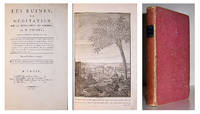
1792000262Paris: Desenne. Volland. Plassan. Libraires 1792. Hardcover. See Description. New and corrected edition First edition printed in France. 8vo. pp. xvi 295 1. With plate depicting the ruins of Palmyra and 2 fold out plates illustrating 1. the eastern hemisphere and 2. the astrological constellations ceil astrologique des anciens. Bound in original pink paste paper boards - some wear to the outer hinges and extremities. Pages are clean; occasional speck of marginal foxing. Volney's book of meditations on the rise and fall of empires was influential on the Romantic movement and on the Hudson River school of painting. Chapters also discuss ancient religions and mysticism. <br/> <br/> Desenne... Volland... Plassan.... Libraires hardcover
179948206Halle Rengerschen Buchhandlung 1799. Without wrappers. In "Annalen der Physik. Herausgegeben von Ludwig Wilhelm Gilbert" Bd. 2 Erstes Stück. The entire issue offered. 1-118 a. 2 folded engraved plates. Cavendish's paper: pp. 1-62. the torsion balance of Michell shown on the plates. <br/><br/><em>First German edition of Cavendish's famous paper in which he calculated the weight of the earth and determined its mass. He also as the first observed gravitational motion of minute portions of matter. He estimates the earth's mass to 66 x 10 to the potential of 24 kg. The original paper "Experiments to determine the Density of the Earth" appeared in Philosophical Transaction 1798."Cavendish published five papers between 1784 and 1809.With one exception they were comparatively minor productions.The exception was his determination of the density of the earth or weighing of the world in 1798 by means of John Michell's torsion balance. The apparatus consisted of two lead balls on either end of a suspended beam; these movable balls were attracted by a pair of stationary lead balls. Cavendish calculated the the force of attraction between the balls fro the observed period of oscillation of the balance and deduced the density of the earth from the force. He found it to be 5.48 times that of water. Cavendish was the first to observe gravitational motions induced by comparatively minute portions of ordinary matter.By weighing the world he rendered the law of gravitation complete. The law was no longer a proportionally statement but a quantitatively exact one; this was the most importent addition to the science of gravitation since Newton."DSB III p. 158.The issue contains further papers by Ritter Chladni et al. </em> unknown
179943865Halle Rengerschen Buchhandlung 1799. Without wrappers. In "Annalen der Physik. Herausgegeben von Ludwig Wilhelm Gilbert" Bd. 2 Erstes Stück. The entire issue offered. Titlepage to vol. 2. Pp. 1-118 a. 2 folded engraved plates. Cavendish's paper: pp. 1-62. the torsion balance of Michell shown on the plates. <br/><br/><em>First German edition of Cavendish's famous paper in which he calculated the weight of the earth and determined its mass. He also as the first observed gravitational motion of minute portions of matter. He estimates the earth's mass to 66 x 10 to the potential of 24 kg. The original paper "Experiments to determine the Density of the Earth" appeared in Philosophical Transaction 1798."Cavendish published five papers between 1784 and 1809.With one exception they were comparatively minor productions.The exception was his determination of the density of the earth or weighing of the world in 1798 by means of John Michell's torsion balance. The apparatus consisted of two lead balls on either end of a suspended beam; these movable balls were attracted by a pair of stationary lead balls. Cavendish calculated the the force of attraction between the balls fro the observed period of oscillation of the balance and deduced the density of the earth from the force. He found it to be 5.48 times that of water. Cavendish was the first to observe gravitational motions induced by comparatively minute portions of ordinary matter.By weighing the world he rendered the law of gravitation complete. The law was no longer a proportionally statement but a quantitatively exact one; this was the most importent addition to the science of gravitation since Newton."DSB III p. 158. </em> unknown
175842952Berlin Haude et Spener 1758. 4to. No wrappers as issued in "Memoires de l'Academie Royale des Sciences et Belles Lettres". tome XII 1756. Pp. 165-234 a. 1 folded engraved plate. <br/><br/><em>First printing of Euler's importent large memoir in which he develops the mathematical theory of windmills and generates analytically the equations of the effects of winds on duoble-bended surfaces in relation to mechanical work. - Together with d'Alembert and Daniel Bernoully Euler laid the foundation of mathematical physics. - Enestroem E 233. </em> unknown
175945126Berlin Haude et Spener 1759. 4to. No wrappers as issued in "Mémoires de l'Academie Royale des Sciences et Belles Lettres" Année 1757 tome XIII pp. a. 1 engraved plate. <br/><br/><em>First printing of an importent paper in which Euler shows how to manufacture catoptrical telescopes and microscopes in accordance with general rules and founded on his own experiments. - The calculation concerning light ray aberrations brought about due to the sphericty of the glass is a masterpiece of analysis of the highest order and he also incorporates the mathematical theory of achromatic combination of lenses which was first realized by Dollond in the same year 1757. </em> unknown
174046843Paris L'Imprimerie Royale 1740. 4to. Without wrappers. Extracted from "Mémoires de l'Academie des Sciences. Année 1737". Pp. 205-227 a. 2 folded engraved plates. <br/><br/><em>First appearance of this extremely importent paper in which Clairaut directly confirms the rotation and the orbital movement of the Earth around the Sun and giving an indirect proof of the axiom that the velocity of light does not depend on whether the light source moves away or toward the observer. The Earth does move after all !!In 1728 James Bradley trying to measure the stellar parallax discovered stellar aberration - the angular displacement of the apparent direction of starlight due to the earth's motion - and attributed it to the combined effect of the finite velocity of light and the earth's orbital velocity. But Bradley had not given any theoretical proof but Clairaut did in the offered paper.Aberration is "the apparent change in direction of a source of light caused by an observers component of motion perpendicular to the impinging rays. During this time the telescope has moved a short distance causing the photons to reach a spot on the focal plane displayed from the former image position. This discovery provided the first direct physical confirmation of the Copernican theory. A second importent application of aberration has been its clear-cut demonstration that as is axiomatic to special relativity light reaching the earth has a velocity unaffected by the relative motion of the source toward or away from earth."McGraw-Hill "Concise Encyclopedia.". </em> unknown
179852947Åbo Frenckellska Boktryckeriet 1798. Orig. blanke kartonomslag. Håndskrevet rygtitel. Lidt rifter i rygpapiret. 41502 pp. Lidt spredte brunpletter. De sidste 5 blade med en skjold øverst. <br/><br/><em>Originaludgaven. First edition. "His Inleding till chemien 1798 was the first Swedishlanguage textbook written in the spirit of the new combustion theory. Although he accepted the phlogiston theory early in his career Gadolin attempted to understand Lavoisier’s ideas. In a paper published in 1788 he tried to define phlogiston and admitted that the French explanation of combustion was superior to some phlogiston theories but for a long time he was not wholly converted. His lectures always made use of the new chemistry and he eventually became the spokesman in Scandinavia for Lavoisier’s nomenclature and combustion theory often encountering Berzelius opposition."DSB.Poggendorff I 827. - Neville I p. 496. </em> unknown
176949805Berlin Haude et Spener 1769. 4to. No wrappers as issued in "Memoires de L'Academie Royale des Sciences et Belles Lettres" tome XXIII pp. 165-310. Clean and fine. <br/><br/><em>First edition of a fundamental paper in the Theory of Numbers in which Lagrange gives a solution in integers of indeterminate equations of the second degree - a remarkable turning point in Diophantine analysis. - Fermat had asserted that he could determine when the more general equation x2-Ay2=B was solvable in integers and that he could solve it when solvable but Lagrange solved it in this paper and furthermore he gives the complete solution to the problem of giving all integral solutions of a general equation where the coefficients are integers. - Cajori calls Lagrange "One of the greatest mathematicians of all times." - Poggendorff I:1344. </em> unknown
176941682Berlin Haude et Spener 1769. 4to. No wrappers as issued in "Mémoires de l'Academie Royale des Sciences et Belles-Lettres" tome XIX. 2 =halftitle Mémoires.141-220. 1.memoir pp. 141-179 a. 1 enraved plate. - 2. pp. 180-193. - 3. pp. 194-220. - 4. pp. 221-234 a. 1 plate. <br/><br/><em>First printing of these 4 fundamental papers on the perturbations of the moon as Euler was the first to use of the Calculus on the motion of the moon in relation to the attractive powers of the Moon the Earth and the Sun. The theories laid down here is also called Euler's second theory and it is the most interesting. It was of the greatest importtence as a basis for later developments."He applied his mathematics to astronomy working out the nature of some perturbations being in this respect the precursor of Lagrange and Laplace. He began to replace the geometric methods of proof used by Galileo and Newton with the algebraic a tendency carried to its conclusion by Lagrange. In particular he worked on lunar theory that is on the analysis of the exact motion of the moon the complications of which have been the despair of astronomers and mathematicians since the time of Kepler. - Eneström: 398 399 400 a. 401. </em> unknown
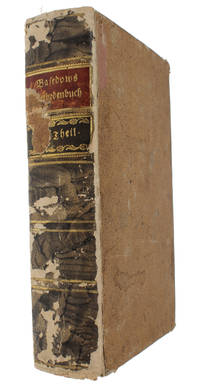
177050344Altona und in der Cramerischen Handlung in Bremen 1770. 8vo. Contemp. marbled boards. The marbled paper on covers gone scratches to marbled paper on spine. Binding fully intact. Title-and tomelabels in leather with gilt lettering. A stamp on foot of title-page. 6XXIV56032;VIII112 pp. Some scattered brownspots mainly to "Verbesserungen des ersten Theiles" and to title-pages. <br/><br/><em>Very scarce first edition of Basedow's main work in educational theory meant to explain his "Elementarwerk".He was strongly influenced by Rousseau's ideas on education in Emile and he proposed the reform of schools and of the common methods of instruction the establishment of an institute for qualifying teachers and solicited subscriptions for the printing of a new illustrated book Elementarwerk "Elementary Book" where his principles were to be explained at length assisted by "Das Methodenbuch".Basedow was called to Denmark in 1753 to become professor at Soroe Akademi where he stayed for 8 years. He was dismissed to Altona in 1761 caused by his theological views going against the prevailing orthodoxy. While he stayed in Soroe he published his "Praktische Philosophie für alle Stände" 1758. </em> hardcover