Bromme, TraugottAntiquariat.de

230 résultats
184833932Stuttgart : Hoffmann'sche Verlags-Buchhandlung, 1848. XIV, 178 S ; 8° gebundene Ausgabe, Pappband der Zeit, Seiten alters- und papierbedingt gebräunt, sonst guter Zustand
188273361Leipzig, Wilhelm Engelmann, 1882. 252 S.IV, 174 S. (24 cm) priv. marmorierter Halbleinenband / gebundene Ausgabe
182861956München, ohne Verlag bzw. Drucker, 1828. 8°. Mit einer gefalt. Tabelle. VI, 321 (1) S., Ppbd. d. Zt. m. Silberprägung (Schulpreisband).
180349442(Halle, Rengerschen Buchhandlung, 1803). Without wrappers as published in ""Annalen der Physik. Herausgegeben von Ludwig Wilhelm Gilbert"", Bd. 13, Viertes Stück. Pp. 385-504 a. 1 engraved plate. (The entire issue offered). Dalton's paper: pp. 438-445.
180349442Halle Rengerschen Buchhandlung 1803. Without wrappers as published in "Annalen der Physik. Herausgegeben von Ludwig Wilhelm Gilbert" Bd. 13 Viertes Stück. Pp. 385-504 a. 1 engraved plate. The entire issue offered. Dalton's paper: pp. 438-445. <br/><br/><em>First German version of one of the founding papers in which he formulated his famous gas laws and raised the foundation of the atomic theory in chemistry.Smyth "John Dalton. A Bibliography" No 29. </em> unknown
1839604315Heidelberg, Winter, 1839. XX, 608 S. Pappband der Zeit mit 2 Rückenschildern.
1839100581Heidelberg, Winter, 1839. XX, 608 S. Halbleder der Zeit.
180549134Halle Rengerschen Buchhandlung 1805. Contemp. hcalf. Spine gilt raised bands a few scratches to spine. In: "Annalen der Physik. Herausgegeben von Ludwig Wilhelm Gilbert" Bd. 21. 8496 pp. and 5 engraved plates. Entire volume offered. Stamp to verso of titlepage and verso of plates. Internally clean and fine. The papers by Dalton Gough Henry: pp. 377-436. And pp. 458-461. <br/><br/><em>First German editions of these importent papers on Dalton's theory of gases. The year "1804 was notable chiefly for controversy over the mixed gases theory and particularly over its denial of weak chemical affinity forces. Continuing criticism of the theory - and the failure of particle weight studies to provide the hoped-for clinching evidence - caused Dalton to revise his ideas on mixed gases during the course of 1805." DSBSmyth "John Dalton. A Bibliography" Nos 33 34 35 a. 42. </em> hardcover
185343123Paris Victor Masson Imprimerie de Bachelier 1853. 8vo. Contemp. hcalf raised bands gilt spine. Light wear along edges. Slightly rubbed. A small weakness to upper part of fronthinge. Small stamps on verso of titlepage and on verso of plates. In "Annales de Chimie et de Physique" 3me Series - Tome XXXVII. 512 pp. and 3 plates. The entire volume offered. Gerhardt's paper: pp. 285-342. Light scattered brownspots. <br/><br/><em>First printing of an importent paper in which Gerhardt introduced the concept of "type" in organic chemistry in order to understand all substitution reactions."Gerhardt adopted Laurent's nucleus or unitary theory and combined it with the theory of types and radicals. In 1852 he discovered the anhydrides of organic acids and explained their structure by an extension of the water type of Williamson. He further proposed that all organic compounds could be related to one of four inorganic types: water hydrogen hydrogen chloride and ammonia. These types could be used to explain most organic reactions as double decompositions. Since Gerhard felt that the formula of organic compounds never ecpressed the actual structure of the molecule but only its reactions he was satisfied with this theory and carried it no farther. However it was a great advance in systematization and helped to bring order into the confused field of organic reactions."Leicester & Klickstein "A Source Book in Chemistry 1400-1900" p. 351."Gerhardt will occupy a permanent position in the history of Chemistry for his services to organic classification for his concept of homology for his preparation of acid anhydrides and for his reform of equivalents."DSB V p. 374.The volume contains further importent papers Marcelin Berthelot "Sur la Bichlorhydrate D'Essence de Térébenthine" pp. 223-230 by Arago Edmond Becquerel etc.etc. </em> hardcover
183549330Paris Crochard 1835. Contemp. hcloth. Gilt lettering to spine. In: "Annales de Chimie et de Physique Par MM. Gay-Lussac et Arago." 2e Series tome 59. 4462 pp. Entire volume offered. Some scattered brownspots. Laurent's papers: pp. 107-111 196-220376-397 a. 397-422. <br/><br/><em>First printing of these importent papers in the history of organic chemistry explaining the differences to Dumas' law of substitutions and introducing a "new type" and what he calls "fundamental and derived radicals". The introduction of the "Nucleus Theory" was the basis for the unitary theory formulated by Gerhardt."While studying the reactions of naphthalene and its compounds with the halogens and nitric acid Laurent was from the start characteristically concerned with the construction of an explanatory theory that would account for these phenomena. Like most creative scientists he generalized his solution to a specific problem through the imaginative use of analogy leading to the elaboration of the first comprehensive theory adequate for dealing with the whole domain of contemporaneous organic chemistry." DSB."A founder of modern organic chemistry Laurent was one of the most important chemists of the nineteenth century. He considered the behavior of matter to be a manifestation of its intimate internal structure which one cannot determine with certainty but which one has to investigate if one wants to understand. Laurent’s preoccupation was to construct a method that could guide the chemist forward along this path from facts to their causes. He was the first chemist to intimately associate crystallo-graphic data and chemical studies. Louis Pasteur and Charles Friedel later followed the way."DSB. </em> hardcover
183349628Paris Crochard 1833. No wrappers. In: "Annales de Chimie et de Physique Par MM. Gay-Lussac et Arago." 2 Séries Tome 55 Cahier 2. pp. 113-224. Entire issue offered. Liebig's paper: pp. 113-156. Scattered brownspots. <br/><br/><em>First appearance in French - the paper was published at the same time in "Annalen der Pharmacie" and in"Annalen der Physik und Chemie. Hrsg.von Poggendorff"- of an importent paper on Radicals in which he regards alcohol as a hydrate of the ethyl radical and ether as the oxide of the ethyl radical. The paper is also relevant for the discovery and development of ether as an anaesthesia. </em> unknown
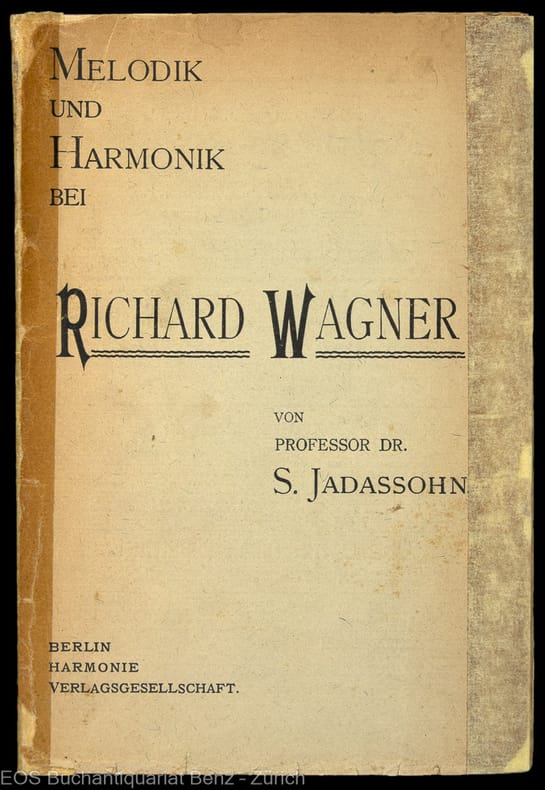
18997642CBBerlin, Harmonie, 1899. 8°. 28 S. Orig.-Broschur.
18937259Berlin, Siemens, 1893. XIX, 346 S. mit zahlr. Textabb. Gr.-8°. HLwd. der Zeit mit Rückentitel (leicht bestoßen, kl. Gebrssprn.).
18997642CBBerlin, Harmonie, 1899. 8°. 28 S. Orig.-Broschur. + Wichtig: Für unsere Kunden in der EU erfolgt der Versand alle 14 Tage verzollt ab Deutschland / Postbank-Konto in Deutschland vorhanden +, 7642CB|7642CB_2 [2 Warenabbildungen]
1839351348Mannheim, Selbstverlag, 1839. 1 Bl., VIII, 227 S., 1 Bl. Pappband d. Zeit (stark beschabt u. bestoßen, Rückenbezug eingerissen u. mit Fehlstellen). [2 Warenabbildungen]
1867391722Berlin, (1867-70). Schöne neue Halbleineneinbände.
186243530Leipzig, Johann Ambrosius Barth, 1862. Without wrappers as issued in ""Annalen der Physik und Chemie. Hrsg. von J.C. Poggendorff"", 115. Bd., 1. issue (""Heft"" No 1, 1862). Titlepage to vol. 115. Pp. 1-176 a. 1 folded engraved plate. (The entire issue offereed (""Heft"" 1)). Clausius' paper: pp. 1-56. Some brownspots to right marginon some leaves.
185350167London Richard Taylor and William Francis 1853 4to. No wrappers as extracted from "Philosophical Transactions" 1853 Vol. 143. Pp. 397-406. <br/><br/><em>First appearance of this importent paper by Adams - famous for his co-discovery with Le Verrier of Neptune in 1846 - in which he introduces new mathematical methods in dealing with the pertubations of the Moon raising a sharp scientific controversy and correcting Laplace's great memoir of 1788."He Adams was elected a fellow of Pembroke College in 1853 and shortly afterward he presented to the Royal Society a remarkable paper on the secular acceleration of the moon’s mean motion. This quantity was thought to have been definitively investigated by Pierre Simon de Laplace in 1788 but Adams showed that Laplace’s solution was incorrect. In particular Laplace had ignored a variation in solar eccentricity that introduces into the differential equations for the moon’s motion a series of additional terms. Adams calculated the second term of the series on which the secular acceleration depends as 3771/64m4 the value computed from Laplace’s work was 2187/128 m4. The effect of the correction was to reduce the figure for the moon’s secular acceleration by about half from 10.58 to 5.70.This paper caused a sharp scientific controversy marked by angry chauvinism on the part of several French astronomers. Their attacks stimulated a number of independent investigations of the subject all of which confirmed Adams’ result. The matter was definitely settled in his favor by 1861 but not without hard feelings."DSB. </em> unknown
185342763London Richard Taylor and William Francis 1853 4to. No wrappers as extracted from "Philosophical Transactions" 1853 Vol. 143 - Part III. Pp. 397-406. Clean and fine. <br/><br/><em>First appearance of this importent paper by Adams - famous for his co-discovery with Le Verrier of Neptune in 1846 - in which he introduces new mathematical methods in dealing with the pertubations of the Moon raising a sharp scientific controversy and correcting Laplace's great memoir of 1788."He Adams was elected fellow of Pembroke College in 1853 and shortly afterwards he presented to the Royal Society a remarkable paper the paper offered on the secular accleration of the moon's mean motion. This quantity was thought to have been definitively investigated by Pierre Simon de Laplace in 1788 but Adams showed that Laplace's solution was incorrect. In particular Laplace had ignored a variation in solar eccentricity that introduces into the diffrential equations for the moon's motion a series of additional terms. Adams calculated the second term of series on which the secular acceleartion depends.This paper caused a sharp scientific controversy marked by angry chauvinism on the part of several French astronomers. Their attack stimulated a number of independent investigations of the subject all of which confirmed Adams' results. The matter was definitely settles in his favor by 1861 but not without hard feelings."DSB I p. 54b. </em> unknown
186243530Leipzig Johann Ambrosius Barth 1862. Without wrappers as issued in "Annalen der Physik und Chemie. Hrsg. von J.C. Poggendorff" 115. Bd. 1. issue "Heft" No 1 1862. Titlepage to vol. 115. Pp. 1-176 a. 1 folded engraved plate. The entire issue offereed "Heft" 1. Clausius' paper: pp. 1-56. Some brownspots to right marginon some leaves. <br/><br/><em>First printing of this importent paper the seciond of C's papers in the working out of the Kinetic Theory of Gases. In the paper he states that he found an error in Maxwell's theory of gases an error Maxwell was to admit as far more serious. "In his initial approach to the conduction of heat in gases Maxwell drew a brilliant analogy between diffusion a transfer of mass and conduction a transfer of kinetic energy thereby making it possible to use the form of his diffusion equation to represent conduction simply replacing the mass of a molecule with its kinetic energy. Clausius critized this adoption of the diffusion equation because given the assumptions mass transfer would accompany the heat conduction and the process would not be one of energy transfer alone. He then offered a revised theory of conduction. "DSB III p. 308."Clausius was one of the founders of the kinetic theory of gases and of the science of thermodynamics. He and Lord Kelvin at about the same time and independently announced the Second Law of thermodynamics. Clausius particularly developed the theory of thermodynamics by applying it to the study of gases and vapors."Magie in "A Source Book in Physics" p. 228. </em> unknown
184045032Paris Fortin Masson et Cie 1840. 8vo. Without wrappers. Extracted from 'Annales de Chimie et de Physique' 2e Series tome 73. Pp. 73-103 incl. Note de Liebig pp. 100-103 and pp. 113-166. Some scattered brownspots. <br/><br/><em>This paper which was published at the same year in "Comptes Rendues" 3 Fevrier is the most importent on the theory of structural types and the nomenclature of organic compounds refuting the electrochemical theory of Berzelius. "The development of this idea type organique into what is sometimes called the "Older Type Theory" as distinguished from Gerhardt's Type heory is contained in Dumas' importent memoir on the substitution and the theory of types presented on 3 febriary 1840."Partington IV p. 365. In the second paper Stas and Dumas record the first use of 'potash-lime' the precursor of soda-lime an invaluable reagent in organic chemistry."Jean Baptiste Dumas advances a theory that the chemical properties of an organic compound are determined by its structure and not as seems to be the case with inorganic compounds by its electrical properties. he illustrates the concept with the example that the basic qualitative properties of acetic acid are retained even after replacing three fourths of the hydrogen by chlorine. As a consequence he calls for a revision of chemical nomenclature for organic compounds basing terms on common features not on elemental composition."Parkinson "Breakthroughs" 1840 C. </em> unknown
183959127Paris Crochard 1839. Entire October-issue with original printed yellow wrappers wrappers loose. In:"Annales de Chimie et de Physique Par MM. Gay-Lussac et Arago." tome 72 Series 2. Entire volume octobre-issue offered. Pp. 113-222. Gerhardt's paper: pp. 184-214.Clean and fine. <br/><br/><em>First printing of a classic paper in organic chemistry in which Gerhardt breaks with the conceptions of dualism and pre-existing radicals and sets forth his "Theory of Residues". The October-issue also contains Gerhards paper "Recherches chimiques sur l'Hellénine" pp. 163-183. A subject for his doctoral thesis in 1840. "A new aspect was given to the substitution-type theory by Gerhardt who explained the formation of organic compounds as due to "pairing" or "copulation" of residues."Findlay "A Hundred years of Chemistry" p. 30 ff. </em> unknown
183443361Leipzig Johann Ambrosius Barth 1834. Without wrappers as issued in "Annalen der Physik und Chemie. Hrsg.von Poggendorff" 1. Bd. 31. Bd. der Reihe No. 21 22 a. 23. Pp. 321-368. Liebig's paper: Titlepage to 1. Bd. pp. 321-360. Clean and fine. <br/><br/><em>First appearance - the paper was published at the same time in "Annalen der Pharmacie" - of an importent paper on Radicals in which he regards alcohol as a hydrate of the ethyl radical and ether as the oxide of the ethyl radical. The paper is also relevant for the discovery and development of ether as an anaesthesia. </em> unknown
183639226Berlin, Nicolai, 1836. 8°. X, 253 (1) S., HLdr. d. Zt. m. etw. Rückenverg., goldgepr. Rückentitel u. dreiseitigem Farbschnitt.
189917338BLeipzig, Breitkopf & Härtel, 1899/1900 - 1905/06. Gr.-8°, Pro Jg. ca. 700 Seiten Original-Umschläge (Buchblock unbeschnitten) bzw. HLn.d.Z. (IV)