96 résultats
155640377BBFlorenz, Laurenzo Torentini, 1556. Folio. 19 S., 358 S., 26 n.n. S. Mit Holzschnitt-Titel und ganzseitiger Holzschnittdruckermarke auf dem letzten Blatt. Halbleinwandband des 19. Jahrhunderts mit goldgeprägtem Rückentitel.
157940501DBBasel, Episcopius, 1579. Folio. (14) Bl., 594 S., (57) Bl., (11) Bl. (Index), (46) Bl. (Excerpt). Mit Holzschnittdruckermarke auf dem Titel und einer abweichenden Holzschnittdruckermarke auf dem letzten Blatt (verso). Schweinslederband aus der Zeit mit Rollstempelverzierung und blindgeprägtem Deckelmedaillon. + Wichtig: Für unsere Kunden in der EU erfolgt der Versand alle 14 Tage verzollt ab Deutschland / Postbank-Konto in Deutschland vorhanden +, A|B [2 Warenabbildungen]
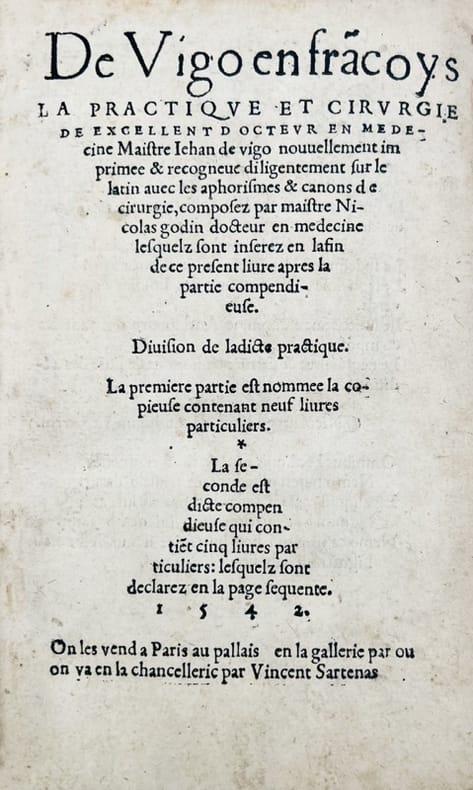
154244491Paris, Vincent Sartenas, 1542. Petit in-8 de 505-(7) ff. (sign. a-z8, &8, AA-RR8), table, maroquin brun, dos à nerfs titré orné du fleuron aldin doré répété quatre fois, double encadrement à froid et fleurons dorés aux angles, frise et roulette dorées intérieures, tranches dorées sur marbrure (Closs).
154140198ABBasel, Froben, 1541. Klein-Folio. 4 n.n. Bl., 1145 S., 1 w. Bl., 74 n.n. Bl. Mit gestochener Druckermarke auf dem Titel und dem letzten Blatt und 2 kleinen Holzschnitten im Text. Halbpergamentband der Zeit mit goldgeprägtem Rückenschild.
154140198DBBasel, Froben, 1541. Kl.-folio. 4 n.n. Bl., 1145 S., 1 weisses Bl., 74 n.n. Bl. Mit gestochener Druckermarke auf dem Titel und dem letzten Blatt und 2 kleinen Holzschnitten im Text. Halbpergamentband der Zeit mit goldgeprägtem Rückenschild.
154140198ABBasel, Froben, 1541. Klein-Folio. 4 n.n. Bl., 1145 S., 1 w. Bl., 74 n.n. Bl. Mit gestochener Druckermarke auf dem Titel und dem letzten Blatt und 2 kleinen Holzschnitten im Text. Halbpergamentband der Zeit mit goldgeprägtem Rückenschild.
154140198DBBasel, Froben, 1541. Kl.-folio. 4 n.n. Bl., 1145 S., 1 weisses Bl., 74 n.n. Bl. Mit gestochener Druckermarke auf dem Titel und dem letzten Blatt und 2 kleinen Holzschnitten im Text. Halbpergamentband der Zeit mit goldgeprägtem Rückenschild. + Wichtig: Für unsere Kunden in der EU erfolgt der Versand alle 14 Tage verzollt ab Deutschland / Postbank-Konto in Deutschland vorhanden +, 40198D
1567zy557Lugduni, apud Ioannem Frellonium Relié 1567 In-12 (11,5 x 18 cm), reliure plein parchemin, ex-libris manuscrit en première garde, paginations multiples (164 pp. + index non paginé, puis 72 pp. + index non paginé, puis 43 pp. + index non paginé), édition originale de 1567 en latin (l'édition originale française date de 1581 ; Brunet III, 576). L'auteur Laurent Joubert (1529, Valence - 1583, Lombers) est à partir de 1579 premier médecin du roi Henri III de Navarre (Henri IV de France) ; plats bosselés, cordons de fermeture cassés, par ailleurs intérieur frais, bon état. Livraison a domicile (La Poste) ou en Mondial Relay sur simple demande.
155260622Strassburg, Balthassar Beck, 1552. 4to. In contemporary blindstamped half pigskin-binding over wooden boards with later marbled paper covering the boards. Endpapers renewed. Upper part of spine with title paper-label. Wear to extremities and front board partly detached. Last blank leaf with annotations in contemporary hand. Internally fine and clean. (6), XCVIII, (7), (blank), (4), CLV, (8) ff. One woodcut illustration in text.
157900551017x11 cm 297 pp + table. Reliure postérieure de bonne qualité, dos à 5 nerfs avec ornements dorés. Etiquette de titre. Rare et précieux recueil de secrets et recettes de médecine hermétique, ici dans sa seconde édition. Nombreuses figures. Inventorié comme "précieux recueil de médecine hermétique" par Dorbon. On y trouve aussi d'insolites informations sur les procédés de distillation en usage à l'époque. Traces d'insolation et quelques annotations au crayon gris, sinon très bon état. De toute rareté.
154040365BBBasel, Isengrin, 1540. Folio. 11 n.n. Bl., 1 w. Bl., 603 (recte 601) S., 1 n.n. Bl. Druckermarke, 1 w. Bl. Flexibler Pergamentband der Zeit mit handschriftlichem Rückentitel.
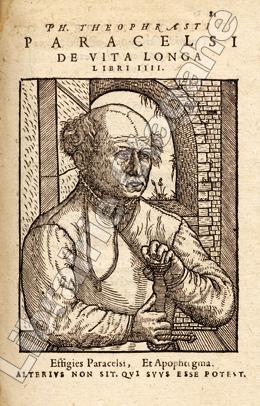
156713778Paris, aedibus Rovillii, (1567) ; in-8 ; plein veau havane marbré, dos décoré et doré, roulette sur les coupes, tranches mouchetées de rouge (reliure du XVIIIe) ; 376, (21) pp. (Index rerum et verborum et Index Autorum), (1) p. blanche, (1) f. blanc. ; portrait gravé sur bois (p.81).
159265469Venedig, Francesco de Franceschi, 1592. 4°. Mit 2 Holzschn.-Druckermarken u. 50 (39 ganzs.) Textholzschnitten. 4 nn., 80 (recte 84) num., 8 nn. Bll. - Angeb. - Ders. De medicina Aegyptiorum. Libri quatuor in quibus multa cum de vario mittendi sanguinis usu per venas, arterias, cucurbitulas, ac scarificationes nostris inusitatas [...], & alijs chyrurgicis operationibus, tum de quamplurimis medicamentis apud Aegyptios frequentioribus, elucescunt. Ebda., 1591. Mit Holzschn.-Druckermarke u. 7 (2 ganzs.) Textholzschnitten. 11 (statt 12; fehlt das Erratablatt c1) nn., 150 num., 25 nn. Bll., Etw. späterer Pgmt.-Bd. m. durchzogenen Bünden, goldgepr. gekrönten verschlungenen Initialen als Supralibros, handschriftl. Rückentitel u. erneuerten Schließbändern.
155212757A Paris, Par Matthieu David, et au Palais en la boutique d'Arnoul L'angelier, 1552. In-8 de (16)-272-(32) pp., peau retournée, dos à 4 nerfs, vestiges de lacets (reliure de l'époque).
154651055Venice, 1546. 4to. Contemporary full vellum. Neatly recased, endpapers renewed. A (mostly fairly faint) damp stain throughout and a marginal worm tract, far from affecting text. Inner blank margin of title-page re-enforced. Some contemporary marginal annotations. Woodcut title-vignette and woodcut printer's device to final blank verso. (4), 76, (4) ff.
155754333Københaffn, (Hans Vingaard), 1557. 4to. Indbundet samlet i et senere enkelt hldrbd. fra omkr. 1850. Med brugsspor men repareret. Ad. 1: Titelblad trykt i sort/rød med sammensat træskåren ramme. (8),160,(1) blade - 2. Titelblad med træskåren ramme. (3),48 blade. - 3. Titelblad med træskåren ramme. (4),32,(12) blade (heraf de sidste 12 blade Apoteckerfortegnelsen). - 4. Titelblad med sammensat træskåren ramme. (7),20 blade. - 5. Titelblad med træskåren ramme. (5),10,(1) blade. Gennemgående i god stand, men her og der med brunpletter, brugspletter særligt på de første blade. Nogle af trykkene har et blankt blad til slut, disse er ikke tilstede i samlingen.
153139416Roma, Apud Antonium Bladum Asulanum (on colophon), 1531, mense Septembri. 4to. Sown, uncut and unbound. Title-page and a few other leaves with a bit of minor brownspotting" overall a very nice and well-preserved copy of this beautifully printed, extremely scarce work. Two quires with loose leaves. Floriated large initial at beginning. [32] ff. (being title-page, 29 ff. text, 1 f. errata, 1 f. blank).
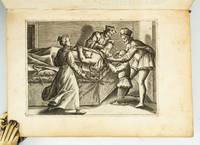
1584ST20779Rome: Bartolomeo Bonfadino & Tito Diani 1584. FIRST EDITION. 215 x 150 mm. 8 1/2 x 6". 6 p.l. 106 pp 1 leaf errata. <br/> 17th century sprinkled vellum raised bands leather spine panels with gilt lion ornaments red morocco label. Engraved title page woodcut initials and headpieces and 11 engraved plates of bloodletting. Title page with ink owner inscription of "Joann De Ville Chirurgo Lugdunesse 1629"; a couple of neat marginal annotations in Italian apparently by the same hand; four ink numbers on lower cover. Wellcome I 3959; EDIT16 CNCE 46661; Mortimer Italian II 267 second edition; USTC 839623. Boards a bit splayed gilt on spine a little rubbed moderate wear and soiling to the vellum text slightly browned at edges and with occasional minor foxing half a dozen leaves slightly browned but still an excellent unrestored copy quite fresh internally the engravings sharp and the binding completely solid.<br/> <br/> This is a 17th century surgeon's copy of a strikingly illustrated and centrally important 16th century treatise on bloodletting. Piacenza physician Pietro Paolo Magni's detailed discussion of the use of leeches and cupping-glasses long served as the standard work on the topic. Its 11 well-executed engravings are visually compelling as well as providing a rich source of information on the details of 16th century medical practice. There is some debate about their creator: Wellcome and Hirsch attribute them to Adamo Ghisi also Scultori ca. 1530-85 who executed the illustrated title page of this edition; Graesse and Mortimer on the other hand assign them to Cherubino Alberti 1553–1615 who was responsible for the engraved title in the second edition. Either way they are as evocative to modern-day viewers as they must have once been useful to surgeons and physicians of the 16th century. The dramatically lit scenes feature focused doctors armed with lancets and bowls to catch the blood attending to patients who grimace wilt or look away in stoic resignation. Our former owner Jean de Ville identifies himself as a Lyonnaise surgeon on the title page in an inscription dated 1629. His occasional notes on the text and illustrations indicate he was consulting this book as a reference for his own practice he writes above one illustration for example that "this operation should be performed on the left arm". This seems to be a rare work in institutional collections USTC finding only one copy in North America. Bartolomeo Bonfadino & Tito Diani unknown
15655777<p><b><i>"FOR MANY YEARS THE MOST IMPORTANT WORK ON THE MEDICINAL PLANTS OF THE NEW WORLD"</i></b></p><p>8vo 13.4 x 9.1 cm 132 ff. with woodcut border to title page and woodcut initials. Bound in later stiff vellum title stamped on spine gift inscription on the front flyleaf to a certain 'Carmen Ballina' dated 1922 now covered in paper. Only minor wear and rubbing to binding. 'Tassa' price of 51 maravedis entered in manuscript on title page as issued early signature of a certain 'Henrique Correa' at fol. aiiir the occasional contemporary annotation in the text minor occasional dampstaining very minor occasional marginal worming.<br /></p><p>Very rare first edition 1565 – virtually unacquirable for the past half century or more – of the first printed work devoted to the botanical and medicinal discoveries made in the Americas a treatise which through its later expansions and numerous translations would remain "for many years the most important work on the medicinal plants of the New World" Garrison & Morton. The <i>Dos libros</i> was written by the renowned physician Nicolás Monardes 1493-1588 in Seville then the center of the Spanish printing industry and the only port from which ships were authorized to sail to and from the New World. Born in 1493 in the very year Columbus returned from his first voyage Monardes thus both occupied a front row seat for first decades of the 'Columbian Exchange' and was ideally positioned to disseminate his findings to a wider European indeed global audience.</p><p>Monardes shared much with his contemporary Garcia d'Orta 1501-68 the Portuguese physician stationed in India and famed for his <i>Coloquios dos simples e drogas e consas medicinais da India</i> Goa 1563: "Just as d'Orta gave the learned world of the West the first accurate accounts of various Asian medicinal and commercial plants so did Monardes with those of America … Monardes like Garcia d'Orta has a strong claim to be regarded as one of the fathers of the science of pharmacognosy. Both of them compiled what were virtually complete monographs on many important items of our actual <i>materia medica</i> which were then unknown or only inaccurately known to the Western World Boxer pp. 23-24. Even the diffusion of these two authors throughout the learned world of early modern Europe shared a common source in the Latin versions made of them by the Flemish physician and botanist Charles de L'Ecluse Carolus Clusius 1526-1609 who published them together for the first time at Antwerp by Plantin in 1574 and afterwards.</p><p>Monardes eagerly capitalized on his unique position in Seville to acquire botanical news specimens and seeds from the New World cultivating his own garden of American plants and distributing cuttings to correspondents throughout Spain and Europe. In 1553 he established a transatlantic business partnership with a colleague in Tierra Firme and over the next three decades Monardes' three sons and four daughters emigrated to Tierra Firme and New Spain thus providing him with a network which would prove invaluable in collecting information for the 1565 <i>Dos libros</i> and in expanding the treatise in its 1571 and 1574 editions published as <i>Segunda Parte</i> and <i>Primera y Segunda y Tercera Partes de la Historia Medicinal</i>. In the <i>Dos libros</i> Monardes describes more than two dozen botanical remedies sarsaparilla copal and other aromatic balsams guaiacum lignum vitae etc. their medicinal applications native nomenclature and where they were to be found Mexico City Jalisco Michoacán Cuba Santo Domingo San Juan Cartagena Honduras Peru Nicaragua. Fascinatingly he views this specialized information through the broader lens of early American exploration discussing the voyages of Columbus and Hernán Cortés Monardes' near contemporary the spread of New World diseases among the first conquistadors and assessing the value of America's medicinal riches against her wealth of gold and silver.</p><p>In his first printed work <i>Dialogo llamado pharmacodilosis o declaracion medicinal</i> Seville 1536 Monardes noted that he was skeptical of the therapeutic value of plants from the New World but "his change of heart between 1536 and 1565 about the value of American <i>materia medica</i> was a gradual process and was due to his own experience" Boxer p. 22. Monardes "took great care after about 1536 to examine those plants imported and/or transplanted into Spain – a self-imposed task facilitated by the unrivaled position of Seville as the sole <i>entrepôt</i> for Spanish trade with the New World … just as d'Orta cultivated Asian plants in his gardens and orchards at Goa and Bombay so Monardes had a botanical garden with native and exotic plants at Sevilla" Boxer 22.</p><p>In addition to Clusius' Latin translation of Monardes <i>De simplicibus medicamentis ex Occidentli India delatis</i> 1574 first Latin edition an English translation appeared in 1577 by John Frampton under the title <i>Joyful newes out of the newe found world. </i>Italian French and German translations followed with the work going through 19 editions during Monardes' lifetime and 14 after his death.</p><p>In the present 1565 first edition of the <i>Dos libros</i> Monardes challenged European travelers and residents in the Americas to "'<i>investigate and experiment with the many kinds of medicines that the Indians sell in their markets or Tianguez; it would be a thing of great utility and profit to see and know their properties and to experiment with their varied and great effects which the Indians make public and manifest through the great experiences they make of them among themselves'"</i> Monardes quoted from Bleichmar <i>Visual Voyages</i> p. 51. But tapping into native knowledge of medicinal matters apparently proved more difficult than Monardes had anticipated: In the 1571 <i>Segunda Parte</i> he notes that the increasing Amerindian hostility to the European presence in the Americas was provoking them to keep their medicinal/botanical practices secret to the point of providing misleading information to colonists seeking local remedies and consequently his 1565 <i>Dos Libros</i> had in fact become the primary source for Indian medicinal knowledge even among Europeans stationed and living in the Americas among the native populace see Bleichmar <i>Visual Voyages</i> p. 51.</p><p>Monardes' other published works include the 1539 <i>De secanda vena in pleuriti inter Grecos et Arabes concordia</i> and his 1540 <i>De rosa et partibus eius</i>. His treatise on the medicinal properties of the bezoar stone is appended to the present <i>Dos libros</i>.</p><p>OCLC locates U.S. examples of this 1565 <i>Dos Libros</i> of Monardes at the National Library of Medicine John Carter Brown Wisconsin Hunt Botanical SMU and NYPL.</p><p> Alden European Americana 565/45; Medina BHA 194; JCB vol. 1 no. 240; Palau 175485; Wellcome 4390; USTC 340089; Garrison & Morton 1817; ; Hunt 106 1569 ed.; Sabin 49936 the 2nd ed.; F. Guerra <i>Nicolás Bautista Monardes</i>; D. Bleichmar <i>Visual Voyages: Images of Latin American Nature from Columbus to Darwin</i>; J. Jiménez-Castellanos y Calvo-Rubio <i>Historia medicinal de las cosas</i>… Seville Padilla 1988; D. Bleichmar "Books Bodies and Fields: Sixteenth-Century Transatlantic Encounters with New World <i>Materia Medica</i>" in L. Schiebinger and C. Swan eds. <i>Colonial Botany: Science Commerce and Politics</i> pp. 83–99; J. M. López Piñero "Las 'Nuevas Medicinas' Americanas en la Obra 1565-1574 de Nicolás Monardes" <i>Asclepio</i> vol. 42 no. 1 1990 pp. 3-67; A. Barrera "Local Herbs Global Medicines: Commerce Knowledge and Commodities in Spanish America" in P. Smith and P. Findlen eds. <i>Merchants and Marvels: Commerce Science and Art in Early Modern Europe</i> pp. 163-81; J. D. Sauer "Changing Perception and Exploitation of New World Plants in Europe" in F. Chiappelli ed. <i>First Images of America</i> vol. 2 pp.-813-32; F. Egmond <i>The World of Carolus Clusius: Natural History in the Making 1550-1610</i>; A. Ubrizy and J. Heniger "Carolus Clusius and American Plants" <i>Taxon</i> vol. 32 no 3 1983 pp. 424-35; C. R. Boxer <i>Two Pioneers of Tropical Medicine: Garcia d'Orta and Nicolás Monardes</i> Wellcome Lecture Series No. 1 1963.</p> Sebastian Trugillo hardcover books