439 résultats
179014514ABLeipzig, Schwickert, 1790. 8°. (6), VIII, (2) 764 S.; (4) 835 (3) S.; XII, 468 S. Mit 1 gest. Titelvignette. Halblederbde. d. Zt. mit je 2 mont., goldgepr. Rückentiteln + Wichtig: Für unsere Kunden in der EU erfolgt der Versand alle 14 Tage verzollt ab Deutschland / Postbank-Konto in Deutschland vorhanden + 3 Bde. Neue, umgearb. Aufl. (stark berieben u. bestossen, mit mehreren Wurmlöchern).
17851267809Göttingen, Dieterich, 1785). 288 (statt 403) S. Interims-Kart. d. Zeit (Einbd fleckig, m. kl. Läsuren u. handschriftlichem Titel, leicht braunfleckig, wenige kl. Feuchtigkeitsränder, unbeschnitten u. teils unaufgeschnitten).
178200TP08Paris France 1782. On June 13th 1782 'Docteur rege de la Faculte de Medecine en L'Universite de Paris ancien Proffesseur de les Ecoles.' Etienne Pourfour-de-Petit first hired by the University in 1732 writes the Faculty beseeching that the Faculty honor and uphold his 1760 retirement 'edict'. Superbly interesting document that highlights the struggles of the revolutionary period and transition of power. The Professor obviously a monarchist and of the 'ancien regime' is faced with a new board made up of the rebels. Easily read is a certain disdain to the new Faculty members his deep respect for the Monarch but also an embracing of the new revolutionary ideas. Biographical Notes: SIR THOMAS PHILLIPPS 1792-1872. Born in 1792 Sir Thomas Phillipps from childhood was obsessed with the idea of obtaining virtually anything written or printed on paper including cartloads of documents from wastepaper merchants and the entire inventories of booksellers. "I wish to have one copy of every book in the world" he declared to a friend. He very nearly succeeded. His collection ultimately grew to more than 100000 books and at least 60000 manuscripts. As a result of his extravagant purchases Sir Thomas was permanently on the verge of bankruptcy and was constantly pursued by creditors. So many books arrived at his house that it was impossible to unpack his acquisitions much less keep pace with them. Visiting scholars driven to distraction would spend days hunting for an elusive text in the dusty heaps that filled every room. Because Sir Thomas has a morbid dread of fire most of his collection was housed in coffinlike boxes that could be carted away quickly. Visitors to Middle Hill were struck too by the presence of numerous logs a ploy he used to lure beetles away from his books. As Sir Thomas relentlessly pursued his passion the house itself began to crumble and its floors started to sag under the cast weight of hundreds of tons of paper. His neglect of Middle Hill was partly deliberate however. Sir Thomas's chief enemy in life James Halliwell had married his daughter against his wishes. It appears that Halliwell was in Sir Thomas' eyes the worst kind of criminal a book thief who had stolen valuable works from university libraries and even from his father-in-law. Having no sons Sir Thomas was unable to prevent Halliwell from inheriting his estate. To ensure that his detested heir would never receive anything of value Sir Thomas's solution was to allow Middle Hill to fall unto complete disrepair. He even went so far as to chop down and sell for lumber the centuries-old oak trees that lined the majestic mile-long drive to his home. In 1863 Sir Thomas decided to move - in order to accommodate his books. With the aid of 160 men 103 wagonloads of books and papers drawn by 230 horses the books were lumbered from Middle Hill top their new estate in nearby Cheltenham. It is said that for years afterwards the countryside was littered with the remains of carts that had collapsed under the sheer weight of the Phillipps collection. Sir Thomas continues to add to his library until his death in 1872. After Sir Thomas's death his immediate family had no room for his collection. So vast was the library that although individual items and large sections were sold privately or through numerous auction sales the Phillipps collection is still being sold more than a century after the death of its owner. In the course of its sales many treasures have come to light. As late as 1964 part of the long-lost and unique medieval manuscript of the Roman poet Ovid's Metamorphoses appeared and was subsequently reunited with its other half at Magdalen College Oxford. Once destined for destruction as worthless wastepaper this and many other priceless works were saved by the single-minded obsession of the greatest bibliomaniac of all time. Autograph. Manuscript. Very Fine. Folio - over 12" - 15" tall. Paperback
1778D19572Dublin: William Sleater 1778. Fifth Edition. Hardcover. Very Good. 8vo. Original calf. 404 pp. Complete with the 11 folding plates. Ink names to title. Some scratches and wear to calf but still a lovely copy of this uncommon Dublin edition. <br/><br/> William Sleater hardcover
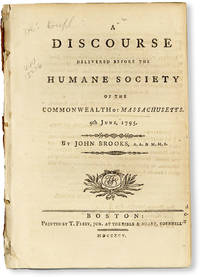
179550032Boston: T. Fleet Jun 1795. First Edition. Octavo 19.5cm.; removed; 32pp. Long shallow loss along fore-edge of title page serving as upper wrapper slightly touching text without loss of meaning else Good or better overall. Address on the state of medicine in the country by John Brooks future Governor of Massachusetts followed by appendices including correspondence with the Humane Society in London; "Premiums adjudged by the Trustees"; and a "Catalogue of the Members of the Humane Society." AUSTIN 278; ESTC W20162; EVANS 28351; SABIN 8355. T. Fleet, Jun unknown
17711214831London, Dodsley, 1771. 100 S. Neuerer Hlwdbd (Vorderdeckel m. kl. Läsur unten im Bezug, Widmung auf Vortitel).
1742ST16000London: Printed for the author 1742. FIRST EDITION. 205 x 130 mm. 8 x 5". xxiv 285 1 pp. 3 leaves index. <br/> Contemporary sprinkled calf covers with double gilt-ruled borders raised bands flanked by gilt rules neatly rebacked preserving original backstrip one corner restored. Front flyleaf with ink inscription of Wm. Barber dated 1790. Weinberger "Introduction to the History of Dentistry" p. 330; Garrison-Morton 3672; Wellcome II 320; ESTC T63467. ◆Joints lightly rubbed corners a little bumped and worn but the binding solid and perfectly satisfactory; a handful of creased corners and a couple of trivial blemishes but the contents in very fine condition the paper clean and bright and obviously read very little.<br/> <br/> This is a fresh appealing copy of the first modern book on teething and the second book on dentistry in English. Weinberger says that "as far as English dental literature is concerned it began with Joseph Hurlock in 1742. Hurlock was a strong advocate of lancing the gums of infants to permit teeth to erupt more readily and thus prevent convulsions. His treatise was a plea for parents and nurses to allow him to carry out this procedure." The book documents symptoms of dentition difficulties and reports on cases in which our author lanced the gums of children whose health problems he attributed to teething trouble--not always with happy outcomes. The book does contain advice that was more beneficial. Weinberger notes "Hurlock apparently was a keen observer of dental conditions then found in children noticing that the havoc wrought by caries in the deciduous teeth was undoubtedly due to diet and recommended that such youngsters be sent to the country where fresh air and better food could be obtained." Little is known of the author who has no other works recorded in libraries or bibliographies. It has been suggested that he was related to the Joseph Hurlock 1715-93 who was a director of the East India Company. We are fortunate that Mr. Hurlock did not stint when it came to the quality of paper on which his treatise was printed; the text here has come down to us crisp and bright as a result. Printed for the author unknown
1778D19569Dublin: P. Higly 1778. First Edition. Hardcover. Good. 12mo. 223 pp. Original calf worn spine cracked. But internally in a very good state. A rare volume far more common in later editions published elsewhere. <br/><br/> P. Higly hardcover
179534586Hanisch,, Hildburghausen 1795. 151 S. Broschiert, ohne Deckelblatt, letzten 10 Seiten halbseitig wasserfleckig, Seiten alters- und papierbedingt gebräunt, sonst guter Zustand
178440387BBBerlin, Christian Friedrich Himburg, 1784-1786. 8°. XXII S., 1 Bl., 317 S.; 2 Bl., 344 S. Mit einer wiederholten gestochenen Titelvignette. Späterer Pappband unter Verwendung eines Inkunabelblattes als Bezugpapier. 2 Bände in 1 Band.
178440387DBBerlin, Christian Friedrich Himburg, 1784?1786. 8°. XXII S., 1 Bl., 317 S.; 2 Bl., 344 S. Mit einer wiederholten gestochenen Titelvignette. Späterer Pappband unter Verwendung eines Inkunabelblattes als Bezugpapier. + Wichtig: Für unsere Kunden in der EU erfolgt der Versand alle 14 Tage verzollt ab Deutschland / Postbank-Konto in Deutschland vorhanden +, A|B 2 Bände in 1. [2 Warenabbildungen]
178828814ABBern, Franz Seizer und Comp., 1788. 4°. 6 n.n. Bl., XVI S., 4 n.n. Bl., 705 S., 9 n.n. S. Mit gestochenem Porträt. Halblederband der Zeit mit Rückenschild. [3 Warenabbildungen]
178245037ABLeipzig, Dyk, 1782. 8°. 4 n.n. Bl., S. I-XXXIX, S. 40-334, 1 n.n. Bl. (Druckfehler und Verbesserungen). Pappband der Zeit.
179663381CBGöttingen, Verlag Johann Christian Dieterich, 1796. Klein-8°. 18 x 11 cm. XII, 115 Seiten. Pappband der Zeit mit Rundum-Rotschnitt. [7 Warenabbildungen]
17811105320Leipzig, Jacobäer, 1781. Titelbl., 757 S. Ppbd d. Zeit (Rückenbezug fast ganz abgeschabt, Kapital am Kopf läd., flieg. Vors. m. Ausschnitt, St. a. T.).
178738288Wien, bey Rudolph Gräffer und Compagnie, 1787. LXXXII, 432pp., illustriert mit einer gestochenen Frontispizplatte, Vignetten und 11 Falttafeln (Kupferstich) im Anhang gebundene Ausgabe, Ledereinband, Exemplar in gutem Erhaltungszustand
178340286ABLeipzig, Weygand, 1783. 8°. 6 n.n. B., 155 S., 1 n.n. S. Pergamentband der Zeit mit handschriftlichem Rückentitel.
178340286DBLeipzig, Weygand, 1783. 8°. 6 n.n. B., 155 S., 1 n.n. S. Pergamentband der Zeit mit handschriftlichem Rückentitel. + Wichtig: Für unsere Kunden in der EU erfolgt der Versand alle 14 Tage verzollt ab Deutschland / Postbank-Konto in Deutschland vorhanden +, 40286D
177740301BBLeipzig, Caspar Fritsch, 1777. 8°. 27 n.n. Bl., 322 (recte 320) S. 9 n.n. Bl. Mit einer gestochenen Titelvignette und einer gestochenen Tafel. Pappband der Zeit.
17721316653Leipzig, Weidmanns Erben u. Reich, 1771 - 1772. 753, (1) S., 7 Bl. (fortlaufend paginiert). Mit gestoch. Titelvignette u. 4 Faltkupfern. Hldrbd d. Zeit (beschabt, Ecken bestoßen, Rückengelenke eingerissen, Rücken mit Fehlstelle, geringf. braunfleckig, 1 Lage lose u. etwas knickspurig).
172030283BBHelmstadt, H.D. Hamm, 1720. 8°. 45, 3 n.n. S. Neuer Papierumschlag.
172030283DBHelmstadt, H.D. Hamm, 1720. 8°. 45, 3 n.n. S. Neuer Papierumschlag. + Wichtig: Für unsere Kunden in der EU erfolgt der Versand alle 14 Tage verzollt ab Deutschland / Postbank-Konto in Deutschland vorhanden +
170430279BB(Jena), Krebs, 1704. 8°. 16 S. Neuer Papierumschlag.