7 résultats
16886026EBHelmstedt, Hamm, 1688. Unpaginert (18 Bl.). Geheftet. Mit Holzschnitt-Bordüre und Schlussvignette. Papier altersbedingt gebräunt und durchgehend leicht braunfleckig, sonst ein sehr gut erhaltenes Exemplar.
168331366ABJena, Krebs, 1683. 16 S. Geheftet. Mit floraler Initiale und Holzschnitt-Bordüre. Frei von Anstreichungen, innen sehr sauber und gut erhalten.
168231389ABJena, Krebs, 1682. 24 S. Geheftet. Mit Holzschnitt-Bordüre und verschiedenen Holzschnitt-Initialen. Papier leicht gebräunt, stellenweise geringfügig fleckig. Ein sehr schön und sauber erhaltenes Exemplar.
16486032EBBasel, Decker, 1648. Unpaginiert (12 Bl.). Geheftet. Blatt 5 und Blätter 9-12 aus Heftung gelöst. Innen sehr sauber.
163440179Wittebergae : Wendt, Zacharias Schürer Erben (Wittenberg) 1629 1634. 614 S. 449 S. 434 Seiten, bei Teil 3:Die Seitenzählung springt von 128 auf 135. - Die Druckerangabe ist dem Kolophon entnommen gebundene Ausgabe, Halbpergament +++ innen etliche Anmerkungen und Unterstreichungen mit Kopierstift und einen grünen Stift. ++++ sonst gut
162956248BBLeiden, Jean Maire, 1629. Klein-8°. 2 (von 4) n.n. Bl., 321 S., 3 n.n. S. Mit 9 Holzschnitten im Text. Halbpergamentband um 1900 mit handschriftlichem Rückentitel.
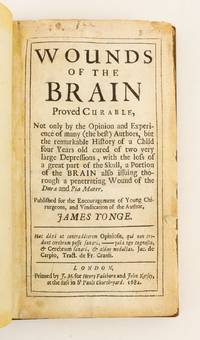
1682ST16813London: Printed by J. M. for Henry Faithorn and John Kersey 1682. FIRST EDITION. 158 x 92 mm. 6 3/8 x 3 5/8". 10 p.l. 132 pp. <br/> Modern retrospective sprinkled calf covers with blind-tooled frame raised bands red morocco label. With three woodcut illustrations in the text. Verso of title page with pasted-on handwritten ownership label of Dr. Borroughs dated 1723. Waller 10434; Wing Y-39; ESTC R5954. Edges of text a little browned first four leaves with a couple of small chips or tears other insignificant imperfections but A FINE COPY clean and fresh in a new sympathetic binding.<br/> <br/> This is a rare and important work in the field of neurosurgery being a detailed account of the successful treatment of a head injury so severe that part of the brain was protruding offered as evidence that such wounds are not invariably fatal. Yonge 1646/47-1721 was apprenticed to a naval surgeon at the age of 12 and was serving as a ship's surgeon for the Newfoundland fishing fleet by age 18. He retired from sea duties which had included being aboard a naval ship in wartime and set up practice in Plymouth at age 25 working as surgeon to the naval hospital there. He was appointed deputy surgeon-general of the navy in 1674. Yonge kept journals recording his cases and began publishing reports of significant and successful treatments and innovations. According to the Dictionary of Canadian Biography "His introduction into surgery of the 'flap technique' in amputating a limb is recorded in his book 'Currus triumphalis e terebinthe' 1679." It was while practicing in Plymouth in 1679 that he was called to treat a four-year-old boy who had suffered a compound fracture of the skull when a heavy gate fell on him. Yonge proceeded to remove splinters of the skull and performed several operations to lift the caved-in portions applying clysters and plasters for which he gives recipes to protect and heal the wound along with "juleps" given orally. All are reported in sufficient detail to allow another practitioner to follow the treatment protocol. The child recovered defying the widely held belief that such wounds meant certain death. This is a very scarce publication: ABPC and RBH record just three other copies at auction since 1970. Printed by J. M. for Henry Faithorn and John Kersey unknown