SOLANAS, ValerieLivre Rare Book

352 résultats
19715021971 - broché - Editions La Nouvelle Société - Collection "Olympa" - 1971 - In-8 (18 x 11 cm) broché - 103 pages - Traduction de Emmanuelle de LESSEPS - Présentation de Christiane ROCHEFORT - S.C.U.M : Society for Cutting Up Men (Société pour émasculer les hommes), le titre original de l'ouvrage étant "SCUM Manifesto" - Ouvrage sous titré "Le premier manifeste de la libération des femmes" - A PROPOS : Pamphlet radical et provocateur qui appelle à l'élimination des hommes pour établir une société matriarcale. Écrit dans un style satirique et agressif, l'ouvrage dénonce le patriarcat, le capitalisme et la société de consommation, tout en proposant une vision utopique basée sur l'automatisation et la suprématie féminine. Bien que souvent associé à la tentative d'assassinat de l'artiste Andy Warhol par l'auteure, le texte reste une référence majeure du féminisme radical et de la littérature underground des années 60
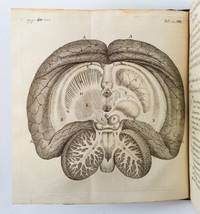
1672ST19899London: William Wells and Robert Scott 1672. FIRST EDITION London Issue. 211 x 155 mm. 8 1/4 x 6 1/4". 28 p.l. 16 33-565 i.e. 563 11 pp. Numbering erratic but text complete including the vertical half title preceding p.1. Without the five-page bookseller's catalogue that usually appears at the end of the Oxford Issue but rarely in the London issue. <br/> Contemporary sprinkled calf raised bands spine attractively gilt in compartments with central floral spray curling vines at corners gilt lettering. WITH EIGHT ENGRAVED PLATES five of them folding. Title page and vertical half title g2 with ink signature of Jean Baptiste Bouthier de Rochefort; head margin of p. 1 with ink manuscript ex-libris of Jean Bailly M.D. dated 1674; the chapter on encephalitis "De Cephalagia" pp. 259-306 with extensive Latin marginalia in Dr. Bailly's hand. Wing W-2827; Garrison and Morton online 1544 4513 4730 4793 4919 4966; Krivatsy 13015; Norman 2245; ESTC R186611. Extremities somewhat rubbed with leather gone at three corners and along part of the edge of one board leather a little pitted and dry as usual from acid treatment but the binding entirely sound with no significant wear to the joints. First plate with short tear to one margin well awas from image occasional mild browning or faint foxing but A FINE COPY INTERNALLY the text clean and fresh and THE PLATES EXCEPTIONALLY CRISP AND BRIGHT.<br/> <br/> This is a fine fresh copy of the first edition London issue of the earliest English work on medical psychology by the father of modern neuroanatomy. Considered by Willis 1621-75 to be his greatest work "Two Discourses on the Soul of Brutes Which Is Vital and Sensitive" recognized the difference between the symptoms of gross brain disease and those of mental illness postulating than humans have a "corporeal soul" akin to that of "brute" animals and a "rational soul" that controls the higher functions. Because he postulated a disturbance of the brain and nerves in terms of disordered "animal spirits" in the absence of pathological findings Willis is often considered the first to have equated mind disease with brain disease. In the section on comparative neuroanatomy are the first detailed dissections of the earthworm the oyster and the lobster all nicely illustrated. The author's contributions to comparative anatomy were significant: his discovery of the esophageal glands and pouches of the earthworm were later to be of interest to Charles Darwin. Willis traced in detail how vibratory impressions from the five senses are transmitted through the plenum of animal spirits which inhabit the nervous system and how these impulses are interpreted processed and stored in specialized parts of the cerebrum and medulla oblongata. In the chapter "Of Stupidity or Foolishness" appears for the first time a description of schizophrenia. Willis also gives the first description of general paresis of the insane and the first definite recognition of the condition now known as myasthenia gravis. The 1683 English translation of this work marks the first use of the word "neurology." Willis was both the most successful medical practitioner of his day and a leading light in experimental natural philosophy whose associates included Robert Boyle Robert Hooke Richard Lower Christopher Wren and John Locke. His international reputation and influence continued into the next century. In 1727 "History of Physic" author John Freind declared Willis "the first inventor of the nervous system.". William Wells and Robert Scott unknown