1 458 résultats
6790Mid-Edo period. An extremely rare survival: an uncommonly tall and large wooden training mannequin called in Japan do-ningyo "copper doll" even those no longer made of bronze in very good condition. It is most unusual to have such a mannequin of a female; the male figure is usually presented. Certain motifs of the model suggest it was carved in the Chinese or Indian style. The first examples of similar models originated in 11th-century China where life-size human acupuncture figures were cast from bronze. "The metal walls of the figures were pierced with small holes corresponding to the principal loci for acupuncture and moxibustion then covered with wax filled with water and used for the examination of medical candidates from the central and provincial colleges. If they located correctly the acu-points which they suggested needling as the result of their diagnoses drops of water would appear otherwise they would fail their test."-Lu & Needham Celestial Lancets. A History and Rationale of Acupuncture and Moxa p. 131. Models produced in 13th-century China also made of fine bronze had the names of the acu-points marked in characters of gold. Smaller models were also created. Later they gradually began to be made of paper or wood which emphasized the ribs and projection of the bones for locating meridians and acu-points which were usually marked. In the 17th century Japanese physicians replicated these figurines making them from materials that were easier to model such as wood sometimes covered with papier-mâché. They depicted the loci appropriate for acupuncture. Our model is covered with more than 100 small holes representing pressure points along with their names. The eyes have been painted white now partially flaked. Models like this were created for medical students to study and for doctors who would refer to them and prescribe treatments. Our model is able to stand on its own. Some wear and flaking of the wood but not affecting the handwritten labels of each acupuncture point. Preserved in a very fine new wooden box. ❧ See Huang Longziang "Reading Visual Imagery and Written Sources on Acupuncture and Moxibustion" in Lo & Barrett eds. Imagining Chinese Medicine 2018 pp. 161-66. unknown books
1699000020Kyoto Genroku period 12 1699. Sewn Binding. Good . 2 volumes. 4to 216 x 150 mm. Contemporary Japanese blue rice paper with silk ties paper worn and torn in places; opening leaves of vol. 1 wormed in blank upper margins. Collation:126 ; 90 pp. 11 large mostly full page woodcuts and several smaller woodcuts in text. The volumes are worn; opening leaves of vol. 1 wormed in blank upper margins occasionally affecting part of a character. There is some staining and foxing in text areas and dusting to edges. Numerous Japanese notations in red ink throughout text. Title from table of contents./ "Igaku shiyo sho . cho Ryuunken . " Cf. Kokusho somokuroku v. 1 p. 146./ "Kottaihitsuretsu . ga henshitaru Kinran junkyo . o honmon ni mochiite chuseraretari." <br/><br/>This study on acupuncture was translated from Chinese to Japanese. This is a translation of a classical text from the Yuan dynasty 1264-1368 written by Hua Shou which translated literally is "An Elucidation of The Fourteen Channels or Meridians and their functions." According to the descritionn for a copy in the National Medical Library "The work is divided into three parts: the first dealing with the circulation of the yin and yang in the arms and legs; the second with the course of the qi through the fourteen meridians; and the third with the eight "extraordinary vessels." Unlike many Western anatomies Hua Shou's does not depict or describe the body's musculature or skeleton; in fact during this period and for many centuries afterward Chinese physicians lacked a specific term for "muscle." unknown books
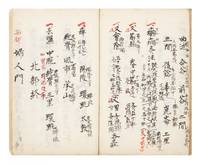
7072Many small brush & black ink drawings in the margins throughout. 111 folding leaves. 8vo 232 x 157 mm. later patterned wrappers new stitching. Japan: in trans.: "copied by Tanaka on 29 January 1830." The index on the first two pages describes the arrangement of the manuscript: by sections of the body. These include the upper section head eyes nose teeth throat and lungs middle section heart abdomen hips and lower section urinary tract large intestine rectum and legs. This is followed by one page describing treatments which are either fast-acting or long-term. There is a further division of treatments for women including reproductive organs children and skin diseases which include contagious diseases and cancer. Next we have the main text which gives a series of approximately 450 case histories and general diagnoses and treatments arranged by symptom. Within each case history or diagnosis the following information is given: symptoms references to either medical works or doctors who have dealt with this illness names of relevant pressure points recipes for medicines to be used and details of the specific case history. In the section devoted to women's reproductive organs there are treatments to encourage pregnancy to cause an abortion and recipes for birth control. The printed or manuscript medical texts referred to are largely Chinese works. They include Jiebin Zhang's Lei jing IIlustrated Appendix to the Yellow Emperor's Inner Canon Arranged by Topic Ziming Chen's Waike jingyao Essentials of External Medicine Simiao Sun's Qianjin yifang Supplementary Prescriptions Worth a Thousand Gold Pieces Tingxian Gong's Shou shi bao yuan Prolonging Life & Preserving the Origin and others. The references to Japanese medical authors include many leading doctors: Okamoto Tanba Ajioka Takeda Tokumoto and others. The delicate drawings depict mostly pressure points on the body. Fine copy written in one neat hand. unknown books
47108Juko Jushikei Hakki. Three parts in one volume. Kyoto Enami Jinbee Genroku 8 = 1685. 4to size 27.0 x 19.0 cm. Xylographically printed on 69 double leaves folded in an accordion or oriental style with 16 full-page woodcut plates. Original blue paper wrappers with xylographic text vignette on front. Contained in a modern blue cloth box made in Japanese style. = Very rare illustrated work on acupuncture. Bibliographically little is known about this work. It was anonymously published and our copy seems to be a second issue. Mestler describes a similar work that was issued in 1684; this copy was published in 1685. The book was written in classical Chinese in Japanese typescript. The author claims that he bases his writings on several classic Chinese medical texts from the 14th and 15th century. The beautiful illustrations appear to be made in the style of the mid-14th-century Chinese classic Shi si jing fa hui An Elucidation of the Fourteen Channels by Hua Shou. The plates show bodies of men with the acupunctural nodes indicated. The first 10 leaves have extensive contemporary handwritten annotations in two different hands in red and black. Minor worming to lower blank margin of last two leaves. Wrappers with some wear and slight loss of blue paper some uniform light age toning but otherwise a very good copy of this rare work. Mestler A Galaxy of Old Japanese Medical Books II 474-475. hardcover
1756235764Hermanni Josephi Krüchten Viennae 1756. Hardcover mit Lederrücken und -ecken 1756-1774. 17 Bände. Zusätzlich zu den 15 Bänden noch zwei Bände: Rationis Medendi continuatae in nosocomio practico 12von 3. Zustand: keine Beschädigungen keine Eintragungen. Rücken Ecken Kanten leicht berieben. Komplett fleckenfrei. Alle Tafeln vorhanden. Die Bände 13 und 14 haben oben einen Wurmstich. Haen ein Schüler von Boerhaaves. Schöpfer der Älteren Wiener Schule. Bitte Bilder anfordern dass der Berieb an den Ecken erkannt wird. Hermanni Josephi Krüchten, Viennae, hardcover
6847Two brush & ink drawings in the text. 89 folding leaves. 8vo 190 x 127 mm. orig. wrappers wrappers somewhat frayed orig. stitching. Japan: mid-Edo.<br/> <br/> A most interesting and extensive manuscript on acupuncture and moxibustion divided into seven parts. Based on WorldCat and Kyoto University’s manuscript with the same title we can attribute the authorship of these texts to Chishin Tanaka a physician of the early Edo period. <br/> <br/> The first four parts “East†“West†“South†“Northâ€; 17 17 25 12 leaves respectively are devoted to general principles of acupuncture and moxibustion. In each of these parts many symptoms and case histories are described in great detail along with their treatments through acupuncture and moxibustion. There are guides to locate the pressure points.<br/> <br/> Part Five eight leaves is devoted to female illnesses and their treatment. Menopause vaginal discharges irregular menstruation breast cancer difficulties during pregnancy and childbirth abortion etc. are all discussed. The sixth part in three leaves describes pediatric illnesses. The final section of seven leaves contains several “secret†methods including the “bone length method†to locate pressure points.<br/> <br/> The two illustrations depict the spine and associated pressure points.<br/> <br/> In very good condition. unknown
6847Two brush & ink drawings in the text. 89 folding leaves. 8vo 190 x 127 mm. orig. wrappers wrappers somewhat frayed orig. stitching. Japan: mid-Edo. A most interesting and extensive manuscript on acupuncture and moxibustion divided into seven parts. Based on WorldCat and Kyoto University's manuscript with the same title we can attribute the authorship of these texts to Chishin Tanaka a physician of the early Edo period. The first four parts "East" "West" "South" "North"; 17 17 25 12 leaves respectively are devoted to general principles of acupuncture and moxibustion. In each of these parts many symptoms and case histories are described in great detail along with their treatments through acupuncture and moxibustion. There are guides to locate the pressure points. Part Five eight leaves is devoted to female illnesses and their treatment. Menopause vaginal discharges irregular menstruation breast cancer difficulties during pregnancy and childbirth abortion etc. are all discussed. The sixth part in three leaves describes pediatric illnesses. The final section of seven leaves contains several "secret" methods including the "bone length method" to locate pressure points. The two illustrations depict the spine and associated pressure points. In very good condition. unknown books
7075Nine folding leaves. 8vo 207 x 145 mm. orig. wrappers a little worn & frayed new stitching. Japan: from the first & final page in trans.: "Information provided by Asaemon Shimizu near Imabari Castle in today's Ehime Prefecture.on an auspicious day in September 1796." This rather slight manuscript is of considerable interest as it lists 35 medical conditions along with names of pressure points and methods of treatment. These illnesses include heart disease skin problems tumors dental matters throat and lung diseases intestinal problems reproductive issues communicable diseases like cholera and gonorrhea obstetrical problems and diseases of children. There is an interesting section on the resuscitation of drowned people. In this work the anonymous author gives instructions to insert needles in veins. Very good copy. Minor worming and staining. unknown books
41535LONDON WOODWARD 1726. 'CONTAINING AN EXACT AND COMPLEAT ACCOUNT OF THE NATURE SIGNS CAUSES AND CURES THEREOF .' OCTAVO FIRST ENGLISH EDITION TRANSLATED FROM THE FRENCH. A SUPER EXAMPLE OF A SCARCE BOOK. MODERN FINE BINDING IN HALF CALF OVER MARBLED BOARDS NEW ENDPAPERS. 490 PAGES PLUS CONTENTS ILLUSTRATIONS IN THE TEXT. VERY SCARCE. LONDON, WOODWARD, 1726 hardcover
40104LONDON JOHN CHURCHILL 1835. . EXHIBITING ON DISSECTED PLATES MANY IMPORTANT SUBJECTS IN MIDWIFERY. SECOND EDITION ENLARGED AND IMPROVED IN TWO VOLUMES. REBOUND IN GREEN CLOTH WITH NEW ENDPAPERS. SPORADIC FOXING THROUGHOUT BUT VERY GOOD CONDITION. PART 1 HAS 10 PLATES OF WHICH 5 ARE PULL-OUTS. PART 2 HAS 9 PLATES 8 PULL-OUTS. VERY SCARCE. LONDON, JOHN CHURCHILL, 1835 hardcover
7074Two parts in one vol. 25 13 folding leaves. 8vo 198 x 135 mm. orig. wrappers rubbed old stitching. Japan: at the beginning of each part & on final leaf in trans.: “Oyo today Nagoya retired doctor Tokei or Tokoku Yoshida copied 6 June 1767.â€<br/> <br/> The first part provides a detailed explanation of the theory and practice of acupuncture concentrating on 28 different ways to use the needle. At the end of this part there is a most interesting discussion of Zi Wu Liu zhu The Midnight-Noon Ebb-Flow Acupuncture Method which is used as a theoretical guide to determine whether the meridian is open at a particular moment.<br/> <br/> The second part contains descriptions of 36 common illnesses sexually transmitted diseases paralysis headache heart disease contagious diseases ulcers various pains fevers children’s diseases gynecological illnesses insanity etc. their symptoms appropriate pressure points for treatment and application of the needle shallow or deep etc.<br/> <br/> Fine copy written in a clear hand. unknown
7074Two parts in one vol. 25 13 folding leaves. 8vo 198 x 135 mm. orig. wrappers rubbed old stitching. Japan: at the beginning of each part & on final leaf in trans.: "Oyo today Nagoya retired doctor Tokei or Tokoku Yoshida copied 6 June 1767." The first part provides a detailed explanation of the theory and practice of acupuncture concentrating on 28 different ways to use the needle. At the end of this part there is a most interesting discussion of Zi Wu Liu zhu The Midnight-Noon Ebb-Flow Acupuncture Method which is used as a theoretical guide to determine whether the meridian is open at a particular moment. The second part contains descriptions of 36 common illnesses sexually transmitted diseases paralysis headache heart disease contagious diseases ulcers various pains fevers children's diseases gynecological illnesses insanity etc. their symptoms appropriate pressure points for treatment and application of the needle shallow or deep etc. Fine copy written in a clear hand. unknown books
1990285674Springer Verlag Berlin 1990. Hardcover Leinen ohne Schutzumschlag 5. Auflage 1990-2000. Hauptbände 1 bis 10 Folgebände 1 bis 6 kumulierendes Register der Bände 1-5 7 und 8 1-4 und 7 1 bis 3 1 bis 4 Folgeband 1: Waren und Dienste. Zustand: Keine Beschädigungen keine Eintragungen. Rücken Ecken Kanten gut. Springer Verlag, Berlin, hardcover
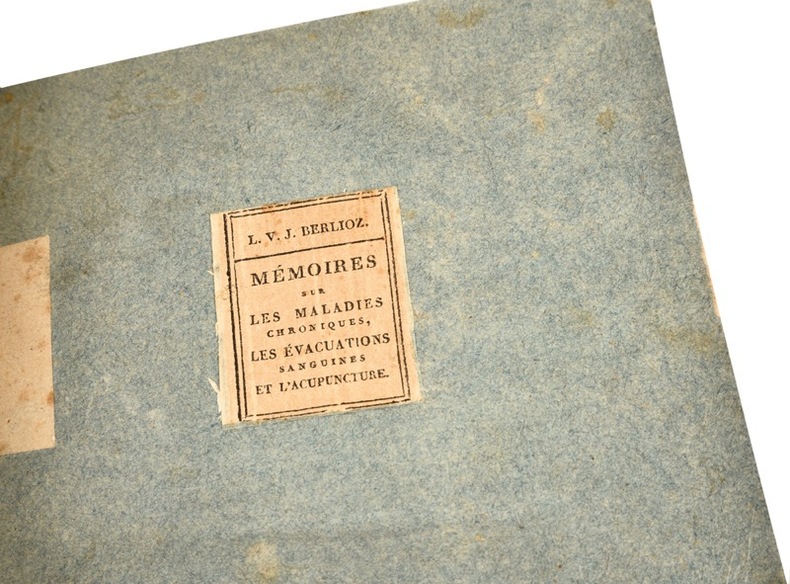
181621648Paris, Croullebois, (imprimerie de Crapelet), 1816 ; in-8 (210 mm), demi-veau bleu outremer, dos à nerfs, titre doré, couverture bleu délavé de l’époque avec l’étiquette imprimée sur le plat, tête arasée, tranches non rognées (rel. de l’époque); VI, 343, [1bl.] pp., [2] pp. d’errata.
189419159Paris, Chamuel éditeur, 1894. In-8°, 164 pp. (coin inf. lég écrasé). ENVOI MANUSCRIT DE L'AUTEUR à NEBO (Stanislas de Guaita). Br. (manques marginaux à la couv. et à la garde bl. inf., dos consolidé grossièrement, dos en partie cassé), une reliure redonnerait toute sa noblesse à cet exemplaire RARISSIME.
189419159Paris, Chamuel éditeur, 1894. In-8°, 164 pp. (coin inf. lég écrasé). ENVOI MANUSCRIT DE L'AUTEUR à NEBO (Stanislas de Guaita). Br. (manques marginaux à la couv. et à la garde bl. inf., dos consolidé grossièrement, dos en partie cassé), une reliure redonnerait toute sa noblesse à cet exemplaire RARISSIME.
7073Two full-page brush & black ink illus. of the human body front & back with names of pressure points. 36 folding leaves. 8vo 247 x 172 orig. wrappers wrappers rather worn & wormed recased new stitching. Japan: late Edo.<br/> <br/> Our manuscript is arranged by section of the body from head to foot with a listing of about 120 pressure points and their meridians allied organs and related illnesses. There are precise instructions on how to locate each pressure point by measurement. <br/> <br/> At the end is a list of 45 pressure points that should not be touched followed by two full-page images of the body front and back with names of pressure points. These are followed by 354 pressure points arranged into groups. Each group is connected to a specific organ.<br/> <br/> Good copy. This manuscript is rather wormed increasingly towards the end but completely legible. unknown
7073Two full-page brush & black ink illus. of the human body front & back with names of pressure points. 36 folding leaves. 8vo 247 x 172 orig. wrappers wrappers rather worn & wormed recased new stitching. Japan: late Edo. Our manuscript is arranged by section of the body from head to foot with a listing of about 120 pressure points and their meridians allied organs and related illnesses. There are precise instructions on how to locate each pressure point by measurement. At the end is a list of 45 pressure points that should not be touched followed by two full-page images of the body front and back with names of pressure points. These are followed by 354 pressure points arranged into groups. Each group is connected to a specific organ. Good copy. This manuscript is rather wormed increasingly towards the end but completely legible. unknown books
1652235753Apud Ludovicum Elzevirium Amsterodami 1652. Hardcover mit Lederrücken. Zustand: keine Beschädigungen keine Eintragungen. Rücken Ecken Kanten gut. Restauriert Innen und Außen. Die ersten und letzten Seiten sind gewaschen und verstärkt. Apud Ludovicum Elzevirium, Amsterodami, hardcover
184379718London: Taylor and Walton 1843. Gebunden. Taylor and Walton unknown
90559aafGuang Yi shu ju (Kuang I shu-chü), o.J., ca. 1913, in-8vo, 8x 11 + 4x 12 Bll. (insges. 136 Bll.) mit 2 ganzseitigen u. zahlr. weiteren Abb. im Text (schematische Zeichnungen des menschl. Körpers, Druckpunkte an verschiedenen Körperteilen, innere Organe etc.), gedruckt auf dünnes chinesisches Papier (jedes Blatt besteht aus 4 gefalt. Bll.), ein Titelblatt u. Einband innen etwas fleckig, ansonsten guter Zustand, einheitlicher chinesischer Orig.-Papiereinband d. Z. (mit Buchblock gebunden), Vord. deckel jeweils mit Titel bedruckt, schönes Exemplar.
1984yam1149Fort in-4 broché en bon état sous jaquette illustrée en état moyen usée par endroits 717 pages
1907276984Franckh`sche Verlagshandlung Stuttgart 1907. Hardcover mit Leinenrücken und -ecken Zeitschrift zur Förderung wissenschaftlicher Bildung Zeitschrift für praktische Arbeit auf dem Gebiet der Naturwissenschaften 1907-1949. Jahrgänge 1234567891011121314151617181920212223242627282930313233353638. Mit Mikroskopie Mikrophotographie Histologie Biologie für Jedermann Praktische Anleitung zur Kultur der Mikroorganismen Apparatebau und Arbeitsmethoden zur Mikroprojektion Botanische Mikrotechnik Apparate und Arbeitsmethoden der Bakteriologie. Zusätzlich: Ungebunden: Jahrgang 34 Hefte 1-81011 39 Hefte 23. Zustand: mit Kennungen einer Privatbibliothek. Rücken Ecken Kanten gut. Franckh`sche Verlagshandlung, Stuttgart, hardcover
28622LONDON G NICOL 1788. SECOND EDITION QUARTO RECENT FINE HALF LEATHER BINDING RAISED BANDS GILT TITLES NEW ENDPAPERS 7 ENGRAVED PLATES. A VERY ATTRACTIVE COPY. LONDON, G NICOL, 1788 hardcover
41544EDINBURGH BELL AND BRADFUTE 1801. SEVENTH EDITION COMPLETE IN SEVEN VOLUMES. WITH 113 COPPER PLATES AS CALLED FOR ONE BOUND UPSIDE DOWN. OCTAVO NEAT MODERN BROWN CLOTH BINDING NEW ENDPAPERS. EX BRITISH MEDICAL ASSOCIATION LIBRARY WITH THEIR STAMP TO EACH TITLE PAGE. A VERY NICE SET CLEAN AND TIGHTLY BOUND. UNCOMMON. EDINBURGH, BELL AND BRADFUTE, 1801 hardcover