440 résultats
1854241271854 Format 58 x 94 cm sous vitre et cadre doré ancien. (Petite restauration dans le ciel).
1 épreuve gélatino argentique [120 x 172 mm] contrecollée sur carton fort de l'époque , , in-8, 1 épreuve gélatino argentique [120 x 172 mm] contrecollée sur carton fort de l'époque, , Portrait de Louis Pasteur sur son lit mortuaire. Étant donné son cadrage et sa proximité, ce portrait mortuaire a sans doute été effectué par un proche de Pasteur; il ne s'agit pas d'une prise de vue officielle. Louis Pasteur, né le 27 décembre 1822, meurt le 28 septembre 1895 à 16h40 à Villeneuve-l'Étang, dans l'annexe dite « de Garches » de l'Institut Pasteur, où il s'installait souvent l'été. Sa chambre y est toujours conservée. Des funérailles nationales lui sont réservées le 5 octobre suivant, au cours desquelles son corps, préalablement embaumé, est déposé dans la crypte de Notre-Dame de Paris. En 1896, à la demande de son épouse, son corps fut placé dans la crypte de l'Institut où il repose au milieu de ses disciples. Un masque mortuaire est visible dans la crypte. Un négatif sur plaque de verre montrant la chambre mortuaire prise en 1926 est conservé au Département Estampes et photographie à la BnF (8/5/26, la chambre mortuaire de Pasteur à Garches : photographie de presse / Agence Rol.) Un cliché mortuaire montrant Pasteur sur son lit de mort en présence de ses petits enfants a été publié en 1956 par sa petite-fille Camille: Pasteur Vallery-Radot, Images de la vie et de l'oeuvre, p. 158 (document photographique provenant de la collection Pasteur Vallery-Radot). Le carton sur lequel est contrecollé le portrait de Pasteur porte un fin liseret rouge d'encadrement, le bord supérieur du tirage est accidenté. Documents annexes joints : 1 tirage argentique contrecollé sur carton [165 x 110 mm] légendé : Portrait de Pasteur avec sa petite-fille Camille Vallery-Radot par Léon Bonnat (1886) / 4 tirages argentiques [170 x 220 mm] de portraits réalisés aux pastels par le jeune Louis Pasteur entre 1835 et 1842 : portrait de sa mère, de Claudine Benoiste Parpandet dite soeur Constance, portrait d'une jeune fille et portrait de son père / 1 gravure du XIXe siècle : portrait âgé de Louis Pasteur par Roussel
189340<p><strong>Very rare Second enhanced edition </strong></p><p><strong>No copy of any edition of this title recorded in WorldCat</strong></p><p><strong>Uncut</strong></p><p>Oliveti Torquato. <em>Della morte apparente nei cholerosi del modo di farli risorgere e della sola cura giovevole nel cholera asiatico / Torquato Oliveti</em>. Savignano : Tipografia dei Filopatridi 1893</p><p>8° 185 x 120 mm original paper binding with title page printed on front board pp. 116.</p><p>Very rare second edition of Torquato Olivetti treatise on Asian cholera and the phenomenon of apparent death in the sufferers of cholera</p><p>The treatise published in First Edition in Naples in 1886 organised as a practical manual to be used by doctors during an epidemic of cholera deals with the causes and symptoms of the disease the most effective cures and deals with the phenomenon of the apparent death of some sick people on how to recognise this symptom and how to raise the apparent dead.</p><p>Olivetti a doctor and lawyer from Emilia formed his experience on cholera during the terrible plague epidemic that broke out in Naples in 1884.</p><p>In the summer of 1884 a devastating cholera epidemic was recorded in Naples. The difficult housing situation in the popular neighbourhoods and poor sanitation conditions favoured the rapid proliferation of the disease. In the space of a few weeks the death toll exceeded 7000. To prevent the recurrence of other similar tragedies the mayor Nicola Amore with the support of King Umberto I and Prime Minister Depretis started the "gutting" of the ancient city with a massive recovery plan.</p><p>CONDITION: Amazing copy with no defects; uncut.</p> Tipografia dei Filopatridi paperback
Very Good Turkish, Ottoman (1500-1928) Original registry book in its original grey art nouveau cloth. All edges marbled. 'The English manufactory of book and register' written on end-papers. 'Zugologion' written in Greek letters on front cover. Slightly faded. A fine copy. Demy 8vo. (22 x 15 cm). In Ottoman script. 52 p. is written of which apprx. 200 p., but it's finished and complete; one folding hand-drawn color map, and 3 tables. [MANUSCRIPT] [Ottoman Prokopi sanitary report] Konya Sihhiye Müfettisligi'nin 16 Tesrinievvel 1327 tarihli mezkûr müfettislige takdim olunan rapordur ki 327 senesi Ürgüp'te zuhur eden koleraya dairdir.; Vilâyetin topografya-yi sihhiye ve harita-yi sihhiyesi. The report on the cholera occurring in Ürgüp in 1910, which was presented to the Inspectorate of Konya Sihhiye on October 16, 1910. Besides cholera, it contains information about diseases such as measles. 1329 (Hegira) written at the end of first 10-paged report. The second part contains title: Mecelle-i Memâlik-i Osmaniye'ye ait minvallere cevabât yazilarak Üsküp Kaymakamligi'na takdim olunan 'Müslüman Sihhiye' raporu [= Muslim health report submitted to the Ürgüp (Prokopi) District Governor]. This and following next chapters include general health and sanity registers on epidemics like 'frengi' (syphilis, pox), all kinds of 'humma' (pyrexia) and several others (almost more 15 titles) and give information about how often diseases are encountered in the region of Prokopi and Cappadocia. One folded map which is hand-drawn includes color markers as 'Ürgüp Bölgesi saglik haritasi' [= Prokopi region sanity and epidemic map]. Also it shows demographic and historical info about region. There are 3 statistical tables contain demographic, historical, religious info such 'Muslim' and 'Non-Muslim'. Maps and tables are perfectly drawn. Another chapter is 'Usul-i sihhiye', has all epidemics and their historical and demographic contexts, their cures etc. Book was written in a very nice hand-writing. Used black, blue, and red inks. Report was not published before such as that. Roumi: 1327 = Gregorian: 1910. The Ottoman land represented a bridge between Asia and Europe, which was destroyed by epidemic diseases that emerged in different periods. In the 19th century, the main source of epidemic was the cholera morbus that emerged in India in the lower Bengal delta between the Ganges and Brahmaputra rivers. At the beginning of the 19th century, the disease became a global threat. Cholera epidemic appeared for the first time in the Ottoman territory in 1822, and continued to emerge into intermediate outbreaks. Due to its geographical location, the cholera epidemic was easily spread to the Ottoman territory and caused great losses in the 19th century, when it became a global threat. At the beginning of the 20th century, still cholera was a serious problem. Prokopi is a settlement in Central Asia Minor, built on a plateau at an altitude of 1,200 m above sea level. It lies near the confluence of four tributary rivers of the Alys River (Kizilirmak), which flows to the north of Ürgüp, within about 10 km from the settlement. It has been claimed that the word Ürgüp is the Turkish version of the Greek name Prokopi. The latter is supposed to refer to St. Prokopios, although there is no evidence suggesting the existence of a namesake church. Levidis supported that the ancient name of the settlement was Osiana, which the traveller Texier (Charles) adopted as well. Ürgüp was inhabited by Muslims, Turkish-speaking Greek-Orthodox and some Armenians. Several conflicting opinions have been stated about the population. Farasopoulos talks about 15,000 Muslims and 5,000 Christians. According to an inventory carried out by the state in 1919, Ürgüp was inhabited by 12,500 Muslims, 6,000 Christian-Orthodox and 15-20 Armenian families.
1814019557Büreau Für Literatur Und Kunst, Halberstadt 1814. Erstausgabe Interim-Broschur Sehr gut
183222939Montreal. A la Librairie de E.R. Fabre & Cie. Juin 1832 1832. Hardcover. 24mo 13cm 16p. in the original plain boards fine n12 A book of prayers in response to a cholera epidemic outbreak in Lower Canada in 1832 which was brought by immigrants from Britain. At the time it was not understood how the disease spread nor how to treat it. Six thousand people were believed to have died. Montreal. A la Librairie de E.R. Fabre, & Cie. Juin 1832 hardcover
1987000928Paris Blaizot 1987
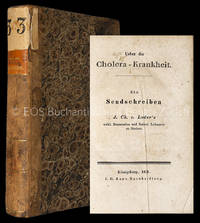
18312684BBKönigsberg, J.H. Bon's Buchhandlung, 1831. 8°. 60 S., 48 S. (Zusätze). Halblederband aus der Zeit. + Wichtig: Für unsere Kunden in der EU erfolgt der Versand alle 14 Tage verzollt ab Deutschland / Postbank-Konto in Deutschland vorhanden +, A|B [2 Warenabbildungen]
MED654M1834, Imprimerie Royale, Paris. In-4, reliure d'attente, plats cartonnés, 205pp suivies de tableaux statistiques et de cartes concernant chaque arrondissement et chaque commune rural. Exemplaire bien complet de toutes ses planches (51 cartes). Intérieur bon. Carte 49 brunie, sûrement une planche provenant d'un autre exemplaire puis montée sur onglet (trace de découpe sur ce qui devait être la planche 49 initiale). Cachet humide ex-libris sur page de titre. Charmant exemplaire de ce rare et éminent ouvrage.
174520421Lugduni Batavorum, apud Gerardum Potvliet, 1745. In-4 de [24]-324-[45]; [2]-de 73 à 258-[2] pages, vélin souple du temps, attache (il en manque une).
18312684BB1831. Königsberg J.H. Bon's Buchhandlung 1831. 8°. 60 S. 48 S. Zusätze. Halblederband aus der Zeit. Beigebunden: Schnurrer Friedrich: Die Cholera morbus ihre Verbreitung ihre Zufälle die versuchten Heilmethoden . Stuttgart und Tübingen Gotta'schen Buchhandlung 1831. X 2 79 S. Mit 1 gef. Karte. Beigebunden: Hegetschweiler Joh.: Ueber den Charakter die Cur und die Verhütung der ostindischen Brechruhr Cholera mit besonderer Berücksichtigung der Verhältnisse der Schweiz. Zürich Orell Füssli 1831. 52 S. Beigebunden: Köchlin J. R.: Ueber die Cholera oder den Brechdurchfall und die dagegen gerichteten Schutz- und Hülfsmittel. Zürich Schulthess 1831. 74 S. Beigebunden: Bastler Anton Dominik: Die Cholera in Wien. Wien Strauss 1832. 1 Bl. 134 S. - Sammlung div. Beiträge über die Cholera in einem Buch gebunden. - Mit Bibliotheksnummern. Der Einband berieben. unknown
18312684BBKönigsberg, J.H. Bon's Buchhandlung, 1831. 8°. 60 S., 48 S. (Zusätze). Halblederband aus der Zeit.
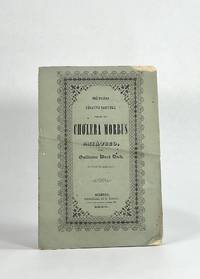
185010296Mexico: R. Rafael 1850. Original Wrappers. near Very Good binding. Octavo. 16 pp. Stitched in original wrappers. Horizontal crease through the center of the pamphlet from accidental folding; light edgewear including folded leaf corners; rear wrapper soiled; wormholes through the entire pamphlet that touch the occasional letter not impacting comprehension. <br /> <br /> Uncommon pamphlet in which the author a self-professed retired physician identifies how to diagnose cholera which had reemerged as a serious problem during and after the Mexican-American War. We've not been able to find other references to work by Duck. Fairly uncommon. While this is not an ideal copy given the condition it is fairly good. Sutro p. 858. R. Rafael unknown
10019El Milia, 1899. Six photographies grand format : Un Cholérique, Une Cholérique Jeune Kabyle de 20 ans enlaidie par la maladie, Le Médecin de Colonisation et l’Adjoint à l’Administration soignant des Cholériques, Un Cholérique de 12 ans sauvé du Choléra, Cholérique jeune garçon de 16 ans.
1923012850Paris Edition du Sagittaire, chez Simon Kra 1923 In-12 Broché Edition originale Dédicacé par l'auteur
In-8 p (mm. 212 x 128), cartonato muto coevo. Il volume raccoglie i seguenti 9 opuscoli (di diverso formato e di editori diversi): - Guyton-Morveau “Metodo per purgare le arie infette...” (1817), pp. 55, con 2 tavole a colori fuori testo. - “Storia della malattia che trasse a morte l’avvocato sig. Luigi Rainoldi..” (1826), pp. 43. - Bodei A. “Preparativi per la soluzione di gravissimi problemi intorno all’epidemia dominante” (1817), pp. 110. - “Lettera d’un medico di città ad un parroco di campagna sulla febbre petecchiale e sui preservativi contro di essa” (s.d.), pp. 18. - “Istruzioni e regolamenti di privata sanitaria quarantina da osservarsi in caso di contagio per tenere lontano dalle proprie abitazioni il cholera-morbus e qualunque alta malattia contagiosa” (1831), pp. 24. - “De Cholerae modo epidimice in quibusdam Europae regionibus furentis symptomatibus diagnosticis...”, Ticini Regii, ex Tip. Fusi (1832), pp. 28. - Calderini C.A, “Precetti salutari per essere preservati dal cholera morbus” (1835), pp. 36. - Ferrario O. “Saggio analitico della così detta acqua purgativa della fonte vicina a Settala Distretto X, Provincia di Milano” (1826), pp.13. - “Avviso al popolo intorno al cholera-morbus” (1835), pp. 13.<br> Con qualche fiorit. ma certam. un buon esemplare.
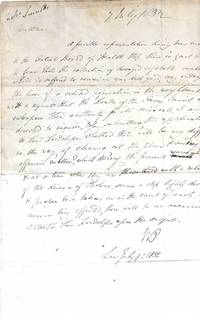
26909Lambeth 7 July 1832. Four pages folio bifolium tipped onto card minor damage not affecting text crude repair with sellotape on 'spine' aged fair condition. A. The 'Petition' two pages folio in a tidy handwriting commencing: "We the undersigned regret to have occasion to trouble your Lordship but under the present alarming apprehension of that dreadful disease of Cholera we intreat your Lordships assistance in the removal of a monstrous nuisance in our immediate neighbourhood. The dust yard of Messrs Sinott situate in Belvedere Road Lambeth is the receptacle for the refuse of the vegetables from Covent Garden market where it is as well as much other very offensive matter suffered to remain till far advanced in decomposition long thought the source of cholera the effluvia from which especially during the present warm weather is almost unbearable and we fear unless abated will materially endanger the lives of many in our populous neighbourhood ." They ask for his Lordship's interference to deal with a longstanding problem. Signed by Thomas Langton Samuel Cross John Barnard John Chas Stahlschmidt and ten others. B. Final page of the bifolium copy of letter presumably sent to Sinnottsalso dated 7 July 1832 tipped on to card with loss of a letter or two initialled discussing the source of effluvia affecting the lives of people a "crowded population" and its connection to cholera. See Image. Notes: a. "Lord Melbourne William Lamb 2nd Viscount Melbourne was heavily involved in the government's response to the first major cholera epidemic in Britain during his time as Home Secretary in the early 1830s" AI; b. "The 1832 Cholera Outbreak in LambethConditions: Lambeth situated along the Thames was a hub of industry and a magnet for poor migrant workers living in cramped filthy conditions with no proper sewerage systems.Water Supply: Residents including those in Lambeth drank directly from the heavily contaminated Thames accelerating the spread of the disease.Impact: By February 1832 cases were reported in London with Lambeth and Southwark among the early affected areas. By the end of 1832 the epidemic had killed over 32000 people across Britain."Miasma" Theory: At the time officials like Edwin Chadwick and the Central Board of Health believed cholera was caused by "miasma"—poisonous air arising from decomposing matter." AI Lambeth, 7 July 1832 unknown
Abundant black and white illustrations and reproductions of photos. Features: Big-Game Hunting for the Cinema - John A. Jordan leads a film expedition into the wilds of British East Africa; The "Gordon" of the Pacific - Thos. J. McMahon visit's Germany's former South Sea possessions - German New Guinea, the Solomon Islands, and Samoa - and reports on the work of Captain Hunter among the savages of the Solomons - lots of nice photos; Our Chase After A Rogue Elephant - photo-illustrated story from Ceylon; Our Chase After a "Rogue Elephant"; In the Jaws of a Lion - J.S. Cowie was carried about the engine room of his ship in the jaws of a lion!; Kidnapped - a young woman finds herself at the mercy of two desperate men; The Holy City of the Mormons - photo-illustrated article on Salt Lake City; The Strap-Hanger of the Ganges - The crocodile Captain J.G. Bennett thought he had killed comes back to life!; Chased by a Boa Constrictor - a 1902 story from Argentina; My Night With Wolves - hunter is surrounded by wolves in Northern Minnesota; The Lake of Soda - Magadi Lake, in British East Africa; The "Black Hole" of Gottingen - Corporal A. Bramwell of the Royal Welch Fusiliers earned the D.C.M. for his service to fellow POWs suffering from cholera and typhus at the Prisoners' Camp, Gottingen, in WWI; A Woman's Travels in Unknown Asia - Part II - Mary Gaunt set out to explore much of China but, under the influence of bandits, rerouted north to the wilds of Siberia - article with many photos; Humours of the East African Campaign; The Reds of the Maranoa - Two cattle-rustlers in Queensland are killed; A Couple of Pirates - "Dr. Martin" of the U.S. Navy served in Honduras during the Nicaraguan War but encountered difficulties later; My Visit to the Veddas - R.L. Spittel visits primitive natives in the interior of Ceylon - article with photos; Photo of the largest book in the world in Chicago; Photo of monster swordfish caught by Mr. W.C. Boschen off Santa Catalina Island, California; and more. pp. 8 [ads], [2], 444-528, 9-16 [ads]. Clean and unmarked with moderate wear. Covers detached as one but present. A quality vintage copy of this wonderful issue. Book
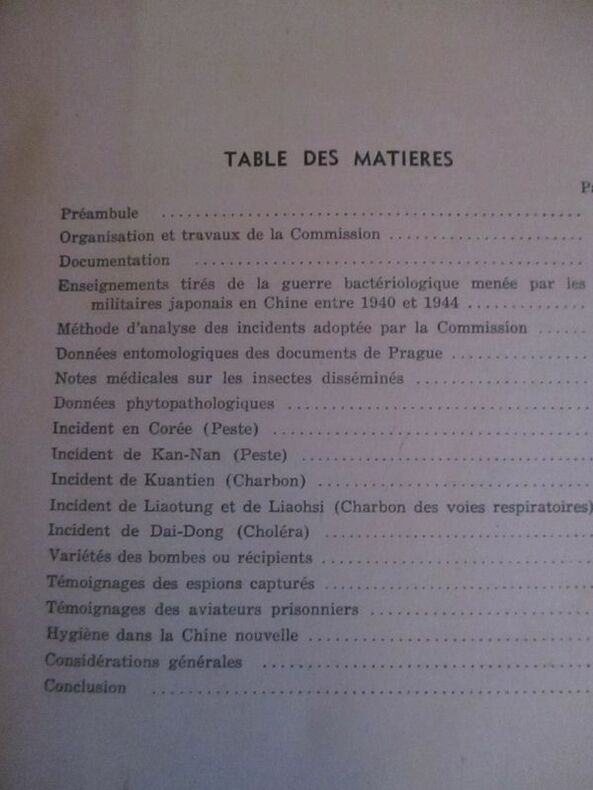
195265131952 Pekin 1952 fort volume In8 659 pages très grandes planches dépliantes et reproductions photographiques dans le texte
18314179Mit 13 Abb. auf 1 mehrfach gefalt. lithogr. Tafel. Berlin, In Commission bei E. S. Mittler, 1831. 8vo. (19,3 x 120 cm). 20 S. Heftstreifen.
Front page loose but present and presents six sketches of 'The Ship-Launch Disaster at Glasgow" - The Daphne capsized upon launch with much loss of life. New items: Mr. Gladstone immolates eight ministerial bills; Wimbledon competition more popular than ever; Malagasy envoys leave for home; Good news from Ireland - a lessening of crime and upset; Update on Cholera outbreak at Damietta; The Ship-Launch Disaster at Glasgow; Live-Saving Apparatus on the Serpentine; The New Steam-Ship Tartar; Banquet to Mr. Henry Irving; National Sports; Parisian Sayings and Doings; Death of the Duke of Marlborough; Royal activities; Church news; Benevolence and Self-Help; Ben Nevis Meteorological Station; Funeral of Mr. W. Spottiswoode; General Home News; The City of London College; Two pages of Classified Ads (please note that this page is loose but present). Full page of sketches of "Complimentary Dinner to Mr. Henry Irving at St. James Hall. Half-page illustration of 'Trial of life-saving apparatus on the Serpentine, Hyde Park. Half-page engraving of "The Union Steam-Ship Company's Royal Mail-Steamer Tartar. Very dramatic two-page engraving entitled "The Great Disaster at a Ship Launch on the Clyde - Sinking of the Daphne, with Two Hundred Men. Above-average but not excessive wear. Includes separate supplement which consists of two full-page engravings - the first shows a kneeling man gardening while tenderly holding an infant, the second shows a sad kitchen scene from a picture by W.H.Weatherhead with the caption "For men must work and women must weep, Though storms be sudden and waters deep, And the harbour bar be moaning - C. Kingsley". The Ben Nevis Summit Observatory - Six sketches on one page. Opening of the City of London College - two sketches; Funeral of the late Mr. W. Spottiswoode, F.R.S., in Westminster Abbey - 4 sketches. Somewhat above-average wear and soiling overall. Perforations along spine indicate this copy from a disbound volume. Magazine
Mr. Pakenham passes away under allegedly outrages circumstances at Tamatave. Suez Canal difficulty - cutting a second canal parallel to the first. Echoes of the week. The Playhouses; Weather; National Sports; The Cholera in Egypt - Quarantine, with full-page engraving entitled 'Quarantine Examination at Brinsisi'. Crab-Catching in Cornwall - 9 sketches on one page (plus text on next page); News from the Court and Church plus Benevolence and Self-Help. New Townhall, Dover - with sketch; The Westminster Townhall - with sketch; The Swanley Homes for Little Boys - with sketch; Sketches in Egypt - Thebes. The Advantages of Wet Weather. Supplement includes: Chapter V of The Canon's Ward, by James Payn; The Savage Club at the Royal Albert Hall (which is featured on front cover illustration and pages 52 and 53); The Jesmond Dene Park, Newcastle; A dramatic two-page engraving entitled "Departure of Irish Emigrants at Clifden, County Galway (please note that this engraving bears a large tear); Obituaries; Chess; Wills and Bequests; Departure of Irish Emigrants; Classified Ads. The Jesmond Dene Public Park, Newcastel-on-Tyne - 8 lovely sketches. The Suez Canal - 3 pages of text and sketches, including map of the proposed Canal and sketch of M. Ferdinand De Lesseps, President of the Suez Canal Company. New Books. Musical Publications. Chipping at edges. Some pages loose but all appear to be present. Perforations along spine indicate this copy from a disbound volume. Magazine
Front cover sketches of Tamatave, Madagascar, Surgeon-General W.G. Hunter - Government Medical Advisor in Egypt, and Mr. John Marshall, New President of the Royal College of Surgeons. Topics: Mr. Waddington appointed French Ambassador to England. Cholera in Egypt. Echoes of the week. Opening of the Homes for Little Boys at Swanley by the Prince and Princess of Wales - 7 sketches on one page. The Prince of Wales at Work - 10 sketches on one page. Presentation of Regimental Colours. City Echoes. The Playhouses. Music. Evening Fete at the Fisheries Exhibition - several sketches on one page. Sketches in Cairo - 3 sketches on one page. Round about Paris. Uproar about plan for a second Suez Canal - Sketches of personalities involved on page 88. Education. Benevolence and Self-Help. 7 sketches of Nidderdale, Yorkshire. Chinese manufacture of great guns. General Home News. Classified ads. Supplement includes Chapters VII and VIII of The Canon's Ward, by James Payn. The Wimbledon meeting. Our fishing industries - with splendid 2-page engraving entitled 'Shrimping at the Mouth of the Thames'. Obituary. Chess. Wills and Bequests. Classifieds ads. 9 sketches of various fishing boats from the International Fisheries Exhibition. Engraving of Captain Matthew Webb - the celebrated swimmer who drowned last Tuesday in his attempt to swim the whirlpool rapids below Niagara Falls. *Excellent* 2-page engraving entitled "War Preparations in China - Welding a Coil for a Great Gun at the Arsenal, Shanghai". The Church. Sonnets. The Inland Parcels Post. Perforations along spine indicate this copy from a disbound volume. Average wear. Magazine
Please note: First page not present. Pencil jottings to page 3 else unmarked with above-average wear. Full page engraving of The Late General Sir W. Knollys, Gentleman Usher of the Black Rod. Two engraving under the heading "The Cholera in Egypt - Its Source and Cause. Wonderful two-page engraving entitled "The Dispute Between France and China - Examining and Packing Chinese Manufactured Rifles at the Arsenal, Shanghai. Garden party at Chelsea Hospital - text and illustrations. Classified ads. Supplement: a portion of The Canon's Ward, by James Payn. Two-page engraving entitled "Our Fishing Industries - Line Fishing for Cod". Half-page illustration of "Volcanoes of the World". Some pages loose but present. Perforations along spine indicate this copy from a disbound volume. Magazine
18322902New York: Jonathan Leavitt printed by G. P. Scott and Co 1832. Good. 8vo in 4's. 4 9-40 pp. Bound in sympathetic wrappers evidence of stab-stitching. Foxing and browning throughout as is true in all copies. An interesting sermon preached in the midst of the 1832 cholera epidemic in New York complete with the characteristic "fire and brimestone" judgments on the sins of the people.<br/><br/>Cholera reached the Western Hemisphere during the second pandemic 1829-1851. Many contemporary journalistic sources associated the disease with "large numbers of Irish and other emigrants" a "class of persons particularly exposed and carrying the disease wherever they go." This particular sermon preached upon Isaiah 26:9 "When thy judgments are in the earth the inhabitants of the world will learn righteousness" lays the blame not on recent emigrants but rather on a wicked and atheistic generation who no longer fear God and has forgotten Him. "Most were thought to have willfully weakened their bodies through unwholesome ways of life and were now being punished for their sins. According to religious leaders the three prominent abominations of the time were sabbath-breaking intemperance and debauchery and cholera was viewed as here as a disease of "'mental and corporeal debility.'"<br/><br/>The preacher Gardiner Spring 1785-1873 was an American minister of the Brick Presbyterian Church from his ordination in 1809 until his death as well as prolific religiou author. He is perhaps most famous for his Gardiner Spring Resolutions which effectively precipitated the creation of the Presbyterian Church of the Confederate States of America and the schism of the Presbyterian Church along regional lines which lasted from the American Civil War until 1983.<br/><br/>Checklist American Imprints 14822. Sabin 89779.<br/><br/>REFERENCES: New York Commercial Advertiser. 1832 Jun. 18. Referenced in: "AIDS: The Burden of History" Elizabeth Fee and Daniel M. Fox eds. Jonathan Leavitt, printed by G. P. Scott and Co unknown books