4 520 résultats
"In-4°; cc. (28), 162, (1), 1 cb. Il frontespizio è entro cornice xilografica a grottesche, sul verso del frontespizio una vignetta incisa su legno raffigura l’autore che consegna il libro al dedicatario dell’opera; prima del ricchissimo Indice degi argomenti, un editto editoriale in cornice alle armi del cardinale Francesco di Chiaromonte; la stessa cornice si ripete nel testo con lo stemma della città di Avignone e la dedica dell’autore che precede la “prefatiuncula”. Inizia poi lo “Iuridicus de peste tractatus editus per excellente iureconsultum Io. franciscum de Sanctonazario cognominatum De Ripa civem papiensem...”. Alcune note manoscritte ai margini. Legatura in piena pergamena coeva, tagli in rosso. prima edizione, con ancora aldina al colophon. De Channey è considerato uno tra i più celebri tipografi avignonesi; la sua marca tipografica riprende esattamente quella di Aldo. De Channey per proteggere il proprio lavoro include, come detto, un privilegio del cardinale legato di Avignone, in cui si prevede la multa di 100 monete d’oro in difesa della non riproducibilità del testo, assieme con la confisca delle copie e la scomunica; il libro fu immediatamente ristampato da Vincent de Portonariis a Lione, il tipografo tentò di perseguire questa violazione ma non vi riuscì perché in Francia il privilegio con la sola autorità papale non era riconosciuto completamente valido (E. Armstrong, Before copyright, the French book privilege system). Edizione originale, dello stesso anno ma precedente quella di Lione, di quello che può essere considerato il primo trattato giuridico sull’igiene pubblica e la prevenzione. L’autore dichiara che spiegare le cause della peste è una questione fisica, e che lui intende esprimersi, da giureconsulto, sulla materia legale relativa alla gestione dello stato di calamità e della prevenzione. Si riconosce che la peste insorge da acque putride, dall’aria insalubre, dall’immondizia delle cloache; la trattazione riguarda quindi l’aspetto legislativo relativo alla gestione del contagio, i rimedi relativi alla salute pubblica in particolare appunto rispetto agli acquedotti e alle cloache pubbliche e private. I risvolti sociali e economici di uno stato di calamità si evidenziano qui numerosi, con le relative indicazioni su come affrontarli: si parla ad esempio della funzione della carità, del ruolo dei dottori, del comportamento che devono tenere i malati e di quello dei “rustici”o, della necessità di costruire ospedali fuori dalle mura della città, sull’uso dei bollettini per informare i cittadini, sull’uso benefico dei giochi per combattere la depressione, da evitare però in tempo di peste per non affaticare il corpo. Francesco Riva di San Nazzaro (1480-1535) fu giureconsulto illustre nato appunto a Rivanazzano, nel pavese; dal 1518 fu professore all’Università di Avignone e dal 1533 a Pavia. Harvard French, 461. In-4 °; cc. (28), 162, (1), 1 cb. First edition with aldine anchor at the colophon.The title page is within a grotesque woodcut frame, on the back of the title page a vignette engraved on wood depicts the author delivering the book to the dedicatee of the work; before the very rich Index of topics, an editorial edict with the coat of arms of Cardinal Francesco di Chiaromonte; the same frame is repeated in the text with the coat of arms of the city of Avignon and the dedication of the author preceding the ""prefatiuncula"". Then begins the “Iuridicus de peste tractatus editus per excellente iureconsultum Io. franciscum de Sanctonazario cognominatum De Ripa civem papiensem ... "". Some handwritten notes in the margins. Full contemporary vellum binding, red edges. De Channey is considered one of the most famous Avignon printers; its typographic brand exactly matches Aldo's. De Channey to protect his work includes, as mentioned, a privilege of the cardinal legate of Avignon, which provides for the fine of 100 gold coins in defense of the non-reproducibility of the text, together with the confiscation of copies and excommunication; the book was immediately reprinted by Vincent de Portonariis in Lyon, the printer tried to prosecute this violation but failed because in France the privilege with the Papal authority alone was not recognized completely valid (E. Armstrong, Before copyright, the French book privilege system). Original edition, from the same year but preceding that of Lyon, of what can be considered the first legal treaty on public hygiene and prevention. The author declares that explaining the causes of the plague is a physical matter, and that he intends to express himself, as a jurist, on the legal matter relating to the management of the state of calamity and prevention. It is recognized that the plague arises from putrid waters, from unhealthy air, from the garbage of the sewers; the discussion therefore concerns the legislative aspect relating to the management of the contagion, the remedies relating to public health, in particular precisely with respect to aqueducts and public and private sewers. The social and economic implications of a state of calamity are highlighted here numerous, with the relative indications on how to deal with them: for example, the function of charity, the role of doctors, the behavior that the sick must have and that of ""rustic ”Or, of the need to build hospitals outside the city walls, on the use of bulletins to inform citizens, on the beneficial use of games to combat depression, to be avoided in times of plague so as not to tire the body. Francesco Riva di San Nazzaro (1480-1535) was an illustrious jurist born in Rivanazzano, in the Pavia area; from 1518 he was professor at the University of Avignon and from 1533 in Pavia. Harvard French, 461. "
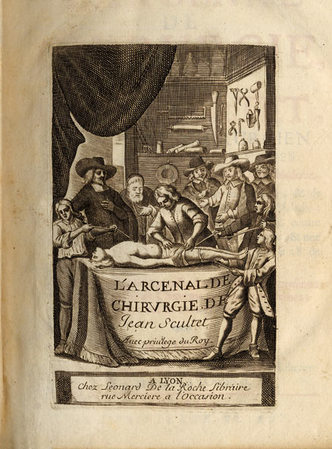
17129402Lyon, Léonard De La Roche, 1712 ; in-4 ; plein veau havane, dos à nerfs richement décoré et doré, pièce de titre grenat, tranches mouchetées rouges (reliure de l'époque) ; (16) y compris le frontispice gravé, titre en rouge et noir, Dédicace aux médecins et chirurgiens de Lyon, table, 369, (3), 138, (22) pp. de tables ; 46 planches numérotées plus 4 non chiffrées soit 50 planches gravées hors-texte au total, certaines dépliantes, représentant de très nombreux outils et appareils, des opérations et 3 planches de monstres.
929Seconde édition corrigée et augmentée par l’auteur.Deux volumes in 4 plein cuir fauve raciné à nerfs,pièce de titre chagrin rouge,pièce de tomaison cuir vert,fers,roulettes,filets,palmettes dorés,double filet à froid sur les plats.Tome premier titre,xii épitre dédicatoire,avertissement sur la nouvelle édition,table des chapitres,532 pages et 23 planches gravées dépliantes en fin de volume.Tome deuxième:titre et 611 pages.Vincent Rue des Mathurins Paris 1774.La présente édition contient 6 planches supplémentaires par le médecin français Portail. (au tome premier:pâle mouillure angle supérieur droit en déclinant jusqu’à la page 39 un coin légèrement émoussé.au tome 2 un coin légèrement émoussé) Ex libris gravé. traité fondamental sur la pathologie cardiaque, fondé sur un examen précis de l'organe.Sénac donne une description systématique de la structure du cœur et de ses observations sur les maladies cardiaques,dont il a noté au relèvement de l'âge.Il traite de la circulation du sang, la transfusion sanguine et la péricardite,il a également effectué des recherches sur le quiquina pour le traitement des irrégularités du rythme cardiaque.Les planches gravées montrent les différents aspects du cœur.
1698PHO-1906London, Chiswell, 1698. In-folio (310x210mm) relié plein veau époque, dos à nerfs, x, xiii, 427, xxiv pp., illustré d’un frontispice, de 5 planches hors-texte dont 3 dépliantes et de 3 cartes, plats détachés, petit trou page 81/82, manque de papier en marge page 80. Titre imprimé en rouge et noir. Fryer était un chirurgien au service de la compagnie des Indes Orientales, pendant 9 ans il voyagea extrêmement des côtes de Coromandel et malabar. Il décrivit les villes de Surat et Bombay le commerce et les coutumes de Madras et de la Perse. Très RARE. Folio, full period paneled calf, boards and free enpaper detached, x, xiii, 427, xxiv pp., illus. with engraved frontispiece portrait of the author, 5 engraved plates (3 folding) and 3 maps, one with printed overslip; title in red and black, woodcut illustrations in text.
[4]-87 (i.e. 86) ff. ; [4]-157 (i.e. 176) ff Velin souple estampé à froid, encadrements de roulettes de feuillages, de portraits en médaillon, d'urnes et de bustes 1531-1532, 1531-1532, in-folio, [4]-87 (i.e. 86) ff. ; [4]-157 (i.e. 176) ff, Velin souple estampé à froid, encadrements de roulettes de feuillages, de portraits en médaillon, d'urnes et de bustes, Réunion de deux volumes publiés à Bâle. Le premier est un recueil de quatre traités de Galien traduits par l'humaniste allemand Johann Winter von Andernach (1505-1574), en tête desquels son manuel de dissection, publié la même année par Simon de Collines. À la suite se trouvent : De constitutione artis medicar liber. De theriaca, ad Pisonem commentariolis ; et De pulsibus, ad medicinae candidatos liber. Garrison & Morton n° 359. NLM n° 2241039R. USTC N° 602652. Le second est la première édition collective, posthume, des oeuvres philosophiques et médicales de Leoniceno (1428-1524) éditées par Andreas Leennius, "dont on sait peu de choses" (G & M). Il s'agit d'un recueil de 8 ouvrages, dont un traité sur la mythique dipsade et autres serpents, un autre sur la vipère, ou encore sa célèbre description de la syphilis : Leoniceno est le premier à avoir décrit cette funeste maladie, "communément appelée la maladie française ou la variole" dans son traité publié en 1497 (Libellus de epidemia quam vulgo morbum gallicum sive brossulas vocant. Venise, Alde Manuce, 1497) ; il pensait alors que la syphilis était connue des auteurs classiques. L'éditeur scientifique a choisi ici la dénomination de "mal français ou napolitain" (De morbo gallico, sive neapolitano). Adams L497. Garrison & Morton n° 11176. NLM n° 2258053R. Traces de moisissure non active en pied des feuillets, auréole claire en tête. Réparations aux mors, manques aux coins, épidermures, lacets anciennement arrachés
183645 tomes in-8, veau marbré, dos à nerfs décoré et doré (reliure de l’époque) ; 24, LXXVI, 515, [11] pp., X planches dépliantes ; 676, [6] pp. pl-XI-XVIII ; 782, [8], pl. XIX-XXXII ; 480 pp., [64] pp., pl. XXXIII-XXXX ; XLVIII, 672 pp., [1] pl. dépliante gravée par Marie Dauvergne.
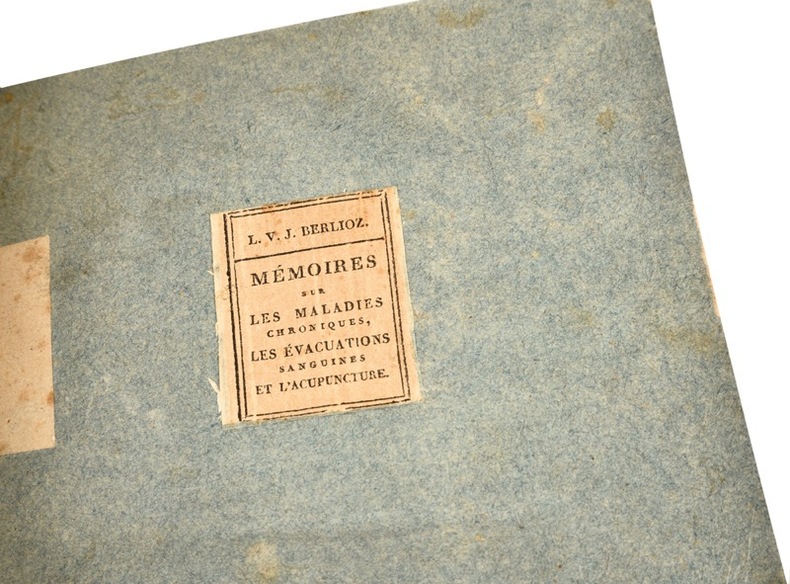
181621648Paris, Croullebois, (imprimerie de Crapelet), 1816 ; in-8 (210 mm), demi-veau bleu outremer, dos à nerfs, titre doré, couverture bleu délavé de l’époque avec l’étiquette imprimée sur le plat, tête arasée, tranches non rognées (rel. de l’époque); VI, 343, [1bl.] pp., [2] pp. d’errata.
Iconic cover photo of Albert Einstein at blackboard proving the principle of Equivalence. 56 pages. Features: Exploring Prehistoric Georgia; Radio Facsimile (early fax machine development) - article with great photos; Building the World's Deepest-Water Bridge - connecting San Francisco and Oakland; Preserving rose bushes with paraffin for shipping; Nova Herculis recently discovered; Amazing growth in the packaging industry; Sundials and their construction - part IX - the principle and construction of the armillary sphere; The Oddest Thing About the Jews - Why Jews have some diseases more and others less than Gentiles - they often are first-class insurance risks; Stout "Scarab" auto photos and write-up; Photo of Einstein with Leo J. Scanlon; Tiny race cars - a developing sport; Astounding facts about American homes and sanitary conditions; Creative photo enlargement; Rapidly growing hybrid poplars; Frederick H. Ecker on progress in this age of science; Photo of harvesting American-grown rubber in California - Guayule; and more. Above-average external wear and soiling. Openings at each end of coverfold. Chip from lower corner of back cover. An uncommon Einstein collectible. Please note that large faint text appearing on image is not on magazine. Magazine
1741001738Paris Guillaume Cavelier 1741
1995ZB393862National Center for Infectious Diseases 1995. volumes 1-10; 13. 1995-2007. partly bound library markings textually clean & tight PRICE IS FOR THE LOT. - If you are reading this this item is actually physically in our stock and ready for shipment once ordered. We are not bookjackers. Buyer is responsible for any additional duties taxes or fees required by recipient's country. Photos available upon request. National Center for Infectious Diseases unknown
42784Paris.Le Mercier.1724.2 vols.en maroquin d'époque aux armes,in-12 de 517 et 495 p. BE.Reliures un peu frottées.Triple filet doré sur les plats.Armes avec couronnes de duc.Coquille.Hermine des Ducs de Bretagne.Double cordelière.Ordre de St.Michel. (ne se trouve pas dans l'Olivier).Dos à 5 nerfs très ornés.Tranches dorées.Intérieurs avec qques rousseurs et mouillures.Légère ouverture à un mors et une charnière.
Second edition, 2 vols., large folio (560 x 420 mm), 96 coloured lithographed plates accompanied by descriptive leaves, some occasional light finger-soiling, inner hinges shaken, orig. half morocco, gilt, rubbed and soiled, some wear at head and foot of spines and slightly split at head of upper joint to volume I. Henry Radcliffe Crocker (1846?1909) started his working life as an apprentice to a general practitioner, before going to London to attend the University College Hospital medical school and became known as one of the world's leading dermatologists. An accomplished water-colour painter, he often sketched his patients' conditions and reproduced them in his works. "Crocker's avid reading and retentive memory facilitated the production of his textbook Diseases of the Skin: their Description, Pathology, Diagnosis and Treatment, which was first published in 1888 and exemplified his lucid and comprehensive writing style. For many years it was the most highly regarded on the subject in English and it ran to several editions. It was followed between 1893 and 1896 by the monthly instalments of The Atlas of Diseases of the Skin. Dermatological societies in America, France, Germany, and Italy recognized his pre-eminence in the speciality, elected him to their membership, and valued his attendance and contributions to their meetings."?(New ODNB). This large format work is lavishly illustrated with colour depiction's of many stomach-turning skin diseases. Garrison & Morton, 3998.
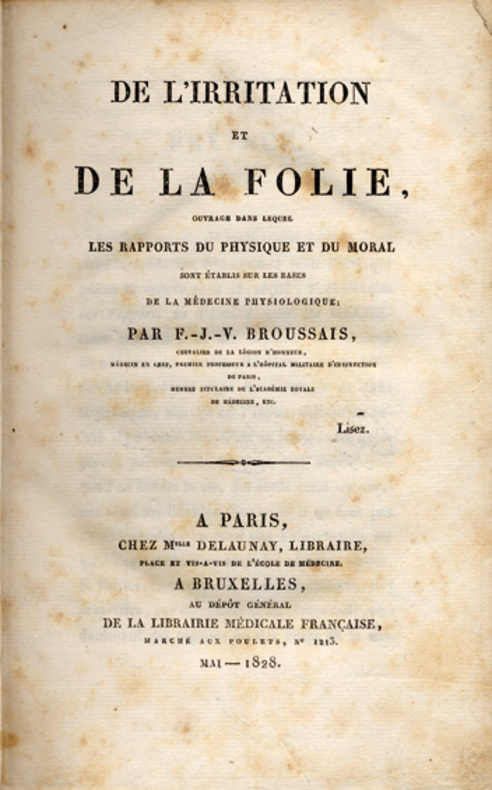
18289398Paris, Melle Delauney et Bruxelles, Librairie Médicale Française (Paris, Imprimerie Lachevardière), mai 1828 ; in-8 ; demi-veau fauve glacé, dos à faux-nerfs décoratifs doré, décoré de fleurons et palettes dorés, pièce de titre vert foncé, tranches jaunes (reliure de l'époque) ; XXXII, 590, (2) pp.
184184327London: George Henderson 1841. Second Edition Entirely Remodelled . Hard. Good/No Jacket as issued. 4to - over 9¾" - 12" tall. Translated from the French by D.Spillan. Plain dull edgeworn binding: rear endpapers marked; xx 120p coloured plates <br/> <br/> George Henderson unknown
39749aafLausannae & Genevae, sumptibus Marci-Michaelis Bousquet, 1746, in-4to, engraved frontispiece (F.A. Aveline after Delamonce) + X, title in red and black + 480 S., decorated with a few engraved headers, initials and tails, browning and foxing, sprinkled calf binding on raised bands, red leather title label on goldtooled spine, rubbed, very small tear in extremities of upper hinge, red edges.
20802Fort in-4° (263 mm) polycopié, demi-maroquin vert sapin, dos à quatre nerfs encadrant l’auteur et le titre dorés ; [11] ff. liminaires, 379 ff. recto, 5 planches hors-texte, 11 tableaux dont 9 dépliants et 12 planches de tirages photographiques originaux.
180621439Lyon, Garnier, Reymann (Imprimerie de Ballanche père et fils), 1806 ; in-8, demi-veau et petits coins de parchemin, dos à nerfs décoré de filets dorés, pièce de titre rouge, tranches jaspées (reliure de l’époque) ; XVI, 341, [3] pp.
423 pages. Index. Glossary. Printed upon glossy stock. "The clues in this volume are organized accoring to where in the skin they are positioned, the first being in the cornified layer and the last one in the subcutaneous fat. Each of the 100 chapters consists of four pages. On the first page appears a single photomicrograph that depicts a clue, but provides no further aid to identification of it. On the second page, the same photomicrograph that was used to picture the clue on page 1 is shown again but this time as one among a sequence of three photomicrographs taken at low, intermediate, and high magnifications of a representative section of the disease for which the clue has Sherlockian value." - from Preface. Openings to each end of backstrip taped in place. Somewhat above-average external wear. Contents clean and unmarked. Binding moderately loose but intact. A worthy working copy of this prized reference. Book
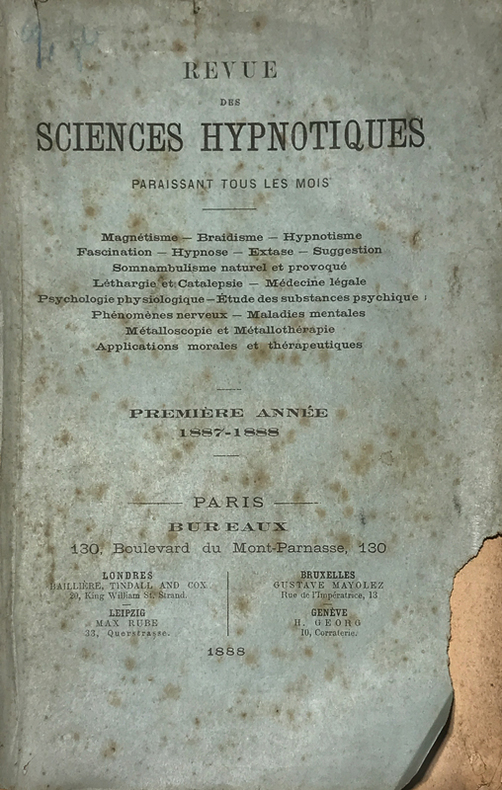
15418Paris, Bureaux (Imprimerie Mersch, puis Ch. Noblet des numéros 2 à 5 ; Amiens, Imprimerie Nouvelle, N°6-7 ; Paris, A. Lamier et Fils N°8, 9, 10 ; Bordeaux, Gounouilhou), juillet 1887 à juillet 1888, en un volume in-8, broché ; (4) faux-titre et titre général, 472 pp., premier plat de couverture.
601 pages. Index (at front). Occasional black and white illustrations. "An invaluable collection of practical recipes for merchants, grocers, saloon keepers, physicians, druggists, tanners, shoemakers and harness makers, painters, jewelers, blacksmiths, miners, gunsmiths, furriers, barbers, bakers, dyers, renovators, farmers and families generally, to which have been added a rational treatment of pleurisy, inflammation of the lungs and other inflammatory diseases, and also for general female weakness and irregularities... with many additions to many departments by the Publishers." - subtitle. .Above-average wear. Hinges open. Front free endpaper and frontispiece loose but present. Many openings along backstrip. External lettering and decoration rubbed but still legible/visible. A worthy reading copy of this stupendous and now antiquarian reference. Book
115194sd E. Sibly, M.D., fellow of the Harmonic Philosophical Society at Paris - Sans date - Fort in-4, plein peau marron, pièce de titre et filets dorés au dos - XVI pp. + 398 pp. + 256 pp. - 37 planches hors texte numérotées + 3 planches non numérotées en N&B (complet) - Ouvrage en anglais
17811099761781 Un volume In-16 (9,5 x 16cm environ), reliure pleine peau, filets, et fleurons dorés au dos, tranche marbrées en couleurs, reprenant le motif des gardes - Cinq ouvrages reliés en un volume intitulé "Recueil II" à l'aide d'une pièce de titre au dos, répartis comme suit : (1) A Amsterdam; et se trouve à Paris, Chez Méquignon l'aîné, Librairie, rue des Cordeliers - M. DCC. LXXIX. 1779 - 46 pages - (2) A Berlin, et se trouve, à Paris, Chez l'Auteur , Barrière de Reuilly; Fauxbourg Saint-Antoine. Et Chez Belin, Librairie, rue Saint-Jacques - M DCC LXXIX. 1779 - 35 pages - (3) A Paris, Chez l'Auteur, rue Croix des Petits-Champs, Maison de M. Bourdet, Chirurgien-Dentiste du Roi. et Chez Blaizot, Librire du Roi, rue Satory, à Versailles - Avec Approbation et Permission - M. DCC. LXXXI. 1781- 139 pages - Cul-de-lampe - (4) A Amsterdam; et se trouve à Paris, Chez Bastien, Libraire, rue du Petit-Lion, Fauxbourg Saint-Germain - M. DCC. LXXIV. 1774 - 56 pages - (5) A Paris, Chez Saugrain, Libraire, Quai des Augustins, près de la rue Pavée - M. DCC. LXXXI. 1781 - 116 pages
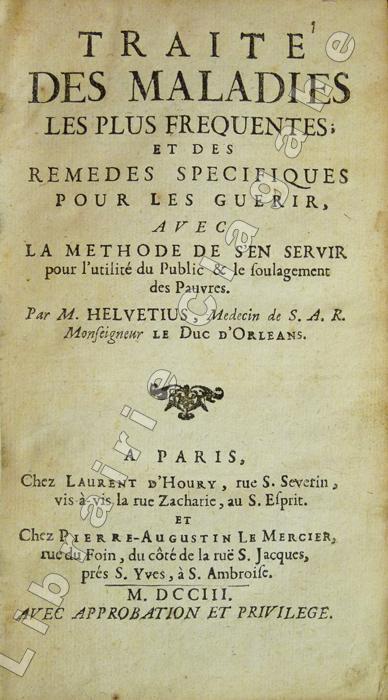
17034532Paris, Laurent d'Houry et Pierre-Augustin Le Mercier, 1703 ; in-12 ; pleine basane brune, dos à nerfs orné et doré, pièce de titre rouge, roulette décorative dorée sur les coupes (reliure de l'époque) ; (15 + 1) ff., pp. 3 - 318, (13) ff. de tables et privilège.
3270P., Vincent, 1776, in 4 volume in 4 relié en plein veau, dos orné de fers dorés (reliure de l'époque), (2), 133pp., (1pp.), (1), 420pp., 1 tableau dépliant
19662092902137704028Professor Retirement Commemorative Party 1966. Soft Cover. Fine. The book is in fine condition. Professor Retirement Commemorative Party paperback