Bischoff, Th(eodor) L(udwig) W(ilhelm)Antiquariat.de

1 025 résultats
1868106921BBMünchen, Verlag der k. Akademie, in Commission G. Franz, 1868. 4°. [2] Bl., 107, (1) S. mit 31 (6 farb.) lithogr. Abb. auf 7 Tafeln. Pappband der Zeit. [8 Warenabbildungen] (Aus den Abhandlungen der k. bayer. Akademie der W. II. Cl. X. Bd. II. Abth.).
18401767Hamburg, J. A. Meissner, 1840. Mit 44 kolorierten lithographierten Tafeln. 1 Bl., XVI, 247 Seiten. Gr.-4°. Halblederband der Zeit mit Rückenschild und Rückenvergoldung.
182071344Leipzig, Verlag Gerhard Fleischer 1820. Mit 10 Kupfertafeln., 134 Seiten Text + 34 Seiten Explicatio Tabularum., 4°. Halbleinwand der Zeit mit Leinwandkanten.,
183068221Weimar, im Verlag des Großherzogl. Sächs. privil. Landes-Industrie-Comptoire 1830. Mit 18 gestochenen Tafeln und dazugehörigem Text., ca. 5 nicht nummerierte Seiten (Titel und Vorwort)., Folio. schwarze Halbleinwand der Zeit mit Leinwandkanten.,
181997430Wien, Michael Lechner, 1819. XX, [96] Text-S. u. [45] Taf. Mit insgesamt 61 Radierungen, davon 45 auf Taf. u. 16 im Text. Folio. 35,5 cm. Pp. d. Zt. m. RSch.
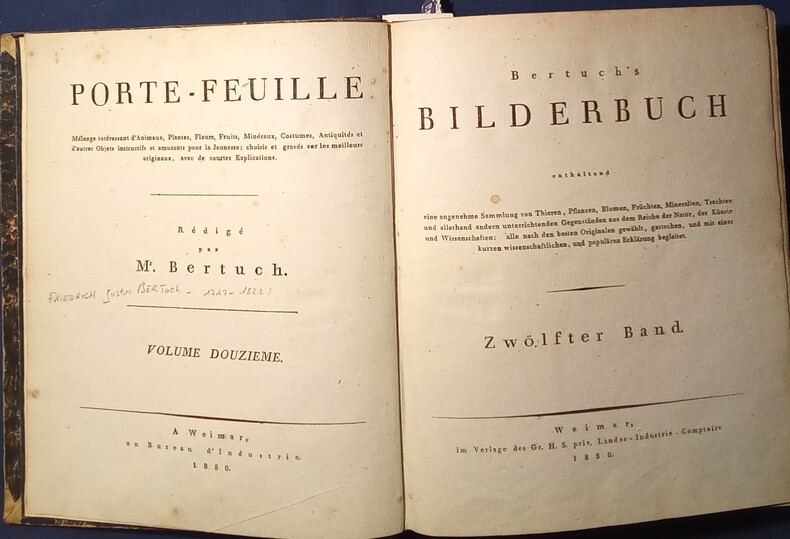
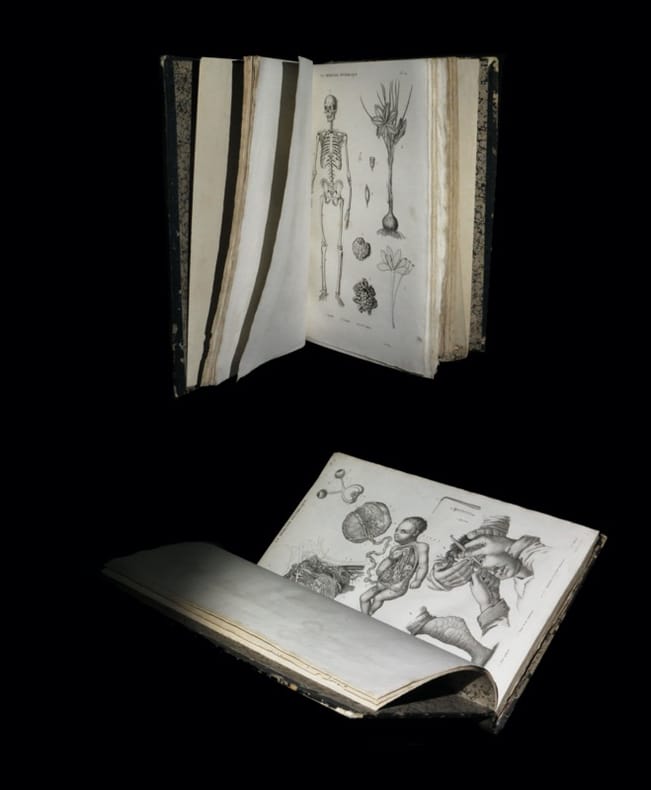
1830WOC-2416Mélange intéressant d'Animaux, Plantes, Fleurs, Fruits, Minéraux, Costumes, Antiquités et d'autres Objets instructifs et amusants pour la Jeunesse; choisis et gravés sur les meilleurs originaux, avec de courtes Explications en Allemand et en Français. Tome 12 sur Mélange, de la planche 301 - Le Sahara - Planches travail de plongeurs dans la mer, Planches Habillements d'Europe (N°1 à 25), Planches d'Anatomie, etc. A Weimar, au Bureau d'Industrie, 1830. In-4 (24,5x4x20cm) relié demi chagrin noir d'époque, dos orné. Ouvrage à pagination multiple.
1842168681842 un volume, reliure demi-chagrin bleu-noir petit in-4 (binding half shagreen in-4), reliure "romantique" d'époque, dos long (spine without raised bands) décoré or (gilt decoration) filets or (gilt line) à fers spéciaux (specials blocking stamps) à motifs oiseau, vase et fleurs à fers évidés et décor à filets or et rinceaux ( gilt lines - with foliages executed in the curved lines) dans un encadrement d'un filet or (gilt line) - titre frappé or (gilt title), reliure signée NERET, papier bleu marine immitation percale aux plats, toutes tranches lisses (all smooth edges), un cahier déboité, marque-page en tissu (bookmark in tissue), illustré de 117 planches en noir, 1 frontispice, 1 plan dépliant, 12 planches en couleur, et de plusieurs centaines de vignettes in-texte. Premier tirage des illustrations, 416 pages, 1842 Paris Curmer Editeur,
183913645Heidelberg, K. Winter, 1839. 4 S. + 10 Tafeln + 10 Blatt mit Erklärungen (36 cm) priv. Pappband der Zeit / gebundene Ausgabe
18279568Verlag Tendler und von Manstein, Wien, 1827. VI, 238(8) Seiten, 8°, Pappband, mit einer mehrfach gefalteten Kupfertafel. Einband berieben, Ecken / Kapitale bestoßen, Rücken lichtgebleicht. Seiten gebräunt, sehr vereinzelt mit zarten Anstreichungen per Bleistift neben Text. Die Kupfertafel randverknickt bzw. dort gedunkelt und randrissig. Davon abgesehen innen sehr guter Zustand, sauber, fester Buchblock. Bibliotheksexemplar mit üblichen Kennzeichnungen auf der Rückseite des Titels. Insgesamt gutes Exemplar dieser Rarität. Sehr selten. Very rare
18603207DBZürich, Denkr. der med.-chirurg. Ges. d. Kt. Zürich, 1860. 4°. S. 130-171. Mit 7 lithogr. Tafeln. Orig.-Broschur. + Wichtig: Für unsere Kunden in der EU erfolgt der Versand alle 14 Tage verzollt ab Deutschland / Postbank-Konto in Deutschland vorhanden +, 3207D
18551264331855 Paris, Chez J.-B. Baillière, Librairie de l'Académie Impériale de Médecine - 1855 - Complet en 2 tomes et 1 Atlas - In-8, demi-chagrin, plats percaline, dos à 5 nerfs portant titre et tomaison en doré, tranches mouchetées rouges - 416 + 646 + 92 pages et 54 planches hors texte en N&B
187113977C.F. Winter, Leipzig und Heidelberg 1857-1871. je Band durchschnittlich 400 S. und wenige lith. (teils gefaltete) Tafeln (insgesamt 3), 8°, marmoriertes Halbleinen mit Rückentitel, Bibliotheksexemplare (ordnungsgemäß entwidmet) mit kleinem unscheinbarem Papier-Rückenschild, mehrfach gestempelt, gelegentlich geringe Papierbräunung, einige Bände am Kopfsteg mit unscheinbarer sich fein abzeichnender Feuchtigkeitsspur (nur am Seitenrand), Einbände teils abweichend voneinander gebunden, kaum beriebenes, insgesamt gutes und innen sauberes Exemplar,
183427522[Page de titre absente] - [Paris, au Bureau de la Médecine pittoresque, 1834 à 1838]. Un vol. au format in-4 étroit (303 x 206 mm) de 1 f. bl., 93 planches, 44 planches et 1 f. bl. Reliure de l'époque de demi-basane glacée marine, dos lisse orné de doubles filets dorés, roulettes dorées, larges fleurons romantiques à froid, titre doré.
181121781Paris, Crochard, 1811 ; in-8, demi-veau, dos lisse, fleurons et filets dorés, pièce de titre bleu de prusse (reliure de l’époque) ; XXIV, 479, [1] pp.
1900188515London: Vinton & Company Ltd c.1900. A set of elaborate moveable books depicting the anatomy of farmyard animals. Each includes five layers of folding colour diagrams showing the skeleton arteries and veins muscles and organs accompanied by a key. It was printed in Bavaria a prestigious centre of moveable books and home to skilled artisanal paper engineers such as Ernest Nister and Lothar Meggendorfer. This is the second edition of the set. Six works oblong quarto. Each 8 pp. and with folding chromolithographic illustration comprising two large overslips and multiple lift-the-flap tabs representing internal anatomy. Original printed boards black cloth backstrips wire-stitched as issued. Foxing toning and soiling to boards and contents wear to backstrips wire-stitches rusted but holding firm outer margins of contents with a few chips and damp stains a handful of neat repairs to folding stubs colours bright: in very good condition. hardcover
1824STLA0051Wien, Ghelen 1824. gr.-8°, XV, 542 S.; XX, 938 S.; XVI, 1050 S.; Interimsbrosch., verstaubt, ungleicher Schnitt staubdunkel, zahlr. Randrisse, tlw. etw. stockfl. Bd. 1: Allgem. Arzeneymittellehre; Bd. 2 u. 3: Besondere Arzeneymittellehre. Wurzbach VIII,387; Hirsch-H. II,192; ÖBL II,292. H. (1785-1839), war Professor der Pathologie und Pharmazie in Wien.
18404754DBTurici, Orell, Fuesslini, 1840. 32 S., 26 einfarbig kolorierte Tafeln. Original Pappmappe/-einband mit gedrucktem Titelschild.
18434835BB2 Bände. Stuttgart, Hoffmann'sche Verlags-Buchhandlung, 1843. 4°. Textseiten mit unregelmässiger Nummerierung. Mit 1 lithogr. Titel, 164 (dv. 133 kol.) Tafeln sowie 18 Textholzschnitten. Halblederbände der Zeit mit Rückenvergoldung.
184367779Leipzig, Verlag Leopold Voss 1843. 26 Tafeln mit 291, teils kolorierten, Figuren, wovon 270 nach der Natur gezeichnet sind., X + 128 Seiten., Folio. privater Halbleineneinband mit mamorierter Pappe und Leinwandecken.,
18901235321890 Asselin et Houzeau, Libraires de la Faculté de Médecine, 1890, 1 volumes de 25 x 18 cm environ, xix pp., 1113 pp - Reliure pleine percaline rouge brique, dos lisses avec titres dorés soulignés par 1 filet doré et 1 filet noir, encadrements des plats d'un triple filet noir, titres en noir sur les premiers plats. Sixième édition, illustrée de figures dans le texte
18404754DBTurici, Orell, Fuesslini, 1840. 32 S., 26 einfarbig kolorierte Tafeln. Original Pappmappe/-einband mit gedrucktem Titelschild. + Wichtig: Für unsere Kunden in der EU erfolgt der Versand alle 14 Tage verzollt ab Deutschland / Postbank-Konto in Deutschland vorhanden +, 4754DB|4754DB_2 [2 Warenabbildungen]
1835jj6155Paris, Depelafol, libraire-éditeur Relié 1835 Cinq volumes in-8 (16,5 x 26 cm), reliure demi-veau à coins, pièce de titre et de tomaison sur les dos à 4 nerfs, 10 tomes en 5 volumes : 419-236, 292-315, 320-260, 278-288 et 315-269 pages, édition augmentée d'une exposition des recherches ou des opinions de la Chambre, de Porta, de Camper, de Gall, sur la physionomie, d'une histoire anatomique et physiologique de la face, précédée d'une notice historique sur l'auteur, complet des 600 gravures en taille-douce dont 82 tirées en couleur ; épidermures et frottements sur le cuir, coins usés, mouillure au cuir au tome 7-8, quelques rousseurs à l'intérieur par ailleurs bien conservé, bon état général. Livraison a domicile (La Poste) ou en Mondial Relay sur simple demande.
180621439Lyon, Garnier, Reymann (Imprimerie de Ballanche père et fils), 1806 ; in-8, demi-veau et petits coins de parchemin, dos à nerfs décoré de filets dorés, pièce de titre rouge, tranches jaspées (reliure de l’époque) ; XVI, 341, [3] pp.
182840962London 1828. <p>Parliament. House of Commons. Report from the select committee on anatomy. Folio. 150pp. London: House of Commons 22 July 1828. 331 x 212 mm. 19th century boards rebacked and recornered in calf light edgewear. Very good copy. Old medical library stamp on title and first page.</p> <p>First Edition of this highly interesting and entertaining report on the British body-snatching crisis. Since the mid-eighteenth century obtaining cadavers for teaching purposes had been regulated in Britain by the Murder Act of 1752 which stipulated that only the corpses of executed criminals could be used for dissection. By the beginning of the nineteenth century however improvements in medical science coupled with a substantial drop in the number of executions caused the demand for cadavers to far outstrip the legal supply. This situation was ripe for exploitation by "resurrection men" criminals who robbed the graves of the newly deceased and sold their corpses to teachers of anatomy who of necessity turned a blind eye to the illegality of these transactions. Some grave-robbers even resorted to murder including the infamous William Burke who in December 1828 was arrested in Edinburgh for the murders of over a dozen victims whose corpses he and his partner Hare sold to an anatomical demonstrator connected to Edinburgh University.</p> <p>In the first half of 1828 in response to increasing calls for reform the British Parliament appointed a committee to "enquire into the manner of obtaining subjects for dissection by schools of Anatomy and the State of law affecting persons employed in obtaining and dissecting bodies." During the course of its investigation the committee heard testimony from a wide range of witnesses from eminent medical men to procurers of bodies for medical schools these last identified only by initials. The medical men included Sir Astley Cooper Benjamin Collins Brodie John Abernethy William Lawrence Herbert Mayo Granville Sharp Pattison who himself was indicted for body-snatching at the age of 23 Thomas Southwood Smith Henry Halford John Webster and Benjamin Harrison the treasurer of Guy's Hospital. The witness list can be found on page 13 of the committee's report. The testimony of these men reproduced in full in the report is followed by several appendices including tables of paupers' deaths broken down by parish; the committee was proposing legislation that would allow the state to seize unclaimed corpses from workhouses and sell them to surgical schools. The committee's efforts were successful: In 1832 Parliament passed the Anatomy Act granting licenses to teachers of anatomy and giving physicians surgeons and medical students legal access to corpses unclaimed after death. Wise The Italian Boy: A Tale of Murder and Body Snatching in 1830s London 2004. Garrison-Morton.com 7096.</p> . unknown
182840962London 1828. <p>Parliament. House of Commons. Report from the select committee on anatomy. Folio. 150pp. London: House of Commons 22 July 1828. 331 x 212 mm. 19th century boards rebacked and recornered in calf light edgewear. Very good copy. Old medical library stamp on title and first page.</p> <p>First Edition of this highly interesting and entertaining report on the British body-snatching crisis. Since the mid-eighteenth century obtaining cadavers for teaching purposes had been regulated in Britain by the Murder Act of 1752 which stipulated that only the corpses of executed criminals could be used for dissection. By the beginning of the nineteenth century however improvements in medical science coupled with a substantial drop in the number of executions caused the demand for cadavers to far outstrip the legal supply. This situation was ripe for exploitation by "resurrection men" criminals who robbed the graves of the newly deceased and sold their corpses to teachers of anatomy who of necessity turned a blind eye to the illegality of these transactions. Some grave-robbers even resorted to murder including the infamous William Burke who in December 1828 was arrested in Edinburgh for the murders of over a dozen victims whose corpses he and his partner Hare sold to an anatomical demonstrator connected to Edinburgh University.</p> <p>In the first half of 1828 in response to increasing calls for reform the British Parliament appointed a committee to "enquire into the manner of obtaining subjects for dissection by schools of Anatomy and the State of law affecting persons employed in obtaining and dissecting bodies." During the course of its investigation the committee heard testimony from a wide range of witnesses from eminent medical men to procurers of bodies for medical schools these last identified only by initials. The medical men included Sir Astley Cooper Benjamin Collins Brodie John Abernethy William Lawrence Herbert Mayo Granville Sharp Pattison who himself was indicted for body-snatching at the age of 23 Thomas Southwood Smith Henry Halford John Webster and Benjamin Harrison the treasurer of Guy's Hospital. The witness list can be found on page 13 of the committee's report. The testimony of these men reproduced in full in the report is followed by several appendices including tables of paupers' deaths broken down by parish; the committee was proposing legislation that would allow the state to seize unclaimed corpses from workhouses and sell them to surgical schools. The committee's efforts were successful: In 1832 Parliament passed the Anatomy Act granting licenses to teachers of anatomy and giving physicians surgeons and medical students legal access to corpses unclaimed after death. Wise The Italian Boy: A Tale of Murder and Body Snatching in 1830s London 2004. Garrison-Morton.com 7096.</p> . unknown books