25 résultats
1112510745.Gpaperback. Good. Access codes and supplements are not guaranteed with used items. May be an ex-library book. paperback
1898013099London: New Sydenham Society 1898. Several faded ink stamps. First Edition. Original Cloth. Fine/No Jacket. New Sydenham Society Hardcover
Fully printable 509 page PDF listing over 2,000 works, searched in seconds, non-English titles translated, this book has been produced in CD-Rom version only, CD in case. New. Compiled from numerous sources by a well-known medical author; Catalogues books, articles and manuscripts written in 10 European languages; Annotations and translations: English; 33MB PDF - Best viewed in Adobe Reader 6.0 or 7.0: Electronic search tools; Small page format for easy reading; Collation, biography & illustrations; Manual search tools: Topic cues in margins - Alphabetical index of authors; Appendix: A New Translation of Cleyer on Tongue Diagnosis 1682.
In 8° (19,7×13,2 cm); 208 pp. e una c. di tav. Legatura in cartoncino molle di recupero con titolo impresso su fascetta al dorso. Antiche firme di appartenenza settecentesche al frontespizio che identificano l’esemplare come appartenuto al medico e fisico “Laurentino Ciglia”. Frontespizio in rosso e nero con fregio xilografico. Qualche macchiolina di foxing nel margine esterno di alcune pagine, un piccolo antico rinforzo al margine interno della 5 carta, ininfluente. Un leggerissimo alone, quasi impercettibile, nelle ultime 5 carte e nel complesso esemplare in buone condizioni di conservazione. Prima assai rara edizione, stampata a Napoli, di questo importantissimo testo del grande medico originario di Ruvo di Puglia (Bari), Domenico Cotugno. In questa celeberrima opera, Cotugno, 29 anni prima della scoperta di Jenner che cambierà il mondo della medicina, sulla base di dirette e numerosissime osservazioni cerca di analizzare la natura del vaiolo arrivando a considerare le lesioni da esso provocate, solo esterne e non anche viscerali. “Egli sosteneva che la sede fosse la cute esposta all’aria e che vi fosse la necessità di trovare rimedi specifici, rigettando per esempio la cura tradizionale dei bagni caldi. Descrisse la storia di persone di diverse condizioni sociali con il linguaggio oggettivo della scienza ma senza perdere di vista il lato umano dei malati. La parte più importante è il sostegno all’inoculazione che lo avrebbe portato, in seguito, ad appoggiare la vaccinazione jenneriana”. L’opera ebbe grande successo e numerose riedizioni. L’autore, celebre medico, anatomista e chirurgo fu uomo di ampi interessi culturali. Fu anche uno dei medici più celebri e geniali del suo tempo ed operò principalmente a Napoli anche se fu socio di numerosissime accademie estere. “Domenico Cotugno fu protagonista di importanti scoperte neurologiche, grazie a un’intensa attività clinica e anatomica, e fin dall’inizio mostrò i suoi interessi per l’anatomia sottile, cioè la ricerca dei piccoli e nascosti meccanismi che compongono il nostro organismo. In tutte le sue indagini egli seguì il metodo indicato nella sua prima opera: mostrare la natura delle cose così come gli era apparsa non una o due volte, ma centinaia di volte, nell’esame dei cadaveri”. Scrisse su svariati argomenti e fu un fine pensatore. “Secondo Benedetto Croce, Cotugno potrebbe essere stato il vero autore del celebre trattato Delle virtù e dei premi (il secondo del suo genere dopo Dei delitti e delle pene di Cesare Beccaria) che, uscito anonimo nel 1766, fu ristampato l’anno seguente, anche in francese, recando come autore il giurista aquilano Giacinto Dragonetti e a questi sempre attribuito”. Il Garrison-Morton, 1382, scrive che Cotugno “was the first to describe the fluid surrounding the spinal cord and to suggest that it was in continuity with the ventricular and cerebral subarachnoid fluids. However, his concept of the cerebral and spinal fluid, which is the beginning of its modern physiology, remained in obscurity until rediscovery by Magendie some 60 years later”. Rara prima edizione. A good copy. Rif. Bibl.: IT\ICCU\MILE\027755.
A clean, unmarked book with a tight binding. 134 pages. Previous owner's inscription inside.
1910VAR1403Wiesbaden, Bergmann, 1910. VI, 171 Seiten, 12 Tafeln (teilw. farb.), H 25,5 x 17,5, OLeinen. - Stempel auf Vorsatz: Hygienisches Institut Universität Freiburg i. Br., Sammlung für Jmpftechnik. Einband berieben, vord. unt. Ecke schadhaft, sonst nur leichte Gebrauchsspuren. fest gebunden/ hardcover
A clean, unmarked book with a tight binding. 145 pages. Full red cloth boards with gilt lettering; sharp corners.
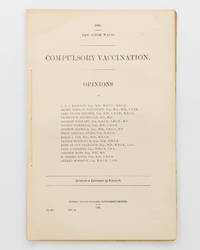
188127355Sydney: Thomas Richards Government Printer 1881. Very Good. Sydney Thomas Richards Government Printer 1881. Foolscap folio 55 pages. Stab-sewn top edge cut others uncut as issued; trifling signs of handling mainly minimal chipping to the uncut edges; an excellent copy. New South Wales Parliamentary Paper Number 289 of 1881; 34 pages of opinion under questioning from 15 qualified medical practitioners plus 19 pages of appendices drawn mainly from overseas experience with some local content. Same questions different disease - small-pox in this instance. Thomas Richards, Government Printer unknown
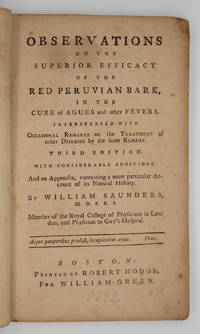
1783101073Boston: Robert Hodge for William Green 1783. Third edition. 8vo. 91 5 ads. Original wrappers; spine perished; covers stained foxing. From the library of Hallowell Maine physician Benjamin Page 1770-1844 one of the earliest proponents of Jenner's smallpox vaccine in America with a presentation to Page on the ffep: "For Dr. Benja. Page From his most obt. humble servant A. Stoddard. Hallowell ME 17th Sept. 1793" and signed by Page on the front wrapper "Benjamin Page's 1793". "Memoir of Benjamin Page M.D. 1770-1844" published in The Boston Medical and Surgical Journal 1845 describes Page's early use of the smallpox vaccine: "he was furnished with some vaccine matter by his most intimate and attached friend Benjamin Vaughan Esq. who had just received it directly from the hands of Dr. Jenner of London. He immediately made use of it and was the first American physician be it known who applied the vaccine virus to the arm of a human subject in this country." The vaccine matter used by Page proved to be inert thus the credit for this major advance in public health would go not to Page but to Benjamin Waterhouse whose experiments were being conducted simultaneously: "Great was Page's disappointment however upon finding the matter dry and inert more especially as a portion of the same parcel which had been sent to Boston proved operative and gave to a distinguished medical philosopher of the times the enviable reputation which he himself would otherwise have obtained" ibid. Page persevered procuring a new sample from Boston as well as cultivating his own vaccine matter from the arm of a women who had recently been vaccinated and was ultimately able to administer successful vaccinations against smallpox.PROVENANCE: Benjamin Page presentation and ownership inscriptions REFERENCE: Austin 1703; ESTC W21356; Evans 18178 Robert Hodge for William Green unknown
51431059like new. unknown
51431059-nnew. unknown
2026__0192870815Oxford University Press 2026. Paperback. New. 2nd revised edition edition. Oxford University Press paperback
2026x-0192870815Oxford University Press 2026. Paperback. New. 2nd edition. 448 pages. 8.66x0.98x10.83 inches. Oxford University Press paperback
Perrin 1994, In-8 broché, 442 pages, avec un index. Préface du Professeur Luc Montagnier. Très bon état
1 épreuve gélatino argentique [120 x 172 mm] contrecollée sur carton fort de l'époque , , in-8, 1 épreuve gélatino argentique [120 x 172 mm] contrecollée sur carton fort de l'époque, , Portrait de Louis Pasteur sur son lit mortuaire. Étant donné son cadrage et sa proximité, ce portrait mortuaire a sans doute été effectué par un proche de Pasteur; il ne s'agit pas d'une prise de vue officielle. Louis Pasteur, né le 27 décembre 1822, meurt le 28 septembre 1895 à 16h40 à Villeneuve-l'Étang, dans l'annexe dite « de Garches » de l'Institut Pasteur, où il s'installait souvent l'été. Sa chambre y est toujours conservée. Des funérailles nationales lui sont réservées le 5 octobre suivant, au cours desquelles son corps, préalablement embaumé, est déposé dans la crypte de Notre-Dame de Paris. En 1896, à la demande de son épouse, son corps fut placé dans la crypte de l'Institut où il repose au milieu de ses disciples. Un masque mortuaire est visible dans la crypte. Un négatif sur plaque de verre montrant la chambre mortuaire prise en 1926 est conservé au Département Estampes et photographie à la BnF (8/5/26, la chambre mortuaire de Pasteur à Garches : photographie de presse / Agence Rol.) Un cliché mortuaire montrant Pasteur sur son lit de mort en présence de ses petits enfants a été publié en 1956 par sa petite-fille Camille: Pasteur Vallery-Radot, Images de la vie et de l'oeuvre, p. 158 (document photographique provenant de la collection Pasteur Vallery-Radot). Le carton sur lequel est contrecollé le portrait de Pasteur porte un fin liseret rouge d'encadrement, le bord supérieur du tirage est accidenté. Documents annexes joints : 1 tirage argentique contrecollé sur carton [165 x 110 mm] légendé : Portrait de Pasteur avec sa petite-fille Camille Vallery-Radot par Léon Bonnat (1886) / 4 tirages argentiques [170 x 220 mm] de portraits réalisés aux pastels par le jeune Louis Pasteur entre 1835 et 1842 : portrait de sa mère, de Claudine Benoiste Parpandet dite soeur Constance, portrait d'une jeune fille et portrait de son père / 1 gravure du XIXe siècle : portrait âgé de Louis Pasteur par Roussel
180730140DBParis, Chomei, 1807. 8°. (2) Bl., XL S., 6 S., 2 S., 214 S. Mit 2 gestochenen Farbkupfern. Halblederband aus der Zeit mit goldgeprägtem Rückentitel und Rückenvergoldung. + Wichtig: Für unsere Kunden in der EU erfolgt der Versand alle 14 Tage verzollt ab Deutschland / Postbank-Konto in Deutschland vorhanden +, 30140DB|30140DB_2 [2 Warenabbildungen]
Pages 513-561. Black and white photos. Features: Full-page photo of William Sidney Rossiter; Is New Hampshire completed? - President Hetzel's tribute to Mr. Rossiter; Great photos of typical scenes at local fairs - most involving animals; A controversy on vaccination - the pros and cons; How the farm community of Epson turned the tide - article with photos; The farm bureau movement; Making needles at Hill - Frank R. Woodward and the story of an indomitable spirit; A fraction of a second - interesting article on auto accidents - with photos; An anthology of one poem poets; Building for the future - the Londonderry Road - article with great photos; The kitchen as a workshop; Romance in the life of John Greenleaf Whittier; the Wo'thless feller; New Hampshire Necrology; and more. Average wear. Some external soiling. A sound vintage copy. Magazine
Pages 722-756. Features: Cover photo of suburban Shanghai Airport converted to defence strong point; The bicentenary exhibition in honour of Dr. Jenner, discoverer of vaccination; Photos of seal pups abandoned in South Africa; Austrian antique arms, armour, models and toys on display in London; Article on "The stately pleasure dome" of the Caliph Hisham revealed in recent excavations near Jericho; Photos of the Khirbet mosaics; Book review of "An Autobiography and other Essays" by G. M. Trevelyan; Article on the Campaign of Novara, 1849 with photo of Radetzky; Photo of flood damage in Fort Worth Texas; Photo of memorial to the Champion Italian Association football team, The Torino F. C., wiped out in an air crash on May 4; Photos from Shanghai, the beleaguered city; One-page map of Shanghai, China's richest prize, now within the communist grasp; Photos of personalities of the week include Maj. Gen. Kvashnin, Wing Commander M.A. Smith, Dr. Gilbert H Grosvenor, Mr. Stanley A. Williams, Sir William Nicholson, Mr. James V. Forrestal, Archbishop Damaskinos, Lieut. George Albert Cairns, V. C., Mr. George Rogers, Mr. Robert Mellish, Mr. J.P. Mallalieu, Mr. William Blyton, Mr. Frank Beswick, Mr. James T. Adams, Dr. H. A. H. Boot, Prof. J.T. Randall, Prof. J. Sayers, and Sir William Coates; Protesting the auction of ex- Marshal Petain's confiscated effects; Photo of Miss Joan Curry, who beat Miss Louise Brough in the French lawn tennis championships; Two pages of dramatic photos of the railway strike in Berlin - scenes of struggle for the stations in the western sectors between the workers on strike and Soviet-controlled railway and "people's" police; Drilling reveals Britain's new Staffordshire coalfield May yield 400 million tons; Photos of huge celebration in Tripoli after the United Nations rejected the proposal to give Italy trusteeship of Tripolitani Photo of royalist Bavarians saluting their Crown Prince Rupprecht on his 80th birthday; Incredible photo of the Martin Marshall Mars flying boat, with its 301 passengers and seven crew on its wings and massed beside it; Two pages of photos of heavenly bodies revealed by the 200 inch Mount Palomar telescope; Page of illustrations shows why a wrecked ship may break in two. Lacking first few pages of advertisements. Unmarked with average wear. Moderate soiling to front cover. A sound vintage copy. Magazine
A9780309095921Paperback / softback. New. The Smallpox Vaccination Programme: Public Health in an Age of Terrorism paperback
1334048959.Gpaperback. Good. Access codes and supplements are not guaranteed with used items. May be an ex-library book. paperback
0364569972.Ghardcover. Good. Access codes and supplements are not guaranteed with used items. May be an ex-library book. hardcover
pp. 666, xxv [Index]. Marbled endpapers. Mildly XLib. 8vo. Original half leather over marbled boards. Gilt lettered spine, raised bands. Small loss at head of spine. Hardbound. Covers travel in China; agriculture; commerce; banks; zoology; vaccination; treaty ports; theater; Taoism; Buddhism; bamboo; architecture; suicide; culture; religion; railways; pottery; gambling; plague; opium; missionaries; Chinese literature; etiquette; etc. Very Good. **PRICE JUST REDUCED! ORIENT BOX 2
First edition, 32pp., disbound. Attacking vaccination as a prevention of small-pox.
112 pages. Index. A very nice copy.
31143o.J. 1. Vorschrift über die Kuhpocken-Impfung in den kaiserl. Königl. Staaten- Das Exemplar erschien als Beilage zum Erlass des k.k. böhmischen Landesguberniums 51581/1836. Es enthält in 2 Abschnitten die "Vorschrift in Bezug auf die Leitung" sowie die "Vorschrift für Aerzte und Wundärzte, welche der Kuhpocken-Impfung sich widmen" sowie eine Beschreibung des Krankheitsverlaufes in vier Perioden. Die auch als "Impfregulativ" bezeichnete von der Hofkanzlei in Wien erlassene Vorschrift vom 9. Juli 1836 sollte der erst seit dem Jahre 1800 durchgeführte Pockenschutzimpfung in Österreich zu einer weiteren Verbreittung verhelfen. Etwas vergilbt und angestaubt. - 2. Kuhpockenimpfungs-Zeugniß. Johann Schneiderer (?), Bäckerssohn alt 1 Jahr gebürtig von Hallein ist vom Unterzeichneten im Jahre 1850 den 29 Juli mit Kuhpockenstoffe geimpft worden, und hat die ächten Kuhpocken ordentlich überstanden. Hallein, 10. August 1850. Halber Kanzleibogen, grobes Papier, Buchdruck und Handschrift. Etwas gebräunt und fleckig mit Faltspuren. - 3. Impfungs-Zeugniss. Julius Sukup, 13 Jahre alt, in Sokolnitz Nro 61 gebürtig, Brünner Kreis, Land Mähren, wurde vom Gefertigten den 25ten März 1842 mit ächten Kuhpocken geimpft, dieselben recht und bester Haftung(?) überstanden. Sokolnitz am 9ten Juny 1855, Gabriel Lesonitzky, Impfarzt. Handschrift auf doppeltem Kanzleibogen mit 6 Kreuzer-Stempel. Faltspuren, sonst sauber.