(INSANITY). PERFECT, WILLIAMBiblio.com
71 résultats
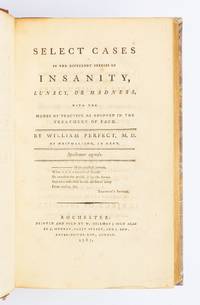
1787ST19486Rochester: Printed and sold by W. Gillman 1787. Third Edition. 218 x 135 mm. 8 1/2 x 5 1/4". viii 335 pp. <br/> Recent retrospective calf-backed marbled boards flat spine gilt-ruled into panels with central floral ornament red morocco label with gilt titling. ESTC T126963. ◆First and last couple of leaves a bit foxed or browned isolated spots of foxing elsewhere but quite an excellent copy--clean and fresh with quite comfortable margins and in an unworn sympathetic binding.<br/> <br/> This is a collection of case studies by a pioneer in the humane treatment of mental illness detailing the symptoms presented and the treatments administered. William Perfect 1734-1809 began his career as an obstetrician then led efforts to inoculate the population in Kent against smallpox. In the 1760s he began to treat patients deemed insane operating his Kentish home as a private asylum. According to DNB "Gentleness and common sense seem to have characterized his approach whether dealing with women in childbirth or the insane." Perfect observed in one of his reports "gentle treatment contributed much to the case and should always be adopted in preference to rigorous measures where possible. . . . The proper management . . . is more to be depended upon than medicine but when both are judicially and humanely blended the patient has always the best chance of recovery." DNB notes he was a "keen believer in the value of advertising . . . and frequently publicized his medical services in the newspapers." He produced several books of case studies including the present work at least in part as a way of promoting his services and methods. This is a rare book: in addition to the present copy RBH lists just two copies sold at auction in 1969 and 2012 and the book is very seldom seen offered for sale by dealers. Printed and sold by W. Gillman unknown
First edition, 4to (276 x 220 mm), large paper copy, xx, [21]-227, [1, errata]pp., engraved frontispiece of the North front vie of the Retreat, quite heavily offset onto title as usual, small oval oil stain to lower blank margin of title and prelims, loss to top corner of P1 removing one letter from margin header, 2 engraved ground plans, nineteenth-century half calf, marbled boards, leather spine label, slightly rubbed. In 1791 a Quaker woman, Hannah Miles, died in suspicious circumstances in the York Asylum (later Bootham Park Hospital). William Tuke was appalled, and when his daughter Ann asked why there could not be an establishment for such persons within the Quaker Society he was immediately taken with the idea. His wife hated the whole idea and the Society of Friends and initially disapproved of the whole scheme, but despite all obstacles the basic principle of The Retreat was formerly laid down. It was to be 1796 before The Retreat first opened its doors to patients and the first three arrived in May of that year. At the time of The Retreat's foundation many patients in other institutions were chained or manacled to starve them to reduce their strength. Many madhouses were filled with stench and patients were cruelly beaten to fit in with the common philosophy that the rule of fear was the only way to control patients. Tuke's philosophy was vastly different and, in 1813 his grandson Samuel published this book. It was to have a profound effect on the conceptions of how to deal with the mentally ill, and was instrumental in bringing about reforms at York Asylum. With intense interest aroused the House of Commons set up a Select Committee to report on 'Madhouses' in 1815 as a direct result. Tuke gave evidence to a second report and his 'mild method' of looking after the mentally ill eventually won support and gave rise to new legislation. The Retreat was to evolve new and far reaching methods of humane treatment of the mentally ill and leave a lasting impression on the theory and practice of other establishments both nationally and internationally. Garrison-Morton, 4925.1; Hunter & Macalpine, pp. 684-90; Norman, 2109.
1880CAT0161Vermont 1880. Albumen photograph. 15 ½ x 10 inches on a 19 x 14 inch cardstock mount. Very Good. A rare 19th century view of an insane asylum. The Vermont Asylum for the Insane which later became the Brattleboro Retreat was founded based on Quaker principles of moral treatment. The founder Anna Hunt Marsh was the first woman credited with starting a hospital for the mentally ill. The approach was based on English institutions such as The York Retreat. “Moral treatment†first developed by William Tuke in the 18th century treated mental disorders as diseases and not character flaws or the results of sinning or mental depravity. This image is unrecorded and would date to sometime before 1890 when the institution was renamed. Some uneven fading otherwise well preserved. Mount toned at edges. Very good overall. unknown
1880CAT0161Vermont 1880. Albumen photograph. 15 ½ x 10 inches on a 19 x 14 inch cardstock mount. Very Good. A rare 19th century view of an insane asylum. The Vermont Asylum for the Insane which later became the Brattleboro Retreat was founded based on Quaker principles of moral treatment. The founder Anna Hunt Marsh was the first woman credited with starting a hospital for the mentally ill. The approach was based on English institutions such as The York Retreat. "Moral treatment" first developed by William Tuke in the 18th century treated mental disorders as diseases and not character flaws or the results of sinning or mental depravity. This image is unrecorded and would date to sometime before 1890 when the institution was renamed. Some uneven fading otherwise well preserved. Mount toned at edges. Very good overall. unknown books
Second edition, 8vo (215 x 130 mm), vii, [1], 345, [1] + 6pp., of publishers' adverts, text woodcut of Haslam's 'Key', small hole to upper blank margin of title page, faint unobtrusive ink library stamp, later plum cloth. "Haslam considered the enlarged second edition... to be his magnum opus; it remained a standard work for several years. This edition includes an illustration of Haslam's infamous "key," an instrument used to force patients' mouths open to receive food, medicine, etc.; the key was intended as an improvement to earlier methods of artificial feeding, as it preserved the patients' teeth."?Hook & Norman. Provenance: Formerly in the library of the Birmingham Medical Institute. Hook & Norman, Haskell F. Norman Library I, 1015; Hunter & Macalpine, pp. 632-636; Wellcome III, p. 221; Garrison-Morton, 4794 (first edition).
First English edition, 8vo (210 x 130 mm), lv, [1], 288pp., with the half-title, faint unobtrusive stamp to title page, 2 engraved plates, one folding table, some light browning and spotting, some minor water-staining more so to the last ten leaves, later maroon cloth, lower hinge torn. The French physician Philippe Pinel (1745-1826), who founded the French School of Psychiarry at Hospice de la Salp?triere, has been described as 'the father of modern psychiatry'. "Pinel was among the first to treat insane humanely; he dispensed with chains and placed his patients under the care of specially selected physicians. Garrison considered the above book one of the foremost medical classics, giving as it did a great impetus to humanitarian treatment of the insane."?Garrison-Morton. The first edition of his Traite medico-philosophique sur l'alienation mentale; ou la manie appeared in 1801. Provenance: Formerly in the library of the Birmingham Medical Institute. Hook & Norman, Haskell F. Norman Library II, 1704; Hunter & Macalpine, pp. 602-610; Garrison-Morton, 4922; Wellcome IV, p. 388.
First edition, 8vo (220 x 130 mm), ix, [1], 320pp., some intermittent light foxing, 1 folding table, fait stamp to title page, later maroon cloth, rubbed, spine lettered in gilt. An investigation of the curability of insanity based on the statistics of a countrywide survey of mental institutions. "Burrows claimed to have cured eighty-one percent of all the mental patients in his private asylum, with the rate rising to ninety-one percent for cases of less than a year's duration?questionable figures that were nevertheless accepted uncritically by his book's many readers. The cult of curability was an extreme reaction to the earlier belief that insanity was beyond help; during the period of its greatest influence, it inspired a marked increase in the construction of state mental hospitals."?Hook & Norman. Provenance: Formerly in the library of the Birmingham Medical Institute. Hook & Norman, Haskell F. Norman Library I, 379; Hunter & Macalpine, p. 778; Wellcome II, p. 277.
First edition, 2 vols., 8vo (210 x 130 mm), xviii, 678; [4], 864pp., with half-titles, BUT WITHOUT THE ATLAS VOLUME OF 27 PLATES, several neat library stamps, later library buckram, joints cracked, upper cover of vol. I detached. The first modern textbook of psychiatry. Provenance: Formerly in the library of the Birmingham Medical Institute. Hook & Norman, Haskell F. Norman Library I, 728; Hunter & Macalpine, pp. 731-38; Garrison-Morton, 4798.
First edition, 8vo (200 x 130 mm) [20], 316pp., ownership inscription on fly-leaf "Harbin - 1743", contemporary calf, spine with raised bands and ruled in gilt, slight nick to headband otherwise a very nice copy. In this work Cheyne aroused much interest in the investigation of the bodily fibres and in exploration of the metaphysical relationship of mind and body. "Like many other authors on nervous diseases of the depressive kind, Cheyne wrote from personal experience and so, perhaps claimed that those 'of the liveliest and quickest natural Parts..... whose Genius is most keen and penetrating' were most prone to such disorders: Fools, weak or stupid Persons, heavy and dull Souls, are seldom troubled with Vapours or Lowness of Spirits.' Perhaps for the same reason he considered that 'of all the Miseries that afflict Human Life, and relate principally to the Body, in this Valley of Tears, I think Nervous Disorders, in their extreme and last Degrees, are the most deplorable, and beyond comparison the worst.' He recommended treatment especially by evacuation and slender diet, by which he himself had been cured."?Hunter and McAlpine. Wellcome II, p.339; Hunter and MacAlpine, pp.351-54.
186919935Paris, Germer et Baillière, 1869 ; in 12, demi chagrin vert foncé, dos à nerf, titre doré ; XXIV, 206, [2] pp. EAS à un confrère.
Second edition, considerably enlarged, 8vo (215 x 130 mm), vii, [1], 345, [1]pp., text woodcut of Haslam's 'Key', foxing to prelims and final few pages, title page browned, blank inner upper corner of title torn away, front hinge weak, cont. half calf, rubbed. "Haslam considered the enlarged second edition... to be his magnum opus; it remained a standard work for several years. This edition includes an illustration of Haslam's infamous "key," an instrument used to force patients' mouths open to receive food, medicine, etc.; the key was intended as an improvement to earlier methods of artificial feeding, as it preserved the patients' teeth."?Hook & Norman. Hook & Norman, Haskell F. Norman Library I, 1015; Hunter & Macalpine, pp. 632-636; Wellcome III, p. 221; Garrison-Morton, 4794 (first edition).
First edition, 8vo (225 x 140 mm), iv, 88pp., faint library stamp to title page, inner hinges shaken orig. cloth-backed boards, uncut. "A surgeon by profession, Brodie was often called upon to treat neurotic or hysterical patients who complained of somatic ailments, such facial neuralgia, joint pains or paralysis, in the absence of any organic disease. In the 'Lectures', Brodie adopted the original approach of discussing types of symptoms rather than particular diseases, distinguishing the manifestations of organic afflictions from those of hysterical origin, and giving the first systematic account of the diagnosis and treatment of pain and paralysis in the absence of local organic disease. He also gave the first description of 'oed?me bleu', the swelling and cyanosis of extremities during hysterical paralysis."?Hook & Norman. Provenance: Formerly in the library of the Birmingham Medical Institute. Hook & Norman, Haskell F. Norman Library I, 346; Hunter & Macalpine, pp. 860-64.
First edition, 8vo (200 x 130 mm), xviii, [2], 451, [1]pp., frontis., portrait, numerous illustrs., orig. blue cloth lettered in gilt, a little rubbed, gilt stamp of the Birmingham Medical Institute to base of spine, a very good copy. Lyttelton Stewart Forbes Winslow (1844-1913) was a British psychiatrist famous for his involvement in the Jack the Ripper and Georgina Weldon cases during the late Victorian era. Provenance: Presentation label of Christopher Marlin to the Birmingham Medical Institute on front paste-down.
124 pages. Features: Peter Whalley's cover illustrations depict the many phases of deer hunting; Editorial laments the 'sickness' of TV giveaway shows; How Iron Man Sir Anthony Eden Made Good; Half-page Wawanesa Insurance ad features photo of 1948 Olympic Champion Barbara Ann Scott figure skating; Great two-page colour ad for a white on red 1956 Plymouth Belvedere V-8 Four-door hardtop; The New Wonder Drugs That Fight Insanity - photo-illustrated article on Chlorpromazine and reserpine; Buck Crump's Love Affair with the CPR - photo-illustrated article on the rise of Buck Crump from machinist's apprentice to 51-year-old president of the Canadian Pacific Railroad (CPR); The Cooney's and their seven adopted children - photo-illustrated article on the family of Lillian and Joe Cooney of Toronto; St. Boniface (Manitoba) is Nobody's Suburb - photo-illustrated article on the largest French-Canadian settlement outside Quebec; Where to buy an ancestor cheap - Ben Ward-Price runs Canada's busiest auction gallery, Ward-Price Ltd. - photo-illustrated article; Uncle Charley's Secret Treasure (short story); The Unconquered warriors of Ohsweken - photo-illustrated article on the Iroquois and their unknown 'republic' in the heart of Ontario; How the Highlanders Took Nova Scotia - they are making the place more Scottish than Scotland - photo-illustrated article; Flashback article on the September 15, 1885 tragic death of Jumbo the elephant at St. Thomas, Ontario; God's Little Fleet - Rev. John Antle and the Columbia Coast Mission visit the raft villages of B.C.'s coastal loggers - nice photo-illustrated article; Two Hunters (arctic short story); Want a Moose in Your Parlor? - photo-illustrated article on taxidermist Clifford McCutcheon and his Oliver Spanner & Co. Ltd. of Toronto; What's Your Day to Shine?; One-page colour-photo ad for NCR (National Cash Register Company) shows lady working adding machine; Nice one-page colour ad for the 1956 Ford Fairlane Victoria (white on salmon colour); Nice Sylvania TV ad; One-page photo-ad for Ronson lighters; Bright two-page colour ad for the 1956 Dodge Mayfair 4-dr hardtop (black on yellow); Beautiful two-page colour ad for the new 1956 De Soto Fireflite 4-door hardtop (white on blue); Colour Seabreeze ad shows eight of their record players; Rare one-page two-colour illustrated ad for McCulloch chain saws shows lady cutting log; Fantastic One-page illustrated Dunlop Tire ad explains how hero Edward Chipman of the Elmhurst Dairy in Montreal entered a burning home three times to save children on the Caughnawaga Indian Reservation just before Christmas 1954; Half-page Canadian Pacific ad features photo of their new Empress of Britain; Molson's Golden ale ad features colour illustration of 'Goldie' the lion playing checkers; Colour ad for Moirs Pot of Gold chocolates; Admiral TV ad features their 'Regina', 'Manitoba' and 'Collingwood' models; Canadian Wine Institute colour ad features M. Andre Vaucher and Mlle. Micheline Dubois, both of France; Nice colour ad for the Sheraton-Park Hotel in Washington shows its huge banquet room; Barrett Company ad includes photos of F.E. Shaw, Tim Kier, George Goddard, L.O. Heron and John Hawthorne; Labatt's IPA ale ad includes photo of Toronto crane operator Leo Maltais; Interesting 1/3-page piece on artist Simpkins and his cartoon bear Jasper; Canadian Anecdote - When B.C. Had a Navy; Caterpillar ad inside back cover shows terribly muddy backroad and explains how the state of Kansas has performed major upgrades to its roads; Nice colour-photo Coke ad on back cover has one-inch stain at top; and more. Discrete clear archival-tape repairs to coverfold, otherwise average wear. Unmarked. A pleasing vintage copy of this nice issue. Book
60 pages. Features: Great cover art of a Sunday School teacher struggling to maintain order; Editorial - a fond farewell to Harry S. Truman; Great ad for International Harvester excavating equipment; Our Sorry Record on Housing - Canada rates last among western nations since WWII - article with photos; Youth and Age in a Timeless Seaport - Karsh photographs Saint John, New Brunswick; Queen of the Sob Sister - a Maclean's Flashback to Mrs. Kathleen (Kit) Blake Watkins, the world's first woman war correspondent; Rory Peter's Last Run - story by David MacDonald - illustrated by Jack Bush; How Margery Anderson Came Back from Insanity after a nervous breakdown in 1945; When Ignorance is Bliss - humour by Robert Thomas Allen illustrated by Duncan MacPherson; Do Civil Servants Earn Their Salaries? - The Government (Ottawa) Girl - red tape, the frustration of routine work and Ottawa's man shortage often bring disillusionment to her - article with photos; Nice colour-photo ad for Allis-Chalmers excavation equipment - Ungava theme; 1953 Dodge ad; Excellent Coke ad on back cover features man in a foundry. Clean and unmarked with light wear. An excellent vintage copy. Book
First edition, 8vo (200 x 115 mm), xxxvi, 392 + 12pp., of publishers' adverts at the front and 4pp., at end, with half-title, faint unobtrusive stamp to title, new endpapers, later quarter blue morocco by Chivers of Bath, untrimmed. Combe maintained that mental disorder was in fact a 'symptom of cerebral disease', and therefore to be regarded in the same way as the diseases of any other organ. Provenance: Formerly in the library of the Birmingham Medical Institute. Hunter & Macalpine, pp. 812-18; Wellcome II, p. 376.
1880889Boston/: Tolman & White Printers/ 1880. Small 4to 10" 25 cm. 2 ff. printed on rectos only. <br/><br/>The prospectus of membership: includes a preamble short history aims its constitution and by-laws. <br/><br/>Old folds. Else almost as issued. [Tolman & White, Printers/] unknown books
1992015500Paris Grasset 1992 Broché Dédicacé par l'auteur
x, 381 pages. Index. "It has been suggested to me that the experience gained through the many years in which I was chiefly concerned with the ascertainment of mental disorder and defect, in accused persons coming before the courts, should afford some help to others similarly engaged. This book is the result." - Preface. Author was a medical doctor, medical inspector of H.M. Prisons, England and Wales; Inspector of Retreats under the Inebriates Acts, Lecturer on Criminology and Forensic Psychiatry, Maudsley Hospital, and Senior Medical Officer, H.M. Prison, Brixton, etc. Most of the sixteen chapters are devoted to the various modes of insanity. Average wear to dark olive green boards. Gilt lettering upon spine. Prior owner's inkstamp upon free endpapers and title page. Ten Point Scale affixed inside back board. Back hinge open. Front hinge started. A worthy copy of this fascinating vintage text. Book
Second edition, enlarged, 8vo (225 x 140mm), half-title, xix, [1], 476pp., original boards, uncut, spine chipped, covers detached. Abercrombie was one of the chief consulting physicians and medical teachers in Scotland and showed an early interest in the mental aspects of medicine. He kept careful notes of all patients seen in his extensive practice among the rich and poor, and these formed the basis of this book. Hunter and MacAlpine, p. 801.
2 works, 38 [107-144]; 17 [ 99-115]pp., disbound. Both works are re-issues published in the periodical 'The Pamphleteer, Vol. XIV & XV 1813.' Hunter & MacAlpine, p. 721. Formerly in the library of the Birmingham Medical Institute.
1880888Boston: Tolman & White Printers 1880. 8vo 9.5" 23.5 cm. 2 ff. printed on recto and verso. <br/><br/>Perhaps the first printing of the association's constitution. <br/><br/>Ex-American Antiquarian Society Copy with its embossed stamp. Top edge tattered with loss of blank paper age-toned some dog-earing. [Tolman & White Printers?] unknown books
8623Rare gravure originale 355x240mm;marge courte, contrecollée sur vergé.
ND-MNWQ-0UYMNew. unknown
188239176New York: G.P. Putnam's Sons 1882. 8vo 24 cm 9". iv 55 1 pp. <br><br>Proceedings of the second meeting and papers by Nathan Allen C.L. Dana E.C. Seguin and J.C. Shaw. Original printed wrappers lacking rear one; front one chipped with small losses. G.P. Putnam's Sons unknown books