GROSSER, S. (praes.) u. J.G. KIRCHHOFF (resp.)Antiquariat.de
ACADEMIE ROYALE DES SCIENCES [AUZOUT, FRENICLE, HUYGENS, MARIOTTE, PICARD, ROBERVAL, ROMER]Biblio.com
Divers ouvrages de mathématique et de physique
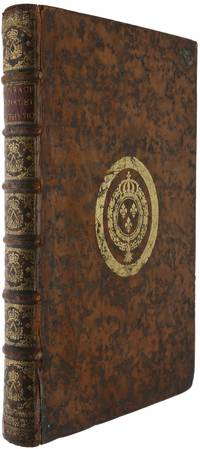
16934565Paris: L'Imprimerie Royale 1693. First edition. <p>First edition a fine copy in its Royal presentation binding of this remarkable union of major texts on mathematics and physics by the leading scientists of seventeenth-century France. Especially important are nine treatises by Roberval comprising the principal corpus of his published works. They include his independent discovery of the geometry of indivisibles his foundation work on kinematic geometry and his treatise on the composition of movements. </p>. Hardcover. A ROYAL PRESENTATION BINDING. <p>First edition of this superb collection of thirty-one treatises by the leading scientists of seventeenth-century France almost all of which are published here for the first time. This is one of the earliest important publications of the Académie des Sciences and one of the most magnificent and the present copy was probably intended for presentation: it is bound in contemporary calf with the arms of Louis XIV on each cover. Founded on 22 December 1666 one of the principal functions of the Académie was to facilitate publication of the works of its members. Frenicle and Roberval were founding members as was Huygens and without the assistance of the Académie it is likely that many of their works would have remained unpublished only two works by Frenicle and two by Roberval were published in their lifetimes. After the death of Frenicle and Roberval in 1675 their books and manuscripts were entrusted to the astronomer Jean Picard; eight treatises by Huygens were also sent to Picard for publication in this collection. After Picard's death in 1682 publication of the works was brought to fruition by Philippe de la Hire. La Hire also included in the Divers ouvrages five treatises by Picard himself including an unusual 37-page work on dioptrics one by Mariotte and two each by Auzout and Rømer. The most important work in the volume is probably Roberval's Traité des indivisibles composed around the same time as Cavalieri's Geometria indivisibilibus 1635 but independent of it and published here for the first time. The treatises by Frenicle a close correspondent of Fermat treat topics in number theory and related fields. See below for a full list of contents.</p> <br /> <p>Gilles Personne de Roberval 1602-75 arrived in Paris in 1628 and put himself in contact with the Mersenne circle. "Mersenne especially always held Roberval in the highest esteem. In 1632 Roberval became professor of philosophy at the Collège de Maître Gervais. On 24 June 1634 he was proclaimed the winner in the triennial competition for the Ramus chair a position that he kept for the rest of his life at the Collège Royal in Paris where at the end of 1655 he also succeeded to Gassendi's chair of mathematics. In 1666 Roberval was one of the charter members of the Académie des Sciences in Paris . He himself published only two works: Traité de méchanique 1636 and Aristarchi Samii de mundi systemate 1644. A rather full collection of his treatises and letters was published in the Divers ouvrages de mathématique et de physique par messieurs de I'Académie royale des sciences 1693 but since few of his other writings were published in the following period Roberval was for long eclipsed by Fermat Pascal and above all by Descartes his irreconcilable adversary.</p> <br /> <p>"Roberval was one of the leading proponents of the geometry of infinitesimals which he claimed to have taken directly from Archimedes without having known the work of Cavalieri. Moreover in supposing that the constituent elements of a figure possess the same dimensions as the figure itself Roberval came closer to the integral calculus than did Cavalieri although Roberval's reasoning in this matter was not free from imprecision. The numerous results that he obtained in this area are collected in the Divers ouvrages under the title of Traité des indivisibles. One of the first important findings was in modern terms the definite integration of the rational power which he most probably completed around 1636 although by what manner we are not certain. The other important result was the integration of the sine . the most famous of his works in this domain concerns the cycloid. Roberval introduced the "compagne" "partner" of the original cycloidal curve and appears to have succeeded before the end of 1636 in the quadrature of the latter and in the cubature of the solid that it generates in turning around its base .</p> <br /> <p>"On account of his method of the "composition of Movements" Roberval may be called the founder of kinematic geometry. This procedure had three applications-the fundamental and most famous being the construction of tangents. "By means of the specific properties of the curved line" he stated "examine the various movements made by the point which describes it at the location where you wish to draw the tangent: from all these movements compose a single one; draw the line of direction of the composed movement and you will have the tangent of the curved line." Roberval conceived this remarkably intuitive method during his earliest research on the cycloid before 1636. At first he kept the invention secret but he finally taught it between 1639 and 1644; his disciple François du Verdus recorded his lessons in Observations sur la composition des mouvemens et sur le moyen de trouver les touchantes des lignes courbes . In the second place he also applied this procedure to comparison of the lengths of curves a subject almost untouched since antiquity . The third application consisted in determining extrema .</p> <br /> <p>"Roberval composed a treatise on algebra De recognitione aequationum and another on analytic geometry De geometrica planarum et cubicarum aequationum resolutione. Before 1632 he had studied the "logistica speciosa" of Viète; but the first treatise which probably preceded Descartes's Géométrie contains only the rudiments of the theory of equations. On the other hand in 1636 he had already resorted to algebra in search of a tangent. By revealing the details of such works he would have assured himself a more prominent place in the history of analytic geometry and even in that of differential calculus .</p> <br /> <p>"In 1647 Roberval wrote to Torricelli: "We have constructed a mechanics which is new from its foundations to its roof having rejected save for a small number the ancient stones with which it had been built" p. 301 . around 1669 Roberval wrote Projet d'un livre de mechanique traitant des mouvemens composez . Roberval dreamed certainly with too great temerity of a vast physical theory based uniquely on the composition of motions" DSB.</p> <br /> <p>Bernard Frenicle de Bessy 1605-75 was an accomplished amateur mathematician who corresponded with Descartes Huygens Mersenne and perhaps most importantly Fermat. "Frenicle de Bessy is best known for his contributions to number theory. In fact Fermat in a letter to Roberval writes: 'For some time M Frenicle has given me the desire to discover the mysteries of numbers an area in which he is highly versed' . He solved many of the problems posed by Fermat but he did more than find numerical solutions for he also put forward new ideas and posed further questions" Mactutor. </p> <br /> <p>In "Méthode pour trouver la solution des problèmes par les exclusions Frenicle says that in his opinion arithmetic has as its object the finding of solutions in integers of indeterminate problems. He applied his method of exclusion to problems concerning rational right triangles e.g. he discussed right triangles the difference or sum of whose legs is given . The most important of these works by Frenicle is the treatise Des quarrez ou tables magiques. These squares which are of Chinese origin and to which the Arabs were so partial reached the Occident not later than the fifteenth century. Frenicle pointed out that the number of magic squares increased enormously with the order by writing down 880 magic squares of the fourth order and gave a process for writing down magic squares of even order" DSB. </p> <br /> <p>In 1666 Jean Picard 1620-82 "was named a founding member of the Académie Royale des Sciences and even before its opening participated in several astronomical observations. In collaboration with Adrien Auzout he perfected the movable-wire micrometer and utilized it to measure the diameters of the sun the moon and the planets. During the summer of 1667 he applied the astronomical telescope to the instruments used in making angular measurements-quadrants and sectors-and was aware that this innovation greatly expanded the possibilities of astronomical observation. The making of meridian observations by the method of corresponding heights which he suggested in 1669 was not put into practice until after his death. Yet when the Academy decided to remeasure an arc of meridian in order to obtain a more accurate figure for the earth's radius Picard was placed in charge of the operation . it was primarily through the use of instruments fitted with telescopes quadrants and sectors for angular measurements that Picard attained a precision thirty to forty times greater than that achieved previously . This increased precision made possible a great advance in the determination of geographical coordinates and in cartography and enabled Newton in 1684 to arrive at a striking confirmation of the accuracy of his principle of gravitation .</p> <br /> <p>"In 1673 Picard moved into the Paris observatory and collaborated with Cassini Romer and later Philippe de La Hire on the institution's regular program of observations. He also joined many missions away from the observatory. The first of these enabled him to provide more precise data on the coordinates of various French cities 1672-1674; others conducted from 1679 to 1681 with La Hire had the purpose of establishing the bases of the principal triangulation of a new map of France. The results of these geodesic observations were published in 1693 by La Hire pp. 368-370 of the present work" DSB. "In 1692 William Molyneux who was familiar with Isaac Barrow's Lectiones XVIII published his Dioptrica nova which was a practical treatise on lenses and telescopes. He independently arrived at Huygens's rule for images in thin lenses though in a slightly different form and stated less generally. In the following year Jean Picard's posthumous writings on dioptrics pp. 375-412 also contained a similar rule for thin lenses as well as a series of equations for thick lenses. Picard had read and admired the Lectiones XVIII shortly after it had appeared" Feingold Before Newton: The Life and Times of Isaac Barrow 1990 p. 151.</p> <br /> <p>Adrien Auzout 1622-91 made a significant contribution to the final development of the micrometer and to the replacement of open sights by telescopic sights . By the summer of 1666 Auzout and Picard were making systematic observations with fully developed micrometers. In a letter sent on 28 December 1666 to Henry Oldenburg the first secretary of the Royal Society of London Auzout explained how his new micrometer with two parallel wires either of silk of silver one of which could be moved by a screw could be used to calculate the diameters of the planets and the parallax of the moon. His treatise Du micrometre pp. 413-422 appears to be the first published account of Auzout's work.</p> <br /> <p>Of the eight works by Christiaan Huygens 1629-95 in the present volume all appear here for the first time except for his treatise on gravity De la cause de la pesanteur which was first published three years earlier as an appendix to the Traitéde la lumière. </p> <br /> <p>Most of these works were reprinted at The Hague in 1731 in quarto format in three separate volumes. </p> <br /> <p>CONTENTS</p> <br /> <p>FRENICLE: Méthode pour trouver la solution des Problèmes par les exclusions 1-44; Abregé des Combinaisons 45-64; Des Quarrez magiques 423-483; Table générale des Quarrez magiques de quatre de coste 484-507</p> <br /> <p>ROBERVAL: Observations sur la composition des mouvements & sur le moyen de trouver les touchantes des lignes courbes 69-111; Projet d'un livre de Méchanique traitant des mouvements composez 112-113; De Recognitione aequationum 114-135; De Geometrica planarum & cubicarum equationum resolutio 136-189</p> <br /> <p>Traité des Indivisbles 190-245; De Trochoide ejusque spatio 246-278; Epistola Aegedii Personerii de Roberval ad R. P. Mersennum 278-282; Epistola Evangelista Torricellii ad Robervallium 283-284; Epistola Aegedii Personerii de Roberval ad Evangelistam Torricellium 284-302</p> <br /> <p>HUYGENS: De la cause de la pesanteur 305-312; Démonstration de l'equilibre de la balance 313-316; De potentiis fila funesque trahentibus 317-319; Nouvelle force mouvante par le moyen de la poudre a canon & de l'air 320-321; Constructio loci ad Hyperbolam per Asymptotos 322-325; Demonstratio regula de maximis et minimis 326-330; Regula ad inveniendas Tangentes curvarum 330-335; Construction d'un problème d'Optique 336</p> <br /> <p>PICARD: De la pratique des grands Cadrans par le calcul 341-365; De mensuris 366-368; Mésures prises sur les originaux & comparés avec le pied du Chastelet de Paris 368-370; De mensura liquidorum & aridorum 370-374; Fragments de Dioptrique 375-412</p> <br /> <p>AUZOUT: Du micromètre 413-422</p> <br /> <p>MARIOTTE: Règles pour les jets d'eau & de la depense qui se fait par différens ajustages selon les diverses élévations des reservoirs 508-516</p> <br /> <p>RØMER: De crassitie & viribus tuborum in aqua-ductibus secundum diversae fontium altitudines diversaequae tuborum diametros 516-517; Experimenta circa altitudines & amplitudeines projectionis corporum gravium institute cum argento vivo 517-518.</p> <br/> <br/> Folio 365 x 240 mm pp. viii last leaf blank 518 2 colophon with numerous woodcut diagrams and illustrations in text. Contemporary mottled calf with the arms of Louis XIV in the centre of each cover Olivier 2494 fer 10 and with his monogram in each spine compartment hinges with some wear and top capital chipped an entirely unrestored copy in its original state. / Hardcover. L'Imprimerie Royale unknown
SOPHIA RARE BOOKS · Danemark8 000,00 $US≈ 6 768,80 €