1 661 résultats
TM 466ELEGANT MANUSCRIPT CONTAINING TWO WORKS OF SPIRITUAL AND MORAL EDIFICATION IN FRENCH TRANSLATION. Illuminated manuscript on parchment in French France after 1482 c. 1490. Dimensions 274 x 175 mm. 70 folios written in a Gothic <i>bâtarde</i> bookhand 18 large initials parti-colored in red and/or blue inserted leaf in first quire with FULL-PAGE HERALDIC COMPOSITION IN GOLD SILVER RED BLUE AND BLACK. BINDING: Bound in modern nineteenth-century blue velvet over wooden boards pink paper pastedowns and endleaves edges gilt. TEXT: Manuscript contains two works that reflect the spirituality of fifteenth-century Carthusians and their quest for the contemplative life. The first text <i>Sept fruits de la tribulation</i> is known in only five extant manuscript and is still unedited. A free French version probably dating from the fifteenth century of either the longer <i>Latin Tractatus de tribulacione</i> or an abridged adaptation of the French <i>Livre de tribulacion</i>. The second text<i> Miroir d'or de l'ame pecheresse</i> is a work of spiritual edification which consists of seven sections: on human misery sin especially lechery penance rejection of the world the vanity of human wishes death and hell and heaven. There is neither a modern critical edition of the second text nor a complete census of the existing manuscripts; the copy here was apparently made from an incunable edition of c. 1490. This manuscript begins with a remarkable added full-page illuminated frontispiece with the coat of arms and motto of Louis de Grolée fl. late fifteenth-early sixteenth century the abbot of Bonnevaux and Saint-Pierre de Vienne. PROVENANCE: Copied in France perhaps northeastern based on script and linguistic characteristics as well as internal evidence. It belonged to Louis de Grolée fl. late fifteenth-early sixteenth century. It then belonged Charles Chardin bibliophile. It was later a part of the collection of Sir Thomas Phillipps 1792-1872 who has been described as the greatest private manuscript collector of all time. CONDITION: Gold slightly rubbed some off-setting from heraldic painted composition to opening text page slight staining in upper margin and into three lines of text ff. 68-69. Overall good condition. Full description and pictures available. TM 466
TM 466ELEGANT MANUSCRIPT CONTAINING TWO WORKS OF SPIRITUAL AND MORAL EDIFICATION IN FRENCH TRANSLATION. Illuminated manuscript on parchment in French France after 1482 c. 1490. Dimensions 274 x 175 mm. 70 folios written in a Gothic <i>bâtarde</i> bookhand 18 large initials parti-colored in red and/or blue inserted leaf in first quire with FULL-PAGE HERALDIC COMPOSITION IN GOLD SILVER RED BLUE AND BLACK. BINDING: Bound in modern nineteenth-century blue velvet over wooden boards pink paper pastedowns and endleaves edges gilt. TEXT: Manuscript contains two works that reflect the spirituality of fifteenth-century Carthusians and their quest for the contemplative life. The first text <i>Sept fruits de la tribulation</i> is known in only five extant manuscript and is still unedited. A free French version probably dating from the fifteenth century of either the longer <i>Latin Tractatus de tribulacione</i> or an abridged adaptation of the French <i>Livre de tribulacion</i>. The second text<i> Miroir d'or de l'ame pecheresse</i> is a work of spiritual edification which consists of seven sections: on human misery sin especially lechery penance rejection of the world the vanity of human wishes death and hell and heaven. There is neither a modern critical edition of the second text nor a complete census of the existing manuscripts; the copy here was apparently made from an incunable edition of c. 1490. This manuscript begins with a remarkable added full-page illuminated frontispiece with the coat of arms and motto of Louis de Grolée fl. late fifteenth-early sixteenth century the abbot of Bonnevaux and Saint-Pierre de Vienne. PROVENANCE: Copied in France perhaps northeastern based on script and linguistic characteristics as well as internal evidence. It belonged to Louis de Grolée fl. late fifteenth-early sixteenth century. It then belonged Charles Chardin bibliophile. It was later a part of the collection of Sir Thomas Phillipps 1792-1872 who has been described as the greatest private manuscript collector of all time. CONDITION: Gold slightly rubbed some off-setting from heraldic painted composition to opening text page slight staining in upper margin and into three lines of text ff. 68-69. Overall good condition. Full description and pictures available. TM 466 books
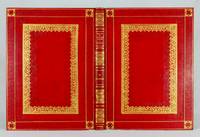
67644aafParis, L.C. Desnos, 1771, gr. in-folio, Avec 116 gravures de fleurs dans un brillant coloris plus récent. 1 f. + 69 p.; 1 f. + 72 p., Maroquin rouge du XIXème siècle, dos refait.
181910-G1819. Öl, auf festem braunem Papier, verso signiert und datiert ?M. Wentzel ad. natur. Wien 1819.?. 25:34,6 cm. Das in einem delikaten Kolorit und einer fein ausgewogenen Lichtführung gestaltete Stilleben entstand während Wentzels Aufenthalt in Wien, der durch die Datierung auf der Rückseite des Bildes sicher für 1819 angenommen werden darf.
1819ST12549London: Published by Thomas McLean 1819. Second Edition. 368 x 273 mm. 14 1/2 x 10 3/4". 26 leaves of text including 3 pp. ads. Three parts in one volume. <br/> SPLENDID CONTEMPORARY ENGLISH RED STRAIGHT-GRAIN MOROCCO ELABORATELY TOOLED IN GILT AND BLIND covers with concentric filigree frames in alternating gilt and blind tooling raised bands spine panels intricately gilt with two large lozenges formed by rectangular and triangular tools surrounded by curling botanical ornaments turn-ins gilt all edges gilt. In an excellent recent matching morocco-lipped slipcase. WITH 36 VERY APPEALING ILLUSTRATIONS BEING 18 ENGRAVINGS six flowers six fruits six birds EACH IN TWO STATES monochrome and fully hand colored. Dunthorne 53-55; Sitwell "Fine Bird Books" p. 82. Text leaves with faint mottled foxing and minor browning and off-setting just a few plates with negligible faint spots or smudges otherwise A WONDERFUL COPY THE ORIGINAL SPARKLING BINDING IN AN AMAZING STATE OF PRESERVATION.<br/> <br/> This is a sumptuously bound copy of three manuals intended to teach the art of drawing to young persons written by the accomplished botanical painter who produced the renowned "Pomona Britannia." In an earlier career Brookshaw ca. 1751-1823 was a successful London cabinet-maker whose painted Neoclassical furniture attracted such titled enthusiasts as the Duke of Devonshire and the Prince of Wales but he suddenly abandoned this livelihood in the 1790s. Art historian Lucy Wood speculates that the sudden change was prompted by involvement in a financial or sexual scandal as he also parted company with his wealthy wife around this time. He spent a decade living under the name "G. Brown" teaching flower painting to refined young ladies before producing his first manual "A New Treatise of Flower Painting" which was finally issued under his real name in 1816. The three guides that make up the present volume were intended as a supplement to that work and they expand the subjects covered to fruit and birds. In the preface to this work Brookshaw observes that flower painting is a "peculiarly appropriate" accomplishment that may be obtained "without the expense of a Master a few elementary instructions and good copies being sufficient." The plates here are more highly finished than the examples in his original "Treatise" in order to "lead the young artist onward in a progressive line of improvement." Fruits and birds are added to offer a new challenge for the pupil and Brookshaw notes that while avian subjects lack the variety of botanical ones they compensate with "the inifinite number of attitudes they assume." Our elaborate and immaculately preserved binding is testament that our volume was never used as a drawing manual but was more likely enjoyed for its own merits as an attractive object. Published by Thomas McLean unknown
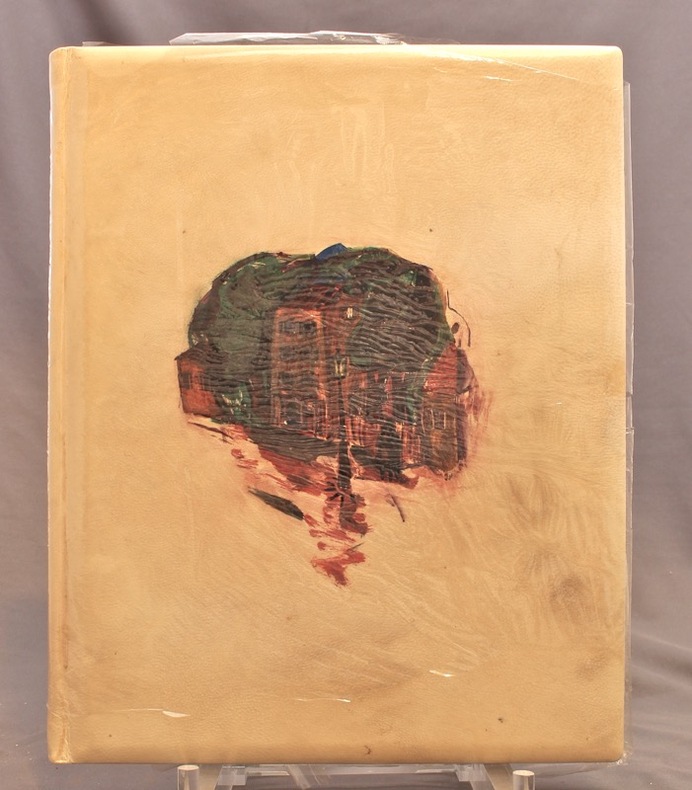
194712735[Lausanne], [Association des écrivains vaudois - AEV], [1947]. In-4 de [106] pages, plein parchemin muet, orné au premier plat d'une composition originale du peintre Jean-Jacques Mennet. Sous emboîtage avec dos toilé muet. La maison Mayer & Soutter à Lausanne a soigné la reliure de ces pages autographes.
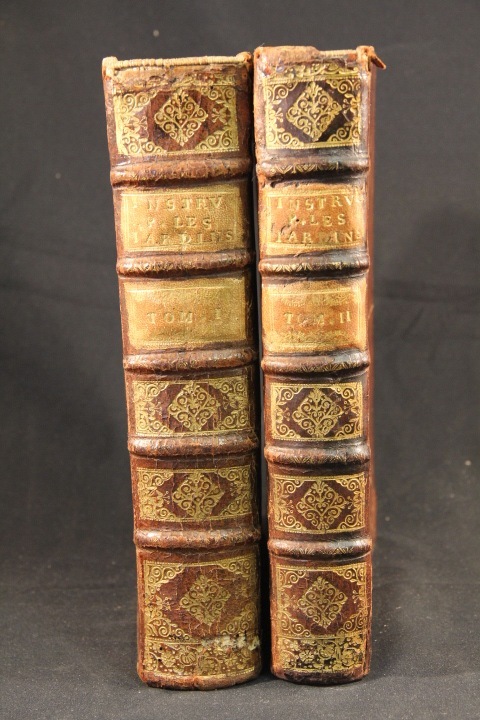
17680033511768 Paris, Saillant et Desaint, 1768. Deux volumes petit in-folio (260 X 329 mm) veau fauve marbré, dos cinq nerfs, caissons dorés ornés, dentelles dorées en queue, pièce de titre maroquin grenat, coupes et coiffes filetées, tranches rouges (Placé). Tome I: (1) f. blanc, (2) ff. de faux-titre et titre, titre-frontispice, XXIX pages de préface et table, (1) page et (1) f. d'extrait des registres et privilège, 337 pages, 62 planches hors-texte; Tome II: (1) f. blanc, (2) ff. de faux-titre et titre, 280 pages, 118 planches hors-texte. Étiquette de l'imprimeur-libraire et relieur «Placé», installé «Rue du Change, N°13, à Tours, Près Saint-Martin».
1880WRCAM43778Rochester N.Y.: Rochester Lithography Co. 1880. 162pp. containing 146 chromolithographic illustrations. Contemporary leather wallet-style binding; leaves in three tri-fold sections joined by pink linen straps. Moderate wear to binding one clasp lacking. Minor soiling. Some contemporary manuscript notations. Very good. In a blue cloth clamshell case leather label. Salesman's nursery sample book containing 146 chromolithographic for over a dozen types of plants including many varieties of fruits and flowers. This book offers an extensive selection of apples peaches grapes roses and trees among other things. A nice example. Rochester Lithography Co. hardcover books
17826372Arreux, 1782-1796. 1782 1 vol in-8° (190 x 125 mm) manuscrit à l'encre brune et au crayon de: 396 pp, dont 12 plans de jardins à pleine ou double page avec les arbres pointés à l'aquarelle, une vingtaine de ff vierges, nombreuses corrections, ajouts et feuillets insérés ou modifications contre-collées. Ex-libris gravé armorié "Montcourcel" au dos du 1er plat (salissures, taches et défauts d'usage). Demi-vélin postérieure, dos lisse titré à l'encre noire, plats recouverts de papier marbré, corps d'ouvrage préservé dans son état d'origine non rogné.
First edition, folio (330 x 210 mm), 3 parts in one, [2], 36; [4], 70; [4], 87, [5]pp., three separate title-pages within border of type ornaments, 39 engraved folding plates of fruits, all with bright contemporary hand-colouring, several related notes in ink to front free-endpaper, cont. half calf, paper covered boards (peeled away from upper cover), uncut. Johann Hermann Knoop (1700-1769), carried out much of his botanical research whilst curator of the gardens of Princess Maria Louisa in Leeuwarden. He broke new ground in the study of fruit varieties and he is regarded as the father of pomology. The first two part are devoted to the kitchen garden, the first part is illustrated with 20 splendid full-page engraved plates with hand-colouring, 12 are apples, 8 of pears, all showing several varieties, each labelled with its time of ripening, many for species now lost. The second has 19 engraved plates with contemporary hand-colouring showing peaches, plums, cherries, berries, etc. Part three is devoted to the cultivation of the garden and was issued un-illustrated. The fruit monographs are among the earliest books on the subject to be illustrated with coloured plates. Knoop himself made the original drawings, which were engraved by Jan C. Philips (1700-1773) or Jacob Folkema (1692-1767). Landwehr, Dutch Books with Coloured Plates, 88 (I) & 92 (II); Nissen, 1078 (I) & 1077 (II); Pritzel, 4754-4755.
184938759Great Britain 1849. Approx. 60 pages. Bound into the rear of: William Forsyth. A Treatise on the Culture and Management of Fruit-Trees; in which a new method of pruning and training is fully described . The Fourth Edition. London: Printed for Longman Hurst Rees and Orme 1806. xxviii 523pp. 13 engraved plates 11 folding. Contemporary calf rebacked to style. Provenance: unidentified armorial bookplate on verso of the title featuring a wolf rampant and the motto Vincit Veritas. Unusual early 19th century gardening diary of an English fruit grower.<br/> <br/>The manuscript records the efforts of a knowledgable gardener. Although unidentified a Liverpool stationeer's blindstamp in the rear and a reference to a Kirkdale gardener suggests a gardener from a Lancashire estate. The manuscript begins with an entry dated 21 Aug. 1812 in which the diarist records his efforts to save a damaged peach tree: "Finding a young tree which had been planted about four years from a two year old plant very much decayed apparently from rain having got into the grafting which had rotted nearly the whole upper part of the stock I tried the following method of cure. I cut away all the rotten part about nine inches in length . plentifully with tar and covered the mixture of cow dung and marl." He updates the entry several times recording prunings to the tree and notes in 1814 that "the tree have two peaches this year . the covering wound was become loose . the tree otherwise healthy." A 15 July 1813 entry records a visit to Mr. Farrer of Kirkdale "for the purpose of enquiring into the mode I had been informed he had adopted of destroying the Coceus or American Buglas in apple trees . he showed me a tree on which the experiment had been made last spring." He describes the method of using mercury in detail and refers to the experiments of Hales. Other entries record his planting pruning and grafting of vines as well as nectarines and apricots and recipes for destroying worms caterpillars slugs and other pests. The manuscript further transcribes extracts concerning the care of fruit trees from the Horticultural Society Transactions and other sources. Many of the later entries concern the hothouse cultivation of grapes; for example a 28 November 1848 inscription: "The hothouse has not had any artificial heat during this year. We cut 14 lbs of excellent grapes." This manuscript is bound into the rear of a copy of Forsyth's Treatise. The Treatise "ran through seven editions in twenty-two years the first three in only two years and two American adaptions of it were also published . Some readers thought the book greatly indebted to Thomas Hitt's Treatise of Fruit-Trees first published in 1755 but E.A. Bunyard. explains the lack of originality of 'the voluble Forsyth' by saying that 'the details of the culture had been well thrashed out by previous authors and little room for innovations was left" Oak Spring Pomona p.101. "William Forsyth was one of that legion of Scottish gardeners who spent their working lives south of the border. His career began at Chelsea Physic Garden and continued at Syon House until he returned to Chelsea in 1771 to take over the care of the garden from Philip Miller. In 1774 Forsyth constructed one of the earliest rock gardens . Ten years later he took charge of the royal gardens at St James's and Kensington. His eminence in the gardening world made him one of the founder members of the Royal Horticultural Society" op. cit.<br/> <br/>For Forsyth: Bradley Bibiliography III p.141; Pritzel 2985; cf. Raphael Oak Spring Pomona 37. unknown books
17154557A Rouen & Paris, Par la Compagnie des Libraires, 1715. 2 volumes in-4 de [8]-16; 32-[8]; 666-[4] + [12]-562-[30 pages, plein veau marron de l’époque, dos à nerfs, étiquettes de titre et tomaison en maroquin fauve. Manque à deux coiffes et au bas du dos d’un volume, mors fendus (1 cm), coins frottés, rares rousseurs.
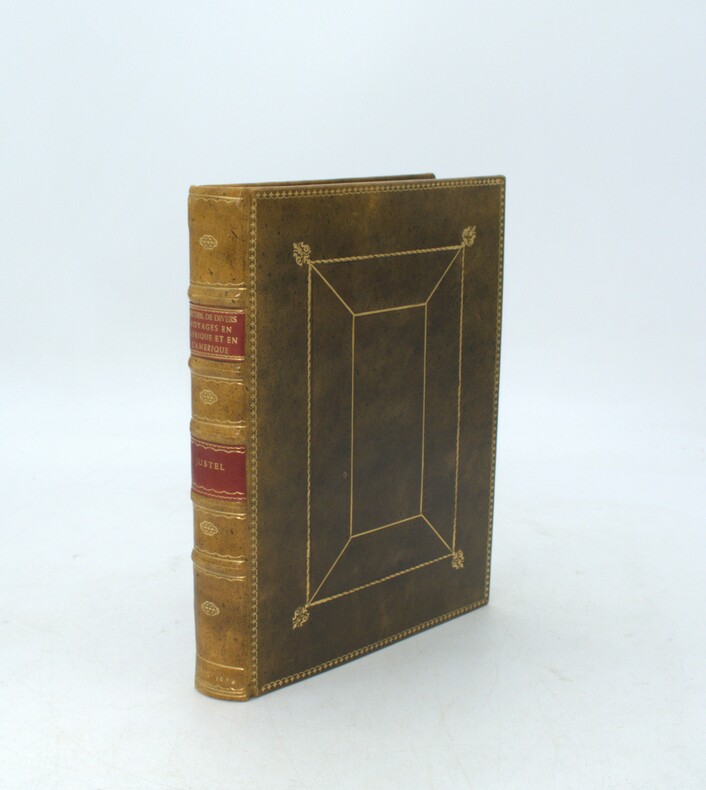
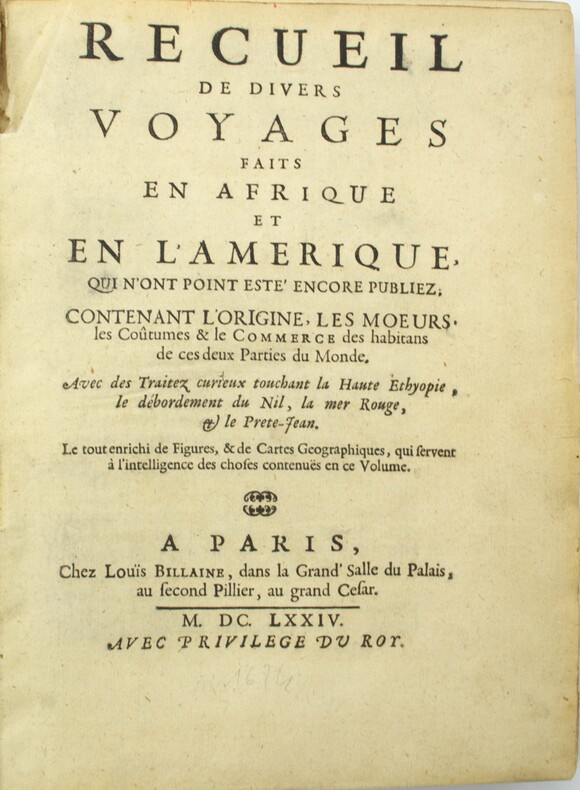
1674PHO-2032Paris, Louis Billaine, 1674. in-4 (228x164) , relié plein veau , filets sur les plats , dos à nerfs orné avec titre , auteur et date (reliure pastiche),tranches rouge. L'ouvrage est illustré de 12 planches hors texte, une carte de l'Éthiopie dans le texte, trois cartes dépliantes (Barbades, Jamaïque et Virginie, Maryland et la Nouvelle-Angleterre) manque la carte du Nil, mouillures, déchirure et réparation au pli (carte des Barbardes)
18800000808Rochester NY 1880. Full leather. Very good. Oblong 8vo. Contemporary black morocco; border tooling on boards later spine gilt on front; wear to corners and edges. Collation: circa 90 plates mostly fruit and flowers a few trees at end. Plates are signed J. W. Thompson & Co’s Fruit and Flower Plates. A number of the plates are trimmed affecting image. The last plate of a “Properly Trimmed Honey Locust Hedge” is from D. M. Dewey. Each Thompson plate has the common name of the fruit flower or tree and information about properties some with origin size flavor and time of year for maturation for fruit or fragrance and time of flowering. Exceptional sample book. <br/><br/> hardcover books
477-Eo.J. Aquarell, stellenweise mit Eiweißlasur, rechts unten signiert und datiert ?J. W. Lindlar. F. 1845.?. 21,2:23,5 cm. Sehr schöne, fein gezeichnete und dadurch sehr plastisch wirkende Arbeit dieses Künstlers.
1944012137Paris Pierre Seghers 1944 In-8 carré Broché
1674PHO-2243Paris, Louis Billaine, 1674, in-4 (228x164), basane postérieure (19eme), dos à nerfs avec titre, lieu et date, tranches marbrées, réparations au dos et aux coins, petite réparation au pli de la carte des Barbades, intérieur frais, illustré de 12 planches (13) et trois cartes dépliantes (Barbades, Jamaïque et Virginie, Maryland et la Nouvelle-Angleterre) manque la carte du Nil comme souvent et un faux titre
20193A Bastia et se trouve à Paris chez Monory, 1780. Broché, couverture muette d'attente en papier marbré, annotation manuscrite d'époque sur la 4ème de couverture: "M. Bergeret à Bordeaux par Monory", réemploi sur la 2ème et 3ème de couverture d'une page de l'ouvrage de Dubet "Réflexions critiques sur la muriométrie (dédicace à monsieur frère du Roi, ornée de bandeaux dessinés par Jean-Baptiste Huet ). in-8 de XXVI-(2)-160 pages, exemplaire à pleines marges.
1818WOC-1477Illustrée de 360 planches hors-texte en couleurs d'après les dessins de Pierre-Jean- François Turpin, lui-même Botaniste, et de Mme. Pankoucke, élève de van Spaendonck et de Redouté, femme de l'éditeur. Paris, C. L. F. Panckoucke, Éditeur, du Dictionnaire ses Sciences Médicales, Rue et hôtel Serpente, n°,16. 1814-1818. 6 volumes in-8 (21x13cm) reliés veau d'époque, reliures très fatiguées avec manque le dos du tome 4.
75338Paris, au Palais chez Paulus-Du-Mesnil, 1750, EDITION ORIGINALE, fort in-12, plein chagrin brun flammé, dos orné avec titre dorés sur dos lisse, tranches rouges, reliure de l'époque, IX - (11) - 525 - (25) pp., ill. par 5 pl. dépliables et de nb. bandeaux, lettrines et culs-de-lampe, préface, table des observations par ordre alphabétique, catalogue de l'éditeur, approbation et privilège du Roy, table des matières pour le travail pour les 4 saisons, table des ouvrages de toutes les saisons, Très bon ouvrage de Joseph Menon, en édition originale parue en 1750 et dans sa reliure de l'époque. Bien complet des 5 planches dépliables. Menon y donne les recettes de différentes préparations sucrées et confites (gelées, confitures, sirops, glaces, compotes, fruits séchés, dragées, macarons, ratafias, candis, fromages glacés, mousses, pralines, biscuits, ainsi que des eaux-de-vie de fruits et liqueurs, en fonction des saisons. Son ouvrage contient également des observations sur la science et les propriétés des fruits. Cet ouvrage est devenu RARE complet de ses 5 planches dépliables et dans sa reliure d'époque. Très bon état du papier et des gravures, sans rousseurs ni salissures; la reliure d'époque est restaurée par une professionnelle qui lui donne tout son charme
1880WRCAM37566Rochester N.Y. 1880. 164 leaves consisting of 157 chromolithograph plates and seven photomechanical plates one handcolored one with text on verso. Oblong 12mo. Later 20th-century calf boards and spine gilt "The Chase Nurseries" gilt on front cover. Some plates abraded with slight loss due to earlier adhesion of leaves some plates lightly worn at edges. A few plates cracking near inner gutter one plate torn bottom half lacking. A good copy. A specimen book of fruits and flowers compiled for the Chase Brothers Nursery Company of Rochester consisting primarily of chromolithograph plates printed by two firms in that city the Rochester Lithography Company and the Stecher Lithography Company. The volume also includes seven photomechanical plates showing the nursery's buildings orchards and specific products. There is no titlepage but the first two leaves are both photomechanical reproductions with the caption "The Chase Nurseries The R.G. Chase Company." Other photomechanical plates also include the firm's name. A good copy of a turn-of-the century nursery specimen book displaying examples of both chromolithographic and photographic reproduction techniques. hardcover books
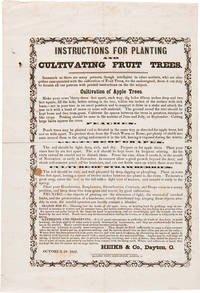
1852WRCAM55573Dayton Oh.: Gazette Print 1852. Letterpress broadside 12 3/4 x 8 3/4 inches with ornamental border. Old folds minor foxing two ink spots in left margin. Very good. A seemingly-unrecorded broadside detailing instructions on the planting cultivating culturing pruning gathering and preserving of various fruit trees in Ohio in the middle of the 19th century. The nursery owners explain their reason for issuing the broadside: "Inasmuch as there are many persons though intelligent in other matters who are altogether unacquainted with the cultivation of Fruit Trees we the undersigned deem it our duty to furnish all our patrons with printed instructions on the subject." The broadside was produced by Heiks & Company of Dayton who provide guidance on proper procedures for care of apple trees peaches grapes and strawberries with brief mentions of gooseberries raspberries and currants. Whether this broadside was given out to customers along with their purchases or posted at the Heiks & Company nursery is unknown but likely the former. A taste of the instructions regarding apple trees reads: "Make your rows thirty-three feet apart each way dig holes fifteen inches deep and two feet square fill the hole before setting in the tree within ten inches of the surface with rich loam - set in your tree in an erect position and to support it drive in a stake and attach the tree to it with a band of straw or some soft material. The ground around the tree should be kept loose and free from grass. Cultivate the spaces between the trees in potatoes turnips or like crops. Pruning should be done in the months of June and July or September. Cutting large limbs injures the trees." <br> <br> Little is known of the issuing company Heiks & Co. other than they were a nursery in Dayton and possibly Troy for some time into the 20th century. We can locate no other copies of the broadside in trade auctions or on OCLC. This is perhaps a unique surviving example. Gazette Print unknown books
1890WRCAM43336Rochester N.Y. 1890. 136 leaves. Chromolithographic plates. Oblong octavo. Contemporary calf cover gilt expertly rebacked in matching calf. Light scattered soiling a few leaves with minor edge tears. Very good. An extensive album of Rochester fruit plates in a nursery specimen book for the Chautauqua Nursery Co. of Portland New York displaying a wide array of fruits including many varieties of grapes as well as trees roses and other flowers. Although there is no titlepage as typical with these books there is a printed label on the front pastedown completed in manuscript indicating that this book was carried by Mr. Frank Gasco a certified sales representative for the nursery. Most of the plates are chromolithographs printed by the Rochester Lithographing Co. though a few are by D.M. Dewey or Stecher both also of Rochester. unknown books
1890WRCAM43779Rochester N.Y.: Vredenberg & Co. 1890. Forty-one leaves of chromolithographs. Oblong. Original black cloth stamped in gilt on cover. Light wear and soiling to binding. Minor dampstaining to contents. Very good. Salesman's specimen book for the Rochester Nursery Co. advertising a wide selection of apples plums grapes trees roses and several varieties of berry all shown in eighty-two full color plates. The book is marked as "No. 101" on the inside of the front cover. A nice example of chromolithographic fruit plates. Vredenberg & Co. hardcover books
1693016899Spread Eagle Westminster hall : Matthew Gillyflower & James Partidge 1693. First English edition. Illustrated with an engraved portrait frontispiece nine engraved plates of eleven - so LACKING two plates a few small wooducts in the text many charming engraved chapter headings folio title page printed in red and black pp 42 188 208 4 80 the top bottom and fore-edge red a few blemishes internally but overall very clean the hinge before the frontispiece cracked but sound contemprary calf rebacked probably in the ealy nineteenth century a little bumped and worn the spine with more wear and a little splitting and fraying at the head and tail. An early un-named owner obviously a knowledgeable and proficient gardener has contributed half a page of manuscript notes on the first front blank in which he questions inter alia why the author has not included mustard-seed in the list of all things that a kitchen-garden should contain; there are also neat marginal notes throughout in the same hand - these are in no way detrimental and indeed enhance the book. Blanche Henrey 218. One of the most influential books in the history of fruit culture. Evelyn's edition though almost certainly the translation work of George London not only brought the French work to an entirely new audience it added short sections on the culture of orange trees and melons which were not in the original. First English edition. Full-Leather. Good. Matthew Gillyflower & James Partidge Hardcover