8 218 résultats
186243997London, Printed by Taylor and Francis - Published by the Author, (1862-) 73. Folio. Papersize 54,5x37 cm. Lithographed and fully handcoloured. 2 birds seen, female and male in natural habitat, foliage. J. Gould & H.C. Richter, del. et lith. - Walter, Imp. Fine and clean. The plate is accompanied with the original textleaf. (2) pp.
London, Printed by Taylor and Francis - Published by the Author, (1862-) 73. Folio. Papersize 54,5x37 cm. Lithographed and fully handcoloured. 2 birds seen, female and male in natural habitat with flowering plant, fruits and an insect. J. Gould & H.C. Richter, del. et lith. - Walter, Imp. Fine and clean. The plate is accompanied with the original textleaf. (2) pp.
London, Printed by Taylor and Francis - Published by the Author, (1862-) 73. Folio. Papersize 54,5x37 cm. Lithographed and fully handcoloured. 2 birds seen, female and male in natural habitat, foliage. J. Gould & H.C. Richter, del. et lith. - Walter, Imp. Fine and clean. The plate is accompanied with the original textleaf. (2) pp.
Litografia tratta dal famoso The Birds of New Guinea and the Adjacent Papuan Islands, ultimo ed importantissimo lavoro di John Gould. L’opera, tirata a soli 250 esemplari, è molto rara; iniziata nel 1875, fu completata da Richard Bowdler Sharpe nel 1888 a causa della morte di Gould. John Gould (Lyme Regis, 14 settembre 1804 – Londra, 3 febbraio 1881) è stato un ornitologo e naturalista britannico. Destinato fin dalla giovinezza a seguire la carriera paterna di giardiniere presso il Castello di Windsor, grazie alle sue precoci conoscenze in tassidermia ebbe l'occasione di entrare a soli 23 anni (1827) nel Museo della Zoological Society di Londra, come conservatore. Gould affinò le sue conoscenze artistiche e scientifiche in ornitologia, consultando i migliori lavori del tempo, in particolari quelli di John James Audubon, William Swainson e Thomas Bewick. Tra il 1832 e il 1837 comparve The Birds of Europe, opera in 5 volumi e con ben 448 tavole litografate e colorate a mano. Per la gigantesca impresa Gould si valse della collaborazione della moglie e del celebre poeta e pittore inglese Edward Lear. Una prerogativa che salvò sin dall'inizio Gould dal tracollo economico fu quella di affrontare questi dispendiosi lavori facendoli uscire in sottoscrizione e a fascicoli. Dopo un viaggio in Australia e in Tasmania, pubblicò, con l'aiuto di Elizabeth per i primi volumi, The Birds of Australia (1840-1848) in ben 7 volumi e 600 tavole, cui seguì tra il 1851 e il 1869 un Supplement di 81 tavole. Tra il 1862 e il 1873 pubblica The Birds of Great Britain, in 5 volumi e con 367 tavole. Pubblicò ben 41 libri, per un totale di 2999 tavole litografate e dipinte a mano, quasi tutte dedicate agli uccelli, consacrandosi così fra i più noti ornitologi inglesi dell'età vittoriana Litografia, bellissima coloritura coeva, in ottimo stato di conservazione. Litograph taken form the famous The Birds of New Guinea and the Adjacent Papuan Islands, Gould’s last great work. With only about 250 sets made, it is amongst the rarest of all Gould's works and was completed after his death by Richard Bowdler Sharpe. Sharpe then in charge of the of the bird collection at the British Museum, assumed the authorship halfway through the series in 1881, after the twelfth part had been issued. Sharpe was more than forty years junior to Gould, whom he had meet when he was only fifteen, and they both shared a passionate interest in ornithology. In his last years, although an invalid and often in pain, Gould was always pleased when Sharpe visited him to look at his collection of skins and discuss the latest bird discoveries. John Gould (Lyme Regis, 14 September 1804 - London, 3 February 1881) was a British ornithologist and naturalist. Destined from his youth to follow his father's career as a gardener at Windsor Castle, thanks to his early knowledge in taxidermy had the opportunity to enter at only 23 years (1827) in the Museum of the Zoological Society of London, as a conservator. Gould refined his artistic and scientific knowledge in ornithology, consulting the best works of the time, in particular those of John James Audubon, William Swainson and Thomas Bewick. Between 1832 and 1837 appeared The Birds of Europe, a work in 5 volumes and with 448 plates lithographed and colored by hand. For this gigantic undertaking Gould availed himself of the collaboration of his wife and the famous English poet and painter Edward Lear. A prerogative that saved Gould from economic collapse from the very beginning was that of dealing with these expensive works by publishing them in subscriptions and in dossiers. After a trip to Australia and Tasmania, he published, with the help of Elizabeth for the first volumes, The Birds of Australia (1840-1848) in 7 volumes and 600 plates, followed between 1851 and 1869 by a Supplement of 81 plates. Between 1862 and 1873 he published The Birds of Great Britain, in 5 volumes and 367 plates. He published 41 books, for a total of 2999 plates lithographed and hand-painted, almost all dedicated to birds, thus establishing himself among the most famous English ornithologists of the Victorian age. Perfect condition.
Litografia tratta dal famoso The Birds of New Guine and the Adjacent Papuan Islands, ultimo ed importantissimo lavoro di John Gould. L’opera, tirata a soli 250 esemplari, è molto rara; iniziata nel 1875, fu completata da Richard Bowdler Sharpe nel 1888 a causa della morte di Gould. John Gould (Lyme Regis, 14 settembre 1804 – Londra, 3 febbraio 1881) è stato un ornitologo e naturalista britannico. Destinato fin dalla giovinezza a seguire la carriera paterna di giardiniere presso il Castello di Windsor, grazie alle sue precoci conoscenze in tassidermia ebbe l'occasione di entrare a soli 23 anni (1827) nel Museo della Zoological Society di Londra, come conservatore. Gould affinò le sue conoscenze artistiche e scientifiche in ornitologia, consultando i migliori lavori del tempo, in particolari quelli di John James Audubon, William Swainson e Thomas Bewick. Tra il 1832 e il 1837 comparve The Birds of Europe, opera in 5 volumi e con ben 448 tavole litografate e colorate a mano. Per la gigantesca impresa Gould si valse della collaborazione della moglie e del celebre poeta e pittore inglese Edward Lear. Una prerogativa che salvò sin dall'inizio Gould dal tracollo economico fu quella di affrontare questi dispendiosi lavori facendoli uscire in sottoscrizione e a fascicoli. Dopo un viaggio in Australia e in Tasmania, pubblicò, con l'aiuto di Elizabeth per i primi volumi, The Birds of Australia (1840-1848) in ben 7 volumi e 600 tavole, cui seguì tra il 1851 e il 1869 un Supplement di 81 tavole. Tra il 1862 e il 1873 pubblica The Birds of Great Britain, in 5 volumi e con 367 tavole. Pubblicò ben 41 libri, per un totale di 2999 tavole litografate e dipinte a mano, quasi tutte dedicate agli uccelli, consacrandosi così fra i più noti ornitologi inglesi dell'età vittoriana Litografia, bellissima coloritura coeva, in ottimo stato di conservazione. Litografia, bellissima coloritura coeva, in ottimo stato di conservazione. Litografia tratta dal famoso The Birds of New Guinea and the Adjacent Papuan Islands, ultimo ed importantissimo lavoro di John Gould. L’opera, tirata a soli 250 esemplari, è molto rara; iniziata nel 1875, fu completata da Richard Bowdler Sharpe nel 1888 a causa della morte di Gould. John Gould (Lyme Regis, 14 settembre 1804 – Londra, 3 febbraio 1881) è stato un ornitologo e naturalista britannico. Destinato fin dalla giovinezza a seguire la carriera paterna di giardiniere presso il Castello di Windsor, grazie alle sue precoci conoscenze in tassidermia ebbe l'occasione di entrare a soli 23 anni (1827) nel Museo della Zoological Society di Londra, come conservatore. Gould affinò le sue conoscenze artistiche e scientifiche in ornitologia, consultando i migliori lavori del tempo, in particolari quelli di John James Audubon, William Swainson e Thomas Bewick. Tra il 1832 e il 1837 comparve The Birds of Europe, opera in 5 volumi e con ben 448 tavole litografate e colorate a mano. Per la gigantesca impresa Gould si valse della collaborazione della moglie e del celebre poeta e pittore inglese Edward Lear. Una prerogativa che salvò sin dall'inizio Gould dal tracollo economico fu quella di affrontare questi dispendiosi lavori facendoli uscire in sottoscrizione e a fascicoli. Dopo un viaggio in Australia e in Tasmania, pubblicò, con l'aiuto di Elizabeth per i primi volumi, The Birds of Australia (1840-1848) in ben 7 volumi e 600 tavole, cui seguì tra il 1851 e il 1869 un Supplement di 81 tavole. Tra il 1862 e il 1873 pubblica The Birds of Great Britain, in 5 volumi e con 367 tavole. Pubblicò ben 41 libri, per un totale di 2999 tavole litografate e dipinte a mano, quasi tutte dedicate agli uccelli, consacrandosi così fra i più noti ornitologi inglesi dell'età vittoriana Litografia, bellissima coloritura coeva, in ottimo stato di conservazione.
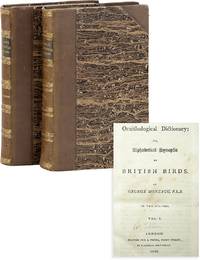
180286211London: For J. White 1802 1813. First Edition. Three volumes bound in two. Octavo 20.5cm. Nineteenth century half-calf over marbled boards. Volume I: xlii; text unpaginated; hand-colored frontispiece Cirl Bunting. Volume II: unpaginated. Volume III Supplement: vi; text unpaginated; 24 inserted leaves of engraved plates uncolored; errata. Bound without half-titles; two plates in Supplement bound out of order; occasional faint foxing and pencil marginalia to all volumes. A clean attractive set collated complete contents fresh and bright. An early 19th c. owner has tipped in a manuscript leaf at close of v.III hand-titled: "In Montagu - added since Pennant i.e. Thos. Pennant "British Zoology" 1766 but not found by Montagu himself;" verso headed "Immature birds or varieties held as species by Montagu." <br /> <br /> A key work of ornithological literature; Montagu often cited as the "father of British ornithology" is credited with describing several new species of British birds as well as proving that others once held as species were in fact examples of the same species in seasonal or immature plumage. For J. White unknown
in-folio, pp. XVI, 678, (2), leg. in tela edit. borgogna, titolo in nero al dorso e al piatto anteriore, con fregi in oro. Seconda edizione, riveduta ed aggiornata dal dott. Edgardo Moltoni e dal dott. Carlo Vandoni. Opera importante, uscita per la prima volta in dispense tra il settembre 1905 e il giugno 1906. Ottimo esemplare.. Ceresoli, p. 346: ''Magnifica opera considerata un capolavoro dell'arte tipografica''..
1891107235BBHamburg, Verlagsanstalt und Druckerei Actien-Gesellschaft, (1891). 4°. XIX, 316 S. mit 17 (davon 9 auf 2, 1 gefalt. Tafeln) Holzschnitten und 40 chromolithogr. Tafeln nach Aquarellen von Christian Förster. Weinroter Orig.-Leinenband mit goldgepr. Rücken- und Deckeltitel und Jugendstil-Deckelvignette.
186243961.London, Printed by Taylor and Francis - Published by the Author, (1862-) 73. Folio. Papersize 52,5x36,5 cm. Lithographed and fully handcoloured. 2 adults on a rock, male and female. J. Gould & H.C. Richter, del. et lith. - Walter, Imp. Fine and clean. Ab. a half cm. of right margin with remains of textpaper, not affecting image in any way..The plate is accompanied with the original textleaf. (2) pp.
197511974Skibby, 1975-92. Solide hshirtbd. Rigt illustr.
190543224Gera-Untermhaus, 1905. Folio. Contemp. hcalf. Spine gilt. Some wear to spine. Stamp on titlepage. Internally clean. XLVI,(6),164,253 pp. Textillustr. and 32 (each 38x28 cm.) fine chromolithographed plates, 2 of which depicts the eggs.
.London, Printed by Taylor and Francis - Published by the Author, (1862-) 73. Folio. Papersize 52,5x36,5 cm. Lithographed and fully handcoloured. 2 adults on a rock, male and female. J. Gould & H.C. Richter, del. et lith. - Walter, Imp. Fine and clean. Ab. a half cm. of right margin with remains of textpaper, not affecting image in any way..The plate is accompanied with the original textleaf. (2) pp.
Skibby, 1975-92. Solide hshirtbd. Rigt illustr.
Gera-Untermhaus, 1905. Folio. Contemp. hcalf. Spine gilt. Some wear to spine. Stamp on titlepage. Internally clean. XLVI,(6),164,253 pp. Textillustr. and 32 (each 38x28 cm.) fine chromolithographed plates, 2 of which depicts the eggs.
tall 8vo [26 x 16.5 cm]; ix, 342 pp, 14 very fine hand colored plates, index. original blind stamped cloth, spine with gilt vignette, spine repaired, corners a little worn, front endpaper chipped, rear endpaper lacking, a clean very good copy, signed by author in ink on dedication page. A picture of this book is available upon requ Nissen 872, BMNH p1913, Anker 469: "The fine plates were executed from drawings by J. G. Keulemanns". Zimmer p588, Wood p566: "The information in this excellent work is derived chiefly from a collection of nearly a thousand skins of birds". The author travelled extensively in the Nile area and was able to observe the birds first-hand. Some of the birds are illustrated here for the first time.
Città di Castello, Lapi, 1912, 8vo brossura originale, pp. 72 (Ceresoli, 66). Uno dei più rari libri sull'argomento.
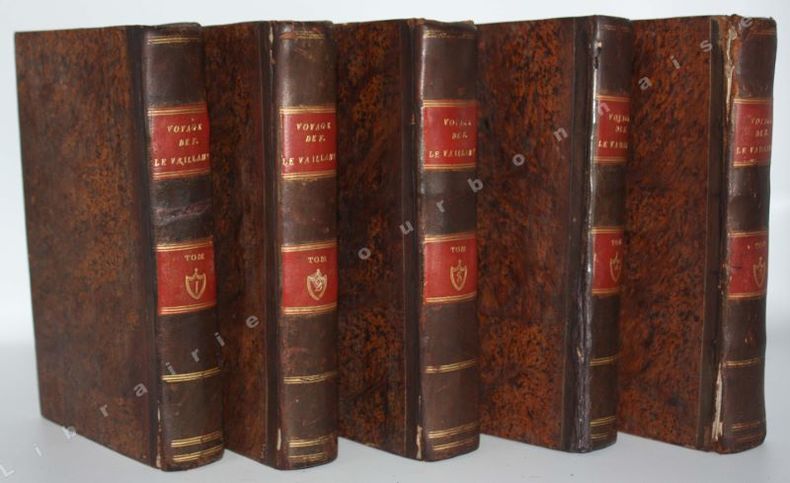
11539Paris, De l'Imprimerie de Crapelet - chez Desray, An VI (1798) pour le Premier Voyage - An XI (1803) pour le Second Voyage. Ensemble de 5 volumes in-8 en reliure uniforme, tomés 1 à 5. Demi-basane brune, dos lisses, pièces de titre et de tomaison en maroquin rouge, filets dorés, tranches bleues marbrées. XXXII-385pp. 2ff.-403pp.-(1)p. XLIV-343pp. - 2ff.-412pp. 2ff.-467pp. - 20 planches hors-texte (dont 7 dépliantes pour les deux volumes du Premier voyage) et 22 planches hors-texte (dont 4 dépliantes et grande carte pour le Second Voyage). (Complet). Vignettes ex-libris de la "Bibliothèque de M. de Thelin" sur les premiers contreplats. Des restaurations anciennes aux dos et charnières des tomes 1 et 4. Quelques rousseurs sur une partie du tome 5.
[In Firenze, nella stamperia Mouckiana, 1767]. Acquaforte colorata a mano, mm. 347x274 (l'impronta della lastra), mm. 462x362 (il foglio). Non firmata. Dedica al marchese Vincenzo Alamanni patrizio fiorentino, incisa in rame, sotto la figura. Magnifica calcografia, proveniente dalla "Storia naturale degli Uccelli", a cura di Saverio Manetti, Lorenzo Lorenzi e Violante Vanni, stampata a Firenze negli anni 1767-1776. Manetti, medico e direttore dell'orto botanico di Firenze dal 1749 al 1782, fu il responsabile del testo, per la nomenclatura delle specie e per la distribuzione dell'opera. L'abate Lorenzo Lorenzi e Violante Vanni (una delle poche donne a lavorare in quel campo) disegnarono le tavole, le incisero su rame e le colorarono a mano. Il risultato fu la migliore e più ampia opera illustrata di ornitologia realizzata fino ad allora. Si tratta della tavola numero LXXIV dell'opera. Ottime condizioni, in passe-partout.
[In Firenze, nella stamperia Mouckiana, 1767]. Acquaforte colorata a mano, mm. 348x275 (l'impronta della lastra), mm. 462x362 (il foglio). Non firmata. Dedica allo stesso Saverio Manetti, autore dell'opera, incisa in rame, sotto la figura. Magnifica calcografia, proveniente dalla "Storia naturale degli Uccelli", a cura di Saverio Manetti, Lorenzo Lorenzi e Violante Vanni, stampata a Firenze negli anni 1767-1776. Manetti, medico e direttore dell'orto botanico di Firenze dal 1749 al 1782, fu il responsabile del testo, per la nomenclatura delle specie e per la distribuzione dell'opera. L'abate Lorenzo Lorenzi e Violante Vanni (una delle poche donne a lavorare in quel campo) disegnarono le tavole, le incisero su rame e le colorarono a mano. Il risultato fu la migliore e più ampia opera illustrata di ornitologia realizzata fino ad allora. Si tratta della tavola numero LXIX dell'opera. Ottime condizioni, in passe-partout.
[In Firenze, nella stamperia Mouckiana, 1767]. Acquaforte colorata a mano, mm. 348x275 (l'impronta della lastra), mm. 462x362 (il foglio). Non firmata. Dedica ad Alessandro Bicchierai, medico fiorentino, incisa in rame, sotto la figura. Magnifica calcografia, proveniente dalla "Storia naturale degli Uccelli", a cura di Saverio Manetti, Lorenzo Lorenzi e Violante Vanni, stampata a Firenze negli anni 1767-1776. Manetti, medico e direttore dell'orto botanico di Firenze dal 1749 al 1782, fu il responsabile del testo, per la nomenclatura delle specie e per la distribuzione dell'opera. L'abate Lorenzo Lorenzi e Violante Vanni (una delle poche donne a lavorare in quel campo) disegnarono le tavole, le incisero su rame e le colorarono a mano. Il risultato fu la migliore e più ampia opera illustrata di ornitologia realizzata fino ad allora. Si tratta della tavola numero LXX dell'opera. Ottime condizioni, in passe-partout.
[In Firenze, nella stamperia Mouckiana, 1767]. Acquaforte colorata a mano, mm. 346x274 (l'impronta della lastra), mm. 462x362 (il foglio). Non firmata. Dedica ad Angelo Attilio Tilli, botanico, incisa in rame, sotto la figura. Magnifica calcografia, proveniente dalla "Storia naturale degli Uccelli", a cura di Saverio Manetti, Lorenzo Lorenzi e Violante Vanni, stampata a Firenze negli anni 1767-1776. Manetti, medico e direttore dell'orto botanico di Firenze dal 1749 al 1782, fu il responsabile del testo, per la nomenclatura delle specie e per la distribuzione dell'opera. L'abate Lorenzo Lorenzi e Violante Vanni (una delle poche donne a lavorare in quel campo) disegnarono le tavole, le incisero su rame e le colorarono a mano. Il risultato fu la migliore e più ampia opera illustrata di ornitologia realizzata fino ad allora. Si tratta della tavola numero LXVIII dell'opera. Ottime condizioni, in passe-partout.
[In Firenze, nella stamperia Mouckiana, 1767]. Acquaforte colorata a mano, mm. 345x271 (l'impronta della lastra), mm. 462x362 (il foglio). Non firmata. Dedica a Foacier de Betteville incisa in rame, sotto la figura. Magnifica calcografia, proveniente dalla "Storia naturale degli Uccelli", a cura di Saverio Manetti, Lorenzo Lorenzi e Violante Vanni, stampata a Firenze negli anni 1767-1776. Manetti, medico e direttore dell'orto botanico di Firenze dal 1749 al 1782, fu il responsabile del testo, per la nomenclatura delle specie e per la distribuzione dell'opera. L'abate Lorenzo Lorenzi e Violante Vanni (una delle poche donne a lavorare in quel campo) disegnarono le tavole, le incisero su rame e le colorarono a mano. Il risultato fu la migliore e più ampia opera illustrata di ornitologia realizzata fino ad allora. Si tratta della tavola numero XXXII dell'opera. Ottime condizioni, in passe-partout.