ROBIN Daniel -Livre Rare Book
2 résultats
150258371502 Broché, comme neuf, 150x220, 233 gr, 168 pages, collection enigma, ISBN: 9782357841468
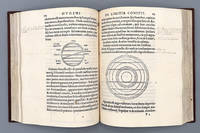
1554winter1<p><strong>PRINCEPS EDITION OF <em>DE AGRORUM CONDITIONIBUS</em></strong></p><p><strong><br />LAND SURVEYING TOPOGRAPHY</strong></p><p><br /><strong>COPY OF THE POET PASCAL ROBIN DU FAUX</strong></p><p><strong><br />FOLLOWER OF LA PLÉIADE</strong><strong> & RONSARD</strong></p><p><em>De agrorum conditionibus et constitutionibus limitum</em> . Paris Turnèbe 1554. 2 parts in 1 volume in-4 2 ff. 256 pp. 6 ff.; 20 pp. Fawn calf pastiche double frame of gilt and blind fillets cornerpieces with azured motifs central oval medallion with scrollwork motifs on an azured ground decorated spine gilt edges Devauchelle. Title-leaf backed and dust-soiled restoration to the corner of two leaves pp. 193-194 and pp. 19-20 of the second part. Dimensions: 20.5 × 15.8 cm. References: BP16_114368. Mortimer <em>Harvard French 16th c. books</em> 244. Provenance: 1. Pascal Robin du Faux 1556 "Paschasii Robini Delphii Andigenae sic 1556" manuscript note at foot of title-leaf. 2. Aymond "Emundi " 17th c. manuscript note at head of title-leaf. Languages of annotation: Latin; Greek a few words.</p><p><strong>Bibliography:</strong> J. Pineaux: "Un admirateur angevin de Ronsard : Pascal Robin du Faux" in <em>La Poésie angevine du xvie siècle au début du xviie siècle</em> Angers Presses de l'Université 1982 pp. 50-59. J. Lewis <em>Adrien Turnebus 1512-1565 a humanist observed</em> Droz 1998. P. F. Girard "Le manuscrit des Gromatici de l'évêque Jean du Tillet" in <em>Mélanges Fitting</em> Montpellier 1908 vol. II pp. 235-286. Michael Crawford "Johannes the last Agrimensor" in C. Carsana and L. Troiani eds. <em>I Percorsi di un Historikos. In Memoria di Emilio Gabba</em> 2016 pp. 216-228 appendix. <em>Les Arpenteurs romains</em> ed. J.-Y. Guillaumin Belles Lettres CUF 4 vols. M. Simonin "René Bellet et Pascal Robin du Faux : une campagne angevine en faveur de La Franciade avant 1572" <em>Mélanges Isamu Takata</em> Classiques Garnier 2009. J.-P. Barbier-Mueller <em>Dictionnaire des poètes français de la seconde moitié du XVIe siècle</em> Q-W Droz 2023.</p><p><strong>A major princeps edition of texts rediscovered during the Renaissance.</strong></p><p><br />An important princeps edition of the treatises of the Roman land surveyors including the <em>De conditionibus agrorum</em> of Siculus Flaccus the <em>De agrorum qualitate et controversis limitum</em> of Frontinus the <em>De limitibus constituendis</em> of Hyginus "the gromaticus" and the <em>De controversiis agrorum</em> of Agennius Urbicus. This corpus is a 5th6th-century compilation of land-surveying and boundary-setting texts from the Roman Empire dating back to the 1st century with agrarian implications use of the cadastre and calculation of tax architectural and religious ones e.g. the layout of a temple. It contains the foundations of surveying the typology of lands the art of tracing boundaries and boundary-marking procedures measurements and plans.</p><p>The work is illustrated with about 150 woodcuts diagrams and schemata inspired by the famous Wolfenbüttel manuscript and our copy is indeed complete with leaf 134bis a printed cancel. It notably includes the figure of the gnomon p. 117 an astronomical instrument whose shadow visualises the movement of the Sun across the celestial vault very valuable for topographical recordings. Adrien Turnèbe is the architect of the edition assisted by Pierre Galland whose dedicatory epistle to Cardinal Charles de Lorraine opens the book. The editors relied on the manuscript they had discovered ten years earlier at the abbey of Saint-Bertin in Saint-Omer today preserved at Wolfenbüttel: Cod. Guelf. 105 Gud. lat.; see Lewis 1998 pp. 38-39 and M. Crawford 2016. After completing most of the edition Turnèbe was given through Gentien Hervetwho was in contact with Pascal Robin our annotator cf. belowa copy of an important Italian manuscript today in the Vatican Library Ms Pal. lat. 1564 then belonging to Angelo Colocci. Hervet likely obtained access to it in Italy through Jean Matal who notes in his copy of the Turnèbe edition regarding passages he transcribed from the Colocci ms.: "I had them copied for Jean du Tillet who showed them to the Parisians" Girard 1908 p. 238. Turnèbe decided to list the main textual contributions provided by Gentien Hervet at the end of the edition in a list of <em>variae lectiones</em> on pp. 247-256.</p><p><strong>Precious copy of the Angevin poet Pascal Robin Seigneur du Faux 1538-1593 an epigone of Ronsard who entered 130 fine scholarly notes in our copy.</strong><br />A follower and devotee of the poets of the Pléiade admirer of Ronsard he wrote numerous occasional pieces or liminary poems: notably for the <em>Oeuvres</em> of Remy Belleau in 1585; and especially for Ronsard's tomb volume: <em>Les funèbres regrets sur la mort de Pierre de Ronsard</em> Paris Linocier 1586 for which he wrote pp. 7-21 including an "Epitaph of Pierre de Ronsard Gentleman of Vendôme Prince of French Poets". In 1582 he announced the publication of an <em>Angiade</em>modelled on <em>La Franciade</em>which however was never completed. Two other poetic collections are attributed to him: <em>Les Sonnets d'Estrenes</em> and <em>Les Vendanges</em> 1572 the latter dedicated to the Duke of Anjou. He also supplied a liminary dizain for the French translation of Saint Augustine's <em>City of God</em> published in 1570 by Gentien Hervetclearly a close associate. Robin du Faux was also very closely connected with the bibliographer La Croix Du Maine and with legal-scholarly circles in Anjou cf. J. Pineaux M. Simonin and Barbier-Mueller.</p><p>Our poet took particular interest in ancient topography: which explainsalong with his closeness to Gentien Hervethis interest in this work on surveying. It is also known that Robin du Faux collaborated on Belleforest's <em>Cosmographie Universelle</em>. As M. Simonin reminds us Robin contributed "at the request of Nicolas Chesneau and Michel Sonnius to this enterprise which bears the name of Belleforest". See on the subject the long article by Jacques Pineaux: "Un admirateur angevin de Ronsard : Pascal Robin du Faux" in <em>La Poésie angevine du xvie siècle au début du xviie siècle</em> Angers Presses de l'Université 1982 pp. 50-59. One also finds in the <em>Cosmographie universelle</em> concerning the environs of Angers Robin du Faux's identification of the village of Reculée described as "a pleasure house near Angers" with Herculée. This is a point of ancient geography that Robin also mentions in one of his poems: "Du grand Hercule a bosquet d'Herculée / Que l'ignorance appelle Recullée" <em>Les Vendanges</em> Nantes Jacques Rousseau 1572.</p><p><strong>Topographical technical & scholarly notes</strong><br />Robin du Faux particularly sought to record systematically in the margins the readings of the Italian manuscript discovered by Gentien Hervet with whom he was in contact and took care to indicate the variants. The most striking variant concerns the beginning of Hyginus's <em>De limitis constituendis</em> p. 91 which elicits the following note with a cross-reference to the end of the work for the alternative beginning: "below fol. 256 another beginning for this book has been added from the Italian manuscript according to Hervet Infra fol. 256 aliud hujus libri initium est additum ex Herveti exemplari italico." Epigraphic considerations require that the examples of <em>tabulae</em> given by Hyginus be accurate: just as Pierre Pithou did in his copy BnF RES-F-891 Pascal Robin restores from the second manuscript the names "P. Tith. filio et Augerio Sullo" missing from the base text p. 132. Robin notes other variants of significant meaning: p. 220 in the short treatise <em>De Casae litterarum</em> concerning the question of the shape of the estate he observes that Turnèbe's text reads <em>rectagoni</em> "rectangle" whereas the Italian manuscript reads <em>tetragoni</em> "square". Several annotations testify to his knowledge of Roman historians: p. 168 regarding <em>scorosiones</em> heaps of rocks he recalls that these evoke Gallic oppida with a reference to Caesar. He is likely thinking of a passage in <em>The Gallic War</em>VI 17 where tumuli erected to Mercury by the Gauls are mentioned. His critical sense appears in a marginal note on Berossus where he shows that he knows it is a dubious source in fact a forgery produced by Annius of Viterbo at the end of the 15th century: "one is close to falsehood and almost to fable unless you trust the history of Berossus" <em>Propinquum tô muthô fabulosumque fere nisi Berosi historiam agnosces</em>. In Hyginus's treatise <em>On Boundaries</em> p. 145 Hyginus 25 CUF ed. vol. II p. 9 he pauses on a development concerning the "quaestorian lands" that is lands entrusted by the people to the authority of the quaestors. He adds a reference to Suetonius's <em>Life of Augustus</em> after writing in Greek the word <em>plinthides</em> a measure designating one hundred <em>jugera</em> of land. He is sometimes halted by questions of etymology etymon of <em>territorium</em> p. 71.</p><p>The second annotator who probably took possession of the book in the 17th century shows interest in technical matters. He adds complementary references: he advises p. 229 referring to Columella for the Gallic agrarian measure <em>arapennis</em> Columella 516 takes interest p. 171 in <em>botontines</em> mounds of earth serving as boundary-markers between plots and refers for additional information to a letter by Symmachus. He does not neglect more contextual developments and thus underlines a passage from Agennius Urbicus's treatise <em>On Land Disputes</em> concerning the increase in the number of Christian faithful in Italy p. 74.</p><p><strong>A precious work annotated by a poet contemporary with Ronsard</strong></p>