55 résultats
185319979Paris: J.-B. Baillière 1853. tlas with 45 plates 26 hand-colored. Text volumes in original printed wrappers atlas in original printed boards rebacked with corners worn. Ownership signature on the atlas of F.A. Alves with his small stamp on title. Francisco Antonio Alves 1832-1873 was chair of physiology and medicine at the University of Coimbra in Portugal and a co-author of a paper on chemical analyses of the water of Coimbra in 1871. First edition of this pioneering work in biochemistry. Robin sought to advance his belief that the future of biological research lay in chemical not cellular analysis. Written in collaboration with the chemist F. Verdeil the book analyzes and compares the different components of human and animal tissues. The atlas depicts some twelve hundred crystalline forms of these compounds as they appear under the microscope. “For him Robin the real seat of life was constituted by the humoral parts of the organism. Beyond the fixed anatomical elements there must be he thought a molecular organization that explained the morphology. In his opinion therefore microscopic investigation was only a stage of biological research and must be followed by chemical analysis.â€<br /> <br /> Robin 1821-1885 was one of the great micrographers of the nineteenth century. He studied medicine at the Faculté de Médécine in Paris where he assumed the chair in natural history. A protégé of Auguste Comte he was won over to the idea of a general science of biology and helped to create the Société de Biologie to promote biological research in France. The Société wanted to distance themselves from what they perceived as the excessively narrow and practical focus of the mainstream of the Paris clinical school. “What is visible at least in the Société’s stated program is an unmistakable shift in the balance between physiology and pathology and between pure science and its applications in the medical art†Lesch. A prolific author Robin’s influence waned with his reluctance to accept later advances in cellular biology such as the discoveries of Pasteur and Virchow. Verdeil was an organic chemist who studied with Liebig publishing his first paper in 1846.<br /> <br /> Bullock History of bacteriology 1938 392; DSB XI 491-492; Hirsch IV 839; Lesch Science and medicine in France 1984 222-224; Waller 8054. J.-B. Baillière unknown
1839013759Paris: Eugene et Victor Penaud Freres 1839. Text in French. 8 Volumes. Contemporary original quarter green calf leather binding with gilt rulling and lettering on spine. Marbled covers and endsheets. Sprinkled edges. This is the Nouvelle edition with two hand colored plates of the various cosutumes in each of the volumes. frontispiece and other black and white plates. Light foxing to some plates not detracting from their beauty. Ribbon-bookmark on each volume. Overall in excellent condition. . New Edition. Quarter Calf Leather. Near Fine. 8vo - over 7¾" - 9¾" tall. Hardcover. Eugene et Victor Penaud Freres Hardcover
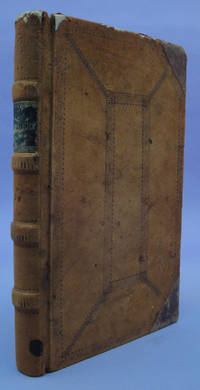
184942428Northumberland County PA 1849. <p>Robin Joseph Craven 1806-93. Manuscript medical daybook / ledger. Approx. 260pp. 19 or 20 pages pasted with clippings primarily poetry. Northumberland County PA 1849-62. 328 x 203 mm. Original reverse calf stamped in black worn. A few leaves in front loose light toning and spotting but a very good example.</p> <p>Medical ledger and daybook of Dr. Joseph Craven Robin the first physician to locate and practice in Elysburg Pennsylvania. "He first read medicine with his brother William at Sunbury completing his professional preparation at the University of Pennsylvania and in 1828 began practice at Sunbury. The following year he removed to Elysburg at which point he was the first physician to locate permanently and he was in active practice there for forty-two years his field covering all the eastern part of Northumberland County and the adjoining portions of Montour Columbia and Schuylkill counties. He was of the old 'saddle-bag' doctors and in spite of the hardships of a physician's life in his day survived all his fellow practitioners who were in practice at the time his career began living to the advanced age of eighty-seven years. He retired from active professional labors about 1870" Floyd's Northumberland County Genealogy.</p> unknown