903 résultats
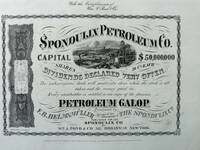
1865List2532New York: Wm. A. Pond 1865. Folio 13 ½ x 10 ½ inches. Fine condition. Fine. An unusual use of sheet music as satire with the lithographed cover showing a fake stock certificate. The cover - engraved by Major & Knapp - advertises an ownership share in the Spondolix Petroleum company and states that F.B. Helmsmuller who was actually a noted composer was the “Treasurer and General Manager†of the company. This is a particularly fine example of the piece. In our research we found several references to this piece as being a real stock certificate for a real company however this is clearly a parody of the oil business. This was printed in 1865 when the Pennsylvania oil industry was booming and the engraved illustration appears to show a countryside scene in Pennsylvania or somewhere similar. Four copies in OCLC. Wm. A. Pond unknown
192556537Chicago IL & La Crosse WI: Standard Oil Company Indiana; Stanolind Record 1925-1929. Two vols. 1st - 4to. 9 x 11.5 in. Approx 120 leaves many added leaves over numbering. mimeographed sheets throughout w/ text illustrations diagrams and decorative lettering with 15 sample sales brochures & catalogues most 12mo. & 16mo. w/ 4 to 24 pp. most illustrated several printed in colour inks and all retaining their original covers carefully tipped-in to their respective sections. Three-quarter black cloth over gray boards post-binder brass split-pin posts at gutter margin occasional minor creasing to a few corners light interior toning still VG copy; together with 2nd -- 8vo. 72 pp. Numerous photo & text illustrations. Colour-illustrated softcovers bound into simulated black calf gilt lettering stamped on front cover rounded corners minor shelfwear rubbing still VG copies of both from the library of Andrew Edward MacMeekin 1884-1949 who was the purchasing manager for Standard Oil of Indiana at the main offices in Chicago IL from before World War I to his death w/ his ownership stamp on front cover of the Stanolind vol. First editions of these very scarce Standard Oil Company Indiana sales publications by one of the independent oil companies to emerge after the breakup of Standard Oil in 1911. Standard Oil Indiana pioneered the “cracking†process for refining crude oil under pressure resulting in far higher yields of gasoline and the many byproducts and by the mid-1920s was the third largest oil refiner in the U.S. behind Standard Oil New Jersey and Standard Oil California. This very scarce salesman’s advertising manual was created for distribution around the time that Standard Indiana had merged with the American Oil Co. Amoco and was looking to streamline both their purchasing and marketing pitches to service stations wholesalers and jobbers. The manual continually extolls the product diversity and reach of the Standard Indiana Company with Sinclair Dixie Pan-American Petroleum and Midwest Refining as subsidiaries the extensive fleet of oil tankers railroad tank cars and chain of service stations. The splendid sample catalogues encompass a range of styles and products including Red Crown gasoline featuring an Art Deco cover of a Standard Oil service station; the high octane Red crown Gasoline; Neolite kerosene for more efficiently and economically raising poultry; competing motor oils of Iso-Vis and Polarine designed for Ford engines; as well as Mica Axle Grease used to coat hog scratching poles; Merusol Petrolatum White petrolatum used as a non-stick coating for bakeries and with a number of “medical†applications as well or the KIP insecticide used for everything from ants and flies to bed bugs and mosquitoes. Also included are customer sales letters sample thank you letters sales goals tips and more. The second volume focuses on an extended article by MacMeekin on the Standard Indiana purchasing department which at the end of the 1920s was spending over $ 50 million a year on 14000 different items ranging from rare Asian flowers to wax from the head of whales pins by the ton locomotives and everything else to fuel the massive oil company. Detailed list of tipped-in catalogues available upon request. No copies located in Worldcat for Sales Manual very incomplete runs and records for holdings of Stanolind Record BP Archive appears to have an issue as well as Univ. of Illinois but incomplete records and run; See: Mark Wilson Stephen Porter Janice Reiff Standard Oil Company Indiana Dictionary of Leading Chicago Businesses 1820-2000. Standard Oil Company (Indiana); Stanolind Record, paperback
200703674Paris, Gauthier villars, 1964 ; petit in-4, 288 pp., pleine toile éditeur. Recueil des principaux termes et expressions usuel en france, dans l'industrie du pétrole.
200617270Paris, Shell france 42, rue Washington, 1950 ; in-8, 48 pp., broché, couverture illustr.
42758P., Les Cahiers de Contre-Enseignement Prolétarien, 1re Série, N°8, Octobre 1932, petit in 8° broché, 59 pages ; couvertuer légèrement fanée.
72012P., Direction Production, Division Gisements, Diffusion Interne, janvier 1989, in 8° relilé pleine toile de l'éditeur, 238 pages.
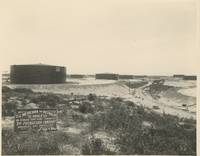
1922List01111Mexico 1922. Various sizes and formats generally preserved in excellent condition. Near Fine. Founded in 1902 the Foundation Company was a subaqueous concrete construction firm based in New York City. According to the Smithsonian the company was “a leader in the development of the pneumatic caisson method for the construction of foundations†— this method was used to build the skyscrapers of New York City and applied to many other types of construction projects as well. The Foundation Company archive consists of photographs blueprints correspondences and business documents relating to construction work that the company undertook in Tampico Mexico between 1915-1922. Tampico was the center of the Mexican oil boom that began at the beginning of the century. The foreign oil industry’s role in this boom was a key issue in the Mexican revolution that spanned roughly 1910-1920. <br /> <br /> After an American drilled the first oil well in Tampico in 1901 foreign companies descended into the town and took full advantage of the oil boom. The large amounts of oil in the region paired with the demand created by the allies in World War I — the United States and British Navies had converted from coal to oil — contributed to the rapid growth of the industry. According to historian Jonathan Brown “A booming foreign market and anemic domestic consumption of Mexican oil production gave many advantages to the foreign oilmen. They proceeded to create an Anglo-American capitalist haven out of the Huasteca.†The Foundation Company contracted with some of the most prominent oil companies in Tampico: El Aguila La Corona and the Transcontinental Petroleum Company. These companies were British Dutch and American. Foreign companies were attracted to Mexico because of the abundance of oil as well as the loose regulations: “At a time when the federal and state authorities in the United States were tightening the regulation of business and busting the trusts the expatriot American oilmen viewed Mexico as the new frontier of deregulation.†<br /> <br /> One reason that the Mexican government did not tighten regulations was because of the politics of the revolution. The competing factions of the revolution took advantage of the success of the oil industry — the only sector of the economy that continued to grow during that time — through taxes and forced loans. “Those who fought for political power and there were many sought to deny the federal authorities control of the oil fields. The result was a buildup of government resentment toward the freewheeling powerful foreign interests threats of drastic action against the oil companies but little governmental influence on how the nation's oil business was being conducted.†In this way the oil industry financed the revolution and also catalyzed increased economic nationalism. “Economic nationalism in Mexico had a social base and that is why the social revolution of 1910 to 1920 also produced an economic nationalism bent on reducing the power of the foreign oil companies.†The Mexican revolution produced the 1917 constitution still in place today which changed the rules for foreign businesses operating in Mexico. After years of companies resisting these regulations in 1938 President Lazaro Cardenas expropriated the foreign owned oil industry.<br /> <br /> The bulk of the documents in this archive are from 1921 and 1922 towards the end of the revolution. The documents are all written in English demonstrating the extent to which foreign companies were able to operate on their own terms despite their projects being in Mexico. The photographs and documents show the flurry of projects that the company quickly acquired in Tampico. In 1921 the Industrial Development and Manufacturers Record reported that “more big construction contracts are being carried out in the Tampico region at this time than ever before in the history of the oil industry in Mexico.†Indeed only a few months after beginning work in Mexico in 1921 the Foundation Company had 4000 men on payroll and 12 projects. These projects included a 30000-barrel refinery and 120 kilometer pipeline for the Corona Petroleum Co. and a 5 story office building for the Transcontinental Petroleum Co. The documents in this archive do not reference the revolution but they do demonstrate the rapid growth and resulting power that foreign businesses in Tampico enjoyed.<br /> <br /> <br /> <br /> Inventory <br /> <br /> 25 photographs 8x10 inches April 19- Sept 30 1921. 12 undated. One cardboard pouch containing 5 photo negatives; pouch is 5 x 7 inches negatives are 3.5 x 5.5 inches.<br /> <br /> Most of the photographs are of construction sites and the company has used a placard to write the name of the contracting company the project type their own company name and the date. These signs show that the Foundation Company was working on an Oil Storage Tank Farm and a Bulkhead for El Aguila; and a pipeline super pumps “boilers valley†and pump house for La Corona. <br /> <br /> Two letters 8.5 x 11 inches 1921-1922. <br /> <br /> Dec 3 1921 letter is addressed to Grant Huntly and contains a list of materials required for the wall size used in the Transcontinental Building. July 12 1922 letter is from Edward Swann DA of County New York saying that Grant Huntley does not have a criminal record in the last 5 years. Addressed to Hon. Ernesto C. Perez Argentine Consul-General at a New York City address. Grant Huntley was an engineer at the Foundation Company.<br /> <br /> 5 documents relating to business operations 1915-1921. Ranging in size from 6.5x 8.5- 11x17 inches.<br /> <br /> These inventories spreadsheets and progress reports reference a bag loading plan in Richmond VA; a La Corona Warehouse at Panuco Valley Terminal; and the cost data of the Transcontinental Petroleum Company’s Office Building.<br /> <br /> 5 blueprints March - August 1921. One undated. Blueprints are all different sizes ranging from 16.5x27 - 30.5x41 inches.<br /> <br /> Blueprints depict plans for: an Oil Barge; a Pile Driver to be used at Aguila’s Bulkhead; a 64000 bbl tank; the Richmond VA Bag Loading Plant. unknown
193450958Houston TX: Refiner and Natural Gasoline Manufacturer A Gulf Publishing Co. Publication 1934. Two parts in one. 4to. 4 194; 162 pp. 100s of photo illustrations diagrams blueprints. Embossed & ribbed dark blue cloth raised gilt & blue decoration & lettering on front cover & spine minor soiling lower fore-edge minor wear to corners minor fraying & slight chipping foot of spine still G copy. Fourth edition of this substantially revised and lavishly illustrated work detailing all of the supply companies manufacturers and equipment available for oil producers refiners ice makers workers as well as food canning and packing. There are reference to asbestos products as well as the extensive process handbook containing blueprints and specialized equipment for distillation cracking lube plants treating gasoline plants and synthesis in refineries. Refiner and Natural Gasoline Manufacturer, A Gulf Publishing Co., Publication, hardcover
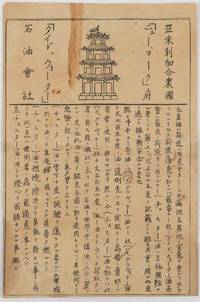
1900178304Japan.: No publication details. Late Meiji circa1900. Mimeograph handbill printed on one side showing signs of wear browned with 7 cm vertical stain from upper margin horizontal crease. 24 x 16cm This mimeographed document from Tide Water Petroleum an American company founded in New York in 1887 presents details about various oil types including high-gravity oil and "Chester oil". According to the document the former ignites at 150 degrees Celsius whereas the latter remains unfrozen even at minus 10 degrees Celsius. Furthermore the latter oil does not produce any odor when it undergoes combustion. . No publication details. unknown
196126016Alger Baconnier Imprimeur pour SHELL ALGERIE 1961 un dépliant publicitaire cartonné illustré en couleur de La Firme SHELL en Algérie, format 21 x 25.1cm replié, 62.6 x 49.8cm déplié, carte des dépots SHELL en ALGÉRIE, sans date (1961)Alger Baconnier Imprimeur pour SHELL ALGÉRIE EDITEUR,
226748[Paris], Imprimerie nationale, novembre 1870 placard in-folio (56 x 45 cm), en feuille. Bords ébarbés, un angle supérieur froissé.
1962LFA-126734880"Revue mensuelle de l'essentiel" : 112 pages, format 150 x 210 mm, illustrée, brochée, bon état
9263LA REVUE PETROLIFERE. Revue générale du pétrole, n° 385, 16 août 1930. In-4, agrafé.
201117172Strasbourg, La nuée bleue - revue trimestrielle, 1974 ; in-8, br. N° 52.
1944LFA-126735058Une revue de 56 pages, format 165 x 245 mm, illustrée, brochée couverture couleurs, bon état
1956J0219Paris, G. Doin & Cie Éditeurs, 1956 ; in-8, VIII-304 pp. + 12 pl. hors-texte, broché. «Géologie» publiée sous la direction de M. Albert Obré. Préface de M. Albert Obré. A l'usage des candidats aux Grandes Ecoles. Quelques illustrations en noir et blanc et en couleurs. Bon état.
Paris, G. Doin & Cie Éditeurs, 1956; in-8, VIII-304 pp. + 12 pl. hors-texte, broché. « Géologie » publiée sous la direction de M. Albert Obré. Préface de M. Albert Obré. A l'usage des candidats aux Grandes Ecoles. Quelques illustrations en noir et blanc et en couleurs. Bon état.
1936LFA-126715332Un ouvrage de 562 pages, format 165 x 255 mm, illustré, broché, publié en 1936, bon état
2011LFA-126745466Un ouvrage de 118 pages, format 215 x 280 mm, illustré, relié cartonnage couleurs, publié en 2011, La Petite Presse, bon état
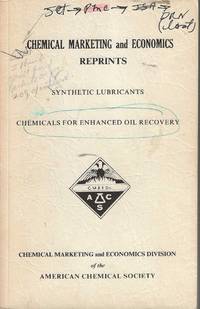
19806799American Chemical Society. Very Good. 1980. Reprint. Softcover. Book is tight. Symposium sponsored by Division of Chemical Marketing and Economics held at Spring meeting of Am. Chemical Society in Houston on March 26 1980. Front cover has writing and marks. There are also pencil marks on pages 213 and 318. Cover is shelf worn. ; 16mo 6" - 7" tall . American Chemical Society paperback
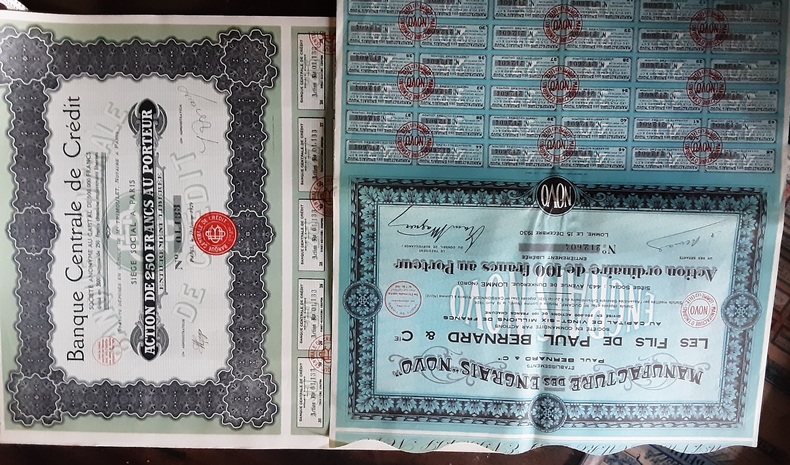
1920CCC-1140Lot de 20 actions : Union charbonnière continentale "charbonnière " action 100 francs au porteur, Paris 1929. Société Générale dès graphistes, action de 100 francs au porteur, Madagascar. La petite metallurgie, part au porteur sans valeur nominale, Paris 1928. Société pétrolière française "caracas" , action de 100 francs au porteur. Banco franco-espagnol, action de 250 pesetas or au porteur, Madrid 1906. Bertagna Société agricole algérienne, action de 100 francs au porteur, 2 Août 1928. Action russe, 3% or 1891. S.A.M.O,action de 50 nouveau francs au porteur, Vendôme. 2 actions : Compagnie agricole & forestière du Cameroun, action de 500 mille francs au porteur, Cameroun et La holding française, action ordinaire de 100 francs au porteur, Paris. Énergie électrique du Rhin, action "0" de 500 francs, Mulhouse 1933. Société fermière du grand casino de saint Raphaël, 100 francs , Saint Raphaël 1925. Société anonyme du parc des sports de bordeaux-lescure, 100 francs, Bordeaux 1923. Banque de Strasbourg, part bénéficiaire au porteur, Strasbourg 1935. Société centrale des banques de Provence, 125 francs catégorie B, Paris 1928. Charbonnages & électricité du sud-est, 100 francs au porteur. Société forezienne du granit Perrin, 500 francs obligation 7% net d’impôt. Pétroles Bellik à Gros yeux, 500 francs, Paris 1921. Compagnie mexicana de Pétrole " El aguila" S.A, Mexico 1949. Manufacture des engrais "Novo", les fils de Paul Bernard &Cie, 100 francs, lomme 1930 et Banque centrale de crédit, 250 francs, Paris 1929. Envoie du lot des 20 actions.
202611324E. Bernard Imprimeur-Éditeur 2026 504 pages IN4. 2026. reliure editeur. 504 pages. Traité technique détaillé sur les moteurs à gaz à essence et à pétrole écrit par Aimé Witz ingénieur et correspondant de l'Académie des sciences. L'ouvrage présente à la fois les aspects théoriques et pratiques de ces moteurs avec plusieurs éditions publié en 1903
1990LFA-126724219Un album de 30 pages, format 210 x 270 mm, illustré, broché couverture couleurs, publié en 1990, Casterman, collection "Cadet-Rama", bon état
1990LFA-126726058Un ouvrage de 84 pages, format 160 x 240 mm, illustré, broché couverture couleurs, publié en 1990, Le Léopard d'Or, collection "L'Homme et..." (dirigée par Louis David), bon état
1928E110305Lausanne, Impr. Commerciale 1928 166 + 46 pp., 23cm., br.orig.? Dissertation présentée à l'Ecole des Hautes Etudes Commerciales de l'Université de Lausanne pour obtenir le grade de docteur ès sciences commerciales et économiques, cachet au verso de la p.d.t., texte frais, E110305