28 résultats
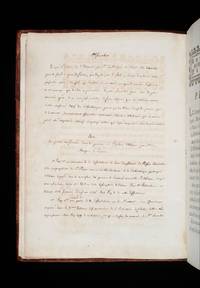
176611625Amsterdam and Paris: P.-F. Gueffier 1766. Contemporary cat’s paw sheep neatly restored slightly defective gilt spine and label red edges pink silk marker; interleaved throughout — a vertical crease divides the interleaves in two columns. <p>With: Jousse Daniel-Charles.       1742-1769.<br />        Lettre D’Un Orléanois…Sur La Nouvelle Histoire De L’Orléanois. Bruxelles and Paris E. Flon and J. Debure 1766. 12mo 173 x 110 mm. inlaid in blank quarto sheets for binding. 40p.</p> <br /> <p>      Ad I-II: This volume belonged to the local historian and Orléans Cathedral canon Louis-Eusèbe Loiseau 1721-95.<br />       Ad I: ALL PUBLISHED SUPPRESSED. Only Edition. Luchet believed “Good history is a long fable†p. iv tr. Immediately upon publication of this first volume of a projected five Luchet’s fanciful account of the history of Orléans and environs 52 B.C.E. to 1428 C.E. came under fire. He had manufactured personal information abandoned the facts cloven to the marvelous and doubted Jeanne d’Arc’s divine mission pp. 307-419. This last angered the clergy and THE DUC D’ORLÉANS FORCED THE AUTHOR TO BUY UP AND DESTROY THE EDITION.<br />       COUNTERING LUCHET’S FANTASIES LOISEAU COMPILED HIS OWN THIRTY THOUSAND WORD DOUBLE-COLUMN CHRONOLOGY filling 115 interleaf pages. Its preface summarizes Luchet’s History — “detestable in substance and form†tr. lists errors and sketches a damning biography of Luchet. One column of the manuscript chronology draws on Polluche’s Essais historiques sur Orléans 1778 and the other on articles in Calendrier historique d’Orléanois by the Orléans Maurist librarian Louis Fabre 1710-98.<br />       The longest and earliest inserted manuscript is A FIFTEEN-PAGE ESSAY UNFAVORABLE TO LUCHET’S HISTORY identifying still more inaccuracies nine concern Jeanne d’Arc. The Mémoire takes a statistical and economic perspective on Orléans its architecture and exports. Signed by Loiseau the Observations treats the by-laws of the new Orléans learned society born of the 1786 merger of two earlier groups. Loiseau was secretary of one for 25 years 1761-85.<br /> ¶Lanéry d’Arc Le Livre d’or de Jeanne d’Arc. Bibliographie 700; Lelong Bibliothèque historique de la France III: 35603-4; Brainne et al. Les Hommes illustres de l’Orléanais I: 250-2.<br />       Ad II: Only Edition the author’s sole book and the first published attack on Luchet’s History. Exposing 108 blunders with context and secondary source proof Jousse used material gathered by his father 1710-81 who supplied all the entries related to Orléans in Lelong’s Bibliothèque historique 1768-78.<br /> ¶Lanéry d’Arc 700; Lelong III: 35604; Conlon Le Siècle des Lumières 66:976.<br />       All items are in good condition.</p> P.-F. Gueffier unknown
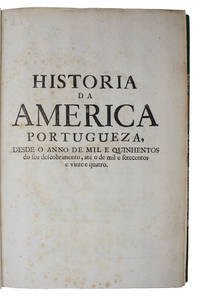
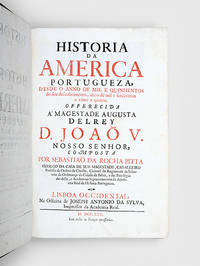
173060026Lisboa Occidental na Officina de Joseph Antonio da Sylva 1730. Folio 29 x 195 mm. In recent green half calf with five raised bands and gilt lettering and ornamentation to spine. Title-page mounted and with repair to outer margin no loss of text. Last leaf with repair to lower outer corner also with no loss of text. First and least few leaves with brownspotting. Very light browning in margins throughout. Title printed in red and black woodcut initials and head-pieces. A fine and clean copy. 14 716 pp. Here with the often missing half title but wanting the final blank. <br/><br/><em>Rare first edition here with the often missing half title of the first general history of Brazil – “This work is extremely copious in the details of its foundation as a colony its successive governors its churches its monasteries and convents†Sabin. "This first edition is becoming rare and is much sought after by Brazilians . since it is the first history of Brazil to have been printed and since it was written by a Brazilian" Borba de Moraes. The author's purpose was to narrate the events that had taken place in Brazil with the help of "truthful reports" these largely from Jesuit sources and "modern information" given by those who had traveled in the vast Brazilian territory. This was the only history of Brazil available to Pitta’s contemporaries since most of the others composed in the first two centuries of colonization remained in manuscript form until the nineteenth century. Rocha Pitta was born in Bahia in 1660 and died in the year 1738. At the age of 22 he left the University of Coimbra where he took his degree to return to Bahia where he got married. He made up his mind to write a history of Brazil and he spent years in collecting documents in the Monasteries of Brazil and Portugal where he went in order to study French Dutch and Italian for the purposes of his history. “In 1728 after 40 years of study he began to print his history which appeared in 1730. It was universally well received and King John V. appointed him a member of the household in consequence yet in a few years the Portuguese government publicly prohibited its being read under the severest penalties.†Sabin.Sabin 72300 Borba de Moraes 1983 p. 748 </em> hardcover
1730176140Lisbon: Joseph Antonio da Sylva Impressor da Academia Real 1730. The first history of Brazil First edition "much sought after by Brazilians" Borba de Moraes. Sebastiao da Rocha Pitta 1660-1738 was himself Brazilian having been born in Bahia. This is an attractive copy of this rare and important work in a carefully restored contemporary binding. The last copy to appear at auction was in 1985. "Though scornfully dismissed by Robert Southey as being 'a meagre and inaccurate work which has been accounted valuable merely because there is no other' the Historia does not deserve such censure. For all its Gongoric turgidity it contains some valuable and authentic information being on some points more fair-minded and accurate than Southey's better written but more prejudiced work" Boxer p. 160. Thomas Lindley writing in his Narrative of a Voyage to Brazil 1805 is less dismissive and certainly more specific in his criticisms describing Pitta as "an intelligent and well-informed Brazilian" who compiled his history "from the chronicles of the Jesuits and other authorities and some valuable local knowledge of his own. This work is copious in its details of the foundation of Brazil as a colony its successive governors its churches its monasteries and convents". However Lindley was less enthusiastic about Pitta's coverage of natural history manufacturing and commerce but the Historia is evidently more of an old-style chronicle than a practical up-to-the-minute guidebook. Lindley also remarks that the Portuguese government "publicly prohibited its being read under the severest penalties and it is now only met with carefully secluded in the cabinets of the curious". Quarto 295 x 197 mm pp. xxvi ii blank 716. Title printed in red and black woodcut headpieces; bound with the half-title and the integral blank before the main body of the text which are frequently lacking. Contemporary sprinkled sheep new dark red morocco label compartments gilt with scrolled foliate corner-pieces floral lozenge central tools edges sprinkled red and blue. Binding a little rubbed and worn in some places some stripping from the front cover. Judicious restoration to spine ends and joints expert repair to head of front board occasional professional paper repairs to margins. Short closed tear to half-title page pale tidemark in margin of last few leaves; overall a very good copy. Borba de Moraes 1983 II 678; Sabin 72300. C. R. Boxer The Golden Age of Brazil 1695-1750: Growing Pains of a Colonial Society 1962. unknown