73 résultats
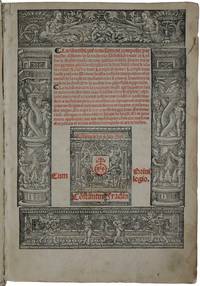
15204636Lyon: Guillaume Huyon for Constantin Fradin 1520. First edition. <p>First edition extremely rare. La Roche was a student of Nicolas Chuquet and published for the first time in the present work large sections from Chuquet's Le Triparty en la Science des Nombres the most original mathematical work of the fifteenth century. The work also "presented an outstanding view of contemporary methods of computation and their applications in trade" DSB. Chuquet's work of which a single manuscript survives remained unpublished until 1881.</p>. Hardcover. THE FIRST PUBLISHED WORK ON ALGEBRA IN FRENCH. <p>First edition extremely rare of the first published work on algebra in French. This is a fine copy in a beautiful contemporary binding. Born in Lyon then the principal commercial centre of France La Roche was a student of Nicolas Chuquet and published for the first time in the present work large sections from Chuquet's Le Triparty en la Science des Nombres the most original mathematical work of the fifteenth century. Chuquet's work of which a single manuscript survives BNF Fonds français 1346 remained unpublished until 1881. La Roche's work thus printed for the first time several important innovations in arithmetic and algebra introduced by Chuquet: the use of exponents to denote powers of a number often credited to Descartes who introduced them in his Géométrie more than a century later; the use of the 'second unknown' see below in the solution of systems of linear equations which was an important step towards the invention of symbolic algebra by Viète; the use of negative numbers in the solution of equations; and the introduction of our terms 'million' 'billion' and 'trillion' for powers of 106. La Roche also includes Chuquet's 'règle des nombres moyens' according to which a fraction could be found between any two given fractions by taking the sum of their numerators and dividing by the sum of their denominators; this rule could be used to find the solution of any problem soluble in rational numbers once an upper and a lower bound for the solution had been found. La Roche intended his work to serve the mercantile class and his account of commercial arithmetic goes considerably beyond Chuquet. "The second and greater part of La Roche's work has apart from some geometrical calculations at the end a commercial character. The author states that as a basis he used 'the flower of several masters experts in the art' of arithmetic such as Luca Pacioli supplemented by his own knowledge of business practice . La Roche's work presented an outstanding view of contemporary methods of computation and their applications in trade" DSB. OCLC lists copies at Columbia and Harvard only in North America. ABPC/RBH list only the Macclesfield copy rebound in the 19th century since Honeyman Sotheby's April 14 2005 lot 1204 £19200 = $36409. The present copy was offered by Librairie Thomas-Scheler in 1996 Catalogue Nouvelle Série No. 15 n. 296 120000F. </p> <br /> <p>"We do not know much about de la Roche c. 1470-1530. Tax registers from Lyon reveal that his father lived in the Rue Neuve in the 1480s and that Estienne owned more than one property in Villefranche from which he derived his nickname. De la Roche is described as a 'master of argorisme' as he taught merchant arithmetic for 25 years at Lyon. He owned the manuscript of the Triparty after the death of Chuquet 1488. It is therefore considered that de la Roche was on friendly terms with Chuquet and possibly learned mathematics from him.</p> <br /> <p>"The importance of the Larismethique has been seriously underestimated. There are several reasons for this. Probably the most important one is Aristide Marre's misrepresentation of the Larismethique as a grave case of plagiarism. Marre discovered that the printed work by Estienne de la Roche contained large fragments that were literally copied from Chuquet's manuscript Marre Le Triparty . par Maistre Nicolas Chuquet 1881 introduction" Heeffer pp. 1-2. But Barbara Moss argues that "the charge of plagiarism against Estienne de la Roche is largely an anachronism . Before the spread of printing academic knowledge had been disseminated through the copying of manuscripts and Chuquet like many of his contemporaries must have written down for reference a large number of examples from the work of others with or without a note of their source . De la Roche's use of citations and sources is similar to that in a number of printed arithmetics of that period. Following the usual commendation of mathematics for its 'great utility and necessity' he continues: 'I have collected and amassed the flowers of several masters expert in this art such as master Nicolas Chuquet Parisian Philippe Frescobaldi Florentine and Brother Luke of Borgo Pacioli with some small addition of what I have been able to invent and test out in my time in its practice' first unnumbered page" Moss pp. 117-9.</p> <br /> <p>Moreover "giving a transcription of the problem text only Marre withholds that for many of the solutions to Chuquet's problems de la Roche uses different methods and an improved symbolism. In general the Larismethique is a much better structured text than the Triparty and one intended for a specific audience. Chuquet was a bachelor in medicine educated in Paris within the scholarly tradition and well acquainted with Boethius and Euclid. On the other hand de la Roche was a reckoning master operating within the abbaco tradition. It becomes clear from the structure of the book that de la Roche had his own didactic program in mind. He produced a book for teaching and learning arithmetic and geometry which met the needs of the mercantile class. He rearranges Chuquet's manuscript using Pacioli's Summa as a model. He even adopts Pacioli's classification in books distinctions and chapters. He moves problems from Chuquet's Appendice to relevant sections within the new structure. He adds introductory explanations to each section of the book such as for the second unknown discussed below. With the judgment of an experienced teacher he omits sections and problems from the Triparty which are of less use to merchants and craftsmen and adds others which were not treated by Chuquet such as problems on exchange and barter" Heeffer p. 2.</p> <br /> <p>"As far as the first book of the Triparty is concerned de la Roche is reasonably faithful to his teacher. He does include an extra chapter on the connotations of the numbers 1 to 12 which he took from Pacioli and Pacioli from St Augustine's Civita Dei. He also prefers some of the more conventional names like 'rule of false position' rather than 'rule of one position' and disagrees with Chuquet's assessment that the rule of apposition and remotion for solving indeterminate equations in integers 'is a science of little recommendation'. However he includes two of the distinctive contributions of the Triparty: nomenclature in terms of the powers of 106 up to the nonillion 1069 and the rule of intermediate terms or 'rule of mediation between the greater and the less' règle des nombres moyens" Moss p. 121.</p> <br /> <p>"Chuquet employs the words byllion trillion quadrillion quyllion sixlion septillion octillion nonillion 'et ainsi des aultres se plus oultre ou voulait proceder' to denote the second third etc. powers of a million. Evidently Chuquet had solved the difficult question of numeration. The new words used by him appear in 1520 in the printed work of La Roche. Thus the great honour of having simplified numeration of large numbers appears to belong to the French. In England and Germany the new nomenclature was not introduced until about a century and a half later. In England the words billion trillion etc. were new when Locke wrote about 1687 Human Understanding Chap. XVI. In Germany these new terms appear for the first time in 1681 . but they did not come into general use until the eighteenth century" Cajori p. 144.</p> <br /> <p>"De la Roche's algebra contains several topics that are not found in the Triparty . he has chapters on algebraic fractions on the rule of quantity a mixture of algebra and the rule of false position used for solving equations in more than one unknown and on equations with more than one solution. He also gives methods for 'proving' or checking results on algebra analogous to Chuquet's proofs in arithmetic.</p> <br /> <p>"The four canons of the rule of the first terms one for solving generalized linear equations and three for the three acceptable forms of the generalized quadratic with all coefficients positive are stated in Chuquet's terms although de la Roche gives more elementary examples and fewer which require solution by means of compound roots or roots of high order. However special cases of cubic equations with no constant term are included among the quadratics.</p> <br /> <p>"The fourth canon for solving equations of the form x2 b = ax which may have two positive roots gave rise to a minor controversy. In 1559 Jean Buteon in his Logistica attacked de la Roche's rule and claimed that it is impossible for an equation to have more than one solution. De la Roche's example to the contrary should be disallowed because he gives 1 as one of the roots and 1 according to Buteon should not be considered as a number ! .</p> <br /> <p>"The weaknesses in de la Roche's algebra are essentially those of conservatism though his work like Chuquet's is not free from careless errors. As in the case of radicals he presents the concepts of algebra both in the terminology and notation of the Triparty and in a more traditional restricted and qualitative system involving symbols not involving numbers for powers of the unknown and he prefers to use the latter . However the index notation is presented. It attracted the attention of Michel Chasles in the nineteenth century . Chasles saw no anticipation of Viete's ideas among the Italians; but he instanced the German Stifel Arithmetica integra 1544 and the Frenchmen Peletier L'Algèbre 1554 and Buteon because they used letters for unknowns and a crude form of index notation. The development of an adequate notation for exponents had hitherto been accredited to Descartes; but Chasles claimed that such a notation is already present in de la Roche's Larismethique nouellement composee" Moss pp. 121-4.</p> <br /> <p>"That de la Roche made an important contribution to the emergence of symbolic algebra during the sixteenth century can best be argued by his treatment of the second unknown sometimes called 'Regula quantitatis' or 'Rule of Quantity' . The importance of the use of letters to represent several unknowns goes much further than the introduction of a useful system of notation. It contributed to the development of the modern concept of unknown and that of a symbolic equation. These developments formed the basis on which Viète In artem analyticum isagoge 1591 could build his theory of equations . De la Roche first mentions 'la regle de la quantite' in the beginning of distinction six together with 'la regle de la chose'. He properly introduces the second unknown in a separate chapter titled Le neufiesme chapitre de la regle de la quantite annexee avec le dict primier canon et de leur application in the sixth distinction of the first part f. 42v .</p> <br /> <p>"In the Rule of Quantity de la Roche sees a perfection of algebra itself. The use of several unknowns allows for an easy solution to several problems which might otherwise be more difficult or even impossible to solve . After this introduction de la Roche gives six examples of the rule of quantity applied to the typical linear problems though he removes the practical context. Then he presents five indeterminate problems under the heading 'questions which have multiple responses' without use of the second unknown. Finally he solves five problems using the second unknown under the heading 'other inventions on numbers'. At the end of the book there is a chapter on applications in which four more problems are given ff. 149v-150r. In total there are twenty problems solved by the regle de la quantite" Heeffer pp. 3-7.</p> <br /> <p>The section on commercial arithmetic provides information about the economic life of fifteenth-century Lyon which had become one of the most important commercial centres of the Western world after Louis XI gave royal protection to the fairs established there in 1464. De la Roche discusses the currencies in use the weights and measures and the financial arrangements between partners in business enterprises. The various currencies mentioned come from different parts of France and from Germany and Italy probably all to be found in the market at Lyon. From some examples one can infer that exchange rates fluctuated considerably. Other examples may relate to actual methods of counting used by money-changers.</p> <br /> <p>"La Roche begins the commercial section independently of Chuquet by stating that numbers can be considered in three ways according to the Bible's Book of Wisdom that God the creator ordered all in measure number and weight. And thus all the affairs of the world are governed and managed by these three things which la Roche continues to examine from the monetary perspective . Dealing with numbers la Roche returns to the basic arithmetic operations in relation to the monetary and coinage system then in relation to measure and third as weight. La Roche divides the entire second part into ten chapters each divided into a number of subsections .</p> <br /> <p>"La Roche first states that all countries use the £ Lire Pound the solz sous shilling and deniers penny. The Lire is always worth 20s solz and the solz is 12d denier penny. But the £ of one country has a different value from that of another country . The section 'numbers as measure' is divided into three kinds according to the three dimensions in geometry: length ell toyse cane brasse palme etc. which is used for cloth measures. The second is the square toyse pye etc. used for tapestries mural work fields. The third way number can be considered is as weight of silver copper lead saffron ginger pepper etc. The weights systems are similar but the values differ. After the introduction follow a number of examples of calculation of different monetary values by addition and subtraction. The examples la Roche mainly took from Chuquet.</p> <br /> <p>"La Roche proceeds to explain multiplication by taking a fraction of a fraction of a higher unit . The method is very simple and easy to explain: if you buy 1200 items at 1 Euro per item the total price will be 1200 Euro; if the price is ½ Euro 50 cents the price is half the number of items which is 600 Euro etc. . The second chapter is about merchandise sold by length or size such as linen . Similar counting methods are followed in calculating the price of merchandise sold by weight in the third chapter and in the fourth chapter which describes selling merchandise by number dozen gross hundred thousand. Subsequent chapters deal with liquid measures 5 corporations 6 barter 7 exchange of money and banking 8 profit and discount 9 and gold and silver 10" Ulff-Møller.</p> <br /> <p>The final section of the book on the application of the science of numbers to geometry includes the measurement of areas and volumes. There are problems on circles triangles and polygons including many examples about inscribed figures the representation of square and cube roots various simple constructions and notes on the quadrature of the circle. This last presented some results about lunes the triangulation of the circle and series of inscribed and circumscribed circles and squares. Algebra is applied to problems of volumes leading to simple cubic equations. Thus geometry is viewed as an area to which algebra can be applied rather than a means of justifying algebraic rules.</p> <br /> <p>"The last few pages are devoted to gauging and show the same instrument as was described by La Court La fabrique et usage de la jauge 1588" Tomash. This gauge or compass so called because of its shape was used in measuring barrels. The results achieved with this instrument were at best approximate as only the bung diameter and a diagonal distance were measured - the shape of the individual barrels was not taken into account.</p> <br /> <p>A second edition of la Roche's book was published at Lyon in 1538. There is no modern edition.</p> <br /> <p>Bechtel L-47; Brunet III 842; Hoock & Jeannin L5.1; USTC 30158; von Gültlingen Huyon 12. Cajori History of Elementary Mathematics 2007. Smith Rara Arithmetica p. 128. Ulff-Møller 'Estienne de la Roche. Larismethique nouellement compose. Lyon 1520 and second edition 1538' in Rechenmeister und Mathematiker der frühen Neuzeit Gebhardt ed. 2017. For Chuquet see Flegg Graham Hay C. Moss B. Nicolas Chuquet Renaissance Mathematician. A study with extensive translation of Chuquet's mathematical manuscript completed in 1484 1985.</p> <br/> <br/> Folio 255 x 178 mm ff. iv 230 title printed in red and black within a beautiful woodcut border woodcut printer's device on title-page woodcut initials and diagrams small tear to head of title-page ink stains on n4v lacking front free endpaper. Contemporary binding using a fifteenth-century vellum manuscript leaf slightly soiled. / Hardcover. Guillaume Huyon for Constantin Fradin unknown
15021035231502 Trois volumes 150x210mm, 80, 96, 96 p., Le Mans et Fericy, à compte d’auteur (1&2), Manfred Rude-Helen of oi (3) brochés sous couvertures photographiques.Our culture Part 1 : (1996)Skins, Mods, Punks, Psychos, Tatoos, Scooters & MusicOur Culture Part 2 : (1998)Skins, Mods, Punks, Psychos : Tribes of EnglandOur Culture Part 3 : (2002)Rudegirls-Skingirls-Psychowomen-Punkettes : Cause we love you(103523)
151932591Revue Rock & Folk n° 19 bis de 1968. In-4 agrafé de 62 pages, au format 27 x 21,5 cm. Couvertures photographiques avec Otis Reding. Couvertures avec d'infimes frottis aux coins. Intérieur frais. Mensuel musical français consacré à la musique rock et pop, fondé en 1966 par Robert Baudelet, Jean Tronchot, Philippe Adler, Jean-Pierre Leloir et Philippe Koechlin. La revue connut la participation de nombreux photographes dont : Jean-Pierre Leloir, Claude Gassian, Pierre Terrasson, Gaëlle Ghesquière, Bruno Ducourant,Patrice Guino, Jean-Louis Rancurel, Dominique Tarlé, Bertrand Alary et Saddri Derradji. Nombreux articles sur le Rock, le blues, la soul, la pop dont : Otis Reding, Les Rolling Stones, Fats Domino, Aretha Franklin, etc. Nombreuses chroniques avec de très nombreuses photographies en noir et blanc. Rarissime édition originale, en superbe état de fraicheur de ce mythique n° 19 Bis spécial Rhythm'n'Blues.
151932707Editions les Sept Couleurs 1948. In-12 broché de 284 pages au format 18,5 x 12 cm. Couverture avec titre imprimé. Dos carré. Plats et intérieur frais. Exemplaire non coupé. Complet du cristal d'origine. Un des 110 exemplaires numérotés sur vélin alma du Marais ( n° 124 ), après 3 Japon, 20 rives vélin pur fil Lafuma. Edition originale, en superbe état de fraicheur. Rare et précieux exemplaire enrichi d'une lettre manuscrite de Maurice Bardèche et d'une lettre réponse, tapuscrite de Charles de Jonquières.
151932587Revue Rock & Folk n° 16 de mars 1968. In-4 agrafé de 70 pages, au format 27 x 21,5 cm. Couvertures photographiques avec Ringo Starr. Couvertures avec d'infimes frottis aux coins. Intérieur frais. Mensuel musical français consacré à la musique rock et pop, fondé en 1966 par Robert Baudelet, Jean Tronchot, Philippe Adler, Jean-Pierre Leloir et Philippe Koechlin. La revue connut la participation de nombreux photographes dont : Jean-Pierre Leloir, Claude Gassian, Pierre Terrasson, Gaëlle Ghesquière, Bruno Ducourant,Patrice Guino, Jean-Louis Rancurel, Dominique Tarlé, Bertrand Alary et Saddri Derradji. Nombreux articles sur le Rock, le blues, la soul, la pop dont : Bob Dylan, Wilson Pickett, Jimi Hendrix, Eric Burdon, Nicoletta, etc. Nombreuses chroniques avec de très nombreuses photographies en noir et blanc. Rarissime édition originale, en très bel état de fraicheur de ce mythique n° 16.
151932586Revue Rock & Folk n° 15 de février 1968. In-4 agrafé de 70 pages, au format 27 x 21,5 cm. Couvertures photographiques avec Ringo Starr. Couvertures avec d'infimes frottis aux coins. Intérieur frais. Mensuel musical français consacré à la musique rock et pop, fondé en 1966 par Robert Baudelet, Jean Tronchot, Philippe Adler, Jean-Pierre Leloir et Philippe Koechlin. La revue connut la participation de nombreux photographes dont : Jean-Pierre Leloir, Claude Gassian, Pierre Terrasson, Gaëlle Ghesquière, Bruno Ducourant,Patrice Guino, Jean-Louis Rancurel, Dominique Tarlé, Bertrand Alary et Saddri Derradji. Nombreux articles sur le Rock, le blues, la soul, la pop dont : Les Beatles, Les Cream, France Gall, Richie Valens, Les Bee Gees, Otis Reding, etc. Nombreuses chroniques avec de très nombreuses photographies en noir et blanc. Rarissime édition originale, en très bel état de fraicheur de ce mythique n° 15.
151932592Revue Rock & Folk n° 20 de août/septembre 1968. In-4 agrafé de 66 pages, au format 27 x 21,5 cm. Couvertures photographiques avec Michel Polnareff. Couvertures avec d'infimes frottis aux coins. Intérieur frais. Mensuel musical français consacré à la musique rock et pop, fondé en 1966 par Robert Baudelet, Jean Tronchot, Philippe Adler, Jean-Pierre Leloir et Philippe Koechlin. La revue connut la participation de nombreux photographes dont : Jean-Pierre Leloir, Claude Gassian, Pierre Terrasson, Gaëlle Ghesquière, Bruno Ducourant,Patrice Guino, Jean-Louis Rancurel, Dominique Tarlé, Bertrand Alary et Saddri Derradji. Nombreux articles sur le Rock, le blues, la soul, la pop dont : Michel Polnareff, Félix Leclerc, Claude Nougaro, Elvis Presley, John Mayall, etc. Nombreuses chroniques avec de très nombreuses photographies en noir et blanc. Dessins en noir de Claire Brétecher et Cabu. Rarissime édition originale, en très bel état de fraicheur de ce mythique n° 20.
151932590Revue Rock & Folk n° 19 de juin/juillet 1968. In-4 agrafé de 70 pages, au format 27 x 21,5 cm. Couvertures photographiques avec Jimi Hendrix. Couvertures avec d'infimes frottis aux coins. Intérieur frais. Mensuel musical français consacré à la musique rock et pop, fondé en 1966 par Robert Baudelet, Jean Tronchot, Philippe Adler, Jean-Pierre Leloir et Philippe Koechlin. La revue connut la participation de nombreux photographes dont : Jean-Pierre Leloir, Claude Gassian, Pierre Terrasson, Gaëlle Ghesquière, Bruno Ducourant,Patrice Guino, Jean-Louis Rancurel, Dominique Tarlé, Bertrand Alary et Saddri Derradji. Nombreux articles sur le Rock, le blues, la soul, la pop dont : Aretha Franklin, Jimi Hendrix, Bill Haley, Nicole Croisille, Donovan, Julie Driscoll, etc. Nombreuses chroniques avec de très nombreuses photographies en noir et blanc. Rarissime édition originale, en très bel état de fraicheur de ce mythique n° 19.
151932588Revue Rock & Folk n° 17 de avril 1968. In-4 agrafé de 70 pages, au format 27 x 21,5 cm. Couvertures photographiques avec Eddy Mitchell. Couvertures avec d'infimes frottis aux coins. Intérieur frais malgré de minuscules manques au bord inférieur des dernières pages. Mensuel musical français consacré à la musique rock et pop, fondé en 1966 par Robert Baudelet, Jean Tronchot, Philippe Adler, Jean-Pierre Leloir et Philippe Koechlin. La revue connut la participation de nombreux photographes dont : Jean-Pierre Leloir, Claude Gassian, Pierre Terrasson, Gaëlle Ghesquière, Bruno Ducourant,Patrice Guino, Jean-Louis Rancurel, Dominique Tarlé, Bertrand Alary et Saddri Derradji. Nombreux articles sur le Rock, le blues, la soul, la pop dont : Eddy Mitchell, Serge Reggiani, Aretha Franklin, Phil Ochs, Herbert Léonard, Eddie Cochran, Les Moody Blues, etc. Nombreuses chroniques avec de très nombreuses photographies en noir et blanc. Rarissime édition originale, en très bel état de fraicheur de ce mythique n° 17.
151932597Revue Rock & Folk n° 25 de février 1969. In-4 agrafé de 70 pages, au format 27 x 21,5 cm. Couvertures photographiques avec Jacques Brel, Léo Ferré, Georges Brassens, Johnny Hallyday, Mick Jagger et Eric Burdon. Couvertures avec d'infimes frottis aux coins. Intérieur frais. Mensuel musical français consacré à la musique rock et pop, fondé en 1966 par Robert Baudelet, Jean Tronchot, Philippe Adler, Jean-Pierre Leloir et Philippe Koechlin. La revue connut la participation de nombreux photographes dont : Jean-Pierre Leloir, Claude Gassian, Pierre Terrasson, Gaëlle Ghesquière, Bruno Ducourant,Patrice Guino, Jean-Louis Rancurel, Dominique Tarlé, Bertrand Alary et Saddri Derradji. Nombreux articles sur le Rock, le blues, la soul, la pop dont : Jacques Brel, Léo Ferré, Georges Brassens, Johnny Hallyday, Les Rolling Stones, Eric Burdon & the Animals, etc. Nombreuses chroniques avec de très nombreuses photographies en noir et blanc. Rare édition originale, en très bel état de fraicheur de ce numéro mythique avec l'interview croisée des 3 géants de la chanson française.
151932589Revue Rock & Folk n° 18 de mai 1968. In-4 agrafé de 70 pages, au format 27 x 21,5 cm. Couvertures photographiques avec Julie Driscoll. Couvertures avec d'infimes frottis aux coins. Intérieur frais. Mensuel musical français consacré à la musique rock et pop, fondé en 1966 par Robert Baudelet, Jean Tronchot, Philippe Adler, Jean-Pierre Leloir et Philippe Koechlin. La revue connut la participation de nombreux photographes dont : Jean-Pierre Leloir, Claude Gassian, Pierre Terrasson, Gaëlle Ghesquière, Bruno Ducourant,Patrice Guino, Jean-Louis Rancurel, Dominique Tarlé, Bertrand Alary et Saddri Derradji. Nombreux articles sur le Rock, le blues, la soul, la pop dont : Julie Driscoll, Pink Floyd, Eddie Cochran, Eric Charden, Arthur Conley, Jean Ferrat, etc. Nombreuses chroniques avec de très nombreuses photographies en noir et blanc. Rarissime édition originale, en très bel état de fraicheur de ce mythique n° 18.
151932601Revue Rock & Folk n° 29 de juin 1969. In-4 agrafé de 82 pages, au format 27 x 21,5 cm. Couvertures photographiques avec Johnny Hallyday. Couvertures avec d'infimes frottis aux coins. Intérieur frais. Mensuel musical français consacré à la musique rock et pop, fondé en 1966 par Robert Baudelet, Jean Tronchot, Philippe Adler, Jean-Pierre Leloir et Philippe Koechlin. La revue connut la participation de nombreux photographes dont : Jean-Pierre Leloir, Claude Gassian, Pierre Terrasson, Gaëlle Ghesquière, Bruno Ducourant,Patrice Guino, Jean-Louis Rancurel, Dominique Tarlé, Bertrand Alary et Saddri Derradji. Nombreux articles sur le Rock, le blues, la soul, la pop dont : Johnny Hallyday, Les Byrds, Milt Buckner, B.B. King, Soft Machine, Bob Dylan, Leonard Cohen, Barney Willen, etc. Nombreuses chroniques avec de très nombreuses photographies en noir et blanc. Rare édition originale, en très bel état de fraicheur.
151932600Revue Rock & Folk n° 28 de mai 1969. In-4 agrafé de 76 pages, au format 27 x 21,5 cm. Couvertures photographiques avec Eddy Mitchell. Couvertures avec d'infimes frottis aux coins. Intérieur frais. Mensuel musical français consacré à la musique rock et pop, fondé en 1966 par Robert Baudelet, Jean Tronchot, Philippe Adler, Jean-Pierre Leloir et Philippe Koechlin. La revue connut la participation de nombreux photographes dont : Jean-Pierre Leloir, Claude Gassian, Pierre Terrasson, Gaëlle Ghesquière, Bruno Ducourant,Patrice Guino, Jean-Louis Rancurel, Dominique Tarlé, Bertrand Alary et Saddri Derradji. Nombreux articles sur le Rock, le blues, la soul, la pop dont : Eddy Mitchell, Donovan, Nina Simone, Hugues Aufray, Janis Joplin, Chambers Bros, etc. Nombreuses chroniques avec de très nombreuses photographies en noir et blanc. Rare édition originale, en très bel état de fraicheur.
151932599Revue Rock & Folk n° 27 de avril 1969. In-4 agrafé de 74 pages, au format 27 x 21,5 cm. Couvertures photographiques avec Les Beatles, Claude Nougaro et Michel Lancelot . Couvertures avec d'infimes frottis aux coins. Intérieur frais. Mensuel musical français consacré à la musique rock et pop, fondé en 1966 par Robert Baudelet, Jean Tronchot, Philippe Adler, Jean-Pierre Leloir et Philippe Koechlin. La revue connut la participation de nombreux photographes dont : Jean-Pierre Leloir, Claude Gassian, Pierre Terrasson, Gaëlle Ghesquière, Bruno Ducourant,Patrice Guino, Jean-Louis Rancurel, Dominique Tarlé, Bertrand Alary et Saddri Derradji. Nombreux articles sur le Rock, le blues, la soul, la pop dont : Les Beatles, Barbara, Claude Nougaro, Michel Lancelot, Jean-Pierre Leloir, Antoine, etc. Nombreuses chroniques avec de très nombreuses photographies en noir et blanc. Rare édition originale, en très bel état de fraicheur.
151932596Revue Rock & Folk n° 24 de janvier 1969. In-4 agrafé de 66 pages, au format 27 x 21,5 cm. Couvertures photographiques avec photo-montage des Bee Gees. Couvertures avec d'infimes frottis aux coins. Intérieur frais. Mensuel musical français consacré à la musique rock et pop, fondé en 1966 par Robert Baudelet, Jean Tronchot, Philippe Adler, Jean-Pierre Leloir et Philippe Koechlin. La revue connut la participation de nombreux photographes dont : Jean-Pierre Leloir, Claude Gassian, Pierre Terrasson, Gaëlle Ghesquière, Bruno Ducourant,Patrice Guino, Jean-Louis Rancurel, Dominique Tarlé, Bertrand Alary et Saddri Derradji. Nombreux articles sur le Rock, le blues, la soul, la pop dont : Les Beatles, James Brown, Les Bee Gees, Jimi Hendrix, Dick Rivers, Simon & Garfunkel, Eddy Mitchell, etc. Nombreuses chroniques avec de très nombreuses photographies en noir et blanc. Rare édition originale, en très bel état de fraicheur.
151932593Revue Rock & Folk n° 21 de octobre 1968. In-4 agrafé de 66 pages, au format 27 x 21,5 cm. Couvertures photographiques avec Ray Charles. Couvertures avec d'infimes frottis aux coins. Intérieur frais. Mensuel musical français consacré à la musique rock et pop, fondé en 1966 par Robert Baudelet, Jean Tronchot, Philippe Adler, Jean-Pierre Leloir et Philippe Koechlin. La revue connut la participation de nombreux photographes dont : Jean-Pierre Leloir, Claude Gassian, Pierre Terrasson, Gaëlle Ghesquière, Bruno Ducourant,Patrice Guino, Jean-Louis Rancurel, Dominique Tarlé, Bertrand Alary et Saddri Derradji. Nombreux articles sur le Rock, le blues, la soul, la pop dont : Les Doors, Jefferson Airplane, Eric Clapton, Ray Charles, Yves Montand, etc. Nombreuses chroniques avec de très nombreuses photographies en noir et blanc. Rare édition originale, en très bel état de fraicheur.
151932598Revue Rock & Folk n° 26 de mars 1969. In-4 agrafé de 70 pages, au format 27 x 21,5 cm. Couvertures photographiques avec Johnny Hallyday. Couvertures avec d'infimes frottis aux coins. Intérieur frais. Mensuel musical français consacré à la musique rock et pop, fondé en 1966 par Robert Baudelet, Jean Tronchot, Philippe Adler, Jean-Pierre Leloir et Philippe Koechlin. La revue connut la participation de nombreux photographes dont : Jean-Pierre Leloir, Claude Gassian, Pierre Terrasson, Gaëlle Ghesquière, Bruno Ducourant,Patrice Guino, Jean-Louis Rancurel, Dominique Tarlé, Bertrand Alary et Saddri Derradji. Nombreux articles sur le Rock, le blues, la soul, la pop dont :Les Rolling Stones, Johnny Hallyday, John Mayall, Joe Tex, Barbra Streisand, etc. Nombreuses chroniques avec de très nombreuses photographies en noir et blanc. Rare édition originale, en très bel état de fraicheur.
151932594Revue Rock & Folk n° 22 de novembre 1968. In-4 agrafé de 66 pages, au format 27 x 21,5 cm. Couvertures photographiques avec les Rolling Stones. Couvertures avec d'infimes frottis aux coins. Intérieur frais. Mensuel musical français consacré à la musique rock et pop, fondé en 1966 par Robert Baudelet, Jean Tronchot, Philippe Adler, Jean-Pierre Leloir et Philippe Koechlin. La revue connut la participation de nombreux photographes dont : Jean-Pierre Leloir, Claude Gassian, Pierre Terrasson, Gaëlle Ghesquière, Bruno Ducourant,Patrice Guino, Jean-Louis Rancurel, Dominique Tarlé, Bertrand Alary et Saddri Derradji. Nombreux articles sur le Rock, le blues, la soul, la pop dont : Les Rolling Stones, Canned Heat, Bee Gees, Julie Driscoll, Pink Floyd, Mary Hopkin, Juliette Gréco, Nicoletta, Michel Lancelot, etc. Nombreuses chroniques avec de très nombreuses photographies en noir et blanc. Rare édition originale, en très bel état de fraicheur.
151932706DixieFrog Records 2024. CD Digipack 3 volet en état de neuf. Dernier album de Jean-Jacques Milteau, dédicacé sur le volet intérieur par l'harmoniciste. Provient de ma collection personnelle.
151932787Fanzine " Jefferson Airplane " sans date ( années 70 ), non paginé, de 62 pages, agrafé, au format 30 x 21 cm. Couverture illustrée. Plats et intérieur frais. Publication en micro-tirage qui contient des textes de chansons illustrées d'albums de Jefferson Airplane, Jefferson Starship et Hot Tuna ( Takes off - Surrealistic pillow - After bathing at Baxter's - Crown of creation - Bless its pointed little head - Volunters of America - Bark + Blow against the Empire - Sunfighter + Hot Tuna Live 1 et 2 + Up against the wall mother fucker. Nombreux dessins en noir dont Robert Crumb et Gilbert Shelton. Portraits photos des musiciens. Rare édition originale en micro-tirage et en superbe état général de fraicheur.
151932603Revue Rock & Folk n° 31 de août 1969. In-4 agrafé de 70 pages, au format 27 x 21,5 cm. Couvertures photographiques avec Brian Jones et Mick Jagger. Couvertures avec d'infimes frottis aux coins. Intérieur frais. Mensuel musical français consacré à la musique rock et pop, fondé en 1966 par Robert Baudelet, Jean Tronchot, Philippe Adler, Jean-Pierre Leloir et Philippe Koechlin. La revue connut la participation de nombreux photographes dont : Jean-Pierre Leloir, Claude Gassian, Pierre Terrasson, Gaëlle Ghesquière, Bruno Ducourant,Patrice Guino, Jean-Louis Rancurel, Dominique Tarlé, Bertrand Alary et Saddri Derradji. Nombreux articles sur le Rock, le blues, la soul, la pop dont : Les Rolling Stones, Brian Jones, Chuck Berry, Richie Havens, Les Beach Boys, Michel Legrand, Sacha Distel, Les Who, Taj Mahal, Led Zeppelin, etc. Nombreuses chroniques avec de très nombreuses photographies en noir et blanc. Rare édition originale, en très bel état de fraicheur.
151932604Revue Rock & Folk n° 32 de septembre 1969. In-4 agrafé de 70 pages, au format 27 x 21,5 cm. Couvertures photographiques avec Serge Gainsbourg et Jane Birkin. Couvertures avec d'infimes frottis aux coins. Intérieur frais. Mensuel musical français consacré à la musique rock et pop, fondé en 1966 par Robert Baudelet, Jean Tronchot, Philippe Adler, Jean-Pierre Leloir et Philippe Koechlin. La revue connut la participation de nombreux photographes dont : Jean-Pierre Leloir, Claude Gassian, Pierre Terrasson, Gaëlle Ghesquière, Bruno Ducourant,Patrice Guino, Jean-Louis Rancurel, Dominique Tarlé, Bertrand Alary et Saddri Derradji. Nombreux articles sur le Rock, le blues, la soul, la pop dont : Serge Gainsbourg, Jane Birkin, Jimmy Smith, Brian Auger, Elvis Presley, Pink Floyd, etc. Nombreuses chroniques avec de très nombreuses photographies en noir et blanc. Rare édition originale, en très bel état de fraicheur.
151932722Revue Rock & Folk n° 85 de février 1974. In-4 agrafé de 118 pages, au format 27 x 21,5 cm. Couverture photographique avec Alice Cooper. Couverture en superbe état. Complet du poster dépliant de Alice Cooper au format 40 x 27 cm. Le poster est solidaire de la couverture et plié sous cette dernière. Mensuel musical français consacré à la musique rock et pop, fondé en 1966 par Robert Baudelet, Jean Tronchot, Philippe Adler, Jean-Pierre Leloir et Philippe Koechlin. La revue connut la participation de nombreux photographes dont : Jean-Pierre Leloir, Claude Gassian, Pierre Terrasson, Gaëlle Ghesquière, Bruno Ducourant, Patrice Guino, Jean-Louis Rancurel, Dominique Tarlé, Bertrand Alary et Saddri Derradji. Nombreux articles sur le Rock, le blues, la soul, la pop dont : Alice Cooper, Magma, Jethro Tull, Strooges, Rory Gallagher, Roxy Music, Syd Barrett, Gato Barbieri, Comix, etc. Nombreuses chroniques avec de très nombreuses photographies en noir et blanc. Planche de " Hamster Jovial " par Marcel Gotlib. Edition originale en superbe état général. Rare complet du poster.
151932717Revue Rock & Folk n° 80 de septembre 1973. In-4 agrafé de 110 pages, au format 27 x 21,5 cm. Couvertures photographiques avec Bob Dylan. Couverture en superbe état. Complet du poster dépliant de Dr John au format 40 x 27 cm. Le poster est solidaire de la couverture et plié sous cette dernière. Mensuel musical français consacré à la musique rock et pop, fondé en 1966 par Robert Baudelet, Jean Tronchot, Philippe Adler, Jean-Pierre Leloir et Philippe Koechlin. La revue connut la participation de nombreux photographes dont : Jean-Pierre Leloir, Claude Gassian, Pierre Terrasson, Gaëlle Ghesquière, Bruno Ducourant, Patrice Guino, Jean-Louis Rancurel, Dominique Tarlé, Bertrand Alary et Saddri Derradji. Nombreux articles sur le Rock, le blues, la soul, la pop dont : Bob Dylan, Dr John, Sly, Miles Davis, Philip Glass, Randy Newman, Eric Burdon, Canned Heat, etc. Nombreuses chroniques avec de très nombreuses photographies en noir et blanc. Planche de " Hamster Jovial " par Marcel Gotlib. Edition originale en superbe état général. Rare complet du poster.
151932602Revue Rock & Folk n° 30 de juillet 1969. In-4 agrafé de 86 pages, au format 27 x 21,5 cm. Couvertures photographiques avec Bob Dylan. Couvertures avec d'infimes frottis aux coins. Intérieur frais. Mensuel musical français consacré à la musique rock et pop, fondé en 1966 par Robert Baudelet, Jean Tronchot, Philippe Adler, Jean-Pierre Leloir et Philippe Koechlin. La revue connut la participation de nombreux photographes dont : Jean-Pierre Leloir, Claude Gassian, Pierre Terrasson, Gaëlle Ghesquière, Bruno Ducourant,Patrice Guino, Jean-Louis Rancurel, Dominique Tarlé, Bertrand Alary et Saddri Derradji. Nombreux articles sur le Rock, le blues, la soul, la pop dont : Bob Dylan, John Mayall, Frank Zappa & les Mothers, Ansley Dumbar, Blind Faith, Elvis Presley, Julien Clerc, etc. Nombreuses chroniques avec de très nombreuses photographies en noir et blanc. Rare édition originale, en très bel état de fraicheur.