Arthur Becket LambBiblio.com

10 704 résultats
45234727like new. unknown
1964AZ578-005Pawhuska OK: Raymond Red Corn 1964. Book. Very Good. Soft cover. 8vo - over 7¾ - 9¾" tall. Binding tight and square. Pages clean and free of writing or marks. Raymond Red Corn Paperback
0805967923.Gpaperback. Good. Access codes and supplements are not guaranteed with used items. May be an ex-library book. paperback
1358Three travel diaries written by Artist Aimee Lamb 2 and her sister Edith Duncan Lamb 1. The two by Aimee measure 8†x 10.5†and the one by Edith measures 7†x 8.5.†All three diaries have very descriptive writing and are filled with photos postcards drawings and ephemera. They talk about seeing the sights taking photographs and sketching.<br /> <br /> Aimee Lamb 1893-1910 was born and died in Boston. She studied art at the Winsor School 1905 - 1910 and the School of Fine Arts in Boston 1913 - 1917 . She also studied under artists Philip Hale and William James.<br /> <br /> Her biography on AskARt includes: <br /> <br /> In the early 1920´s she studied two summers in Dublin N H. with Alexander James and Richard Meryman and two more summers with the artist Charles Woodbury in Maine. In New York she studied under the Portrait painter artist Cecilia Beaux. Although she is better known for her philanthropic contribution to the arts community Lamb's paintings and drawings have been represented in exhibitions with the Boston Institute of Modern Art The Copley Society The Boston Athenaeum and the National Museum of Women in the Arts as well as in a number of private collections.<br /> <br /> Her work is in the MFA in Boston including a portrait of her sister Edith Duncan Lamb.<br /> Edith 1901-1928 was born in Massachusetts and died in Maine after a long illness.<br /> <br /> Diary #1 – Aimee Lamb 1911 – 153 handwritten pages 7 unused with approximately 115 photos 60 postcards and 18 drawings some on the page some tipped in. Other items inside include Grouse feathers playbills clippings etc. The diary starts on July 25th and ends on October 25th. On this trip she visited England and France. On the first day she wrote “My first trip abroad with Aunt Rose 1911.†They started from Boston and arrived in Liverpool on August 7th. The covers are detached and the spine is missing. Some items are detached from the page though it appears that nothing is missing.<br /> A few examples of her writing include:<br /> August 14th Monday Porlock: I got up quite early and went out and took some photographs and sketched a little before breakfast. The sun was rather fad for photographing……We went to the Castle Hotel where we found we could have a beautiful large double room overlooking the sea so we took it. I tad the most magnificent views of great high pinky cliffs. You could not see the horizon as there was a fog but it made the view so soft and lovely. I went sound asleep in the afternoon and Aunt Rose rested. When I woke up she read me from Lorna Doone. It is the most enchanting book I never appreciated it when I first read it but now I have seen the country and I am older and I think it is most charming. After dinner I wrote to Tom and then went to bed.<br /> September 27th: In the morning we took a carriage for the day and started at nine o’clock. We drove first to Tregastel where there were the most wonderful rocks I have ever seen. They looked like queer animals monsters. We stayed there an hour or so walking around on them. I wish we had had more time for it was enchanting. I picked up quantities of lovely yellow shells I found in the sand for Edith. I also took some photographs but they give no idea of the size of the rocks where were gigantic. They were all named but we didn’t know the names. <br /> <br /> Diary #2. Aimee Lamb undated as to year. Starts February 21st on board the SS Adriatic with her mother and they spent time in Italy. I believe the year is 1917 as she says that they leave on Ash Wednesday and that year it was February 21st. There are 9 larger souvenir type of photos over 30 postcards and four small watercolors. There are also some dried flowers in between the pages. <br /> Examples of her entries include:<br /> Friday March 8th Naples to Sorrento: The Hunnewells had accepted our invitation to join us in taking the trip around Sorrento Amalfi etc. We started out bright and early stopping at Parks on our way where we met the Hunnewells. We took the 10 O’clock train for Pompeii. I was perfectly delight with Pompeii. It was so picturesque and paintable. I had an idea that it had only one or two streets but I was much mistaken. It is a large city. We walked for two hours and a half steadily and then didn’t see it all. There were so many interesting houses that we walked until we nearly dropped. I took a good many photographs. We took a carriage on Cook’s ticket and drove to Sorrento. About a two-hour drive. We had brought our lunch with us expecting to eat it at Pompeii but hadn’t had time so we ate it in the carriage. Mana and Louisa sat forwards and Arnold and I sat backwards. We won the drivers heart by offering him a piece of cheese which had fallen at the bottom of the carriage. He was delighted and stuffed it under the seat of the box saying he had had three wives and fifteen children……. The drive to Sorrento was pretty. We found very good rooms in a delightful hotel Victoria over hanging the sea. <br /> Tuesday March 19th Rome: Passed morning in bed very tired. Harriet Post came to lunch but had to go early sorry to say. I read and painted all afternoon while Mama went out with Miss Pine to call on Mr. and Mrs. Millet. <br /> <br /> The third diary is written by Aimee Lamb’s sister Edith Duncan Lamb whose name is listed in a passenger list headed to Europe in June 1923 and headed back to New York that September. 243 pages used with 55 pages unused. It is chock full of about 160 postcards 75 photos one watercolor theatre programs ticket stubs and other assorted ephemera. She traveled around England and Scotland. Her handwriting takes a little more time to get used to but it is legible. Some examples include:<br /> Winchester July 22nd: In the morning I was told that Master woods would go with me the cathedral. So off we started. He is a most charming child of twelve. The music was lovely with beautiful soprano notes. We sat in the back as the choir was so full. It is hard to hear the service here but the singing was more lovely…… <br /> Edinburgh Sunday August 25th: This morning we went to the St. Giles to church. Edinburgh was very quiet indeed a change from the jostling mob of Saturday night. St. Giles was most impressive. The soft light and the stone pillars and wall that looks made of square stones rightly put together……The service was one of the most impressive I have ever been to. The first lesson was about the friendship of Saul & Jonathan the second chapter of St. John……In the afternoon I have been writing to catch up with my diary. unknown
2378Edinburgh: T. N. Foulis 1904. An oblong 8vo. 95 pages plus footnotes bound in original Japon vellum. Both the cover and spine of this exceptional example of Arts and Crafts period design have decorative ornaments and titles executed in light olive green and gilt. The design consists of stylized rose buds and foliage that replicate stenciled hand work. Top edge gilt. Elaborate ornamental title page in the Celtic tradition as well as several head and tail pieces in a mirroring design. A most unusual and handsome gift book produced by one of the leading publishers of the day. The book is notable also as the first volume to be produced in the highly regarded series the Library of English Prose. A fine copy. hardcover books
20161-3330732687Novas Edições Acadêmicas 2016. Paperback. New. 68 pages. Portuguese language. 8.66x5.91x0.16 inches. Novas Edições Acadêmicas paperback
133474775X.Gpaperback. Good. Access codes and supplements are not guaranteed with used items. May be an ex-library book. paperback
0656225858.Ghardcover. Good. Access codes and supplements are not guaranteed with used items. May be an ex-library book. hardcover
Mm 140x210 Collana Le Spade. Brossura editoriale di 383 pagine, copertina figurata, evidenti sottolineature con matita rossa e blu al frontespizio e alle prime 18 pagine. Buono stato. Spedizione entro 24 ore dalla conferma dell'ordine.
Book show very light shelf wear to covers only. Binding is solid and square, text/interior is clean and free of marking of any kind. 95 pages, illustrated with color plates of the weavings with descriptions as to the symbols they contain, as well as color photographs of the Anatolian loomers in their native environs. milking, shearing sheep, doing fieldwork, dying the rugs, weaving methods, a brief entry on the maintenance and cleaning of the rugs.
1834256301834 Planche parue dans La Caricature politique, morale, littéraire et scénique, volume 7, 10 avril 1834 (Planche n°376-377),Pli vertical médian- Lithographie - Œuvre: Hauteur: 35.5cmx Largeur: 52.2cm - Image: Hauteur: 25.2cmx Largeur: 37.2cm - Titre en bas au centre : « Imitation libre d’un tableau de Mr. Horace Vernet, représentant le massacre des Janissaires. » ; indications : en ht à gche : « La Caricature (Journal) N°179 », en ht à dte : « Pl. 376 et 377. »Inscription - Dans la lettre : « Au bureau, chez Aubert, galerie Véro-Dodat. » [éditeur], « Lith. Delaunois, rue du Bouloy, 19. » [imprimeur]Inscription - Les encens utilisés dans le brûle-parfum sont des feuilles de journaux favorables au gouvernement : le « FIGAR […] [FIGARO] », « PARFUMS // DES // DÉBATS » (Journal des débats), le « NOUVELLIST […] [NOUVELLISTE] », l’ « ENCE […] [ENCENS] // MON […] [MONITEUR] ». Sur la feuille tenu par le personnage se trouvant à côté de d’Argout : « SOMMATIONS ». L’enseigne de la boutique de l’immeuble à gche : « AU GUET-APENS // [ ?] ND MAGAZIN [MAGASIN] DE NOUVEAUTÉS »
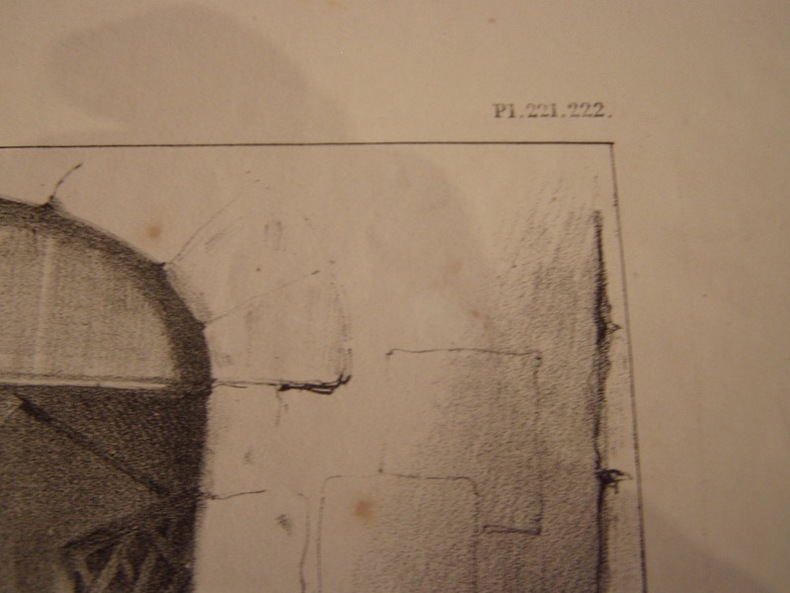
1832251951832 Planche double HT parue dans La Caricature politique, morale, littéraire et scénique, volume 5, 22 novembre 1832 (Planche n°221-222) - Hauteur: 27.3cmx Largeur: 35.8cm - Image :Hauteur: 23.5cm x Largeur: 33.8cmTitre en bas au centre : « LA CHAIR EST FAIBLE. » ; indications : en ht à gche : « La Caricature (Journal) N°107. », en ht à dte : « Pl. 221.222. »Inscription - Dans la lettre : « Lith. de Becquet, rue Childebert N°9. » [imprimeur], « On s’abonne chez Aubert, galerie véro dodat. » [éditeur] ; attribution : Jean-Jacques Grandville, dessinateur, et Eugène Forest, lithographeDescription iconographique:Dans la partie gauche de la composition, les membres du gouvernement son rassemblés. Dans les bulles au-dessus des personnages, au second plan de gche à dte : Dupin, refusant de suivre d’Argout : « Non, non, // vous n’y voyez // pas plus long // que votre nez. Ça // finira mal. », d’Argout, s’adressant à Dupin : « Venez donc avec nous, // [mon] cher, chacun-z-a // le droit d’y aller. », Lobau : « Connu, connu, la // vieille. On les a // vues tes femmes ! », Guizot, s’adressant à Louis-Philippe : « J’ai prouvé que vous auriez // tort, j’ai prouvé que vous // auriez raison. Je prouverai // tout ce qu’il faudra. », Barthe, s’adressant à Louis-Philippe : « Allez y, je vous // y engage, foi de Carbonaro ! ». Au premier plan, de gche à dte : Soult, s’adressant à Louis-Philippe et posant une main sur l’épaule de ce dernier pour l’inciter : « Allez donc, allez // donc, ce sont de // bonnes personnes, // Je les connais de // longue main. », Thiers au tout premier plan, et enfin Louis-Philippe, vu de trois quarts dos. Il porte un grand manteau et tient à la main son chapeau décoré de la cocarde tricolore. Les membres du gouvernement se trouvent dans la rue, « Boulevard // De // Coblentz » (Coblentz est le lieu où Louis-Philippe trouva, lors de son exil, sauvegardées des éléments de la noblesse française d’ancien régime). Les ministres incitent le roi à aller rendre visite à des prostituées, incarnations de l’ancien régime. La pl. se moque ainsi des tentations monarchiques auxquelles est soumis Louis-Philippe. La mère maquerelle, vieille femme portant une fleur de lys sur sa coiffe, un médaillon avec la lettre « H » surmontant une poire au cou, est vêtue d’une robe sur laquelle peut se lire « GAZETTE //DE // FRANCE // et // Holyrood » : il s’agit du journal le plus légitimiste sous la Monarchie de Juillet. Il essaie d’attirer le roi. Holyrood est une référence à un des lieux de séjour en Ecosse des émigrés aristocrates après la Révolution française. Cette mère maquerelle dit à Louis-Philippe : « Venez donc, belhomme, // elles sont bien aimables, // elles ont un bon feu. belhomme ! // cupidon ! ». Derrière se tiennent deux courtisanes : la première, mince, porte une robe décorée d’une frise de poire en bas. Elle a le pied droit posé sur une feuille volante titrée « CHARTE », montrant de manière significative que les principes de la Charte sont bafoués. Il s’agit de la princesse Louise, fille aînée de Louis-Philippe. La seconde prostituée, plus forte, porte deux broches en forme de fleur de lys. Il s’agit de la duchesse d’Angoulême, fille de Louis XVI et Marie-Antoinette. Les deux travailleuses représentent respectivement la légitimité et l’illégalité. Au fond à dte, dans la pénombre, un homme assiste à la scène. Il cache un fusil dans son dos, porte une arme blanche à sa ceinture, et un médaillon avec l’initial « H » autour du cou, certainement l’initial de Henri V, qui aurait dû monter sur le trône à la place de Louis-Philippe.La pl. dénonce les mauvais conseils prodigués par les ministres au roi des Français, lequel est poussé à abandonner ses principes républicains et d’embrasser les idées moins libérales. La pl. utilise le parallèle d’un homme incité à s’adonner aux plaisirs de la chair. Le titre est la parole du Christ tirée de l'Evangile affirmant « Ainsi vous n'avez pas eu la force de veiller une heure avec moi. Veiller et prier pour ne pas entrer en tentation; l'esprit est ardent mais la chair est faible ». Louis-Philippe est, quant à lui, tenté par les principes monarchiques.Personne / Personnage représenté:Thiers, Adolphe; Louis-Philippe Ier, roi des Français; Dupin, André Marie Jean-Jacques (dit Dupin aîné); Mouton, Georges, comte de Lobau; Guizot, François; Argout, Antoine Maurice Apollinaire d', baron; Soult, Nicolas-Jean de Dieu; Barthe, Félix
19049100London: J M Dent and Company 1904. A beautiful copy in the publisher's deluxe binding of this revised and expanded third edition. Small octavo format 13x8.5cm bound in tan calf with stylised gilt foliate decoration to boards and spine; all edges gilt; gilt decoration to turn-ins. Dove grey endpapers; tissue guard to frontispiece. Beardsley's 'grotesques' throughout the text. Aubrey Beardsley 1892-1898 was a leading member of the aesthetic movement whose black ink drawings were influenced by Japanese woodcuts and emphasized the grotesque the decadent and the erotic. His work caused controversy for decades after his early death. Please contact Christian White Rare Books Ltd for more information or images of this item 1904 J M Dent and Company hardcover
1020828420.Ghardcover. Good. Access codes and supplements are not guaranteed with used items. May be an ex-library book. hardcover
36800277-nnew. unknown
36800277like new. unknown
ria9783111048529_inpHardcover. New. New Book; Fast Shipping from UK; Not signed; Not First Edition; N/A hardcover
ria9783111048505_inpHardcover. New. New Book; Fast Shipping from UK; Not signed; Not First Edition; N/A hardcover
35930424-nnew. unknown
35930424like new. unknown
ria9783111212531_inpHardcover. New. New Book; Fast Shipping from UK; Not signed; Not First Edition; N/A hardcover
35029786-nnew. unknown
35029786like new. unknown
ria9783111256764_inpHardcover. New. New Book; Fast Shipping from UK; Not signed; Not First Edition; N/A hardcover
80 pages. Undated. Circa early 1900s? Colour illustration upon front board shows two young girls and a boy making daisy chains. Colour plate frontis (by D.C.S.?) shows girl on park bench reading to three youngsters and a dog seated around her, with the caption "There sits fair-haired Effie." Stories include: Playing Horses; The Concert at the Zoo; The Holiday Coach; The Bravest Deed; Going to See the Queen; A Visit to the Country; Elsie's Team; Eric's Holiday; Mrs. Lion's Infant School; A visit to the West Indies; Five Peas in a Pod; Proud Mr. Drake; The Whistling Pig; The Stray Lamb; The Boy and the Monkey; A Merry Game; How do you Do?; Mrs. Otter and Her Young Ones; Morning Song; The Wonderful Doll's House; Tired of Waiting; Poor Mrs. Duck!; The Grand Duchess; The Clever Cat; Eddy's Accident; My Portrait; Father's Birthday Present; Will's Wondrous Story; Katie's Present; and Topsy and the Gypsies. Contemporary pencil gift greetings atop front free endpaper. Erased pencil writing inside front board nearly invisible. Hinges intact. Binding sound. Original maroon cloth backstrip intact. Average wear and soiling to boards. Moderate yellowing to contents. A sound copy of this charming work. Book