1 625 résultats
18-3244London: Vanity Fair 1871. Original colour lithograph. 13.5 x 8.5 inches accompanied by 1 sheet of description. Very Good. Published in Vanity Fair 14 Jan 1871. London: Vanity Fair, 1871. unknown
18-3240London: Vanity Fair 1870. Original colour lithograph. 13.5 x 8.5 inches accompanied by 1 sheet of description. Very Good. Published in Vanity Fair 2 July 1870.John Poyntz Spencer 5th Earl Spencer KG PC 27 October 1835 – 13 August 1910 known as Viscount Althorp from 1845 to 1857 and also known as the Red Earl because of his distinctive long red beard was a British Liberal Party politician under and close friend of British prime minister William Ewart Gladstone. He was twice Lord Lieutenant of Ireland. London: Vanity Fair, 1870. unknown
18-3251London: Vanity Fair 1871. Original colour lithograph. 13.5 x 8.5 inches accompanied by 1 sheet of letterpress description. Very Good. Published in Vanity Fair 18 March 1871.Gerard James Noel PC DL JP 28 August 1823 – 19 May 1911 styled The Honourable Gerard Noel from birth was a British Conservative politician. Noel was the son of Charles Noel 1st Earl of Gainsborough and his third wife Arabella daughter of Sir James Hamlyn-Williams 2nd Baronet. London: Vanity Fair, 1871. unknown
18-3250London: Vanity Fair 1871. Original colour lithograph. 13.5 x 8.5 inches accompanied by 1 sheet of letterpress description. Very Good. Published in Vanity Fair 11 March 1871.George Ward Hunt 30 July 1825 – 29 July 1877 was a British statesman of the Conservative Party who was Chancellor of the Exchequer and First Lord of the Admiralty in the first and second ministries of Benjamin Disraeli. London: Vanity Fair, 1871. unknown
18-3255London: Vanity Fair 1871. Original colour lithograph. 13.5 x 8.5 inches accompanied by 1 sheet of letterpress description. Very Good. Published in Vanity Fair 15 April 1871.Robert Grosvenor 1st Baron Ebury PC 24 April 1801 – 18 November 1893 styled Lord Robert Grosvenor from 1831 to 1857 was a British courtier and Whig politician. He served as Comptroller of the Household between 1830 and 1834 and as Treasurer of the Household between 1846 and 1847. In 1857 he was ennobled as Baron Ebury. London: Vanity Fair, 1871. unknown
18-3245London: Vanity Fair 1871. Original colour lithograph. 13.5 x 8.5 inches accompanied by 1 sheet of letterpress description. Very Good. Published in Vanity Fair 21 Jan 1871.John Laird Mair Lawrence 1st Baron Lawrence GCB GCSI PC 4 March 1811 – 27 June 1879 known as Sir John Lawrence Bt. between 1858 and 1869 was an English-born Ulsterman who became a prominent British Imperial statesman who served as Viceroy of India from 1864 to 1869. London: Vanity Fair, 1871. unknown
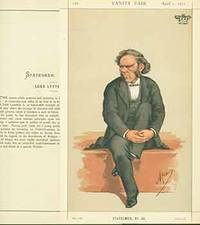
18-3253London: Vanity Fair 1871. Original colour lithograph. 13.5 x 8.5 inches accompanied by 1 sheet of letterpress description. Very Good. Trimmed at bottom of page with some loss of text. Published in Vanity Fair 1 April 1871.George William Lyttelton 4th Baron Lyttelton KCMG PC DL FRS 31 March 1817 – 19 April 1876 was a British aristocrat and Conservative politician from the Lyttelton family. He was chairman of the Canterbury Association which encouraged British settlers to move to New Zealand. Lyttelton was the eldest son of William Lyttelton 3rd Baron Lyttelton and Lady Sarah Spencer daughter of George John Spencer 2nd Earl Spencer. He was educated at Eton and Trinity College Cambridge. He succeeded his father as fourth Baron Lyttelton in 1837 and took his seat in the House of Lords on his 21st birthday a year later. The Lyttelton seat is Hagley Hall in Worcestershire. London: Vanity Fair, 1871. unknown
18-3261London: Vanity Fair 1871. Original colour lithograph. 13.5 x 8.5 inches accompanied by 1 sheet of letterpress description. Very Good. Published in Vanity Fair 15 July 1871.Edward Bootle-Wilbraham 1st Earl of Lathom GCB PC 12 December 1837 – 19 November 1898 known as The Lord Skelmersdale between 1853 and 1880 was a British Conservative politician. He was a member of every Conservative administration between 1866 and 1898 and notably served three times as Lord Chamberlain of the Household under Lord Salisbury. Having succeeded his grandfather as Baron Skelmersdale in 1853 he was created Earl of Lathom in 1880. London: Vanity Fair, 1871. unknown
18-3291London: Vanity Fair 1871. Original colour lithograph. 13.5 x 8.5 inches accompanied by 1 sheet of letterpress description. Very Good. Trimmed at bottom of page with some loss of text. Published in Vanity Fair 17 June 1871.Algernon Borthwick 1st Baron Glenesk JP 27 December 1830 – 24 November 1908 known as Sir Algernon Borthwick Bt between 1887 and 1895 was a British journalist and Conservative politician. He was the owner of the Morning Post which merged with The Daily Telegraph in 1937. London: Vanity Fair, 1871. unknown
18-3262London: Vanity Fair 1871. Original colour lithograph. 13.5 x 8.5 inches accompanied by 1 sheet of letterpress description. Very Good. Published in Vanity Fair 29 July 1871.Edward Miall 8 May 1809 – 30 April 1881 was an English journalist apostle of disestablishment founder of the Liberation Society and Liberal Party politician. London: Vanity Fair, 1871. unknown
18-3248London: Vanity Fair 1871. Original colour lithograph. 13.5 x 8.5 inches accompanied by 1 sheet of letterpress description. Very Good. Trimmed at bottom of page with some loss of text. Published in Vanity Fair 18 Feb 1871.George Hammond Whalley 22 January 1813 – 8 October 1878 was a British lawyer and Liberal Party politician.He was the eldest son of James Whalley a merchant and banker from Gloucester and a direct descendant of Edward Whalley the regicide. George was educated at University College London gaining a first class degree in Metaphysics and Rhetoric and entered Gray's Inn in 1835 being called to the bar in 1839. He was an assistant tithe commissioner between 1836 and 1847 writing over 200 articles for the Justice of the Peace between 1838 and 1842. In 1838 and 1839 he published a pair of treatises on the Tithe Acts which were expanded bound and published in 1848 as The Tithe Act and the Whole of the Tithe Amendment Acts.In 1846 he married Anne Wakeford with whom he had a son and two daughters. During the Irish Potato Famine in 1847 he established several fisheries on the Irish west coast.citation needed In 1852 he was made High Sheriff of Caernarvonshire a Deputy Lieutenant of Denbighshire and a captain in the Denbighshire Yeomanry.He was chairman of the Llanidloes & Newtown Railway the first in Montgomeryshire from its inception in 1852 and was the first chairman of the Mid Wales Railway in 1859. He was also active in the Railway Benevolent Institution and the National Temperance League London: Vanity Fair, 1871. unknown
18-3189London: Vanity Fair 1871. Original colour lithograph. 13.5 x 8.5 inches accompanied by 1 sheet of description. Very Good. Published in Vanity Fair 13 May 1871.Sir John Everett Millais 1st Baronet PRA /ˈmɪleɪ/; 8 June 1829 – 13 August 1896 was an English painter and illustrator who was one of the founders of the Pre-Raphaelite Brotherhood. He was a child prodigy who aged eleven became the youngest student to enter the Royal Academy Schools. The Pre-Raphaelite Brotherhood was founded at his family home in London at 83 Gower Street now number 7. Millais became the most famous exponent of the style his painting Christ in the House of His Parents 1850 generating considerable controversy and painting perhaps the embodiment of the school Ophelia in 1850-51.By the mid-1850s Millais was moving away from the Pre-Raphaelite style to develop a new form of realism in his art. His later works were enormously successful making Millais one of the wealthiest artists of his day but some former admirers including William Morris saw this as a sell-out Millais notoriously allowed one of his paintings to be used for a sentimental soap advertisement. While these and early 20th-century critics reading art through the lens of Modernism viewed much of his later production as wanting this perspective has changed in recent decades as his later works have come to be seen in the context of wider changes and advanced tendencies in the broader late nineteenth-century art world and can now be seen as predictive of the art world of the present.Millais's personal life has also played a significant role in his reputation. His wife Effie was formerly married to the critic John Ruskin who had supported Millais's early work. The annulment of the marriage and her wedding to Millais have sometimes been linked to his change of style but she became a powerful promoter of his work and they worked in concert to secure commissions and expand their social and intellectual circles. London: Vanity Fair, 1871. unknown
18-3257London: Vanity Fair 1871. Original colour lithograph. 13.5 x 8.5 inches accompanied by 1 sheet of letterpress description. Very Good. Trimmed at bottom of page with some loss of text. Published in Vanity Fair 20 May 1871.Michael Thomas Bass DL 6 July 1799 – 29 April 1884 was an English brewer and a member of Parliament. Under his leadership the Bass Brewery became the largest brewery in the world and Bass the best known brand of beer in England. Bass represented Derby in the House of Commons as a member of the Liberal Party between 1848 and 1883 where he was an effective advocate for the brewing industry. He was a generous benefactor both in Derby and in Burton-on-Trent where his company was based. London: Vanity Fair, 1871. unknown
18-3252London: Vanity Fair 1871. Original colour lithograph. 13.5 x 8.5 inches accompanied by 1 sheet of letterpress description. Very Good. Trimmed at bottom of page with some loss of text. Published in Vanity Fair 25 March 1871.Richard Dowse PC 1824 – 14 March 1890 was an Irish politician barrister and judge reputed to be the wittiest orator of his time. He was born in Dungannon County Tyrone eldest son of William Dowse and Maria Donaldson. He was educated at the Royal School Dungannon and the University of Dublin entered Lincoln's Inn in 1849 and was called to the Irish Bar in 1852. After practicing for some years on the North-West Circuit he became Queen's Counsel in 1863 and Third Serjeant in 1867. London: Vanity Fair, 1871. unknown
18-3246London: Vanity Fair 1871. Original colour lithograph. 13.5 x 8.5 inches accompanied by 1 sheet of letterpress description. Very Good. Published in Vanity Fair 4 Feb 1871.Konstantinos Mousouros Greek: Κωνσταντίνος ΜουσοÏÏος Turkish: Kostaki Musurus PaÅŸa; 1807–1891 also known as Kostaki Musurus Pasha was an Ottoman Greek diplomatic official of the Ottoman Empire who served as ambassador to Greece Austria Great Britain Belgium and the Netherlands. London: Vanity Fair, 1871. unknown
18-3287London: Vanity Fair 1871. Original colour lithograph. 13.5 x 8.5 inches accompanied by 1 sheet of letterpress description. Very Good. Trimmed at bottom of page with some loss of text. Published in Vanity Fair 29 April 1871.Sir Francis Grant PRA 18 January 1803 – 5 October 1878 was a Scottish portrait painter who painted Queen Victoria and many distinguished British aristocratic and political figures. He served as President of the Royal Academy. London: Vanity Fair, 1871. unknown
18-3292London: Vanity Fair 1871. Original colour lithograph. 13.5 x 8.5 inches accompanied by 1 sheet of letterpress description. Very Good. Trimmed at bottom of page with some loss of text. Published in Vanity Fair 1 July 1871.Sir John George Shaw-Lefevre KCB 24 January 1797 – 20 August 1879 was a British barrister Whig politician and civil servant.Shaw-Lefevre was the son of Charles Shaw-Lefevre by his wife Helen daughter of John Lefevre. Charles Shaw-Lefevre 1st Viscount Eversley was his elder brother. He was educated at Trinity College Cambridge where he was Senior Wrangler in 1818 and was called to the Bar Inner Temple. He was elected a Fellow of the Royal Society in 1820. He was returned to Parliament for Petersfield in December 1832 but was unseated on petition in March 1833. He served under Lord Grey as Under-Secretary of State for War and the Colonies in 1834. The latter year Shaw-Lefevre was appointed a Poor Law Commissioner after the passing of the Poor Law Amendment Act which he remained until 1841. Between 1856 and 1875 he served as Clerk of the Parliaments. He also helped found the University of London and served as its Vice-Chancellor for many years. He was made a KCB in 1857 for his public services.Shaw-Lefevre married Rachel Emily daughter of Ichabod Wright in 1824. They had one surviving son George who became a prominent politician and was ennobled as Baron Eversley and five daughters. One daughter Madeleine Shaw-Lefevre was the first Principal of Somerville Hall; another daughter Rachel married Arthur Hamilton-Gordon son of the Prime Minister the 4th Earl of Aberdeen.Shaw-Lefevre died in August 1879 aged 82. His wife lived for six more years before dying in February 1885.The Lefevre Peninsula in South Australia was named by Governor John Hindmarsh on 3 June 1837 after Shaw-Lefevre who was one of South Australia's Colonisation Commissioners. London: Vanity Fair, 1871. unknown
18-3288London: Vanity Fair 1871. Original colour lithograph. 13.5 x 8.5 inches accompanied by 1 sheet of letterpress description. Very Good. Trimmed at bottom of page with some loss of text. Published in Vanity Fair 6 May 1871.Thomas Erskine May 1st Baron Farnborough KCB PC 8 February 1815 – 17 May 1886 was a British constitutional theorist. This derived from his career at the House of Commons. London: Vanity Fair, 1871. unknown
18-3211London: Vanity Fair 1870. Original colour lithograph. 13.5 x 8.5 inches accompanied by 1 sheet of description. Good. Loss in bottom margin not affecting image else fine. Published in Vanity Fair 22 Oct 1870.Thomas Carlyle 4 December 1795 – 5 February 1881 was a Scottish philosopher satirical writer essayist translator historian mathematician and teacher. Considered one of the most important social commentators of his time he presented many lectures during his lifetime with certain acclaim in the Victorian era. One of those conferences resulted in his famous work On Heroes Hero-Worship and The Heroic in History where he explains that the key role in history lies in the actions of the "Great Man" claiming that "the history of the world is but the biography of great men".A respected historian his 1837 book The French Revolution: A History was the inspiration for Charles Dickens' 1859 novel A Tale of Two Cities and remains popular today. Carlyle's 1836 Sartor Resartus is a notable philosophical novel.A great polemicist Carlyle coined the term "the dismal science" for economics. He also wrote articles for the Edinburgh Encyclopædia and his Occasional Discourse on the Negro Question 1849 remains controversial. Once a Christian Carlyle lost his faith while attending the University of Edinburgh later adopting a form of deism.In mathematics he is known for the Carlyle circle a method used in quadratic equations and for developing ruler-and-compass constructions of regular polygons. London: Vanity Fair, 1870. unknown
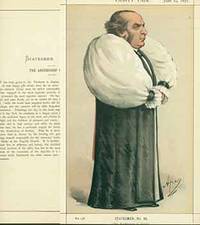
18-3259London: Vanity Fair 1871. Original colour lithograph. 13.5 x 8.5 inches accompanied by 1 sheet of letterpress description. Very Good. Trimmed at bottom of page with some loss of text. Published in Vanity Fair 24 June 1871.William Thomson FRS FRGS 11 February 1819 – 25 December 1890 was an English church leader Archbishop of York from 1862 until his death. He was born the eldest son of John Thomson of Kelswick House near Whitehaven Cumberland and educated at Shrewsbury School and at The Queen's College Oxford of which he became a scholar. He took his B.A. degree in 1840 and was soon afterwards made fellow of his college. He was ordained in 1842 and worked as a curate at Cuddesdon. In 1847 he was made tutor of his college and in 1853 he delivered the Bampton lectures his subject being The Atoning Work of Christ viewed in Relation to some Ancient Theories. These thoughtful and learned lectures established his reputation and did much to clear the ground for subsequent discussions on the subject. London: Vanity Fair, 1871. unknown
18-3249London: Vanity Fair 1871. Original colour lithograph. 13.5 x 8.5 inches accompanied by 1 sheet of letterpress description. Very Good. Trimmed at bottom of page with some loss of text. Published in Vanity Fair 4 March 1871.Carlo Cadorna 8 December 1809 Pallanza – 2 December 1891 Rome was an Italian politician and the elder brother of General Raffaele Cadorna.He graduated in law in 1830 at the University of Turin. In 1840 he was elected to the Chamber of Deputies in the constituency of Pallanza. He was the Minister of Education during the government headed by Vincenzo Gioberti.He was rapporteur of the law of secularisation of 29 May 1855 and spoke to a principle of separation of church and state and that the Church would be responsible only spiritual power on "thoughts aspirations beliefs" while the assets of the Church must be under the jurisdiction of the state.In 1857 Cadorna was elected President of the Chamber of Deputies of the Kingdom of Sardinia and in 1858 became a senator and appointed Minister of Education in the government led by Camillo Benso Count of Cavour 1858-1859.In 1864 he was the prefect of Turin and in 1868 Minister of the Interior of the Legislature I of Italy.He was the ambassador to the United Kingdom from 1869 to 1875. London: Vanity Fair, 1871. unknown
18-3241London: Vanity Fair 1870. Original colour lithograph. 13.5 x 8.5 inches accompanied by 1 sheet of description. Very Good. Published in Vanity Fair 9 July 1870.George Granville William Sutherland-Leveson-Gower 3rd Duke of Sutherland KG FRS 19 December 1828 – 22 September 1892 styled Viscount Trentham until 1833 Earl Gower in 1833 and Marquess of Stafford between 1833 and 1861 was a British politician from the Leveson-Gower family. London: Vanity Fair, 1870. unknown
18-3239London: Vanity Fair 1870. Original colour lithograph. 13.5 x 8.5 inches accompanied by 1 sheet of description. Very Good. Published in Vanity Fair 18 June 1870.William Ward 1st Earl of Dudley 27 March 1817 – 7 May 1885 known as The Lord Ward from 1835 to 1860 was a British landowner and benefactor.Ward was born on 27 March 1817 at Edwardstone Boxford Suffolk England the son of William Ward 10th Baron Ward who had succeeded in the barony of Ward on the death of his second cousin Foreign Secretary John Ward 1st Earl of Dudley in 1833 the earldom becoming extinct. His mother was Amelia daughter of William Cooch Pillans. He was educated at Eton and Christ Church Oxford and Trinity College Oxford. He played first-class cricket for Oxford University Cricket Club between 1838 and 1842. His inheritance included Himley Hall and the ruins of Dudley Castle. In 1837 his trustees puchased the Witley Court estate in Worcestershire from Thomas Foley 4th Baron Foley. London: Vanity Fair, 1870. unknown
18-3254London: Vanity Fair 1871. Original colour lithograph. 13.5 x 8.5 inches accompanied by 1 sheet of letterpress description. Very Good. Published in Vanity Fair 8 April 1871.Dudley Ryder 2nd Earl of Harrowby KG PC FRS 19 May 1798 – 19 November 1882 styled Viscount Sandon between 1809 and 1847 was a British politician. He held office under Lord Palmerston as Chancellor of the Duchy of Lancaster in 1855 and as Lord Privy Seal between 1855 and 1858. Harrowby was born in London the son of Dudley Ryder 1st Earl of Harrowby and Lady Susan d. 1838 daughter of Granville Leveson-Gower 1st Marquess of Stafford. He was educated at Christ Church Oxford. He was an officer of the Staffordshire Yeomanry resigning his captain's commission in March 1831. London: Vanity Fair, 1871. unknown
18-3243London: Vanity Fair 1870. Original colour lithograph. 13.5 x 8.5 inches accompanied by 1 sheet of description. Very Good. Published in Vanity Fair 16 July 1870.Hugh Lupus Grosvenor 1st Duke of Westminster KG PC JP 13 October 1825 – 22 December 1899 styled Viscount Belgrave between 1831 and 1845 and Earl Grosvenor between 1845 and 1869 and known as The Marquess of Westminster between 1869 and 1874 was an English landowner politician and racehorse owner. He inherited the estate of Eaton Hall in Cheshire and land in Mayfair and Belgravia London and spent much of his fortune in developing these properties. Although he was a member of parliament from the age of 22 and then a member of the House of Lords his main interests were not in politics but rather in his estates in horse racing and in country pursuits. He developed the stud at Eaton Hall and achieved success in racing his horses winning the Derby on four occasions. Grosvenor also took an interest in a range of charities. At his death he was considered to be the richest man in Britain. London: Vanity Fair, 1870. unknown