Monkey PunchBiblio.com
1 625 résultats
1591824893.Gpaperback. Good. Access codes and supplements are not guaranteed with used items. May be an ex-library book. paperback
1595320725.Gpaperback. Good. Access codes and supplements are not guaranteed with used items. May be an ex-library book. paperback
20072-0387494928Springer Verlag 2007. Spiral-bound. New. spiral-bound edition. 238 pages. 9.75x7.00x0.75 inches. Springer Verlag unknown
20-03729Rotovision 37438. Hardcover. New. In shrink wrap. Rotovision hardcover
3639400909.Gpaperback. Good. Access codes and supplements are not guaranteed with used items. May be an ex-library book. paperback
19882090502113709042Not Available 1988. Soft Cover. Fine. The book is in fine condition. Not Available paperback
19492110502150412947Asahishinbunsha 1949. Soft Cover. Fine. Volume: 1 Asahishinbunsha paperback
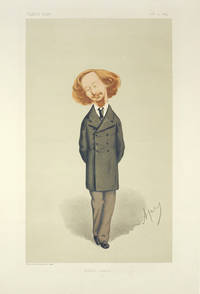
18741262721874. London: Vanity Fair November 21 1874. <br /> <br /> Color lithographic portrait after a watercolor painting by Pellegrini. Image size: 12 x 7 inches 30.5 x 18cm. Matted in a museum board. Printed by Vincent Brooks Day & Son Lith. Fine.<br /> <br /> § This portrait of the English poet 1837-1909 emphasizes his diminutive stature oversized head and shambling posture. It is not generally known that the Italian-born Pellegrini 1836-1889 was the originator of the Vanity Fair series of weekly caricatures of individuals of distinction and that the better-known Sir Leslie Matthew Ward 1851-1922 known as "Spy" was his successor. unknown
18-3190London: Vanity Fair 1871. Original colour lithograph. 13.5 x 8.5 inches accompanied by 1 sheet of description. Very Good. Minor loss on bottom left corner. Published in Vanity Fair 22 July 1871.Alfred Tennyson 1st Baron Tennyson FRS 6 August 1809 – 6 October 1892 was Poet Laureate of Great Britain and Ireland during much of Queen Victoria's reign and remains one of the most popular British poets. London: Vanity Fair, 1871. unknown
18-3286London: Vanity Fair 1871. Original colour lithograph. 13.5 x 8.5 inches accompanied by 1 sheet of letterpress description. Very Good. Trimmed at bottom of page with some loss of text. Published in Vanity Fair 25 February 1871.Henry Edward Manning 15 July 1808 – 14 January 1892 was an English Cardinal of the Roman Catholic church and the second Archbishop of Westminster from 1865 until his death in 1892. London: Vanity Fair, 1871. unknown
18-3290London: Vanity Fair 1871. Original colour lithograph. 13.5 x 8.5 inches accompanied by 1 sheet of letterpress description. Very Good. Trimmed at bottom of page with some loss of text. Crease on bottom left corner not affecting image. Published in Vanity Fair 10 June 1871.The Tichborne case was a legal cause célèbre that captivated Victorian England in the 1860s and 1870s. It concerned the claims by an individual sometimes referred to as Thomas Castro or as Arthur Orton but usually termed "the Claimant" to be the missing heir to the Tichborne baronetcy. He failed to convince the courts was convicted of perjury and served a long prison sentence.Roger Tichborne heir to the family's title and fortunes was presumed to have died in a shipwreck in 1854 at age 25. His mother clung to a belief that he might have survived and after hearing rumours that he had made his way to Australia she advertised extensively in Australian newspapers offering a reward for information. In 1866 a butcher known as Thomas Castro from Wagga Wagga came forward claiming to be Roger Tichborne. Although his manners and bearing were unrefined he gathered support and travelled to England. He was instantly accepted by Lady Tichborne as her son although other family members were dismissive and sought to expose him as an impostor.During protracted enquiries before the case went to court in 1871 details emerged suggesting that the Claimant might be Arthur Orton a butcher's son from Wapping in London who had gone to sea as a boy and had last been heard of in Australia. After a civil court had rejected the Claimant's case he was charged with perjury; while awaiting trial he campaigned throughout the country to gain popular support. In 1874 a criminal court jury decided that he was not Roger Tichborne and declared him to be Arthur Orton. Before passing a sentence of 14 years the judge condemned the behaviour of the Claimant's counsel Edward Kenealy who was subsequently disbarred because of his conduct.After the trial Kenealy instigated a popular radical reform movement the Magna Charta Association which championed the Claimant's cause for some years. Kenealy was elected to Parliament in 1875 as a radical independent but was not an effective parliamentarian. The movement was in decline when the Claimant was released in 1884 and he had no dealings with it. In 1895 he confessed to being Orton only to recant almost immediately. He lived generally in poverty for the rest of his life and was destitute at the time of his death in 1898. Although most commentators have accepted the court's view that the Claimant was Orton some analysts believe that an element of doubt remains as to his true identity and that conceivably he was Roger Tichborne. London: Vanity Fair, 1871. unknown
18-3258London: Vanity Fair 1871. Original colour lithograph. 13.5 x 8.5 inches accompanied by 1 sheet of letterpress description. Very Good. Trimmed at bottom of page with some loss of text. Published in Vanity Fair 27 May 1871.Baron Mayer Amschel de Rothschild 29 June 1818 – 6 February 1874 was an English businessman and politician of the English branch of the Rothschild family. He was the fourth and youngest son of Nathan Mayer Rothschild 1777–1836. He was named Mayer Amschel Rothschild for his grandfather the patriarch of the Rothschild family. London: Vanity Fair, 1871. unknown
18-3289London: Vanity Fair 1871. Original colour lithograph. 13.5 x 8.5 inches accompanied by 1 sheet of letterpress description. Very Good. Trimmed at bottom of page with some loss of text. Published in Vanity Fair 3 June 1871.Captain Sir Eyre Massey Shaw KCB 17 January 1830 – 25 August 1908 was the first Chief Officer of the Metropolitan Fire Brigade now renamed the London Fire Brigade and the Superintendent of its predecessor the London Fire Engine Establishment from 1861 to 1891. He introduced modern firefighting methods to the Brigade and increased the number of stations. London: Vanity Fair, 1871. unknown
18-3244London: Vanity Fair 1871. Original colour lithograph. 13.5 x 8.5 inches accompanied by 1 sheet of description. Very Good. Published in Vanity Fair 14 Jan 1871. London: Vanity Fair, 1871. unknown
18-3240London: Vanity Fair 1870. Original colour lithograph. 13.5 x 8.5 inches accompanied by 1 sheet of description. Very Good. Published in Vanity Fair 2 July 1870.John Poyntz Spencer 5th Earl Spencer KG PC 27 October 1835 – 13 August 1910 known as Viscount Althorp from 1845 to 1857 and also known as the Red Earl because of his distinctive long red beard was a British Liberal Party politician under and close friend of British prime minister William Ewart Gladstone. He was twice Lord Lieutenant of Ireland. London: Vanity Fair, 1870. unknown
18-3251London: Vanity Fair 1871. Original colour lithograph. 13.5 x 8.5 inches accompanied by 1 sheet of letterpress description. Very Good. Published in Vanity Fair 18 March 1871.Gerard James Noel PC DL JP 28 August 1823 – 19 May 1911 styled The Honourable Gerard Noel from birth was a British Conservative politician. Noel was the son of Charles Noel 1st Earl of Gainsborough and his third wife Arabella daughter of Sir James Hamlyn-Williams 2nd Baronet. London: Vanity Fair, 1871. unknown
18-3250London: Vanity Fair 1871. Original colour lithograph. 13.5 x 8.5 inches accompanied by 1 sheet of letterpress description. Very Good. Published in Vanity Fair 11 March 1871.George Ward Hunt 30 July 1825 – 29 July 1877 was a British statesman of the Conservative Party who was Chancellor of the Exchequer and First Lord of the Admiralty in the first and second ministries of Benjamin Disraeli. London: Vanity Fair, 1871. unknown
18-3255London: Vanity Fair 1871. Original colour lithograph. 13.5 x 8.5 inches accompanied by 1 sheet of letterpress description. Very Good. Published in Vanity Fair 15 April 1871.Robert Grosvenor 1st Baron Ebury PC 24 April 1801 – 18 November 1893 styled Lord Robert Grosvenor from 1831 to 1857 was a British courtier and Whig politician. He served as Comptroller of the Household between 1830 and 1834 and as Treasurer of the Household between 1846 and 1847. In 1857 he was ennobled as Baron Ebury. London: Vanity Fair, 1871. unknown
18-3245London: Vanity Fair 1871. Original colour lithograph. 13.5 x 8.5 inches accompanied by 1 sheet of letterpress description. Very Good. Published in Vanity Fair 21 Jan 1871.John Laird Mair Lawrence 1st Baron Lawrence GCB GCSI PC 4 March 1811 – 27 June 1879 known as Sir John Lawrence Bt. between 1858 and 1869 was an English-born Ulsterman who became a prominent British Imperial statesman who served as Viceroy of India from 1864 to 1869. London: Vanity Fair, 1871. unknown
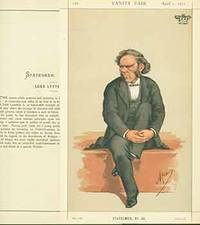
18-3253London: Vanity Fair 1871. Original colour lithograph. 13.5 x 8.5 inches accompanied by 1 sheet of letterpress description. Very Good. Trimmed at bottom of page with some loss of text. Published in Vanity Fair 1 April 1871.George William Lyttelton 4th Baron Lyttelton KCMG PC DL FRS 31 March 1817 – 19 April 1876 was a British aristocrat and Conservative politician from the Lyttelton family. He was chairman of the Canterbury Association which encouraged British settlers to move to New Zealand. Lyttelton was the eldest son of William Lyttelton 3rd Baron Lyttelton and Lady Sarah Spencer daughter of George John Spencer 2nd Earl Spencer. He was educated at Eton and Trinity College Cambridge. He succeeded his father as fourth Baron Lyttelton in 1837 and took his seat in the House of Lords on his 21st birthday a year later. The Lyttelton seat is Hagley Hall in Worcestershire. London: Vanity Fair, 1871. unknown
18-3261London: Vanity Fair 1871. Original colour lithograph. 13.5 x 8.5 inches accompanied by 1 sheet of letterpress description. Very Good. Published in Vanity Fair 15 July 1871.Edward Bootle-Wilbraham 1st Earl of Lathom GCB PC 12 December 1837 – 19 November 1898 known as The Lord Skelmersdale between 1853 and 1880 was a British Conservative politician. He was a member of every Conservative administration between 1866 and 1898 and notably served three times as Lord Chamberlain of the Household under Lord Salisbury. Having succeeded his grandfather as Baron Skelmersdale in 1853 he was created Earl of Lathom in 1880. London: Vanity Fair, 1871. unknown
18-3291London: Vanity Fair 1871. Original colour lithograph. 13.5 x 8.5 inches accompanied by 1 sheet of letterpress description. Very Good. Trimmed at bottom of page with some loss of text. Published in Vanity Fair 17 June 1871.Algernon Borthwick 1st Baron Glenesk JP 27 December 1830 – 24 November 1908 known as Sir Algernon Borthwick Bt between 1887 and 1895 was a British journalist and Conservative politician. He was the owner of the Morning Post which merged with The Daily Telegraph in 1937. London: Vanity Fair, 1871. unknown
18-3262London: Vanity Fair 1871. Original colour lithograph. 13.5 x 8.5 inches accompanied by 1 sheet of letterpress description. Very Good. Published in Vanity Fair 29 July 1871.Edward Miall 8 May 1809 – 30 April 1881 was an English journalist apostle of disestablishment founder of the Liberation Society and Liberal Party politician. London: Vanity Fair, 1871. unknown
18-3248London: Vanity Fair 1871. Original colour lithograph. 13.5 x 8.5 inches accompanied by 1 sheet of letterpress description. Very Good. Trimmed at bottom of page with some loss of text. Published in Vanity Fair 18 Feb 1871.George Hammond Whalley 22 January 1813 – 8 October 1878 was a British lawyer and Liberal Party politician.He was the eldest son of James Whalley a merchant and banker from Gloucester and a direct descendant of Edward Whalley the regicide. George was educated at University College London gaining a first class degree in Metaphysics and Rhetoric and entered Gray's Inn in 1835 being called to the bar in 1839. He was an assistant tithe commissioner between 1836 and 1847 writing over 200 articles for the Justice of the Peace between 1838 and 1842. In 1838 and 1839 he published a pair of treatises on the Tithe Acts which were expanded bound and published in 1848 as The Tithe Act and the Whole of the Tithe Amendment Acts.In 1846 he married Anne Wakeford with whom he had a son and two daughters. During the Irish Potato Famine in 1847 he established several fisheries on the Irish west coast.citation needed In 1852 he was made High Sheriff of Caernarvonshire a Deputy Lieutenant of Denbighshire and a captain in the Denbighshire Yeomanry.He was chairman of the Llanidloes & Newtown Railway the first in Montgomeryshire from its inception in 1852 and was the first chairman of the Mid Wales Railway in 1859. He was also active in the Railway Benevolent Institution and the National Temperance League London: Vanity Fair, 1871. unknown
18-3189London: Vanity Fair 1871. Original colour lithograph. 13.5 x 8.5 inches accompanied by 1 sheet of description. Very Good. Published in Vanity Fair 13 May 1871.Sir John Everett Millais 1st Baronet PRA /ˈmɪleɪ/; 8 June 1829 – 13 August 1896 was an English painter and illustrator who was one of the founders of the Pre-Raphaelite Brotherhood. He was a child prodigy who aged eleven became the youngest student to enter the Royal Academy Schools. The Pre-Raphaelite Brotherhood was founded at his family home in London at 83 Gower Street now number 7. Millais became the most famous exponent of the style his painting Christ in the House of His Parents 1850 generating considerable controversy and painting perhaps the embodiment of the school Ophelia in 1850-51.By the mid-1850s Millais was moving away from the Pre-Raphaelite style to develop a new form of realism in his art. His later works were enormously successful making Millais one of the wealthiest artists of his day but some former admirers including William Morris saw this as a sell-out Millais notoriously allowed one of his paintings to be used for a sentimental soap advertisement. While these and early 20th-century critics reading art through the lens of Modernism viewed much of his later production as wanting this perspective has changed in recent decades as his later works have come to be seen in the context of wider changes and advanced tendencies in the broader late nineteenth-century art world and can now be seen as predictive of the art world of the present.Millais's personal life has also played a significant role in his reputation. His wife Effie was formerly married to the critic John Ruskin who had supported Millais's early work. The annulment of the marriage and her wedding to Millais have sometimes been linked to his change of style but she became a powerful promoter of his work and they worked in concert to secure commissions and expand their social and intellectual circles. London: Vanity Fair, 1871. unknown