Reichenbach-Klinke, H. & E. ElkanLivre Rare Book
1 111 résultats
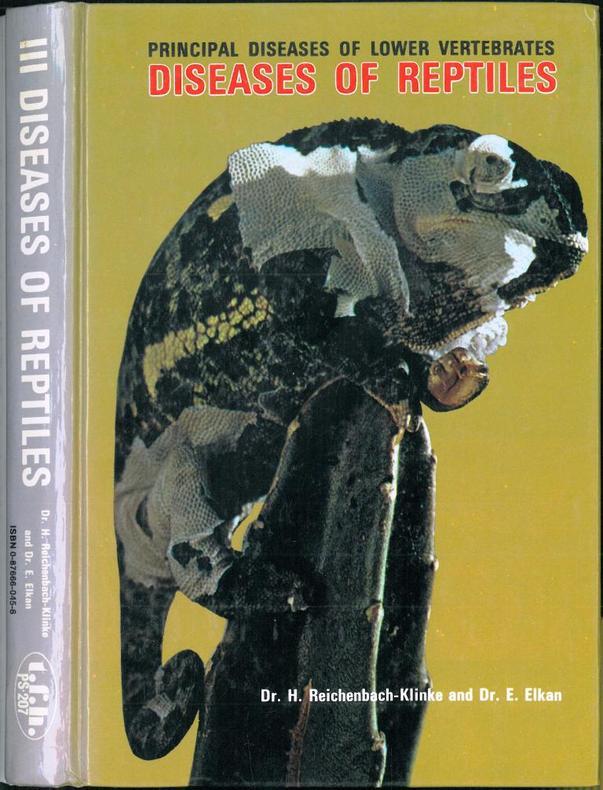
1965VR323391965 Neptune, T.F.H., 1965 : In-8 Carré, Cartonnage d'éditeurs. xii, pp. 385-600, fig. 288-397 in-texte, 3° livre d'une série traitant des maladies des vertébrés inférieurs, un excellent livre sur la pathologie des reptiles Très bon état, Couv. fraîche, Dos fané, Intérieur frais.
1770ZW233201770 xvi, 147, [1] p., 1 folded plate with five engraved figures, contemporary speckled paper-covered boards (spine worn, inner joint reinforced with ''old' paper strip. Pages 59-62 are missing. Repaired tear in margin of plate. Rare.
1995MM346351995-1996 34, 43 p., 29 figs, printed wrappers. Published in: Cahiers des Naturalistes.We added: Le Renard et al., 1996. On Candinia (Juliidae), a new fossil genus of bivalved gastropods (6 p., 7 figs).
1913BL2854Berlin:: R. Friedlander & Sohn 1913. 1913. 8vo. vi 545 pp. Figures plates including color. Gilt-stamped half black cloth over marbled papered boards. Fine copy. Sternfeld's article on "mimicry" in snakes is accompanied by many beautiful plates. "In mimicry a message feature or signal of one organism the mimic resembles some message of another organism which usually belongs to a different species some feature of the environment or a generalization of either of those that is called the model. This resemblance should have some functionality for the mimic by being deceptive for a third participant the receiver whose recognition and response is relevant for the mimic. Some researchers use the notion mimicry system to emphasize the systemic nature of mimicry and the relatedness of the three participants. There is a remarkable variety among mimicry cases in nature. Mimicry exists in most animal classes and also in many plants. Mimetic messages can be transferred in visual auditory chemical tactile and other channels or frequencies that animals use for communication. Mimicry can also be based on many ecological relations such as predation symbiosis parasitism and it can employ different life functions such as foraging reproduction and defense. To organize such high diversity researchers have proposed many mimicry types and typologies. Historically the oldest and best-known mimicry types are Batesian mimicry resemblance of harmless species to some non-edible species that signals their unsuitability to possible predators Mullerian mimicry resemblance of aposematic signals of different non-edible species and aggressive or Peckhamian mimicry resemblance of predators' messages to messages of some species or to some objects that are harmless to their prey. Biologists who have carried out most of the research in mimicry pay much attention to evolutionary aspects of the phenomenon. The main aspects in the mimicry research of modern biology include: dynamics of mimic and model populations in various selective situations and environmental conditions; behavior of signal receivers with respect to mimics and models receivers' abilities to discriminate and learn; variability of mimetic features including genetic and geographical variability of mimics and models. There are also alternative explanations to mimicry that do not rely on evolutionary concepts. Researchers have explained mimicry for instance as coincidence because of limited structural combinations in living organisms or as similarity caused by influences of physical conditions in similar living environment. Also paradigms outside of the natural sciences use the concept of mimicry. For instance in postcolonial studies mimicry has been understood as disruptive imitations that are characteristic of postcolonial cultures. In psychology many authors use mimicry to indicate unconscious imitations between humans especially related to facial gestures and body movements. In a semiotic context several authors Sebeok Noth Deacon have discussed biological mimicry in terms of sign categories and sign processes. There are indeed many directions in mimicry studies where a semiotic approach can be productive. For instance semiotics can be applied in analyzing long and complex mimicry displays. Uexkullian biosemiotics that pays attention to meanings in nature can be successful in analyzing abstract mimicry where abstract features such as ocular shapes movements or body types common to larger groups are imitated rather than species-specific characteristics. The Peircean typology of signs opens up new perspectives for classifying mimicry resemblances. This article was written with the support of Estonian Science Foundation Grant No 6670." - Semiotics Encyclopedia Online. The Natural History Society of Berlin GNF was founded in 1773 and is adjacent to the Gdansk Scientific Society the oldest German private natural history society. She had a number of prominent members in the natural sciences especially the biology influential members. The company still exists today and is currently based at the Institute of Zoology Free University of Berlin. R. Friedlander & Sohn, 1913. hardcover books
115348sd Edition du Musée Océanographique de Monaco - Ouvrage non daté (Approx. 1930 / 1940) - 18e édition - 89e Mille - Petit in-8, broché avec illustration sur la première de couverture, sous papier cristal - 67 pages - Très nombreuses illustrations et reproductions photographiques en N&B in et hors texte
1976VR410821976 [6], 90 p., numerous figures, 12 plates with coloured photographs, paperbound.
1898VR219031898 9 p., 1 lithographed plate, disbound (no covers, loose). Published in: Proceedings of the Zoological Society of London.
1897VR104471897 with Remarks on the Affinities of the Aglossa; 76 p., 4 lithographed pls, disbound (no covers). Published in: Journal of the Linnean Society. Zoology.
2001VR448482001 759 p., numerous illustrations (many coloured), hardbound. Mertensiella, Supplement zu Salamandra. Ex library Roger Bour (with his small stamp). Very good copy.
2013MM189562013 191 p., 3 figs, 25 pls, paperbound. Scripta Geologica.
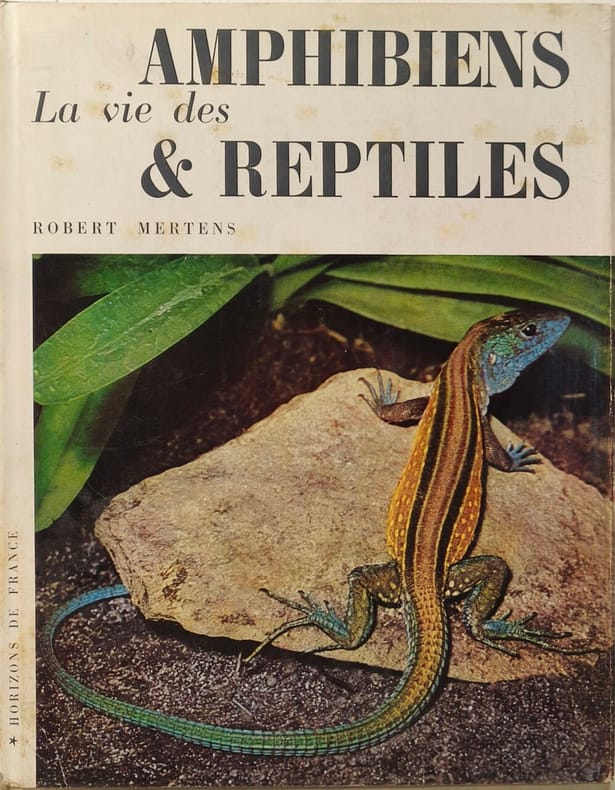
19594283Horizons de france 1959 205 pages IN4. 1959. Reliure Editeur avec jaquette. 205 pages. Ouvrage de référence sur les amphibiens et reptiles probablement un guide naturaliste illustré présentant les espèces européennes ou mondiales avec des descriptions scientifiques accessibles
1959RO30109105HORIZONS DE FRANCE. 1959. In-4. Relié. Bon état, Couv. convenable, Dos satisfaisant, Intérieur frais. 207 pages. Avec 80 planches en héliogravure et 16 hors texte en couleurs. Jaquette abîmée.. Avec Jaquette. . . Classification Dewey : 597.9-Reptiles
1959R240056176HORIZONS DE FRANCE. 1959. In-4. Relié. Etat d'usage, Couv. convenable, Dos satisfaisant, Intérieur acceptable. 206 pages - 80 planches en héliogravure et 16 hors texte en couleurs - jaquette en état d'usage.. Avec Jaquette. . . Classification Dewey : 597.9-Reptiles
1963VF250491963 ii, 236 p., num. pls, small 4to, cloth. Library stamps (Zoologisch Museum Amsterdam). Scarce.
1987R320046647SAGA. 1987. In-8. Broché. Bon état, Couv. convenable, Dos satisfaisant, Intérieur frais. 32 pages agraffées - Nombreuses photos en couleurs hors texte et nombreux dessins e nnoir et blanc in texte.. . . . Classification Dewey : 597.9-Reptiles
5102Paris, Maisonneuve & Cie, 1877-1911, brochés. Tome I : 17,5x25 cm, les 12 autres tomes : 14x22,5 cm. Tome I : LES MAMMIFERES SAUVAGES, 1877, 179 pages. Tome II : LES OISEAUX SAUVAGES, 1879, 421 pages. Tome III : LES REPTILES, LES POISSONS, LES MOLLUSQUES, LES CRUSTACES ET LES INSECTES, 1881, 365 pages. Tome IV : LES MAMMIFERES DOMESTIQUES (première partie), 1881, 275 pages. Tome V : LES MAMMIFERES DOMESTIQUES (deuxième partie), 1882, 264 pages. Tome VI : LES OISEAUX DOMESTIQUES & LA FAUCONNERIE, 1883, 243 pages. Tome VII : LES MAMMIFERES SAUVAGES, COMPLEMENT, 1906, 267 pages. Tomes VIII : LES MAMMIFERES SAUVAGES (suite & fin), LE LOUP, LE RENARD ET LES CETACES. 1908, 175 pages. Tome IX : OISEAUX SAUVAGES (première partie), 1911, 250 pages, volume tiré à 200 exemplaires. Tome X : OISEAUX SAUVAGES (seconde partie), 1915, 245 pages, volume tiré à 200 exemplaires. Tome XI : REPTILES ET POISSONS (première partie), 1910, 251 pages, volume tiré à 200 exemplaires. Tome XII : LES MOLLUSQUE, LES CRUSTACES, LES ARACHNIDES ET LES ANNELIDES, 250 pages. Tome XIII : LES INSECTES (première partie), 1911, 217 pages, volume tiré à 250 pages. Edition originale comlète en XIII volumes, RARE.
Gr. In-8, 343p. Deuxième édition. Illustré 11 planches en quadrichromie et de 24 planches en héliogravure. Inscription en page de garde, sinon bel exemplaire, agréablement relié.
Gr. In-8, 343p. Troisième édition. Illustré 11 planches en quadrichromie et de 24 planches en héliogravure. Tampon de possesseur en page de garde, sinon exemplaire en parfaite condition.
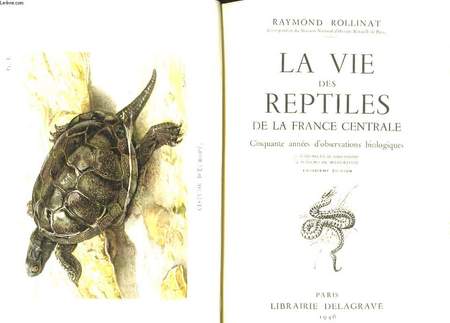
Librairie Delagrave 1934, grand et fort In-8 broché, 343 pages. 11 planches en couleurs et 24 planches en noir et blanc + 13 fgures en trait dans le texte. Couverture un peu abimée en dos, corps de l'ouvrage en bon état. Edition originale.
1946RO80042081DELAGRAVE. 3ème édition. 1946. In-8. Relié toilé. Bon état, Couv. défraîchie, Dos satisfaisant, Intérieur frais. 343 pages. Frontispice en couleurs. Nombreuses planches d'illustrations en quadrichromie et de photos en héliogravure, hors-texte. Quelques croquis en noir et blanc dans le texte. Dos toilé marron. Tranche en-tête rouge.. . . . Classification Dewey : 597.9-Reptiles
1946RO80159108DELAGRAVE. 1946. In-8. Relié demi-cuir. Bon état, Couv. fraîche, Dos satisfaisant, Intérieur frais. 343 pages. Nombreuses planches de photos en héliogravure et d'illustrations en quadrichromie. Titre doré sur demi-chagrin noir. 1er plat broché, conservé.. . . . Classification Dewey : 597.9-Reptiles
1909113481909 Paris, Au Siège de la Société Zoologique de France, 1909; Plaquette grand in-8° broché de 3pp. et 1 planche hors texte; couverture vert d'eau imprimée en noir ( légèrement jaunie en bordure des plats).
1897113471897 Paris, Au Siège de la Société Zoologique de France, 1897; Plaquette grand in-8° broché de 12pp. ( pp.88-99), couverture vert d'eau imprimée en noir ( jaunie en bordure des plats).
1909113491909 Paris, Au Siège de la Société Zoologique de France, 1909; Plaquette grand in-8° broché de 5pp.- (1) f. ; couverture gris bleu imprimée en noir ( jaunie en bordure des plats avec très petits manques)
ORD-13251Paris. Delagrave. 1934. Fort in-8 (164 x 252mm) broché, couverture imprimée en noir et bleu et illustrée d'un serpent, 343 pages, 11 planches en quadrichromie et 24 planches en héliogravures. Couverture très piquée et un peu abîmée, très bon état intérieur.