RENARD, LouisBiblio.com
15 988 résultats
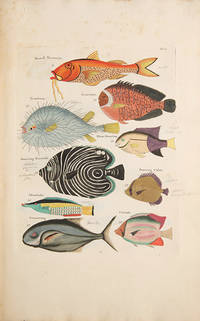
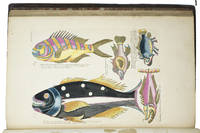
1754ABC_46313Amsterdam: Reinier & Josua Ottens 1754. Contemporary calf richly-gold tooled spine and bords green morocco spine label with title in gold decorated edges marbled endpapers. Preserved in a professionally made black cloth box with a black morocco spine label with the author title and imprint in gold. Folio. Title-page in red and black a divisional-title for each volume and 100 engraved plates numbered 1-43 & I-LVII no. LVII folding vividly hand-coloured as published showing 460 fishes and other marine animals. 2 volumes bound as 1. Renard's famous but rare work noted for the spectacular imagery of colourful but also bizarre tropical fishes crabs and lobsters from the Indo-Pacific being the first colour-plated fish book here in its rare second edition. The book contains 100 plates with 460 originally and extraordinary hand-coloured copper engravings divided over two volumes with their own half-title 'Histoire naturelle des plus rare curiositez de la mer des Indes' of 415 fishes 41 crustaceans two stick insects a dugong and even a mermaid all living in the Indian Ocean between the East Indies. Sometimes the descriptions specifically refer to fishes of some islands in the East Indies as Ambon the Moluccas or Buton but they also contain references to the "fishes of the Antilles Brazil" Sabin and Mauritius. The illustrations in the first volume seems to be quite realistic in contrast to those in the second volume which are sometimes quite surreal which is even more emphasized by the short anecdotical and highly entertaining descriptions.The Amsterdam publisher and bookseller Louis Renard compiled this collection of ichtyological illustrations by copying the sets of drawings which were brought to Amsterdam by Frederik Julius Coyett the son of the governor and ambassador of Ambon and Banda Balthasar Coyett. The drawings in the first part were copied after the collection of Balthasar Coyett. The illustrations in the second part were copied by Samuel Fallours a soldier in the service of the Dutch East India Company who started drawing marine life in the East Indies for the governors after those in the collection of Andriaen van der Stel governor of the Moluccas.The book shows marine life in the East Indies and the Indo-Pacific when Europe knew very little on this subject there. Because of the brilliant colours fantastic shapes and the described habits of its subjects the work however was often dismissed in its own time as fantasy. Nevertheless Renard's Poissons ecrevisses et crabes is nowadays still one of the rarest and most magnificent ichtyological works being the first colour-plated fish book and a highly interesting scientific effort to represent the Indo-Pacific maritime life mixed with flights of fantasy.Spine and joints professionally restored preliminaries a little foxed some minor browning especially in volume 1 but overall in good condition with brightly coloured plates. One of 35 known copies of a rare ichthyological work.l Landwehr Coloured plates 159; Nissen ZBI 3361; Nissen Schone Fischbucher 103; Sabin 69600; cf. Grace Costantino Renard's book of fantastical fish 2016 on https://blog.biodiversitylibrary.org; Julie Gardham Louis Renard: Poissons ecrevisses et crabes 2002 on www.gla.ac.uk; Theodore W. Pietsch Fishes crayfishes and crabs . 1995 pp. 22-26. Reinier & Josua Ottens, hardcover
118288Amsterdam Reinier & Josué Ottens 1754. . Second edition; 2 volumes bound in 1 folio 41.5 x 26.5 cm; 100 hand-coloured engraved plates of which 1 is folding title printed in red and black engraved dedication leaf divisional title printed 19th century bookplate of Dr. Henry Petit later pencilled notes identifying species short closed tear to plate 22 not affecting the image some spotting primarily to the front matter and index but plates overall clean; later paste-paper boards in red blue and yellow marbled paper backstrip in tree-calf pattern manuscript title to spine some wear hinges and spine professionally conserved a very good copy housed in a custom marbled slipcase with chemise.<br /> The first colour plate book on ichthyology among the rarest and most beautiful of all works of this type. One of only approximately 35 remaining copies of the second edition.<br /><br />The first edition of Poissons Ecrevisses et Crabes was produced by Amsterdam publisher Louis Renard in 1718 or 1719. This edition and the two that followed it 'each contain 100 color plates bearing a total of 460 brilliantly colored copper engravings representing 415 fishes 42 crustaceans two stick-insects a dugong and a mermaid. With one exception all of the illustrations represent tropical species of the East Indies said to have been drawn from nature on the island of Ambon in the South Moluccas by an artist named Samuel Fallours in the employ of the Dutch East India Company. The original drawings were obtained by Renard from various individuals who brought them to Holland in 1708 and 1715'. A recent survey by biologist and historian of science Theodore Pietsch determined that of the one hundred copies printed only sixteen are still know to exist Pietsch 'Louis Renard and his Poissons' in Ichthyology in Context 2023.<br /><br />The second edition is 'only slight more accessible' than the first'. 'It seems that the publishing firm of Ottens took the 30 or 36 unbound copies purchased from Renard's estate had the plates colored replaced the old undated title page of Renard and added a "Preface" provided by Vosmaer and the 'Declaration sur cet Ouvrage' of Renard. These then together with some 70 additional copies newly printed from the original coppers save for the new title page and "Preface" constitute the second edition' of which around 35 copies still exist Pietsch.<br /><br />While the illustrations have been criticised in the past for their 'dazzling' colour and embellishments they are in fact based on real specimens and were considered a valuable source of information by naturalists including Georges Cuvier who in 1828 described them as 'still indispensable'. 'Indeed fully 91% of the 460 organisms depicted in the book have been identified at least to the taxonomic level of family' Pietsch.<br /> Amsterdam, Reinier & Josué Ottens, 1754. hardcover
200985454Charlottesville: Virginia Arts of the Book Center Press 2009. Limited Edition number 4/50 on last page. Hardcover. Very good. Jeff Pike. Format approximately 4 inches by 6.75 inches. Unpaginated 28 pages. No dust jacket present may not have been issued. Signed by both the author and illustrator on the title page. Very rare early published compendium by emerging poetic force and award-winning illustrator. Contents include: After the Party On Plenitude Metropolitan the Consolations of Philosophy After Love Charlie Chaplin and Nineteenth Symphony. Handsome and well made example of a finely produced specialty volume. This volume was printed on the letterpress and handbound at Virginia Arts of the Book Center Charlottesville in the summer of 2009. The text was set in Cambria and printed from polymer plates made by Boxcar Press of Syracuse NY. The paper used was Hahnemuhle photo rag 100% cotton smooth. Ryan Fox is a graduate of the University of Missouri and received his MFA from the University of Virginia. The poems in this volume first appears in New Orleans Review Columbia Caketrain and New Ohio Review. Jeff Pike is a Professor of Communication Design program of the College & Graduate School of art Sam Fox School of Design & Visual Arts Washington University in St. Lois. He worked in Charlottesville while on sabbatical. Ryan Fox attended St. Louis University High School where he was an editor of Sisyphus and a frequent contributor to the magazine and also features editor of the Prep News. Fox was a 2016 winner of the Discovery Poetry Context. He earned an MFA from the University of Virginia where he was poetry editor of Meridian and a JD from Fordham University School of Law where he was Editor-in-Chief of the Fordham Intellectual Property Media & Entertainment Law Journal. His poems have appeared in The New Yorker Boston Review and others. A member of the New York State bar. Jeff Pike earned a BFA degree from the Kansas City Art Institute and an MFA in Visual Communication from Syracuse University. Pike joined the faculty of the School of Art at Washington University in 1983. He has directed the Illustration program and in 1993 he was appointed Associate Dean responsible for the undergraduate programs. Pike was appointed Dean of the School of Art in 1999 a position he held through July 2008. Pike's professional work has appeared in numerous print and broadcast venues. He has worked for major advertising agencies and clients. His work has been recognized in Print Art Direction Creativity and Adweek magazines. He also has won Addy's and Flair awards for his creative work in advertising. In 2010 Pike published a boxed letterpress book of illustrations and works of fiction by two authors based upon the letters of Heloise and Abelard titled From Letters to Fictions: Heloise & Abelard. Most recently Pike's work has been accepted into the 53rd Annual New York Society of Illustrators exhibition. Pike has lectured at a number of schools and universities. He has twice been a resident at the Cité International des Arts Paris. He has led abroad programs in Belgium France and Italy. As dean he has traveled throughout Asia. Pike has been a board member for several art organizations most recently the National Association of Schools of Art and Design NASAD. Virginia Arts of the Book Center Press hardcover
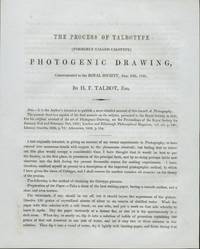
184148243London.: Printed by J. L. Cox and Sons. 1841. Loose as issued later morocco-backed portfolio. 4to. 229 x 182 mm. Leaf with drop-head title and note above opening text printed text recto and verso on following leaves folded as issued. The rare first edition of the first announcement of William Henry Fox Talbot's calotype method - the negative / positive photographic process - the most important innovation in the history of photography.Although Talbot had announced his researches and progress in the field of what was to become photography in his 1839 lecture to the Royal Society 'Some Account of the Art of Photogenic Drawing . &c.' that lecture although ground-breaking dealt largely with the achievement of an image on treated paper and only alluded briefly to the possibility of a more versatile development. It was not until his 1841 lecture to the same body the title as per the present publication is 'The Process of Calotype Photogenic Drawing . &c.' that the details of his refinements and most particularly his successes with the negative / positive process were delineated. Those successes and Talbot's development of the resultant negative / positive process for photographic reproduction and duplication remained the predominant methodology in the field for more than 150 years; all subsequent refinements whether in the chemicals used differing methods for image capture printing and so on were merely variations on Talbot's original scheme. Talbot had patented his method in secret he was awarded 'Her Majesty's Royal Letters Patent No. 8842' in February 1841 prior to his lecture to the Royal Society concerned by Arago's announcement of Daguerre's discoveries the efforts of Hippolyte Bayard and the priority of his own work.'In 1841 William Henry Fox Talbot announced an improvement of his photogenic drawing process which he named 'calotype' from the Greek meaning 'beautiful picture'. Previously he had allowed his sensitized paper to remain exposed to light until an image became visible. He now made a remarkable discovery: a much shorter exposure so changed the characteristics of the silver salts that they could be reduced to silver by chemical after-treatment. This principle of the 'development of the latent image' is basic to most subsequent photographic processes . To make a calotype negative Talbot bathed a sheet of paper in two solutions one of silver nitrate the other of potassium iodide . After exposure the paper was bathed again in this solution a mixture of gallic acid and silver nitrate which acted as a physical developer and gradually brought out the image . He printed them the resultant negative with his original silver chloride paper.' Beaumont Newhall. 'Privately printed for the author for distribution to friends and editors.' Gernsheim.'Between 1835 and 1839 Talbot and Henneman continued their experiments motivated by a desire . for reproducing images from nature. Following Arago’s announcement to the Académie des Sciences 7 January 1839 of the existence of Daguerre’s photographic process Talbot became concerned over the priority of his work; he frantically sought to improve his process prior to the disclosure of Daguerre’s . In 1840 Talbot would develop a latent image on paper and he called this new process the calotype. He patented and then disclosed the process in a paper presented to the Royal Society in June of 1841 . '. DSB.Talbot's document is scarce: COPAC locates no copies in the UK and the catalogue for the British Library reports no example; OCLC lists two copies in Germany at Marburg and Stuttgart's Staatsgalerie and four in the US at Syracuse Columbia Harvard and Princeton.The document was reprinted with an altered title 'The Process of Talbotype formerly called Calotype Photogenic Drawing . &c. in 1846.Gernsheim 655; see Beaumont Newhall's 'The Calotype: The Pencil of Nature' in 'The History of Photography' New York 1997 pg. 43. Printed by J. L. Cox and Sons. unknown
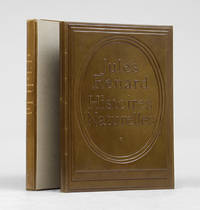
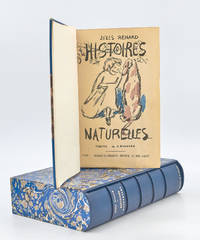
189997129Paris: Floury 1899. Toulouse-Lautrec's masterpiece of the illustrated book First edition number 84 of 100 copies only one of the most celebrated and sought-after of all livres d'artiste some of Lautrec's finest illustrations and the prototype of nearly all modern bestiairies Garvey. Lautrec and Jules Renard met first in 1894. The artist asked to illustrate some of the charming and witty portraits of animals and his first sketches were made at the Jardin d'Acclimatation and Jardin des Plantes in 1896. The last two illustrations printed were executed by Lautrec while he was a patient at the Neuilly clinic of Dr Sémalaigne. Renard's Histoire naturelles "contains some of Toulouse Lautrec's most refined draftsmanship and with Yvette Guilbert it is considered one of the masterpieces of the illustrated book. It was Lautrec who requested the pleasure of illustrating Renard's bestiary and Renard agreed hoping for descriptions that 'would please the animals themselves'. The two creative personalities clashed. Lautrec resented the book's limitation to mundane animals while Renard although paid homage to by a cover design of a fox objected to a number of Lautrec's drawings. Today we are amazed that it took Floury twenty years to sell out the edition of 100 copies" Donson/Gripp. Small folio 310 x 220 mm. With an original transfer lithograph to front wrapper on Japan paper and 22 throughout the text on vélin paper by Toulouse-Lautrec. Finely bound in 1973 by Pierre Lucien Martin 1913-1985 in olive green modelled calf titles to covers in raised lettering. Housed in a matching quarter calf chemise and slipcase. Foot of spine lightly rubbed with one small nick contents fresh; slipcase slightly sunned and rubbed. A finely bound copy. Adhémar 333-355; The Artist and the Book 304; Delteil 297-319; Donson/Gripp Great Lithographs by Toulouse-Lautrec nos. 78/79; Garvey 304 "Now one of the greatest rarities of the 19th century. Not only does it contain some of Lautrec's finest illustration but it is the prototype of nearly all modern bestiaries"; Rauch 17; Wittrock Toulouse-Lautrec I 202-224. unknown
184649London: Printed by J. and H. Cox Brothers 74 and 75 Great Queen Street Lincoln’s-Inn Fields 1846. First edition under this title. Privately printed reprint of Talbot’s memoir that was published with variant title and imprint Process of Calotype Photogenic Drawing … London: J. L. Cox & Sons 1841. The printers J. & H. Cox were active from 1844–1846. Housed in blue cloth folder. In fine condition. First edition under this title. Privately printed reprint of Talbot’s memoir that was published with variant title and imprint Process of Calotype Photogenic Drawing … London: J. L. Cox & Sons 1841. The printers J. & H. Cox were active from 1844–1846. Housed in blue cloth folder. 4 p. In this paper Talbot 1800–1877 photographer inventor announced his invention of the photographic process the first permanent negative process on paper that he called Calotype and later – first in print in the title of this paper – Talbotype. His process was the forerunner of most photographic processes of the 19th and 20th century. It also had the advantage of fastness compared to other photogenic drawing processes of the time. <br /> An extremely rare and early paper on photography as Talbot printed privately in limited number for presentation to his friends and editors. Printed by J. and H. Cox, Brothers, 74 and 75, Great Queen Street, Lincoln’s-Inn Fields unknown
1562376729Frankfurt am Main: David Zöpfel 1562. Woodcut title vignette 43 woodcut illustrations some repeated. Title page in red and black. 8 300 leaves. Small 4to 7-3/4 x 5-7/8 inches. Late nineteenth century brown crushed morocco gilt by Frances Bedford marbled endpapers gilt edges. Provenance: William Title inscription dated 1856 on front free endpaper; C. S. Ascherson bookplate and inscription to; Edward Ascherson bookplate. Woodcut title vignette 43 woodcut illustrations some repeated. Title page in red and black. 8 300 leaves. Small 4to 7-3/4 x 5-7/8 inches. The first of two Frankfurt printings by David Zöpfel that year using the same woodcuts. The text is descended from the Low German version Reynke de Vos first printed at Lübeck in 1498. <br /> <br /> Among the most widely adapted of the beast fables the tales of Reynard the Fox originated in the 12th and 13th centuries with early versions in French Dutch Latin and German being notable. One of the most important secular literary traditions of the Middle Ages Reynard the Fox is at its essence biting satire and parody. The character of Reynard an anthropomorphic fox and trickster has since become almost an archetype in the literatures of many languages. "The supreme 'anti-hero' of medieval fiction" Cambridge Guide to Children's Books in English.<br /> <br /> This copy from the renowned library of the eminent British architect and book collector Sir William Tite 1798-1873 whose sale at Sotheby's in May-June 1874 took sixteen days certainly one of the greatest collections of the time. [David Zöpfel] unknown
195417365ZAUBERKREIS 1954. 1. softcover. Weisse Hölle Maloftege! ZAUBERKREIS paperback
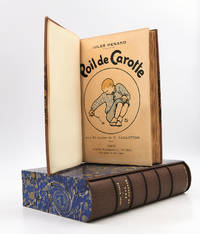
190487526Paris: Flammarion 1904. Fine. Flammarion Paris s.d. 1904 11.50 x 19 cm relié sous chemise et étui New edition and first printing of the superb illustrations by Pierre Bonnard one of 20 numbered copies on japon the only deluxe paper issue. Half blue percaline bradel binding with corners smooth spine adorned with a central gilt fleuron and double gilt fillet at the foot chocolate brown shagreen title label with minor scuffing french curl on Turkish patterned paper boards covers and spine preserved contemporary binding signed Carayon. Spine slightly browned corners slightly dulled. Our copy is housed under a half morocco chemise with five raised bands ill. de P. Bonnard stamped in gilt at foot of spine boards of tiger patterned paper and a slipcase bordered with blue Morocco with boards of tiger patterned paper signed T. Boichot. Illustrated with 68 drawings by Pierre Bonnard the second cover is also illustrated with a drawing by Félix Vallotton for the edition of Poil de Carotte published by the same publisher two years earlier. A rare and pleasant copy in a contemporary binding by Carayon. Flammarion hardcover
184152094London: Printed by J. & H. Cox Brothers 74 & 75 Great Queen Street Lincoln's-Inn Fields 1841. First edition. 4to. 4 pp. Aside from a few faint pinpoint spots of foxing this is a fine as new copy. Housed in a custom made cloth chemise and slipcase titled in gilt along the spine. Shortly after the presentation of his paper before the Royal Society on 31 January 1839 Talbot at his own expense printed the text as a pamphlet of 14 pages; "Some Account of the Art of Photogenic Drawing."became the world's first separate publication on photography. Through this process an ordinary piece of writing paper was immersed in a sensitizing solution dried placed in a camera and exposed in daylight to a subject for upwards of an hour or longer. Upon examination a tonally reversed rendering of the subject was visible. It was then soaked in a solution of salt and washed and dried then the process was essentially repeated exposing the first print to the new sensitized sheet reversing the tones to produce an image with the tonality as in nature. Through a series of further experiments over the next months Talbot discovered that a "latent" image always existed and that through chemical development it could be brought to life. This allowed for speeding the exposure in the camera to be cut to a mere 30 seconds and the enriched chemical solutions would produce a sharper and tonally richer image. This process he first called the Calotype from the Greek kalos - beautiful. <br /> <br /> On June 10 1841 Talbot presented the Calotype process at a meeting of the Royal Society and at his own expense he published a four page description of his process. Unlike his earlier publication on Photogenic Drawing here he states in detail the full process. <br /> Upon the urging of John Herschel and David Brewster he began to call his process the Talbotype rather than Calotype. His intention was to license this process and likely this printed description was printed to distributed to potential licensees. <br /> <br /> Aside from changing the name from Calotype to Talbotype in the title of this publication and the slight alteration in the printer's imprint the text of the two issue are identical - the word Calotype remains in the body of the text This is the foundation stone of the negative-positive process that has been in use since it was first published.<br /> <br /> This printing is much rarer than the Calotype variant with WorldCat locating only Harvard University - Houghton Library and Cornell University. Gernsheim Incunabula No. 655 listing only the Calotype variant. Roosens and Salu No. 10285 listing only the Calotype variant. Weaver HENRY FOX TALBOT SELECTED TEXTS AND BIBLIOGRAPHY No. 87 listing only the Calotype variant. Printed by J. & H. Cox, Brothers, 74 & 75, Great Queen Street, Lincoln's-Inn Fields unknown
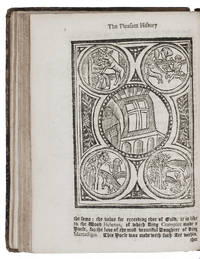
17016399London: T. Ilive 1701. Early English editions. Bound together with:<br /> <br /> The Most Pleasant and Delightful History of Reynard the Fox. The Second Part. Containing Much Matter of Pleasure and Content. Written For the Delight of young Men Pleasure of the Aged and Profit of all. To which is added many Excellent Morals. London: Printed by A.M. and R.R. for Edward Brewster 1681.<br /> <br /> And:<br /> <br /> The Shifts of Reynardine The Son of Reynard the Fox Or a Pleasant History of His Life and Death. Full of Variety &c. And may fitly be applied to the Late Times. Now Published for the Reformation of Mens Manners. London: Printed by T.J. for Edward Brewster and Thomas Passenger 1684.<br /> <br /> Three parts in one small quarto volume 7 5/16 x 5 9/16 inches; 186 x 141 mm. 156 2 table of contents 2 publisher's advertisements; 111 1 publisher's advertisements; 8 160 pp. Mostly black letter with titles and side notes in roman letter. Sixty-two woodcuts in the first part printed from thirty-nine blocks and fifteen woodcuts in the second part five repeated all repeats from the first part. Most cuts signed "E.B." Edward Brewster. Woodcut on C1 recto Part I printed upside down. Some browning occasional light damp staining and soiling. Part I with tiny puncture marks in the lower blank margin through gathering I just touching one letter in the imprint on the title-page six small holes in I3 and one tiny hole in I4 causing loss of a couple of letters. Part III with paper flaw in the upper blank corner of A3 and A4 tiny tear 1/4 inch in the lower blank margin of F4 and paper flaw in the lower blank corner of I2 none affecting text. Contemporary sprinkled sheep. Covers ruled and decoratively tooled in blind spine decoratively tooled in gilt in compartments with two red morocco gilt lettering labels. Some expert restoration to joints and corners. Armorial bookplate of Gloucester on front free endpaper. Bookplate of Hugh Cecil Lowther 5th Earl of Lonsdale 1857-1944 on front pastedown his sale 12 July 1937 lot 445. An excellent copy. Housed in a felt-lined quarter brown morocco clamshell case spine with five raised bands decoratively tooled and lettered in gilt in compartments.<br /> <br /> Reynard the Fox "hero of several medieval European cycles of versified animal tales that satirize contemporary human society. Though Reynard is sly amoral cowardly and self-seeking he is still a sympathetic hero whose cunning is a necessity for survival. He symbolizes the triumph of craft over brute strength usually personified by Isengrim the greedy and dull-witted wolf. . The main literary tradition of Reynard the Fox descends from the extant French 'branches' of the Roman de Renart about 30 in number nearly 40000 lines of verse. The facetious portrayal of rustic life the camel as a papal legate speaking broken French the animals riding on horses and recounting elaborate dreams all suggest the atmosphere of 13th-century France" Merriam-Webster's Encyclopedia of Literature. There is some variation in chapter number within the early editions: From "Caxton's first edition 1481 to Thomas Gaultier's only edition 1550 the story is divided into 43 chapters" while the anonymous edition 1560-1585 has 58 chapters Varty. By the 17th century when the text is titled The Most Delectable History of Reynard the Fox it appears with only 25 chapters and maintains its image cycle. Early 17th century editions also maintained this "picture cycle" through Edward Brewster's 1662 edition but at this point the Wynkyn de Worde blocks were extremely worn and new set was created Varty. Forty images were used for his second edition 1671 and all contain his initials EB. "He published further illustrated editions in 1676 1681 1694 and 1701. in 1672 he grafted new life onto the old story with A Continuation Or Second Part of the Most Pleasant and Delightful History of Reynard the Fox" Varty for which he eventually created an additional 15 illustrations. In 1684 he would produce an additional sequel following the adventures of Reynard's son Reynardine. <br /> <br /> Brunet IV cols. 1228-1229. Lowndes p. 2076. Varty Appendix Three: "A Short-Title List of All Extant Illustrated Histories of Reynard the Fox from Wynkyn de Worde c. 1495 to A. Soulby c. 1800 which are kept in United Kingdom libraries based on H. Menke Bibliotheca Reinardiana" 24 18 and 21. Wing S3512 Part II and S3436 Part III. T. Ilive unknown
190287525Paris: Flammarion 1902. Fine. Flammarion Paris s. d. 1902 11.50 x 19 cm relié sous chemise et étui Second edition with some parts in first edition with 5 added tales Félix Vallotton's illustrations in first issue one of 20 numbered copies on japon only deluxe issue. Bradel binding brown 3/4 cloth smooth spine with floral motif stamped in gilt at center twice ruled in gilt at foot slightly chafed morocco title-label marbled paper boards original covers and spine preserved contemporary binding signed Carayon. Small clear stains to the top edge of first board one corner slightly rubbed a spot of foxing at foot of the first few pages. Illustrated with 50 drawings by Félix Vallotton. Rare and handsome copy housed in a contemporary binding by Carayon. Renard and Vallotton the foreign nabi had met in the offices of La Revue Blanche a famous avant-garde journal which frequently featured Vallotton's woodcuts and published numerous contributions by Jules Renard. The writer invited Vallotton to illustrate this ""other first edition of Poil de Carotte which includes 5 previously unpublished stories: My dear Vallotton Would it amuse you to illustrate - in complete freedom - Poil de Carotte for Flammarion Renard wrote him in a letter dated June 21 1902. Vallotton was chosen ahead of Toulouse-Lautrec and Alexandre Steinlen two other great artists of the time who had shown an interest in the project. Renard's affinity with Vallotton's style is easy to understand as Vallotton's raw simplicity perfectly matches Poil de Carotte's incisive depiction of a loveless childhood: A few words a few lines are enough for these two artists. They both ruthlessly cut away the superfluous Léon Guichard L'Interprétation graphique cinématographique et musicale des uvres de Jules Renard. Flammarion hardcover
170122642London 1701. 4to. Thomas Ilive for Edward Brewster Late-18th-century sprinkled calf sewn on 5 cords 3 attached to the boards and 2 cut short gold double fillets blind-tooled board edges red morocco spine label in 2nd of 6 compartments red sprinkled edges. With woodcut of King Lion's court on the title page 61 woodcuts in text of part 1 including 23 repeats all signed Edward Brewster and all half-page 7.5 x 10.5 cm to nearly full-page 13 x 9.5 cm and 15 woodcuts in part 2 all repeated from part 1. Further with a large woodcut decorated initial in part 3 and decorations built up from cast fleurons in parts 1 and 2. Set in textura types with incidental roman and italic including Moxon's 1669 Canon roman on the title-page of part 3. 3 parts in 1 volume. 160; 112; 4 160 pp. One of the rare sets of all 3 parts of the English Reynard the Fox the third part here in its first edition. The Reynard stories were already established as a coherent collection in the 12th century and were first printed in 1479 in a Dutch prose edition. They became especially well known when translated into English and adapted for Caxton's 1481 edition in 43 chapters. The publisher Edward Alde in London began work on an extensive revision of Caxton's text with many new additions but he published only the first part probably in 1620 the first edition of the present part 1 containing 25 chapters some corresponding with chapters in Caxton's edition and some not. Although the second part would have to wait 52 years the first part quickly became the standard English version of the Reynard the Fox stories with 8 editions from 1620 to 1671. Its language was modernized giving both a view of the stories as they were known through most of two centuries and insights into English values and culture of the time. In 1684 Brewster added the present first edition of part 3 giving the adventures of Reynard's son Reynardine.With 20th-century woodcut bookplate. The woodcut on C1 of part 1 is printed upside down. In good condition with parts 2 and 3 slightly browned. One front endleaf is detached the spine slightly damaged at the head and the front hinge cracked.l Ebert II 18879; ESTC T60836 R218371 R40614; Kirmse 15; Menke V B c note on pp. 221-222 nos. 35 29 30; Wing S3512 S3436 parts 1-2; not in Prien. hardcover
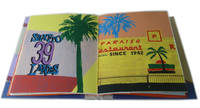
9647Achill Island Ireland: Rex Fox Press 2014. One of only 69 signed and numbered copies. 24 screen printed pages. 25 x 33 cms. In a superb large enginerred binding by the great British bookbinder Peter Jones of brown tan and green morocco backed wooden and perspex boards with palm tree and signs design in various coloured pape applied to perspex sections. All housed in a superb wooden orange felt lined box perspex windows with original upper wrapper screen print on the upper cover. Original screen printed back wrappers in a pocket at the back. The binding statement declares: Through my choice of materials design and structure I sought to capture the essence of the scenes depicted within the book. The treatment of the spine and adjacent shapes are palm trees with the shapes at the fore-edges being stylised representations of signage viewed from street level. The structure of the binding was devised to cope with the particular demands of a thick single section text block printed on heavy paper. The original covers of the edition binding have been incorporated into the box as the top of the lid.â€<br>Peter Jones worked in London as a furniture restorer and leather liner before training in bookbinding at Brighton Polytechnic. He now works as a bookbinder and as a carpenter and his books have a remarkably engineered quality with a great understanding of how to use different material in his work. He has taught bookbinding extensively including at the Universities of Brighton and Roehampton and is a Fellow and Past President of Designer Bookbinders. His work is exhibited internationally and held in numerous collections. Peter mainly works from his studio bindery in Wannock East Sussex. Rex Fox Press hardcover
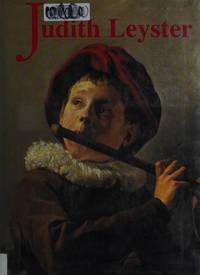
198987140Davaco Publishers. New. 1989. Hardcover. 9070288621 . FREE UPGRADE to Courier/Priority Shipping Upon Request - IN STOCK AND IMMEDIATELY AVAILABLE FOR SHIPMENT - FLAWLESS COPY BRAND NEW PRISTINE NEVER OPENED -- - Corresponds to ISBN: 9070288621. Text in English. 300 pages; 176 illustrations. Leijster Catalogue Raisonne Catalog Raisonné Complete Works Life and Work Raisonnee -- with a bonus offer . Davaco Publishers hardcover
1951665Los Angeles: Twentieth Century Fox Film Corp 1951. 38 x 24 1/2 inches. Very good condition. Movie poster of the Ben Hogan Story called Follow the Sun. Very rare. See pics. Twentieth Century Fox Film Corp unknown
192429268ABHB NODustjacket March 1924 1st Edition 2ND Printing STATED on Copyright Pg Dates MATCH on Title & Copyright pg VG- Minor damage to the inside of the back cover creating scuffing blankendpaper. Hardcover no dust jacket.VG- condition overall spine and all pages intact. 1st Edition 2nd Printing 1924 SPINE TITLES ARE Gone but Front book is Nice Some wrinkling to Back Cvr <br /><br /> New York: Knopf, Plates engraved by Beck Engraving hardcover
001NY: Charles Scribner's Sons 1903. Very Rare Book. Another indicator of it's rarity is the name of the Publisher. Publisher is Grosset & Dunlap of New York.<b>Grosset & Dunlap</b> is a United States book publisher founded in 1898. Book is in tack. Will need some restoration. Imaging finding a book from the late 1800 with a love note dedicating this book to Miss Carrie Duke. Rare edition thus. Hardcover. Orig. spine that is intact but needs restoration. Front and back cover intact. I searched the internet intensively and found pictures of first editions HOWEVER none of them had the love dedication note or the black trim around the title of the book. Information on Miss Carrie Duke listed below:Woman's Work in Kentucky." by Mrs. Eugenia Dunlap Potts. <br />Publication: Eagle Mary Kavanaugh Oldham ed. The Congress of Women: Held in the Woman's Building World's Columbian Exposition Chicago U. S. A. 1893. Chicago Ill: Monarch Book Company 1894. pp. 562-568.<br /><br />Susannah Hart the aunt of Mrs. Henry Clay raised and pulled the flax which she wove and spun into her wedding gown with an art so clever that she could draw the width through her wedding ring. She belonged to the wealthiest of those early families of note and was the wife of Gov. Isaac Shelby. She died at the age of seventy-two years at "Travelers' Rest" the grand old homestead which has never passed out of the Shelby family. She was the mother of ten children and her descendants are widely scattered. Mary Hopkins Cabell Breckinridge was a contemporary whose work can never die. Hers were not deeds of daring nor of tragic from the lurking Indian. Her power was in her eloquent conversation her strong opinions her decided views of duty. Her sons are orators and statesmen; her daughters are ambitious and progressive. Margaret Breckinridge a granddaughter devoted heart and hands to hospital work during the war of the Blue and the Grey; and by her gentle self-sacrificing ministering was named the "Angel of the hospitals." She said "Shall men die by thousands for their country and no woman risk her life" Still a younger generation is led by Miss Sophronisba Breckinridge who after years of travel in Europe studied law in her father's office. Mrs. Catherine Hunt the chatelaine of one of Lexington's proud homes reigned a queen in her domain. The train of servants the management of her handsome estate and all the demands upon the mistress of such possessions called for executive ability of rare degree. Hers was the thinking head and the guiding hand. The Baroness Burdett Coutts says: "Woman may be allowed to lead in acts of charity" and right nobly has she set this example. This woman Mrs. Hunt used her prerogative here. Sixty-one years ago when cholera wellnigh depopulated the Blue Grass capital she went forth on pious mission bent. Coming upon three desolate little children whose parents lay dead she said to a friend: "What shall we do with them Let us buy them a home." She opened her purse and established the Orphans' Home Lexington's oldest charitable institution where many little feet have found a resting place. Mrs. Henrietta Hunt Morgan was her daughter and the Hon. Francis Kay Hunt of legal celebrity was her worthy son. Mrs. Morgan presided over her household much after the manner of her bringing up. She was the mother of a remarkable family. Her sons were Gen. John Hunt Morgan Col. Calvin Morgan Capt. Charlton Hunt Morgan and Lieut. Thomas Morgan. Her daughters were the wives of Gen. A. P. Hill and of Gen. Basil W. Duke. Behold the evolution of the Kentucky girl if I may so term the greater liberty of today! Mrs. Henrietta Morgan Duke of Louisville Ky. one of our commissioners is a woman of incomparable qualities of heart and brain. She reflects the grandmother and mother in strength of character and in executive ability. Times have changed and she has risen to the demands. Her young daughter <b>Miss Carrie Duke</b> the violin virtuoso represents the fourth generation of this family. The ancient code would have held her captive but the liberty of the present sent her abroad to develop the divine genius that now sways multitudes. Another young descendant of Mrs. Hunt is Miss Lucy Lee Hill a World's Fair Commissioner who bravely and briskly went about the work of collecting exhibits; faithfully she has presided at the state building. Yet another great-granddaughter is Miss Eleanor Howard Morgan daughter of Capt. Charlton Morgan who entered Bryn Mawr College where her scientist brother Dr. Thomas Morgan holds the chair of biology. This young girl perfectly illustrates the fact that developing a woman's brain does not necessarily rob her of feminine charm. No lily of the valley breathing its delicate fragrance far below the gaze of man is more modestly environed; yet her influence pervades all the atmosphere about her. She inherits not the dash of her uncle the <b>cavalry chief</b> but the steady glow of woman's star when lit by the brilliancy of intellectual fire<br /><br />Since I don't have a true value of this book it may be priceless. I have decided to start at $5000.00. Grosset & Dunlap hardcover
9573Monterey KY: Larkspur Press 2006. Full Leather. Fine binding. Octavo. 4 36 4 pp. Limited edition number 9 of 75 copies on Somerset Book paper there was also an edition of 500 regular copies. Signed by Wendell Berry at the colophon; additionally noted by Fox the year it was bound. In full goatskin binding with a series of leather onlays tooled in gold and blind all creating a fantastic pictorial binding. Accompanying the binding is a fine paper portfolio with publisher's prospectuses samples and associated material; additionally some templates related to Fox's binding. All housed a custom clamshell by Fox. <br /> <br /> The text offers a lens into the 19th century view of how a native of region assesses the value of the natural wonders. Berry's commentary at the end of Allen's text brings the troubling viewpoint into a modern context: "The chapter is built upon a division of mind which in our time has become terrifying but which Allen believed to be no more than a simple equation. On the one hand in a sentimentally romantic fashion he was sensitive to the natural life of the area which was then still intact. And on the other hand he seems eager for the destruction of this virgin bounty that so inspired him. I say 'the destruction' and not 'the use' for his language is patently that of an exploiter intent upon 'conquering' nature." A sobering volume that will most surely always remain relevant. Larkspur Press unknown
1381n.p.: n.p. 1671. First Edition . Hardcover. Good. Quarto. 28 pages. A4-C4 D2. First edition. In a modern cloth binding leather title label on spine. ESTC R30372. Title-page mounted. Pages 23 and 24 with a hole in the first three lines affecting some letters. Pages 25 through 28 with a hole extending through seven lines in pages 25 and 26 and eight lines in pages 27 and 28 affecting words and letters. Many leaves silked. An extremely rare item that has not shown up in auctions in several decades. <br/> <br/> n.p.: n.p., 1671. hardcover
17911909070003Florence: Niccolo Pagni and Giuseppe Bardi 1791 & 1795 1791. First Edition. Hardcover. Good. A Monumental Work of 18th century Italian engraving 2 volumes. Large folios 51 x 35 cm 19 3/4 x 13 in. 1st edition. Bound in contemporary 1/2 vellum over marbled boards. Some cover wear. Rear joint of v.1 cracked. Hinges of v. 2 cracked. Text in Italian and French printed in parallel columns. Collation: v.1 Engraved title frontispiece 64 leaves 60 plates. v.2 Engraved title 62 leaves 60 plates. Many of the plates are printed in colored ink: siena shades of brown or green and blue. 120 artists' portraits. <br> A gorgeous and large format work on Tuscan painting beginning with Guido da Siena and considering all the great painters of Florence such as Buffalmaco Cimabue Giotto Paolo Uccello Andrea Verrocchio Masaccio Fra fifilppo Lippi Andrea del Castagno Pollaiolo Botticelli Leonardo da Vinci Michelangelo Andrea del Sarto Antonio Tempesta Giuseppe Grisoni etc. Carlo Lasinio 1759-1838 was responsible for many of the engravings. Other engravers included: Giovanni Francisco Ravenet Marco Lastri Giuseppe Bardi Niccolo Pagni Matteo Carboni Ferdinando Gregori Gaetano Vascellini and Cosomo Colombini. <br> Refs: "Pregevole opera" Cicognara 3387. Cohen-Ricci 366. Thieme-Becker XXII 404. Brunet II 1095. Graesse II 509. Moreni I 509: "Ciascuno di questi volumi racchiude 60 articoli di notizie di altrettanti pittori toscani scritti in italiano da M.L. promotore di questa eccellente impresa e tradotti in francese da Bartolomeo Renard. Ognuno di essi ha una stampa incisa in rame scelta dalle Opere le piu stimate di quel pittore." <br> Armorial bookplates of Paul Beilby Thompson 1784-1852. Thompson was a Whig MP for Wenlock and East Riding; later made a Baron. <br> This is an oversized or heavy book which requires additional postage for international delivery outside the US. Florence: Niccolo Pagni and Giuseppe Bardi, 1791 & 1795 hardcover
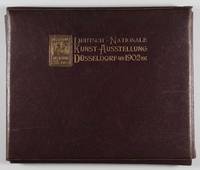
190252612Düsseldorf: Verlag der Dt. Nat. Kunstausstellung 1902. First edition. Loose leaf. Very good to fine condition. Oblong Quarto. 35 original silver gelatin prints. Original brown leather portfolio with gilt emblem and gilt lettering on gilt-framed cover. Red silk inside front cover and portfolio flaps. The bottom flap gilt-stamped Otto Renard Paul Adam Buchbinderei Düsseldorf.<br /> <br /> Album of thirty-five original photographs 9 3/4 x 11 1/4" by court photographer Otto Renard that document National Art exhibtion of 1902 by room. The photographs include a exterior panorama view of the newly built Art Palace its courtyard an interior view of the dome the large gallery the large hall and various galleries with work of artist groups and art organizations e.g. Kunstgenossenschaft Berlin Secession Berlin Dresden Düsseldorf 6 Munich Luitpold Group Munich Secession Munich Art Association Rhineland and Westfalia Art Alliance "Hagen" from Vienna 2 Art Collective Vienna Secession Vienna recreation room Secession Vienna the Van der Velde room the art historian gallery 5 old Japanese art. The exhibition includes paintings furniture sculpture and statuettes and a variety of interiors. The Art Palace was built for the 1902 Industry and Craft Exhibition for the Rhineland Westfalia and neighboring districts. <br /> <br /> The building of the Kunstpalast was in large part due to the efforts of Fritz Roeber director of the Düsseldorf Art Academy the painter Georg Oeder and the art historian Paul Clement in the late 1800s who were able to convince Heinrich Lueg director of the association for commerce that the time for another great art and commerce exhibition had come. The goal was the establishment of a new permanent venture for art exhibitions that was to become the center of the arts in the Rhinelands and Westfalia. Lueg took the lead and started the planing for the Kunstpalast already in 1898. The goal was to exhibit the development of the past 20 years in a formidable gallery and the 1900 Paris World exhibition was the model for the undertaking. Despite the fact that some of the planned buildings were not ready by the opening of the two exhibitions it opened on May 1st and closed on October 20th 1902 the exhibitions became a huge success. Two OCLC entries.<br /> <br /> Text in German. Portfolio with light wear one inch closed tear at top right of portfolio cover. Some light worm damage in silk of inside front cover and right flap. Few plates with minor damage at edges and lightly age-toned in margins. Images fine. Otto Renard 1855-1943 was known for his documentation of art exhibitions among them the 1902 art and commerce exhibition in 1902. The distinction "Hof Fotograf Court photographer" he earned while working at the court of Zar Nikolaus II. Renard returned to Germany after the turn of the century to open photo-studios in Düsseldorf and Aachen. He became wealthy due to his invention of a photo-paper moved to Berlin and then to Darmstadt. Verlag der Dt. Nat. Kunstausstellung unknown
1989C87140Davaco Publishers. As New. 1989. Hardcover. 9070288621 . FREE UPGRADE to Courier/Priority Shipping Upon Request - IN STOCK AND IMMEDIATELY AVAILABLE FOR SHIPMENT - FLAWLESS COPY BRAND NEW PRISTINE NEVER OPENED -- - Corresponds to ISBN: 9070288621. Text in English. 300 pages; 176 illustrations. Leijster Catalogue Raisonne Catalog Raisonné Complete Works Life and Work Raisonnee -- with a bonus offer-- - May be EITHER: out of print OOP and extremely rare in this pristine condition; signed by author or contributor; or a first or special edition; inquire for details . Davaco Publishers hardcover
191023430Reilly & Britton Chicago 1910. Hardback NODUSTJAKCET 1910 1ST EDITION VG/VG- AS-IS. NO JACKET Slight SOIL & Sun SPINE COVER 19cm. with four titles listed on title page. Ending with YUCATAN Small Corner Ding From Top edge Cover. Interior nice Tight Light FOX Wear. 343 pgs ADS Aeroplane Boys Series & Airship Boys Series Verso of half title lists five titles ending in Boy Fortune Hunters in Yucatan. Very good condition with slight remains of smoke to spine. Gift inscription dated 1911 on front free endpaper . One of the scarcer titles in the series and one especially hard to find in collectible condition. . First Edition. Hard Cover. Reilly & Britton, Chicago, hardcover
1701AQ33150London: Printed by T. Ilive for Edward Brewster 1701. 160pp. With a terminal leaf of publisher's advertisements. ESTC T60836. Bound with: The Most Pleasant and Delightful history of reynard the fox. The second part. London. Printed by A. M. and R. R. for Edward Brewster 1681. 112pp. ESTC R218371 Wing M2912. And: The shifts of reynardine The son of Reynard the Fox Or a Pleasant history of his life and death. London. Printed by Thomas James for Edward Brewster 1684. 8 160pp. ESTC R40614 Wing S3426. Quarto. Text predominantly black letter with headlines and side notes in roman and italic. Modern blind-ruled chestnut morocco lettered in gilt to spine. Very occasional minute marginal worm-tracks scattered spotting naive marginal paper repairs to title page and first mentioned and terminal leaf of final mentioned work. Reynard the Fox 'hero of several medieval European cycles of versified animal tales that satirize contemporary human society. Though Reynard is sly amoral cowardly and self- seeking he is still a sympathetic hero whose cunning is a necessity for survival. He symbolizes the triumph of craft over brute strength usually personified by Isengrim the greedy and dull-witted wolf.The main literary tradition of Reynard the Fox descends from the extant French 'branches' of the Roman de Renart about 30 in number nearly 40000 lines of verse. The facetious portrayal of rustic life the camel as a papal legate speaking broken French the animals riding on horses and recounting elaborate dreams all suggest the atmosphere of 13th-century France' Merriam-Webster's Encyclopedia of Literature. ESTC R35186. Quarto. Printed by T. Ilive, for Edward Brewster unknown