Renard, LouisBiblio.com
9 résultats
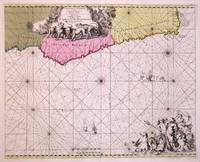
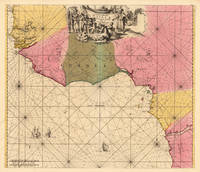
170018827Amsterdam: Louis Renard 1700. Other. In excellent condition. 490 by 569mm 19¼ by 22½ inches. Copper engraving hand colored in outline and wash when published. A fine and large and decorative sea chart depicting West Africa with its coastline from Gambia in the north towards Angola and the Congo in the southern part. The antique sea chart is equipped with two compass roses and three sailing ships for decoration. Along the coastline with engraved bays place names and small islands. This rare map was published around 1700 in Louis Renard's famous sea-atlas. Louis Renard received the copperplates of Frederic De Wit´s maritime atlas. Louis Renard did only minor modifications to the plate of map he addedapud L. RenardÂ’ below the engraved titles. Louis Renard unknown
1683263524London: printed by John Bringhurst at the sign of the Book in Grace-Church Street 1683. 12 pp. Page number "12" set upside down. 1 vols. 4to. Later wrappers first leaf very toned. 12 pp. Page number "12" set upside down. 1 vols. 4to. ESTC R235652;m WingF1795 printed by John Bringhurst, at the sign of the Book in Grace-Church Street unknown
167517584Lyon, Antoine Cellier Fils (imprimerie Jacques Faeton), 1675 ; in-8 veau glacé caramel, dos à nerfs décoré et doré aux petits fers, triple filet d'encadrement des plats, roulette intérieure, tranches dorées (Koehler) ; [18], 234 (i.e. 232 pp. 95-96 numérotées 2 fois), [4] pp. ; dédicace à Monsieur de Carcavy (mathématicien lyonnais), conseiller du Roi et Garde de sa bibliothèque, avec ses armes gravées vis à vis. lllustrations gravées sur bois et sur cuivre dans le texte, 4 planches hors-texte gravées sur cuivre.
167722982Amsterdam Justus Dankerts 1677-1689 -in-8 plein-VELIN deux tomes reliés en un volume, reliure janséniste d'époque en plein vélin ivoire parcheminé (jansenist's binding full vellum in-8) in-octavo carré (20,2 x 16,3 cm), dos long (spine without raised band), Auteur et Titre manuscrit à l'encre brune en haut du dos (handwritten title on the spine), tranches lisses (smooth edges), 1er Tome : GRONDIGE BEWYS-REDENEN DER BOUW-KUNST: texte en néerlandais, orné d'un titre-frontispice gravé à l'eau-forte en noir par L. Renard et de 31 planches hors-texte gravés à l'eau-forte en noir, 68 pages, 1689 Amsterdam Justus Dankerts Editeur, + DE GRONT-REGULEN DER BOUW-KONST, ofte de uytnementheyt van de vijf ordens der ARCHITECTURA : texte en néerlandais, orné de 42 planches hors-texte gravés à l'eau-forte en noir par L. RENARD, (trace claire d'humidité en haut des 16 pages de texte), 16 pages, 1677, Amsterdam Justus Dankerts Editeur,
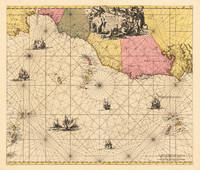
170014955Amsterdam: Louis Renard 1700. Other. 430 by 535mm 17 by 21 inches. 430 by 535mm 17 by 21 inches. Copper-engraving hand colored in outline and wash when published. Large and decorative sea chart showing West Africa with the Canary and Cap Verden Island in the Atlantic Ocean. Published around 1700 in Louis Renards famous sea-atlas. An execellent copy of this rare map. Louis Renard unknown
170019204Amsterdam: Louis Renard. 1700. Other. In excellent condition. 484 by 567mm 19 by 22¼ inches. 484 by 567mm 19 by 22¼ inches. Copper-engraving hand colored in outline and wash when published. Large and decorative sea chart showing West Africa with the Canary and Cap Verden Islands in the Atlantic Ocean. The map is equipped with two compass roses and several sailing boats. Published around 1700 in Louis RenardÂ’s famous sea-atlas. Louis Renard received the copperplates of Frederic De Witt´s sea-atlas and did only minor modifications in the engraved titles. The image of the map is orientated with the North to the East. Louis Renard. unknown
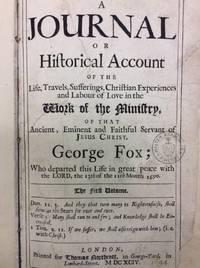
169411750London: Thomas Dorthcott 1694. In-8 gr. mm. 278 x 170 legatura ottocentesca in mz. pelle con angoli dorso a cordoni e titolo oro pp. XVIII63216. "Prima edizione" di questa celebre opera che fu sovente ristampata anche nel Novecento. Cfr. BatesonII855 - GraesseII622 - BrunetVI22524. Predicatore inglese e teorico del principio della tolleranza 1624-91 il Fox fondò a metà Seicento la setta protestante dei Quaccheri. Irruente parlatore e scrittore efficace il suo "Journal" è un classico non solo nella mistica il Fox ha dei punti di contatto specie nel valore dato alla rinascita spirituale con J. Boehme. Ma la principale ragione del suo successo sta forse nel fatto che egli unì l'insistenza sulla semplicità dei modi nei rapporti umani e la protesta contro il culto meramente esteriore e contro le ingiustizie sociali all'altra protesta contro il rigido predestinazionismo calvinista. Così Diz. TreccaniV p. 51.Timbro di appartenenza al frontespizio; prime e ultime 3 carte con antico restauro per mancanze margin. che intaccano anche alcune lettere del testo; con lievi aloni o fioriture ma complessivamente discreto esemplare. Thomas Dorthcott, unknown
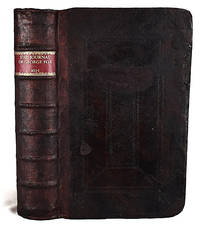
16940001910Thomas Northcott 1694. First Edition. Hardcover. Good. Full leather. Original boards with fairly heavy rubbing to edges. Handsomely rebacked with raised bands red label stating "Fox's Journal". Fairly small chip to upper corner of title page - no text involved. Thomas Northcott hardcover
16941706050008London: Thomas Northcott 1694-01-01. Hardcover. Good. 0x0x0. Quarto. Volume I all published. Preface by William Penn. 50 xviii 632 & 16 pages. Modern leather raised bands. Title page provided in facsimile. Corrosion to 2nd page of preface. Foxing marginal soiling. Lacks third table. <br> George Fox was a founder of the Religious Society of Friends commonly known as the Quakers or Friends. He rebelled against the religious and political authorities by proposing an unusual and uncompromising approach to the Christian faith. He traveled throughout Britain as a dissenting preacher. He was often persecuted by the authorities who disapproved of his beliefs.This work was edited by Thomas Ellwood an associate of John Milton. Interestingly this journal omits the dissent within the Quaker movements and the contributions of others are largely excluded. Historians have used it as a primary source because of its wealth of detail on ordinary life in the 17th century and the many towns and villages which Fox visited. Jones Rufus Preface of Jone's version of Fox's journal 1908. <br> Ellwood describes Fox as zgraceful in countenance manly in personage grave in gesture courteous in conversation." Peen says he was "civil beyond all forms of breeding". We are that he was "plain and powerful in preaching fervent in prayer" "a discerner of other men's spirits and very master of his own". Refs: Wing F1854 & P1341 London: Thomas Northcott hardcover