193 résultats
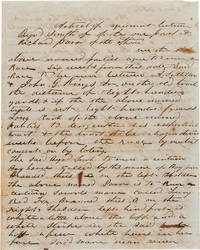
1851WRCAM55569Gonzales County Tx. 1851. 2pp. on a folded folio sheet. Old folds a few ink smudges. Very good. An original manuscript agreement setting the terms of a horse race in Texas in 1851. The document is signed by the principal parties to the contest Byrd Smith and Richard Parr both of Gonzales Texas as well as witnesses C.C. DeWitt and A.S. Miller. <br> <br> The agreement totaling approximately 375 words reads in part: <br> <br> "Article sic of agreement between Byrd Smith.& Richard Parr.we the above named parties agree to run a Race six weeks from this date said race to be run between A.S. Miller's & John G. King's on the old tracks the distance of eight hundred yards.the said Byrd Smith to run a certain Bay horse called by the name of Boy Jim.the above named Parr is to run a certain sorrell sic mare called Lucy Red Fox.for the sum of one thousand Dollars.the above race to be run between the hours of 12 & 4 o'clock." <br> <br> Each of the horses is identified in the agreement by physical marks and with brands written as symbols. Additionally there is a description of the filly whose "left hind foot is white a little above the hoof with a white strike in the said hoof and a few white hairs in her face." The weight each horse is to carry is stipulated and each horse owner was required to post a $500 bond at the time of signing to be held by one William A. Matthews in case of forfeiture. <br> <br> The six names mentioned in connection to this race all had solid backgrounds in antebellum Gonzales County Texas. C.C. DeWitt A.S. Miller and William A. Mathews are all listed as stockholders in "An Act to Establish & Incorporate Gonzales County College." John G. King Sr. a grant holder in Gonzales County died there in 1856. Byrd Smith was a private in an 1841 Gonzales County militia company. Finally Richard Parr was killed in Gonzales County in 1855 - over a land squabble not a horse racing debt. <br> <br> Antebellum Texas documents on sports of any kind are exceedingly rare. Material relating to horse racing is especially hard to find considering the state did not officially sanction the sport until well into the 20th century after pari-mutuel betting was approved in 1925. unknown books
1817078-L1817. Kreidelithographie, 1817, auf Velin. 27,1:36,1 cm. Mit der Adresse von C. de Lasteyrie. Literatur: Béraldi VII, S. 260. - Sehr selten! Gros zeichnete nur zwei Lithographien auf Stein.- Nicht ganz frisch, linke untere Ecke fehlt, jedoch ohne Bildverlust.
181610042DBLondon, S. & J. Fuller, 1816. 4°. 26 cm. 30 Blatt. Dunkelbrauner Ganzlederband der Zeit mit goldgeprägtem Rückentitel. Buch in Leinenmappe, diese im roten Halbleder-Schmuckschuber mit goldgeprägtem Rückentitel. [8 Warenabbildungen]
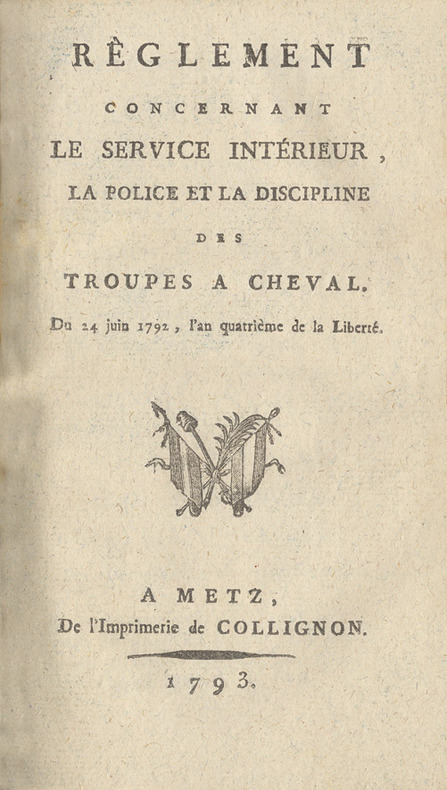
1804172471- Décret impérial relatif aux cérémonies publiques, préséances, hommes civils et militaires. Au palais de Saint-Cloud, le 24 messidor an XII. Paris, Magimel, an XII - 1804 ; 58 pp. 2- Instruction pour le campement des troupes à cheval (par le ministre de la guerre Alexandre Berthier). s.l. , s.n. , s.d. (sous le Consulat ou début de l'Empire) ; 39 pp. et 3 planches gravées dépliantes. 3- Réglement concernant le service des troupes à cheval en campagne. Du 20 juin 1788. Metz, imprimerie Collignon, 1788 ; (2), 199 pp. 4- Instruction élémentaire pour les jeunes guerriers républicains français dans l'arme de l'infanterie (présenté au Ministre de la guerre, le général de division Krieg). Strasbourg, F.G. Levrault, an V (1797). 5- Instruction destinée aux troupes légères et aux officiers qui servent dans les avant-postes, rédigée sur une Instruction de Frédéric II à ses officiers de cavalerie. Seconde édition. Paris, Du Pont (de Nemours), an II (1794) ; 207 pp. 6- Réglement concernant le service intérieur, la police et la discipline des Troupes à cheval. Du 24 juin 1792. Metz, imprimerie Collignon, 1793 ; (2), 113 pp. (réédité pour que le nom du Roi n'y figure plus). 7- Code pénal militaire, ou lois et arrêtés relatifs à la justice militaire. Paris, Magimel, 1806 ; 118 pp. , (1) f. de table.
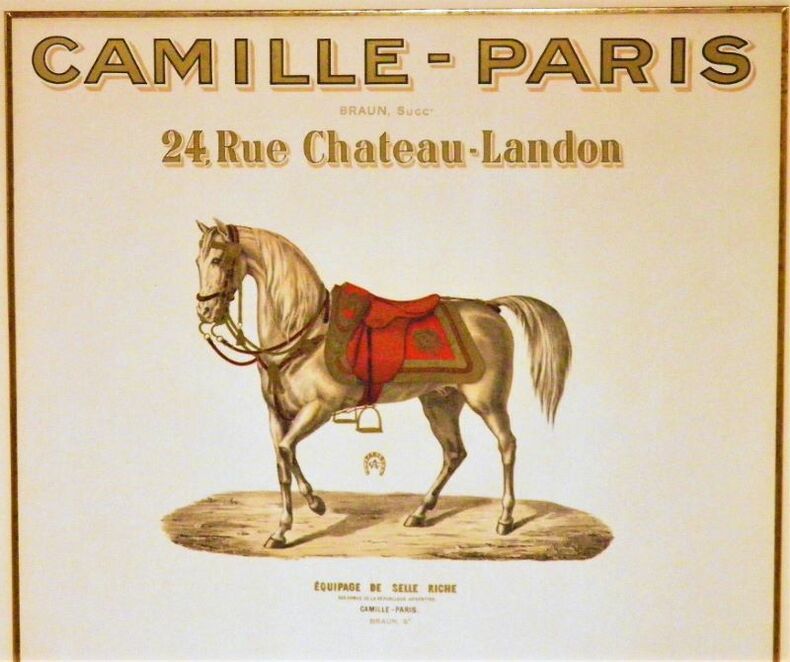
18902194Paris, sans mention d’éditeur, sans date (circa 1890). Dimensions : 49,5 x 71 cm (65 x 87 cm avec passe-partout). Affiche sous cadre (moderne) en chêne clair et passe-partout sable. Belle affiche imprimée en chromolithographie et rehaussée à l’or, encollée sur carton épais, avec passe-partout, représentant dans sa partie haute un « Equipage de selle riche » aux armes de la République argentine et, dans sa partie basse, une « Paire de harnais de grand gala ». Grâce, notamment, à d’importantes commandes militaires en France et à l’étranger, la maison "Alp. Camille jeune" tient la première place de l'industrie de la sellerie dès la fin du XIXe siècle et cela jusqu’au début du XXe. Fondée en 1826 par M. Essminger, la société est reprise 30 ans plus tard par Monsieur Trousselle, qui s'associe avec Alphonse Camille en 1871. Une décennie s’écoule et ce dernier reste seul aux commandes de l'entreprise, dont l’ascension débute alors, jusqu’à ce qu’elle devienne une des premières concurrentes de la célèbre industrie anglaise. Dès 1892, la maison Camille, située 24 rue Château-Landon à Paris, est un leader en France, et ses confections se vendent dans de nombreux pays d'Europe ainsi qu'en Amérique du Sud, Amérique Centrale, dans les Antilles, en Orient ou en Extrême Orient.
182320873Le Puy, J.B. La Combe, (imprimerie Pasquet père et fils), 1823 ; in-8, demi-veau marron, dos lisse à faux nerfs dorés, roulettes et fleurons dorés, fleuron à froid (reliure de l’époque) ; X-303, [1], XV pp., [1]f. d’Errata.
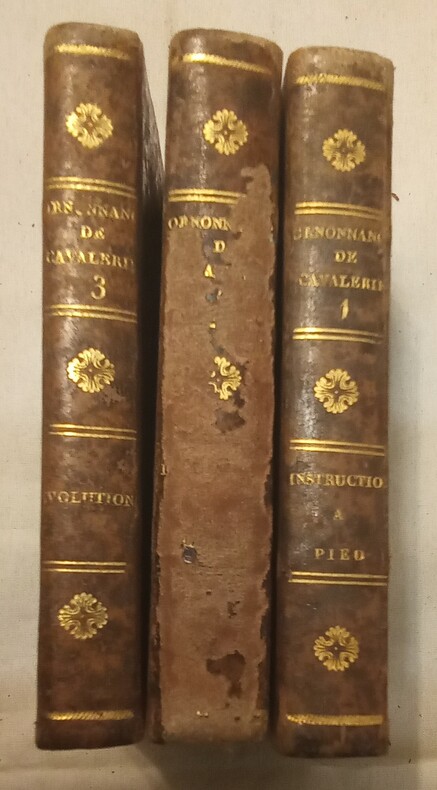
1830WOC-1021Tome 1:Bases de l'Instruction et Instruction à Pied.Tome 2: Ecole du Cavalier et Instruction à Cheval. Tome 3:Evolutions de Régiment de Ligne.Tome 4:Atlas oblong (11 x 23 cm) de 130 planches dont certaines dépliantes. Paris, F. G. Levrault, 1830. 3 volumes in-16 (11x7,5cm) de texte reliés plein veau d'époque, dos ornés avec petit manque au dos du tome 2 et atlas(10,5x23cm) en cartonnage marbré d'époque, tranches jaune. LXIV,275pp avec 28ff de Sonnerie+339pp+272pp+Atlas 8pp avec 130 planches.Avec son étui d'époque en cartonnage bleu clair imprimé un peu fatigué.
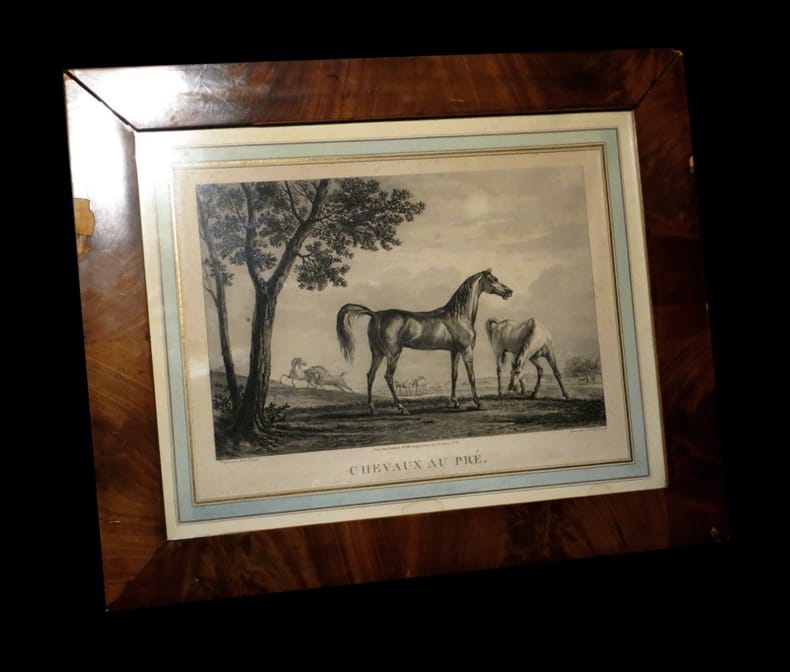
182024099A Paris, chez Rolland, s.d. [circa 1800]. Dimensions à vue : 444 x 328 mm + passe-partout + cadre.
189060507New York:: C. M. Moseman & Brother no date 1890s. Fifth edition according to the Preface. publisher's purple gilt-lettered cloth. Old retailer's stamp the same NYC address of Mosemans' warehouse as given on the title page in the corner of numerous pages; light use to cloth; tight and sound. Folio. Spectacularly illustrated throughout including color lithographs. C. M. Moseman & Brother, hardcover
1817143-L1817. Kreidelithographie mit hell- und mittelbrauner Tonplatte, ausgekratzte Lichter, 1817, auf cremefarbenem Velin. 31,7:37,5 cm. Literatur: Jahn 198; Dussler 8; Winkler 408.9, I (von II) und 967.14; Schwarz 4, II und Abb. S. 232. ? Das 14. Blatt in der dritten Lieferung der Folge: Original-Handzeichnungen der vorzüglichsten lebenden bayerischen Künstler. ? Inkunabel der Lithographie!
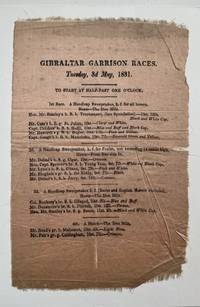
18311324<p><strong>1831 </strong><strong>GIBRALTAR</strong><strong> PRINTED HORSE RACING BROADSIDE ON S</strong><strong>ATIN</strong></p><p><strong></strong><strong>GIBRALTAR</strong><strong>. HORSE RACING. </strong><em>Gibraltar</em><em> Garrison Races. </em><em>Tuesday 3d May 1831</em><em>. To Start at Half-Past </em><em>One O'Clock</em><em>. </em>Small 4to broadside on yellow satin 9 ¾ x 6 3/8" edges fringed. Gibraltar: 1831. </p><p>The day's program and a very rare souvenir of early horse racing at the British garrison of Gibraltar. "I cannot find any record of any formal horse racing on the isthmus or elsewhere in the Campo arc prior to 1765 but the enormous popularity of the Calpe Hunt which established itself as a major institution in Gibraltar in the very early 19th century will undoubtedly have led to impromptu races from time to time and may have been the catalyst for organizing a more formal approach to racing. As early as 1838 Charles Rochfort Scott a Royal Artillery officer stationed in Gibraltar was singing the praises of horse racing on the Rock…From this one might gather that formal racing probably did not begin until after 1821 but that it was definitely in full swing in 1839 by which time it had become a pretty full blooded affair with a considerable number of horses taking part. It also seems to have been an activity in which only the officers of the garrison were allowed to indulge."-Neville Chipolina <em>The People of Gibraltar </em>online which includes a long quote from an article by "Nimrod" Charles James Apperley in Thomas Hook's <em>New Monthly Magazine and Humorist: 1841 Part the Second </em>pp. 42-43 which says "Twenty years back who would have dreamed of races at Gibraltar! Such however is the case now…"</p><p>Owners names given as are weights names of horses and colors. The first three races were Sweepstakes the first "A Handicap Sweepstakes h.f. for all horses. Heats—The Don Mile 5 contestants; the second "for Ponies not exceeding 14 hands high Heats—From Bay-side In 5 contestants; the third "Barbs and English horses excluded Heats—The Don Mile 3 contestants; the last "A Match—The Don Mile" with only two horses listed to run. Horse racing in Gibraltar was included in a novel by Arthur Griffiths entitled <em>Lola: A Tale of Gibraltar </em>NY: 1877. Folded and a little dusty else nearly fine.</p>
1893VBA-473Pairault & Cie Libraires-Éditeurs, Paris 1893 (aux frais de l'auteur). Relié pleine percaline illustrée de l'éditeur. Première page de la couverture de la version brochée conservée. 25,5 x 17 x 2,5 cm. 159 pages + 20 planches hors texte. Illustrations en noir dans le texte. Poids : 825 g. Signature sur la page de faux titre du comte C. de Maigret (?)
18950029961895 Saumur, Librairie Militaire S. Milon, 1895-96. Deux tomes reliés en un fort volume in-8 (170 X 250 mm) percaline rouge, premier plat et dos orné d'encadrement à froid de style "nouille", auteur et titre en noir sur le premier plat et au dos (reliure de l'éditeur) ; 419 & 406 pages.
189058349New York:: C. M. Moseman & Brother no date 1890s. Fifth edition. publisher's purple gilt-lettered cloth. Large corner blank of one preliminary leaf torn away; old retailer's stamp the same NYC address of Mosemans' warehouse as given on the title page in the corner of numerous pages; light use to cloth; tight and sound. Folio. Spectacularly illustrated throughout including color lithographs. C. M. Moseman & Brother, hardcover
1807064-L1807. Federlithographie 1807. 28,5:44,6 cm. Literatur: Man, Anfänge der Künstlerlithographie in England, Anonym 10; Desjardijn Kat. 3 und Abb. S. 55.- Mit der Adresse Vollweiler Imprint III.
188425249Paris Imprimerie Veuve Éthiou Pérou 1884 1 in-4 oblong Préface de Jules Paton. Paris, Imprimerie Veuve Éthiou Pérou, 1884, in-4 oblong, percaline verte de l'éditeur, filets dorés en encadrement et titre doré sur le plat supérieur.
1894017244Paris 1894 Librairie agricole de la maison rustique Soft cover
189037920np 1890. Box 7 3/4/ x 5 x 2 1/4 inches. Lid is split at joint else a fine set. Box 7 3/4/ x 5 x 2 1/4 inches. unknown books
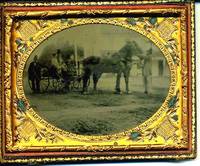
185099561850. Horse and carriage ambrotype circa 1850-1859 documents mid-19th century American civilian transportation and rural social life during the decade immediately preceding and encompassing the early Civil War period. The image holds research value for the study of early photographic practice particularly outdoor ambrotype production as well as material culture relating to horse-drawn mobility family presentation and dress in pre-industrial and wartime America. Ambrotypes were typically produced in controlled studio environments due to technical limitations; the presence of an outdoor composition situates this image within a less common subset of early American photography.<br /> Quarter plate ambrotype photograph showing a family seated within a horse-drawn carriage accompanied by two large horses with an adult man standing at the front holding the animals. The man wears a broad-brimmed hat consistent with mid-19th century rural or frontier attire. The group is positioned outdoors likely on unpaved ground with no visible studio backdrop emphasizing natural light exposure. The composition centers the carriage and team with human figures arranged to present both transport and family unit simultaneously. The photograph is housed in its original leather presentation case with red velvet interior lining and a decorative copper mat framing the image. The ambrotype process a glass-based photographic technique introduced in the early 1850s produces a unique non-reproducible positive image distinguishing it from later paper-based photographic formats such as cartes de visite.<br /> Ambrotypes emerged during a transitional period in photographic history bridging earlier daguerreotype practices and the rise of reproducible paper photography. By the late 1850s and into the Civil War era photographic documentation expanded alongside technological shifts yet outdoor images remained comparatively uncommon due to exposure constraints and equipment limitations. This image contributes to the visual record of civilian life during a period often dominated by military imagery offering insight into transportation clothing and social presentation outside formal studio settings. Light wear to case exterior minor rubbing at edges; interior velvet intact with moderate compression; glass plate and mat remain well-preserved with clear image visibility. Overall very good condition. unknown
18152855A PARIS. CHEZ MAGIMEL, LIBRAIRE POUR L'ART MILITAIRE. 1815. 2 VOLUMES IN-12 (10,5 X 18 X 8,5 CENTIMETRES ENVIRON), RELIURE D'EPOQUE PLEIN VEAU MARBRE, DOS LISSE ORNE D'UN DECOR DE FLEURONS DORES, ROULETTE DOREE SUR COUPES, TITRE DORE SUR ETIQUETTE MAROQUIN ROUGE. UN VOLUMES DE TEXTE DE (4) + XXIII + (1) + 498 PAGES ET 8 PLANCHES REPLIEES DE MUSIQUE NOTEE, ET UN VOLUME DE PLANCHES, DE 12 PAGES ET 126 PLANCHES, DONT DE NOMBREUSES REPLIEES. COLLATIONNE, COMPLET. EX-LIBRIS MANUSCRIT SUR UN FEUILLET BLANC DE GARDE DE «MR DE GOULAINE, CAPITAINE AUX CHASSEURS DE LA VENDEE». PETITS DEFAUTS EXTERIEURS SANS GRAVITE, PETITES DECHIRURES SANS MANQUES SUR QUELQUES RARES PLANCHES, SINON BON EXEMPLAIRE.
18153301A PARIS. CHEZ MAGIMEL, LIBRAIRE POUR L'ART MILITAIRE. 1815. 2 VOLUMES IN-12 (12 X 18 X 8 CENTIMETRES ENVIRON), RELIURE POSTERIEURE 1/2 CHAGRIN ROUGE A COINS, DOS A QUATRE NERFS ORNE DE FILETS DORES, TITRE DORE, VIGNETTE DOREE AU SANGLIER EN PIED (FAMILLE LEMONNIER DE LORIERE). UN VOLUME DE TEXTE DE (4) + XXIII + (1) + 498 PAGES, ET UN VOLUME DE PLANCHES, DE 12 PAGES ET 126 PLANCHES, DONT DE NOMBREUSES REPLIEES. COLLATIONNE, COMPLET, LES 25, 26 ET 27 SUR UNE SEULE PLANCHE REPLIEE.(MENESSIER DE LA LANCE. II. 397). ETIQUETTE MANUSCRITE SUR UNE GARDE : « CETTE THEORIE (2 VOLUMES, PLANCHES ET TEXTE) A APPARTENU A MON GRAND-PERE, MR ARMAND DE MONFRAND, QUAND IL ETAIT AUX GARDES DU CORPS DE SA MAJESTE LOUIS XVIII ET DE SA MAJESTE CHARLES X, COMPAGNIE D’HAVRE. (SIGNE) ED. DE LORIERE. ». BEL EXEMPLAIRE.
186828553Paris J. Dumaine 1868 fort vol. in-8 demi-basane bouteille modeste à coins, dos lisse orné de filets, guirlandes et fleurons dorés [Rel. de l'époque], reliure très défraîchie
1818103736Paris, Didot jeune, chez Magimel, Anselin, et Pochard, Libraires et chez Delaunay 1818 4 volumes en 1. In-8 21 x 13 cm. Reliure de l’époque basane havane marbrée, dos lisse orné de petits fers encadrés de filets et de roulettes dorés, pièce de titre maroquin grenat, XXVII-271-146-[Les pp. 33-146 incorporées par erreur dans le vol. I après la page 192]-83-IV-134 pp., 1 gravure hors-texte, 8 planches - 9 planches - 2 planches. Vocabulaire de l’art de l’éperonnier in fine vol. III. Vocabulaire des marchands de chevaux et vocabulaire de l’art du vétérinaire in fine vol. IV. Reliure légèrement frottée, intérieur frais.
1899AB7018London: The Hackney Horse Society / Cassell 1899-1918 1899. First Edition. . Hardcover. G. 8vo 19 volume set in burgundy cloth with gilt titling. Some neat pencil markings on a few pages minor shelf wear to spine tops and tails and corners otherwise good. VERY HEAVY BOOKS WILL INCUR ADDITIONAL POSTAGE CHARGE. <br/> <br/> The Hackney Horse Society / Cassell 1899-1918 hardcover