3 456 résultats
2001LFA-126741088UUne revue de 14 pages, format 220 x 285 mm, illustrée, brochée couverture couleurs, Editions Atlas, bon état
48408P., Guide Mondain Hippique, 1947, in 12 broché ; nombreuses ublicités ; couverture illustrée.
1979LFA-126723661Une plaquette de 98 pages, format 145 x 210 mm, illustrée, brochée couverture couleurs, publiée en 1979, bon état
1928838891928 Paris, Le Goupy, 1928, grand in 8° broché, 95 et 8 pages ; couverture illustrée.
224737Paris, Leneveu, 1853 in-8, VIII-264 pp., broché. Exemplaire défraîchi, manque au dos, qqs rousseurs.
11614Paris Panckouke 1 [Paris, Panckouke], demi-toile ocre, couverture renforcée, reliure postérieure aux planches.
1939_201900510Saumur, Imprimerie Girouard & Richou, 1939 ; in-4 (246 x 324 mm), 8 pp., couverture de Morin et cahier agrafés. Programme: Carrousel de Manège, dirigé par le lieutenant-colonel Lesage, instructeur en chef d'Équitation. I. Entrée, Salut, Figures variées. II. - Courses de Bagues. III. - Reprise des Écuyers. IV. - Courses de Têtes. V. - Reprise des Sauteurs. VI. - Figures variées & Salut final. VII. - Reprise de Saut de Haies. VIII. - Présentation de Chevaux du Centre de Préparation aux Concours hippiques internationaux, par le capitaine Bizard, chef de l'Équipe internationale; Lacher de Pigeons voyageurs, par le lieutenant Revon. Carrousel militaire, présenté par le lieutenant-colonel Le Pelletier de Woillemont, instructeur en chef militaire. Première Partie: entrée - présentation de l'étendard - Salut à l'étendard - Jeux - Sortie de l'escadron. Deuxième Partie: Évolutions d'Unités à Cheval & Motocyclistes. Troisième Partie: Défilé de l'escadron - Salut à l'Étendard et Sortie.
Saumur, Imprimerie Girouard & Richou, 1939; in-4 (246 x 324 mm), 8 pp., couverture de Morin et cahier agrafés. Programme : Carrousel de Manège, dirigé par le lieutenant-colonel Lesage, instructeur en chef d'Équitation. I. Entrée, Salut, Figures variées. II. - Courses de Bagues. III. - Reprise des Écuyers. IV. - Courses de Têtes. V. - Reprise des Sauteurs. VI. - Figures variées & Salut final. VII. - Reprise de Saut de Haies. VIII. - Présentation de Chevaux du Centre de Préparation aux Concours hippiques internationaux, par le capitaine Bizard, chef de l'Équipe internationale ; Lacher de Pigeons voyageurs, par le lieutenant Revon. Carrousel militaire, présenté par le lieutenant-colonel Le Pelletier de Woillemont, instructeur en chef militaire. Première Partie : entrée - présentation de l'étendard - Salut à l'étendard - Jeux - Sortie de l'escadron. Deuxième Partie : Évolutions d'Unités à Cheval & Motocyclistes. Troisième Partie : Défilé de l'escadron - Salut à l'Étendard et Sortie.
Paris, Action Artistique de la Ville de Paris, 2006; in-4 (254 x 282 mm), 216 pp., cartonnage d'éditeur, coloris vert pomme, dos lisse, sous jaquette illustrée. Collection « Paris et son patrimoine », dirigée par Béatrice de ANDIA, déléguée générale de l'Action artistique. Textes réunis par Frédéric JIMÉNO et Dominique MASSOUNIE. Sommaire : Préface de B. Delanoë ; B. de ANDIA : le Cheval dans la cité et dans la vie ; P. FRANCHET d'ESPÈREY : Paris, capitale de l'équitation « romaine » ; I. - Cheval et cérémonial ; II. - Architecture et décor urbain ; III. - Statuaire et Urbanisme ; IV. - Transports et attelages ; Bibliographie. Nombreuses illustrations en noir et blanc et en couleurs.
1788H47D4T46464Q1788. Amassed over the last fifty years and covering four centuries of relevant material the present collection spans all aspects of the history and development of the breeding of Arabian horses. It comprises within itself many books from the Le Vivier collection: fine press books of racing and thoroughbred literature produced by Eugene Connett's famous Derrydale press as well as numerous important items from the library of Duke Maximilian in Bavaria 1808-88 himself a great enthusiast of Arabic horses. Including items of exceptional rarity such as the rare beautifully illustrated first German edition of Friedrich von Eisenberg's famous riding school 1747 which lauds Arabian horses as "the finest produced by the Orient". Also we here find the early Arabian Horse Registry of America Stud Books and many items also bear presentation inscriptions from the authors Carl Raswan Gladys Brown Edwards etc. The common practice in such a specialized field most of the publications here were issued for a very limited circulation in runs of 1000 or fewer individually-numbered copies. As a reference library for breeding the collection is unparalleled: almost any Arabian horse's forefathers will be found amongst the exhaustive stud books and breeding serials from the 18th to the 20th century from Australia Poland Spain Russia the USA etc. often with accompanying photographs. Perhaps the most famous reference work is the Raswan Index of which only 380 copies were printed and many destroyed by a flood. Raswan became an expert on the Arabian breed through his lengthy trips to the desert where he lived with the Bedouins and learned their language and customs. Several scarce early 20th century works also testify to the Western fascination with the Bedouin and desert roots of the Arabian horse: Homer Davenport's My Quest of the Arabian Horse 1909 and Raswan's The Black Tents of Arabia: My Life Amongst the Bedouins 1935. Alongside modern surveys of the key centres of horse-breeding in the Arab world the early Western classics are also found here in their scarce first editions. French and German authors are also well-represented including the text and first French translation of the Hilyat al-fursân wa-shi'âr ash-shuj'ân an abridgement of Ibn Hudhail's horse treatise prepared around 1400. Finally the owner's collection of notable catalogues and magazines paints a fascinating composite picture of the evolution and heyday of Arabian horse-breeding in the Arab world Poland America and the United Kingdom. Also contained in this magnificent collection are the classic reference works on Arabian and Anglo-Arabian racehorses and their breeding. These standard works and encompassing sets of specialised thoroughbred literature include not only the indispensable guides to horse pedigrees the Racing Calendar General Stud Book Spanish American and Australian Stud Books Bloodstock Breeders' Review and Prior's Register of Thoroughbred Stallions in near-complete runs stretching back as far as the 18th century but also British and international horseracing history and several volumes of exquisite coloured plates. The size and comprehensiveness of the present collection cannot be overstated; it is safe to say that it represents the largest private collection of its kind which has come up for sale in recent decades. Many of the items found here can be located in just a handful of public institutions worldwide. Such items come into the market so rarely and have recently like the Raswan Index and the AHRA Stud Books commanded prices of five figures that it would be impossible to build a comparable collection item-by-item; the volumes here represent a lifetime of serious dedication to the task. Yet the value of such a collection lies not simply in its impressive number of important publications but in the vast amount of practical knowledge contained within. As the introduction to one manual expresses it "The horses shown and described form the foundation ancestry of a major number of breeding programs being propagated today. They appear in every area of endeavour. Yet pictures and facts are not easy to obtain. A knowledge of what has been and is what proved successful and what endured is pertinent to the maintenance of type and quality in the Arabian. Whatever your chosen bloodline this is a worthy study."Illustrated catalogue available upon request. unknown
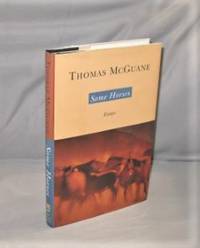
199927480New York:: Lyons Press 1999. First Printing of the First US Edition. A Fine tight copy in a Fine bright unclipped dust jacket. In the nine essays in this collection Montana novelist Tom McGuane animates the wide prairie the ranches where cattle roam and cutting horses are trained and the packed coliseums in which these horses compete for prestige and prize money. Best of all McGuane brings to life the horses he has known celebrating the unique glories that make each of them memorable. McGuane's writing is infused with a love of the cowboy life and the animals and people who inhabit that world where the intimate dance between horse and rider is as magical as flight--well beyond what the human body could ever discover on its own. Lyons Press, hardcover
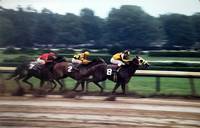
40892Ephemera. A remarkable archive of 449 vintage color slides capturing the drama elegance and grit of late-20th-century American horseracing. Shot primarily on Kodachrome and Ektachrome these images preserve the rich saturated tones and crisp detail that defined the era’s best photography. Most appear to date from the late 1970s through the early 1980s offering an evocative window into racetrack culture at a time when legends were being made. The collection features an impressive roster of renowned jockeys including Angel Cordero Jr. Jean Cruguet Eddie Maple Ruben Hernandez George Martens Mike Venezia Ramon Encinas Eric Beitia Antonio Graell Marjorie Clayton Declan Murphy Jeffrey J. Fell Jerry Bailey Angel Santiago Jacinto Vasquez Jack Neagle Frank Lovato Jr. and Jean-Luc Samyn among others. Equally compelling is the lineup of notable thoroughbreds such as Cabin Proof Diplomatic Envoy Gratification Angelic Lass Suite of Dreams Hang Together Demure Bold Ascent Autumn Angel Know How and Luck Bravest Girl Double Dacquare History Belle Tyrolean Miss Agile Jet Big Walt Rose Crescent Rocky Marriage Thunder Bridge Our Escapade Father Don Juan Medieval Moon Fifth Division Bold Reason Aztec Red Galaxy Guide Shadowmar Trenchant and many more. A rich and substantial collection for the racing enthusiast and fan of equine photography. unknown
191443941New York: Thomas Floyd-Jones 1914. 8vo. xxxi 1 275 1 pp. Photo frntsp. numerous plates facsimile plates of letters & documents. Gray cloth gilt lettrng on spine mnr bmpng to crnrs mnr shlfwr some dustsoilng still a VG- copy. First edition of this exceedingly scarce personal memoir of the horse racing and trotting sport as it evolved in New York through the 19th century. The author’s family and he owned and raced thoroughbreds and trotting horses and were key members in the Union Course Long Island. Of particular interest is the exhaustive 75 page index Floyd-Jones appended to the work which details every name horse and event mentioned in the book. Thomas Floyd-Jones, hardcover
70399London Ackermann 1837. Four hand-coloured aquatint plates. Broadsheets oblong 42 x 64 cm in uniform frames with gilt borders. Each frame size 62.5 x 82.0 cm. = Four rare images after the paintings by James Pollard 1792-1867 commemorating this great race. With the following captions: "Anticipation. Who is the winner"; "Approbation. Off in good shape"; "Vexation - The false start"; "Joy and desperation! - All over but settling". Single plates are rather rare complete sets are very rare. Some light spotting small chip to one frame corner otherwise very good. The frames are from a renowned Dutch firm Heijdenrijk in The Hague and Amsterdam founded in 1845 and still active. unknown
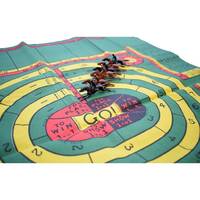
19212571Philadelphia: Racego Game Company 1921. Good in a Poor box. Box: 9-3/4 x 12 inches. Game includes: linen board printed in green yellow black and red 26-1/2 x 26-3/4 inches when unfolded; 4pp set of directions for play printed in black on cream paper; six metal playing pieces in the shape of jockeys riding horses painted black or brown numbered consecutively and housed in a cardboard holder with individual "stalls" for the pieces; cardboard box containing 60 flat circular red white and blue bone betting counters.Based on a description of Go! in a 1922 ad in Modern Stationer this copy of the game is lacking 40 betting counters but is otherwise complete. Heavy wear to box with splitting to all edges and numerous neat black tape repairs; apron missing from one side of the lid and the lid is now taped to the base at that edge so it opens like a hinge. Light wear to directions; some scuffing to playing pieces. Scarce horse racing-themed board game that capitalizes on the popularity of the sport in the 1920s with pieces named Man o' War Sir Barton Behave Yourself Broomspun Gray Lag and Audacious -- all famous racing horses of the era. Using an ordinary deck of cards not included players move the pieces around the board in such a way that "the horses speed up or drop back pass each other and fight for the 'pole' and inside positions just as the live ones do on the track" Directions p.2. Meanwhile the players place wagers on the winners colors and time using white red or blue betting counters to indicate the amount of their wager.Racego Game Company may have been formed solely to sell this game as we find no record of other games associated with it and advertisements for the game only in 1922. The copyright holder James B. Ludlow appears to have been a Philadelphia salesman at the time; census records indicate that he sold a variety of goods but in 1920 was engaged in selling rubber tires.Not located in OCLC although we know of one holding at UVA. Racego Game Company unknown
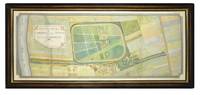
1903F6LCZ7CDMSG7Poissy: Charles Robin 1903. Framed 105 x 205 cm. Large hand-coloured four-sheet plan 90 x 170 cm as assembled. Drawn in pen and ink graphite and watercolour on paper mounted on canvas. Large manuscript plan beautifully drawn in ink and watercolour: a unique witness to Vanderbilt's passion and ambitions. A member of one of America's wealthiest and most prominent families William Kissam Vanderbilt 1849-1920 managed railroads and bred horses. He was one of the founders of The Jockey Club and the owner of a successful racing stable. In 1896 he built the American Horse Exchange at 50th Street Manhattan. In World War II the United States liberty ship SS William K. Vanderbilt was named in his honour.The present impressive manuscript plan represents the horse-racing stable and track at the chateau which Vanderbilt built in 1906 with the help of Henri Guillaume and Pierre Sardou architects. The hippodrome comprised three oval tracks the outer of which was 2400 metres as well as a straight track. A long wall separated the racing areas from the Chateau St. Louis where the Vanderbilts lived called the Chemin Plat now known as Avenue Vanderbilt. When World War I started the racing stables were shut down and eventually sold. Ch[arles] Robin, unknown
1904306793<p>First edition so stated. Thick octavo. Frontispiece and 48 b/w halftone illustrations. Full gilt stamped contemporary dark green morocco by Stikeman t.e.g. others uncut the spine with gilt stamped horse head fish and sporting dog devices. Fine. Heraldic bookplate of M.C.D. Borden on the front pastedown. 369 pages. Number 20 of 100 copies on large paper. The American Sportsman Library. Printed by the Norwood Press Norwood Massachusetts.</p> The Macmillan Company hardcover
190460288Detroit MI: Tuttle & Clark Manufacturers The Improved Printing Co. Half-tone illustrations made by Detroit Electro-Gravure Co. 1904. Two parts in one vol. 222 2; 32 unpaginated. pp. With 100’s of text illustrations diagrams throughout both. Quarter-black cloth over purple-coloured decorated limp thick covers Arts & Crafts cover art in green red & gilt rounded corners minor shelfwear slight sunning to fore-edges; second part w/ self-printed softcovers mounted on verso of front cover still an excellent pair. First edition of this lavishly illustrated and very scarce horse tack & harness catalogue. This catalogue illustrates racing harnesses sulky harnesses pole harness harness ornaments bridle fronts monograms rosettes horse hooves boots of a dizzying array blankets halters and more. Tuttle 1862-1937 began as a harness maker and leather merchant in Hamtramck MI in post-Civil War Michigan and by the end of the 19th Century with partner John Clark 1871-1931 had built the thriving harness & tack business on Jefferson & Woodward in downtown Detroit. No copies in Worldcat. Tuttle & Clark, Manufacturers, [The Improved Printing Co., Half-tone illustrations made by Detroit Electro-Gravure Co.], paperback
191458466Buffalo NY: Smith Sons Harness Co. Inc. 1914. 4to. 9 x 12.25 in. 95 1 pp. Over 500 illustrations many photos. Purple-gray printed softcovers printed front cover w/ woodcut border company logo on back cover minor chipping head & foot of spine edgewear minor creasing a few leaves w/ minor foxing still VG copy. First edition of this lavishly illustrated and very scarce saddle and tack catalogue. This was the first catalogue issued after incorporation by the longtime saddlery hardware manufacturer in Buffalo NY which supplied many of the harness & saddle shops in and around New England & New York. Of interest are the sections on harness bridles collars whips bits rosettes hardware and much more. This catalogue also includes products such as riveting machines Boston Coach axle oil Buffalo Robes and more. No copies located in Worldcat; See: Trade News From Near and Far Harness Vol. 28 January 1915 pp. 26-27. Smith Sons Harness Co., Inc., paperback
1995LFA-126746690N° 15 (Octobre 1995) : revue de 66 pages, format 215 x 285 mm, illustrée, brochée couverture couleurs, bon état
1992LFA-126721674Revue de 152 pages, format 210 x 300 mm, illustrée, brochée couverture couleurs, bon état
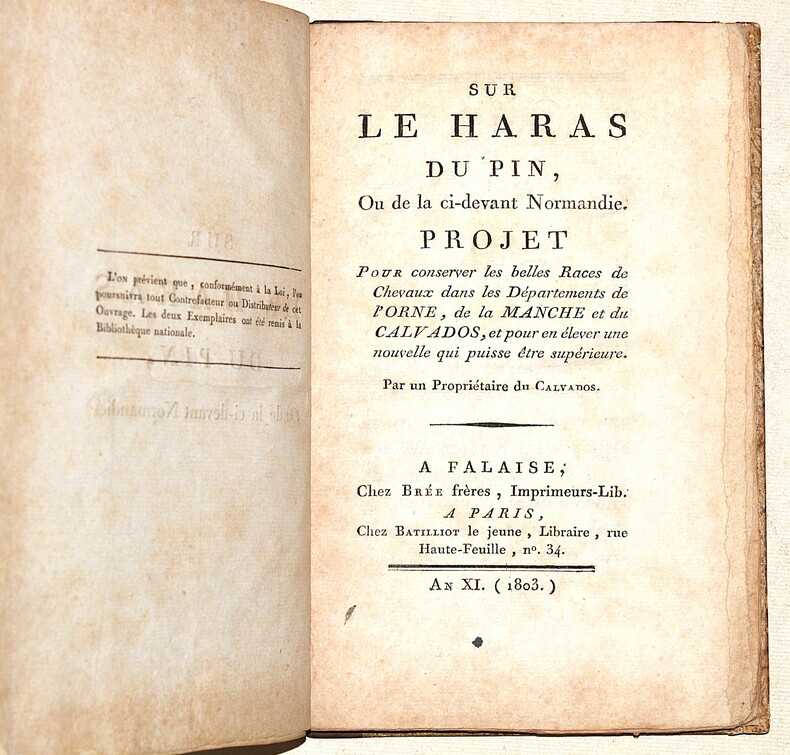
18030055901803 Falaise, Brée frères - Paris, Batilliot le jeune, 1803. In-8 (210 X 140 mm) demi-basane havane relié sur brochure, dos à nerfs orné de fleurons dorés, pièce de titre maroquin rouge (Reliure ancienne) ; (1) f. de faux-titre, XII-106 pages. Coins émoussés, petites épidermures, rousseurs éparses. Quelques intéressantes annotations manuscrites anciennes à la plume dans les marges, par un amateur éclairé.
1996LFA0118eUn calendrier mural, format 210 x 255 mm, couverture cartonnée, illustré de photos, édité en 1996 (La Poste)
1980LFA008a6N° 114 - Septembre 1980 Une revue d'environ 140 pages, format 295 x 220 mm, brochée, illustrée
1931LFA-126721608Un volume de 442 pages, format 265 x 350 mm, illustré, relié toile, publié en 1931, Hachette, bon état