Sainte-Beuve, (Charles Augustin), HerausgeberAntiquariat.de

2 371 résultats
18805553CBParis, Garnier Frères, (1880). Kl.-4°. XII, 622 S., 2 Bl. Mit 32 handkolorierten Tafeln und Textillustrationen in Holzstich. Roter Halblederband aus der Zeit mit Rückenvergoldung und dreiseitigem Goldschnitt, Blindprägung auf Deckeln (Ch. Magnier). + Wichtig: Für unsere Kunden in der EU erfolgt der Versand alle 14 Tage verzollt ab Deutschland / Postbank-Konto in Deutschland vorhanden +, A|B [2 Warenabbildungen]
1780016402Paris Mérigot le jeune 1780 in-12, pleine basane d'époque, dos lisse orné, pièce de titre, fleurons dorés, tranches rouges, (4)-175pp. (deux coins frottés, plats légèrement tâchés et épidermés, galerie de ver sur la bordure inférieure des feuillets mais sans atteinte au texte).
1393petit in 8 oblong cartonné,couverture illustrée en couleur. 28 pages avec gardes.12 illustrations couleur pleine page de Félix LORIOUX plus couverture et pages de garde et 20 vignettes en noir. Une déchirure réparée.Imprimerie moderne de Nantes.Beuchet et Vanden Brugge.4ème Trimestre 1960.belles illustrations, coloris frais
1924117336Paris Flammarion, coll. "L'histoire de la nature vivante..." n° 1 1924 1 vol. relié in-12, demi-chagrin vert, dos à nerfs orné de fleurons dorés, pièce de titre rouge, tête dorée, couvertures et dos conservés, 248 pp. Très bon exemplaire, bien relié.
1924117336Paris Flammarion, coll. "L'histoire de la nature vivante..." n° 1 1924 1 vol. relié in-12, demi-chagrin vert, dos à nerfs orné de fleurons dorés, pièce de titre rouge, tête dorée, couvertures et dos conservés, 248 pp. Très bon exemplaire, bien relié.
'This book is concerned with what France means to the Western World. Its aim is to set out some of France's contributions, permanent, recurrent or ephemeral, to civilization. We bring to the subject the harvest of forty years' study and close acquaintance with France and the French.' With Index. Illustrated. 312 pages.
1985LFA00b2aUn ouvrage de 38 pages, format 155 x 240 mm, illustré, broché couverture couleurs, publié en 1985, Editions du Bien Public, bon état
1990SPN-690Paris/Marburg : Editions Hitzeroth & Créaphis, 1990. Couverture illustrée en noir, 122 pages illustrées en noir, bibliopétrie, bloc-note.
1995101046Presses Universitaires de France - P.U.F. , Revue d'Histoire des Sciences Malicorne sur Sarthe, 72, Pays de la Loire, France 1995 Book condition, Etat : Bon broché, sous couverture imprimée éditeur blanche, titre en bleu et noir grand In-8 1 vol. - 162 pages
1961100976Presses Universitaires de France - P.U.F. , Revue d'Histoire des Sciences Malicorne sur Sarthe, 72, Pays de la Loire, France 1961 Book condition, Etat : Bon broché, sous couverture imprimée éditeur crème grand In-8 1 vol. - 94 pages
182930406London: William Orr 1829 1831 1832 c. 1833 1835. 1st edition. V.g./No Jackets. Full leather re-binds Title page of 'the domestic habits of birds' missing and confusingly it has the title 'faculties of birds' on the spine which is actually the title of another volume in the series. Owner's signature on half-title of some volumes. London: William Orr hardcover
1932GITd577Paris Garnier Frères sans date (1932). In-4 228pp. Cartonnage éditeur, dos de percaline rouge, plats de papier bleu orné de motifs animaliers, grande vignette illustrée en couleurs appliquée sur le 1er plat. Orné d'un titre-frontispice en couleurs, nombreuses illustrations dans le texte et 23 compositions en couleurs à pleine page. Accroc au bas du dos, charnières fendues, intérieur en bon état.
CCC-224mb. Éditeur : Paris, Librairie Garnier Frères, non date (1913). In-4°, 459 pages. Première édition. Illustré d'innombrables dessins en noir et en couleurs dans le texte et de 33 planches hors texte en couleurs.Reliure demi-chagrin rouge, dos lisse décoré de fers animaliers, plats marbrés, photo possible
39956Puf.1954.Corpus général des Philosophes Français.In-4 toilé.Frontispice.616 pages. BE avec quelques rousseurs.Couverture insolée.
197033422Genève Edito-Service sans date [1970] Fort in-4 illustré, 2 portefeuilles sous couvertures imprimées.
062670Genève., Edito Service, S.A. 134 Seiten mit Text und 21 Radierungen, weitere 10 Radierungen mit einem vorangestellten Titel (L'Abeille; Le Papillon; La Langouste; ...) ohne Paginierung. Ohne Jahr, vermutlich um 1970. Zustand: Der blaue Lederband (vermutlich Kunstleder) hat auf dem Vorderdeckel wenige, kleine beriebene Stellen (wenige Millimeter groß), der braun-rote Vorsatz hat am vorderen Rand Spritzflecken von Farbe (verlaufen, von 1 cm bis 4 cm Länge; wenige Millimeter breit). Cette édition en fac-similé 25 x 33 cm a été tirée avec l'autorisation de Martin Fabiani, éditeurà Paris, sur papier bouffant des Papeteries de Casteljoux, No. 004226. 4°. S OLeder / OKunstleder.
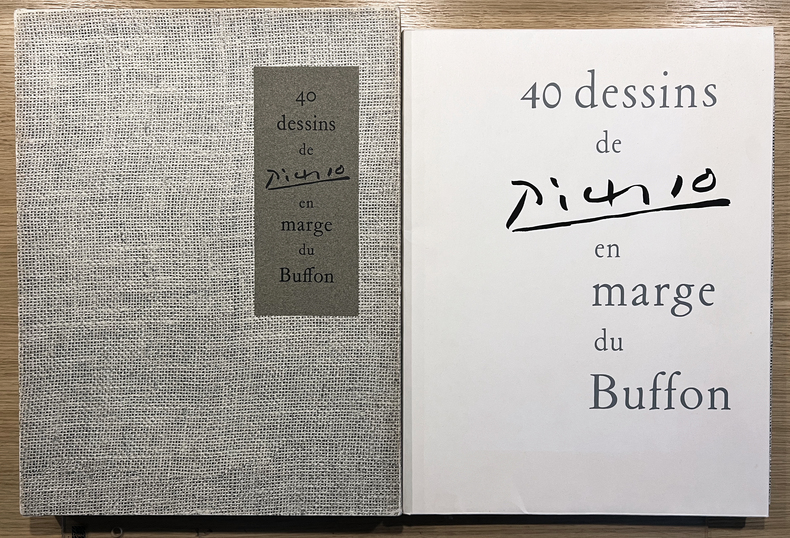
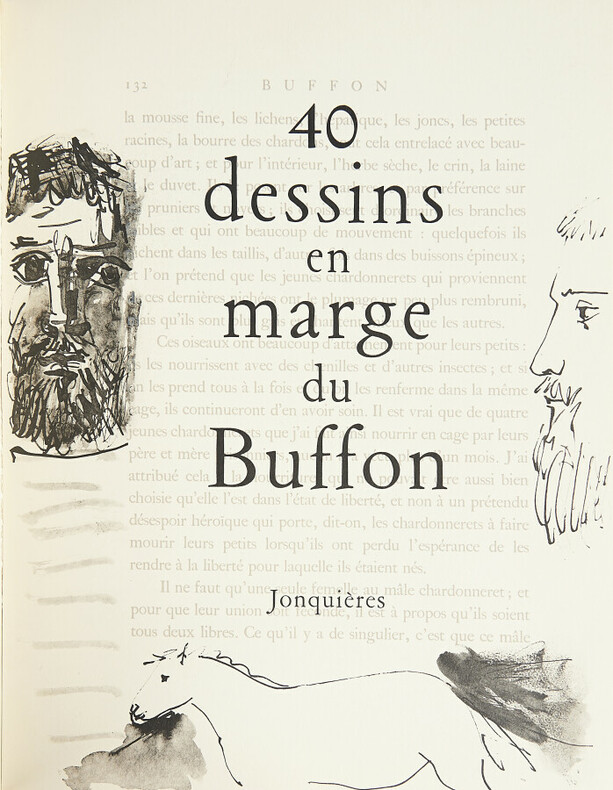
195794571957 Paris, Jonquières, 1957. In-folio, 28,5 x 37,5 cm, 94 pp. en ff. avec 40 dessins de Pablo Picasso réalisé sur l'exemplaire du Buffon de Dora Maar, publié par Martin Fabiani éditeur à Paris. Explicit de Picaaso: «Tous les dessins qui sont sur ce livre ont été faits ce dimanche 24 janvier 1943 au cours de cette après-midi, à Paris, 6 rue de Savoie». EDITION ORIGINALE, tirée à 2226 exemplaires, celui-ci un des 2000 exemplaires sur vélin du Marais, après 226 exemplaires sur vélin à la forme dArches. Couverture rempliée, sous chemise et étui en carton. Mors inférieur de la chemie légèrement fendu, bords de létui légèrement frottés, autrement ouvrage en très bon état
19571543Henri Jonquières, Paris 1957. Un volume in-folio (387 x 292 mm) en feuilles sous couverture imprimée rempliée, chemise-étui de l'éditeur. Fac-similé de l'exemplaire enluminé et offert par Picasso à Dora Maar (édition Fabiani 1942) reproduisant l'ensemble des dessins originaux. Tirage à 2226 exemplaires : 226 sur vélin d'Arches comprenant une gravure à la gouge signée + 2000 sur vélin du Marais. Celui-ci exemplaire de collaborateur, nominatif, SIGNÉ PAR PICASSO AU CRAYON ROUGE à la justification. Exemplaire de choix réservé à M. Robert Rigault, imprimeur pour les Ateliers Duval. Ces exemplaires signés, hors le tirage de luxe avec la gravure et qui ne le sont pas, sont très rares car tous réservés et nominatifs. Parfait état.
19573181Henri Jonquières, Paris 1957. Un volume in-folio (387 x 292 mm) en feuilles sous couverture imprimée rempliée, chemise-étui de l'éditeur. Fac-similé de l'exemplaire enluminé et offert par Picasso à Dora Maar (édition Fabiani 1942) reproduisant l'ensemble des dessins originaux. Tirage à 2226 exemplaires : 226 sur vélin d'Arches comprenant une gravure à la gouge signée + 2000 sur vélin du Marais. Celui-ci exemplaire de luxe (n° 140) comportant LA LINOGRAVURE ORIGINALE gravée en 1939 et signée au crayon de couleur (vert) par PICASSO. Notre épreuve, imprimée sur une feuille de vélin d'Arches (37,5 x 28,2 cm), porte la justification 140/226 au crayon noir et la signature au crayon vert. La signature au crayon de couleur est très recherchée des amateurs. Catalogues raisonnés : Bloch 326 ; Baer 1028 ; Cramer Les Livres illustrés 84 ; MoMA 1017.1964.1-2.
41193Paris Henri Jonquières 1957 in folio (37,5x28,5) 1 volume broché, couverture imprimée rempliée, rhodoïd, avec 40 dessins de Pablo Picasso.. Album réalisé sous la direction de Henri Jonquières. Les compositions inédites de Pablo Picasso, ont été dessinées sur un exemplaire du Buffon appartenant à Dora Maar. L'impression des planches a été réalisée par l'atelier Duval à Paris, et celle de la typographie par l'imprimerie Priester Frères Tirage limité à 2226 exemplaires numérotés, celui-ci un des 2000 exemplaires numérotés sur vélin du Marais. Très bel exemplaire ( Photographies sur demande / We can send pictures of this book on simple request )
129399aafParis, Jonquières, 1957, gr. in-4to, (38 x 27 cm) 40 planches, en feuilles, Un des 2000 ex. N° 1635 sur Vélin du Marais, sous couverture à rabats
197023984(Genève), (Edito), s.d. (circa 1970). Un vol. au format in-folio (387 x 292 mm) de 1 f. de faux-titre, 1 page de titre, 1 f. de Table, 1 f. de dédicace à Dora Maar sur double-page, 40 planches fol., 1 planche sur double-page n.fol. et 1 f. de colophon, en ff., sous chemise à rabats rempliés titrée et étui-chemise cartonné, dos lisse de demi-basane havane, titre doré en long.
1970239841970. GenÂve Edito s.d. circa 1970. Un vol. au format in-folio 387 x 292 mm de 1 f. de faux-titre 1 page de titre 1 f. de Table 1 f. de dÂŽdicace ˆ Dora Maar sur double-page 40 planches fol. 1 planche sur double-page n.fol. et 1 f. de colophon en ff. sous chemise ˆ rabats rempliÂŽs titrÂŽe et ÂŽtui-chemise cartonnÂŽ dos lisse de demi-basane havane titre dorÂŽ en long. Fac-similÂŽ de l'ÂŽdition Mariani de 1942. Un des exemplaires numÂŽrotÂŽs du tirage sur papier bouffant des Papeteries de Casteljoux. L'ouvrage recÂle outre l'ensemble des illustrations qu'il se doit de contenir une suite desdites compositions prÂŽsentÂŽe sous chemise titrÂŽe et illustrÂŽe. ''Curieuse publication pour l'ÂŽtude de la maniÂre de graver d'un peintre moderne trÂs estimÂŽ''. in Carteret. Cramer 84 - Carteret IV Le TrÂŽsor du bibliophile / IllustrÂŽs modernes p. 85 pour l'ÂŽdition de 1942. Infimes altÂŽrations affectant les coiffes de la chemise. Etui prÂŽsentant quelques t‰ches et abrasions. Du reste trÂs belle condition. b42961 unknown
pp. xxiii, 368 + Portrait Frontis of Darwin and numerous full page plates. Sm. 4to. Original full green cloth binding, front board soiled. Hardbound. NATURAL HISTORY BOX 5
1774FB640 /6A<p>Full leather binding black title plate. Gilt floral design on the spine. The <strong><em>Histoire Naturelle générale et particulière avec la description du Cabinet du Roi</em></strong> English: <em>Natural History General and Particular with a Description of the King's Cabinet</em> is an encyclopaedic collection of 36 large quarto volumes written between 1749–1804 initially by the Comte de Buffon and continued in eight more volumes after his death by his colleagues led by Bernard Germain de Lacépède. The books cover what was known of the "natural sciences" at the time including what would now be called material science physics chemistry and technology as well as the natural history of animals. <strong>Georges-Louis Leclerc Comte de Buffon</strong> 7 September 1707 – 16 April 1788 was a French naturalist mathematician cosmologist and encyclopédiste. His works influenced the next two generations of naturalists including two prominent French scientists Jean-Baptiste Lamarck and Georges Cuvier. Buffon published thirty-six quarto volumes of his <em>Histoire Naturelle</em> during his lifetime with additional volumes based on his notes and further research being published in the two decades following his death. Ernst Mayr wrote that "Truly Buffon was the father of all thought in natural history in the second half of the 18th century". Credited with being one of the first naturalists to recognize ecological succession he was later forced by the theology committee at the University of Paris to recant his theories about geological history and animal evolution because they contradicted the Biblical narrative of Creation. Buffon held the position of <em>intendant</em> director at the Jardin du Roi now called the Jardin des Plantes. Buffon's <em>Histoire naturelle générale et particulière</em> 1749–1788: in 36 volumes; an additional volume based on his notes appeared in 1789 was originally intended to cover all three "kingdoms" of nature but the <em>Histoire naturelle</em> ended up being limited to the animal and mineral kingdoms and the animals covered were only the birds and quadrupeds. "Written in a brilliant style this work was read . by every educated person in Europe". Those who assisted him in the production of this great work included Louis-Jean-Marie Daubenton Philibert Guéneau de Montbeillard and Gabriel-Léopold Bexon along with numerous artists. Buffon's <em>Histoire naturelle</em> was translated into many different languages making him one of the most widely read authors of the day a rival to Montesquieu Rousseau and Voltaire. In the opening volumes of the <em>Histoire naturelle</em> Buffon questioned the usefulness of mathematics criticized Carl Linnaeus's taxonomical approach to natural history outlined a history of the Earth with little relation to the Biblical account and proposed a theory of reproduction that ran counter to the prevailing theory of pre-existence. The early volumes were condemned by the Faculty of Theology at the Sorbonne. Buffon published a retraction but he continued publishing the offending volumes without any change. In the course of his examination of the animal world Buffon noted that despite similar environments different regions have distinct plants and animals a concept later known as Buffon's Law. This is considered to be the first principle of biogeography. He made the suggestion that species may have both "improved" and "degenerated" after dispersing from a center of creation. In volume 14 he argued that all the world's quadrupeds had developed from an original set of just thirty-eight quadrupeds. On this basis he is sometimes considered a "transformist" and a precursor of Darwin. He also asserted that climate change may have facilitated the worldwide spread of species from their centres of origin. Still interpreting his ideas on the subject is not simple for he returned to topics many times in the course of his work. Buffon considered the similarities between humans and apes but ultimately rejected the possibility of a common descent. He debated with James Burnett Lord Monboddo on the relationship of the primates to man Monboddo insisting against Buffon on a close relationship. At one point Buffon propounded a theory that nature in the New World was inferior to that of Eurasia. He argued that the Americas were lacking in large and powerful creatures and that even the people were less virile than their European counterparts. He ascribed this inferiority to the marsh odours and dense forests of the American continent. These remarks so incensed Thomas Jefferson that he dispatched twenty soldiers to the New Hampshire woods to find a bull moose for Buffon as proof of the "stature and majesty of American quadrupeds". In <em>Les époques de la nature</em> 1778 Buffon discussed the origins of the solar system speculating that the planets had been created by a comet's collision with the sun. He also suggested that the Earth originated much earlier than 4004 BC the date determined by Archbishop James Ussher. Basing his figures on the cooling rate of iron tested at his Laboratory the Petit Fontenet at Montbard he calculated that the age of the earth was 75000 years. Once again his ideas were condemned by the Sorbonne and once again he issued a retraction to avoid further problems.</p> De L'Imprimerie Royal. Paris. hardcover