Buffon, Comte de, and Martinet:Biblio.com

1 039 résultats
17706219Paris l: Imprimerie Royale 1770-86. Engraved plate with original hand-colour approx 25.5 x 21 cms from Histoire Naturelle de Oiseaux. Print Imprimerie Royale unknown
17706216Paris l: Imprimerie Royale 1770-86. Engraved plate with original hand-colour approx 25.5 x 21 cms from Histoire Naturelle de Oiseaux. Print Imprimerie Royale unknown
17704023Paris l: Imprimerie Royale 1770-86. Engraved plate with original hand-colour approx 25.5 x 21 cms from Histoire Naturelle de Oiseaux. Print Imprimerie Royale unknown
17706650Paris l: Imprimerie Royale 1770-86. Engraved plate with original hand-colour approx 25 x 21 cms from Histoire Naturelle de Oiseaux. Print Imprimerie Royale unknown
17706666Paris l: Imprimerie Royale 1770-86. Engraved plate with original hand-colour approx 25 x 21 cms from Histoire Naturelle de Oiseaux. Print Imprimerie Royale unknown
0332194213.Ghardcover. Good. Access codes and supplements are not guaranteed with used items. May be an ex-library book. hardcover
17706213Paris l: Imprimerie Royale 1770-86. Engraved plate with original hand-colour approx 25.5 x 21 cms from Histoire Naturelle de Oiseaux. Print Imprimerie Royale unknown
17704575Paris l: Imprimerie Royale 1770-86. Engraved plate with original hand-colour approx 25.5 x 21 cms from Histoire Naturelle de Oiseaux. Print Imprimerie Royale unknown
17706665Paris l: Imprimerie Royale 1770-86. Engraved plate with original hand-colour approx 25 x 21 cms from Histoire Naturelle de Oiseaux. Print Imprimerie Royale unknown
1791018552Sl Padoue Sd1791. Un volume 21x29 cm con 112 tavole incise da Scattaglia 24 delle quali incise da Benard sono replicate con coloritura a mano dell'epoca. Qualche brunitura qualche rara piccola macchia un paio di strappi al margine bianco ma nel complesso incisioni in condizioni molto buone e di ottimo stampo. Le incisioni in bn sono opera di Scattaglia mentre quelle colorate sono di Benard. Le tavole sono precedute solo dalla pagina di titolo Planches des quadrupedes. Première partie con bollo di proprietà vistoso e con ex libris Polesini al retro del piatto. Il volume di quadrupedi eseguito da Daubenton faceva parte della pubblicazione Tableau encyclopédique et méthodique des trois regnes de la nature pubblicato sia a Parigi da Pankoucke sia a Padova alla Stamperia del Seminario. Legatura coeva in mezza pelle del primo Ottocento con titolo dorato al dorso qualche spellatura e piatti con carta marmorizzata. Louis Daubenton 1716-1799 descrisse circa 200 specie di quadrupedi nei primi volumi dell'opera di Buffon con tale esattezza e precisione da servire da base allo sviluppo dell'anatomia comparata. Pietro Scattaglia 1739-1810 veneziano fu incisore ed editore di stampe nella sua Calcografia Magna. unknown
1765B7181Paris c.1765. One plate with small tear at gutter not affecting plate. Interior generally crisp and clean colours vivid. Binding: Half brown calf over marbled paper boards. Spine with 5 raised bands red morocco label in second compartment green morocco label in fourth compartment gilt rolls on bands. Notes: Edme-Louis Daubenton 12 August 1730 – 12 December 1785 was a French naturalist. Daubenton was the cousin of another French naturalist Louis Jean-Marie Daubenton. Georges-Louis Leclerc the Comte de Buffon engaged Edme-Louis Daubenton to supervise the coloured illustrations for the monumental Histoire Naturelle 1749–89. The Planches Enluminee started to appear in 1765 and finally accounted for 1008 plates all engraved by François-Nicolas Martinet 1731–1800 and all painted by hand. The Parisian publisher Panckoucke published a version without text between 1765 and 1783.<br>The Histoire Naturelle générale et particulière avec la description du Cabinet du Roi is an encyclopaedic collection of 36 large quarto volumes written between 1749 and 1789 by the Comte de Buffon. The books cover what was known of the "natural sciences" at the time including what would now be called material science physics chemistry and technology as well as the natural history of animals.<br>A de luxe edition of Histoire Naturelle des Oiseaux 1771–1786 was produced by the Imprimerie royale in 10 folio and quarto volumes with 1008 engraved and hand-coloured plates executed under Buffon's personal supervision by Edme-Louis Daubenton cousin and brother-in-law of Buffon's principal collaborator Louis Jean-Marie Daubenton. The plates were originally issued in 42 cahiers each containing 24 plates and no accompanying text or titles.<br> Size: Folio 460 x 315mm Illustration: A beautifully bound collection of 100 handcoloured plates produced by Daubenton for the Comte de Buffon’s Histoire Naturelle which was issued in multiple parts between 1765 and 1783 and came to encompass over 1000 plates. The numbered plates depict birds from many parts of the world including Africa Canada Mexico France Italy Brazil China and America. The present volume represents an impressive compilation of plates originally issued across different parts the numbering not always chronological. One plate with etched caption crossed and rewritten in contemporary hand. Category: Book Natural History; Book Plate Books Colour; hardcover
35547Paris 1761. Single leaf 25.1 x 18.4 cm. Copper engraving. Passe-partout size 45.8 x 33.0 cm. = Portrait of the famous French naturalist George Louis Leclerq or le Clerq Comte de Buffon 1707-1788 whose influence on popular natural history remains apparent to this day. Claude Baron made the engraving under the supervision of Jean Germain Drouais 1763-1788 the French historical painter and portraitist Baron also worked for Buffon engraving many birds and mammals for his publications. The printed surface is 20.0 x 16.1 cm. A few small marginal smudges otherwise very good. unknown
17706658Paris l: Imprimerie Royale 1770-86. Engraved plate with original hand-colour approx 25 x 21 cms from Histoire Naturelle de Oiseaux. Print Imprimerie Royale unknown
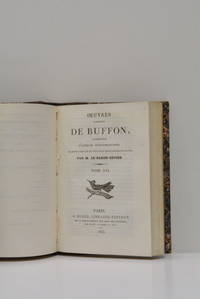
118321Paris 1835. 2 tomes en 1 volume. 500 pages. 2 feuillets. 15x10cm. Demi-cuir. Couverture légèrement frottée. Dos à nerfs orné avec titre et tomaison en lettres dorées. Coins et coiffes un peu émoussés. Ces volumes publiés à Paris en 1835 représentent une extension significative de l'uvre originale de Buffon figure emblématique des Lumières françaises grâce à l'apport de Georges Cuvier éminent naturaliste de son époque. Alors que Buffon avait posé les bases de la zoologie moderne Cuvier enrichit cet héritage en intégrant des découvertes postérieures sur la faune encore inconnue du premier. Cette collaboration posthume illustre l'évolution des sciences naturelles au début du XIXe siècle marquant un pont entre le siècle des Lumières et les avancées scientifiques du XIXe siècle reflétant ainsi la continuité et l'expansion du savoir à travers les générations. À l'exception de quelques petites taches éparses bien conservé. Tomes XV et XVI seuls. Paris, 1835. unknown
17706211Paris l: Imprimerie Royale 1770-86. Engraved plate with original hand-colour approx 25.5 x 21 cms from Histoire Naturelle de Oiseaux. Print Imprimerie Royale unknown
17706663Paris l: Imprimerie Royale 1770-86. Engraved plate with original hand-colour approx 25 x 21 cms from Histoire Naturelle de Oiseaux. Print Imprimerie Royale unknown
19942091202133208756Hosei University Press 1994. Soft Cover. Fine. Volume: 1 Hosei University Press paperback
1812122071Piacenza dai Torchi del Majno 1812/1832. Opera in 90 volumi in 16° piccoli opuscoli aggiunti tutti ancora nelle brossure originali con solo problemi ai dorsi non di tutti i volumi per esposizione alla luce e alla polvere. L'opera è così suddivisa. Parte generale in 4 volumi dal vol. 1 al vol. 4 - Quadrupedi in 7 volumi dal vol. 5 al vol. 11 - Uccelli in 16 volumi dal vol. 12 al vol. 27 con aggiunta di 3 volumi dal vol. 28 al vol. 30 dell' editore italiano 1 volume di Indice vol. 31 - Minerali in 5 volumi dal vol. 32 al vol. 36 con una traccia di tarlo alle prime 20 pagine del volume 36. Dal vol. 37 il titolo dell'occhietto cambia in: Continuazione della storia naturale di Buffon. - Pesci in 11 volumi dal vol. 37 al vol. 47 nella copertina il IV volune è erroneamente segnato come III ma giusta la collazione - Rettili in 5 volumi dal vol. 48 al vol. 52 - Insetti in 11 volumi dal vol. 53 al vol. 63 contrariamente al piano dell'opera che ne conta 62 - Crostacei in 2 volumi dal vol. 64 al vol. 65 - Conchiglie in 5 volumi dal vol. 66 al vol. 70 - Vermi in 3 volumi dal vol. 71 al vol. 73 - I Vegetabili con indicazione dell'uso che se ne può fare in 16 volumi dal vol. 74 al vol. 89 - Indice vol. 90 Piano dell'opera. Tutti i volumi recano le tavole in nero incise da Maurizio De Magistris e Guglielmo Silvestri dai disegni di Jacques Eustache Deseve alle quali va aggiunto il ritratto del B. in antiporta al primo volume. Buoni esemplari salvo il detto di questa importante opera che mantiene ancora una carta sana e fresca Piacenza, dai Torchi del Majno unknown
1166371956.Ghardcover. Good. Access codes and supplements are not guaranteed with used items. May be an ex-library book. hardcover
181213391Milano 1812. Compendiata da C.S.B.M. ad uso della gioventu italiana. Rücken defekt. Im Bund locker Kl.-8°. Pbd. Biologie unknown
1166318060.Gpaperback. Good. Access codes and supplements are not guaranteed with used items. May be an ex-library book. paperback
1120028426.Gpaperback. Good. Access codes and supplements are not guaranteed with used items. May be an ex-library book. paperback
0656362782.Ghardcover. Good. Access codes and supplements are not guaranteed with used items. May be an ex-library book. hardcover
1774FB640 /6A<p>Full leather binding black title plate. Gilt floral design on the spine. The <strong><em>Histoire Naturelle générale et particulière avec la description du Cabinet du Roi</em></strong> English: <em>Natural History General and Particular with a Description of the King's Cabinet</em> is an encyclopaedic collection of 36 large quarto volumes written between 1749–1804 initially by the Comte de Buffon and continued in eight more volumes after his death by his colleagues led by Bernard Germain de Lacépède. The books cover what was known of the "natural sciences" at the time including what would now be called material science physics chemistry and technology as well as the natural history of animals. <strong>Georges-Louis Leclerc Comte de Buffon</strong> 7 September 1707 – 16 April 1788 was a French naturalist mathematician cosmologist and encyclopédiste. His works influenced the next two generations of naturalists including two prominent French scientists Jean-Baptiste Lamarck and Georges Cuvier. Buffon published thirty-six quarto volumes of his <em>Histoire Naturelle</em> during his lifetime with additional volumes based on his notes and further research being published in the two decades following his death. Ernst Mayr wrote that "Truly Buffon was the father of all thought in natural history in the second half of the 18th century". Credited with being one of the first naturalists to recognize ecological succession he was later forced by the theology committee at the University of Paris to recant his theories about geological history and animal evolution because they contradicted the Biblical narrative of Creation. Buffon held the position of <em>intendant</em> director at the Jardin du Roi now called the Jardin des Plantes. Buffon's <em>Histoire naturelle générale et particulière</em> 1749–1788: in 36 volumes; an additional volume based on his notes appeared in 1789 was originally intended to cover all three "kingdoms" of nature but the <em>Histoire naturelle</em> ended up being limited to the animal and mineral kingdoms and the animals covered were only the birds and quadrupeds. "Written in a brilliant style this work was read . by every educated person in Europe". Those who assisted him in the production of this great work included Louis-Jean-Marie Daubenton Philibert Guéneau de Montbeillard and Gabriel-Léopold Bexon along with numerous artists. Buffon's <em>Histoire naturelle</em> was translated into many different languages making him one of the most widely read authors of the day a rival to Montesquieu Rousseau and Voltaire. In the opening volumes of the <em>Histoire naturelle</em> Buffon questioned the usefulness of mathematics criticized Carl Linnaeus's taxonomical approach to natural history outlined a history of the Earth with little relation to the Biblical account and proposed a theory of reproduction that ran counter to the prevailing theory of pre-existence. The early volumes were condemned by the Faculty of Theology at the Sorbonne. Buffon published a retraction but he continued publishing the offending volumes without any change. In the course of his examination of the animal world Buffon noted that despite similar environments different regions have distinct plants and animals a concept later known as Buffon's Law. This is considered to be the first principle of biogeography. He made the suggestion that species may have both "improved" and "degenerated" after dispersing from a center of creation. In volume 14 he argued that all the world's quadrupeds had developed from an original set of just thirty-eight quadrupeds. On this basis he is sometimes considered a "transformist" and a precursor of Darwin. He also asserted that climate change may have facilitated the worldwide spread of species from their centres of origin. Still interpreting his ideas on the subject is not simple for he returned to topics many times in the course of his work. Buffon considered the similarities between humans and apes but ultimately rejected the possibility of a common descent. He debated with James Burnett Lord Monboddo on the relationship of the primates to man Monboddo insisting against Buffon on a close relationship. At one point Buffon propounded a theory that nature in the New World was inferior to that of Eurasia. He argued that the Americas were lacking in large and powerful creatures and that even the people were less virile than their European counterparts. He ascribed this inferiority to the marsh odours and dense forests of the American continent. These remarks so incensed Thomas Jefferson that he dispatched twenty soldiers to the New Hampshire woods to find a bull moose for Buffon as proof of the "stature and majesty of American quadrupeds". In <em>Les époques de la nature</em> 1778 Buffon discussed the origins of the solar system speculating that the planets had been created by a comet's collision with the sun. He also suggested that the Earth originated much earlier than 4004 BC the date determined by Archbishop James Ussher. Basing his figures on the cooling rate of iron tested at his Laboratory the Petit Fontenet at Montbard he calculated that the age of the earth was 75000 years. Once again his ideas were condemned by the Sorbonne and once again he issued a retraction to avoid further problems.</p> De L'Imprimerie Royal. Paris. hardcover
0282092900.Gpaperback. Good. Access codes and supplements are not guaranteed with used items. May be an ex-library book. paperback