1 039 résultats
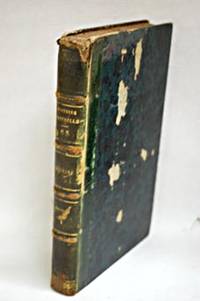
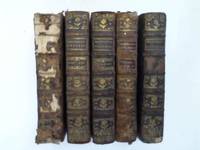
177714625AB1777. Nouvele édition. volume 3 of 10. Paris Thou 1777. 205 : 125 cm. Title 308 pages with 31 engraved plates. Contemporary calf spine richly gilt back label. The engraving in strong printing show birds in there surroundings at a river on the sea in the field near houses etc. - Some minor stains otherwise fine. unknown
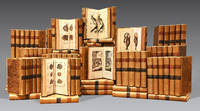
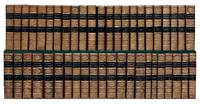
178960389Paris l' Imprimerie Royale Plassan 1749 - 1789. 4to 262 x 205 mm. Uniformly bound in 32 contemporary full sprinkled calf bindings with five raised bands and richly gilt spines. Leather tome- and title-labels to all volumes. Edges of boards gilt. Light wear to extremities primarily affecting head and foot of spines corners bumped. Internally with light occassional marginal brownspotting but generally fine. With "J. Collin" Danish zoologist Jonas Collin to top margin of most front free end-papers. An overall nice set comprising the following:Histoire Naturelle Générale et Particulière 15 vols - 578 plates and 2 maps.Supplément à l'Histoire naturelle 6 vols - 141 plates and 2 maps.Histoire naturelle des Oiseaux 9 vols - 257 plates.Quadrupedes Ovipares et des Serpens 2 vols - 66 plates. A total of 1042 plates and 4 maps. Wanting the portrait. The complex collation of this work has not been accurately described by bibliographers. Nissen and Heilbrun differ in the listing of number of plates and misname the descriptions of the plates. <br/><br/><em>First edition of this extensive landmark work in natural science. After his death several other volumes were published making the total number of volumes 44. Together with Diderot's Encyclopaedia this work represents the peak of book printing of the French enlightenment. Buffon was the first to sum up an entire natural history based on science instead of theology; It constitutes one of the first attempts to provide a comprehensive account of the natural world aiming at describing the entire known natural world - including plants animals and minerals - in a single work. Buffon based his work on first-hand observations and scientific analysis rather than on second-hand accounts or mythological beliefs making it a seminal work in the development of modern science. "Buffon's "Natural History General and Particular" presented for the first time a complete survey of natural history in a popular form . he was the first to present the universe as one complete whole and to find no phenomenon calling for any but a purely scientific explanation. In 1739 he was appointed Director of the Jardin du Roi now Jardin des Plantes. It would appear that the 'Natural History germinated in the preparation of a catalogue of the royal collection. Buffon then enlarged its scope to Aristotelian or Plinian proportions and finally transformed it into a conspectus of nature of a breadth and depth previously unknown". … he was the first to present the universe as one complete whole and to find no phenomenon calling for any but a purely scientific explanation." PMM. Buffon's work had a significant impact upon the field of natural history and influenced many other scientists including Charles Darwin; In a part of the work "Des Epoqeus de la Nature" Supplement vol. V 1778 present here Buffon attacked several Christian doctrines on natural science. He saw man as a part of the animal world he objected to earth being only 6000 years old and he dismissed a rigid classification system thus paving the way for Darwin's thoughts a century later:"Georges Buffon set forth his general views on species classification in the first volume of his Histoire Naturelle. Buffon objected to the so-called "artificial" classifications of Andrea Cesalpino and Carolus Linnaeus stating that in nature the chain of life has small gradations from one type to another and that the discontinuous categories are all artificially constructed by mankind. Buffon suggested that all organic species may have descended form a small number of primordial types; this is an evolution predominantly from more perfect to less perfect forms." Parkinson Breakthroughs. "Buffon's work is of exceptional importance because of its diversity richness originality and influence. Buffon was among the first to create an autonomous science free of any theological influence. He emphasized the importance of natural history and the great length of geological time. He envisioned the nature of science and understood the roles of paleontology zoological geography and animal psychology. He realised both the necessity of transformism and its difficulties. Although his cosmogony was inadequate and his theory of animal reproduction was weak and although he did not understand the problem of classification he did establish the intellectual framework within which most naturalists up to Darwin worked." DSB From the library of Danish zoologist Jonas Collin 1840-1905 who issued a new edition of Kjærbølling's "The Birds of Scandinavia" in 1875-1877 See Anker 251 - a work most likely inspired by his knowledge from his i.e. the present copy of Buffon's "Histoire Naturelle".The 'Histoire Générale' was widely reprinted and translated. Sometimes only individual sections were produced other times the complete work appeared. PMM 198.Nissen 672.Brunet I 376.Dibner 193.Sparrow p. 23.Anker 6. </em> hardcover
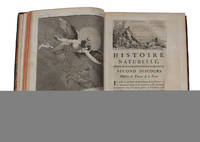
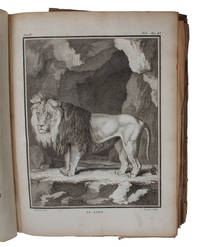
176139518Paris Imprimerie Royale 1761. 4to. Contemporary full mottled calf spine and boards worn. 4 376 pp. With engraved vignette on titlepage and 41 full-page engraved plates many folding. Plate 16 torn. <br/><br/><em>Volume 9 in the first edition. Plates describing lions tigers leopards hyenas &c. Buffon is best remembered for his great work Histoire naturelle générale et particulière 1749-788: in 35 volumes 9 additional volumes published after his death by Lacépède. It included everything known about the natural world up until that date. "Written in a brilliant style this work was read. by every educated person in Europe." Those who assisted him in the production of this great work included Louis-Jean-Marie Daubenton. His Histoire was translated into many different languages making him one of the most widely read authors of the day equaling Rousseau and Voltaire. </em> hardcover
64405Paris l'Imprimerie Royale 1776. 4to 24.1 x 18.5 cm. Title page with engraved vignette engraved head and tail pieces. iii 582 xx pp. six engraved plates many tables. 20th century brown cloth spine with gilt title. = Supplement volume to the quarto edition of this large and important series on natural history by Georges-Louis Leclerc Comte de Buffon 1707-1788. Not to be confused with the much smaller 12mo sometimes listed as 8vo edition. Well-illustrated by De Sève one of the best natural history illustrators of the 18th century. This volume deals with Man and addresses issues as Man's longevity and the probabilities percentages of reaching a certain age. Other topics are ovulary glands body temperature skin colour and albinism siamese twins and other teratological issues. Some mostly marginal toning and infrequent light spotting weak old library stamp on several text pages and the title page but generally clean. Nissen ZBI 672; Casey Wood p. 267. hardcover
1799134887Paris: Librairie Stereotype 1799. Hardcover. very good. 338pp. 18mo. Contemporary full calf heavily rubbed with one spot of worming. Gilt titles and decorations to spine with leather spine labels partially perished. Missing headbands. All edges died red. Age toning to endpapers else internally tight and clean. With 22 engraved plates. very good A single volume on birds from Buffon's Natural History. Includes 22 charming engraved plates of birds associated with water including gulls kingfishers geese and several varieties of ducks. Clean and attractive internally. 1799 Librairie Stereotype hardcover
35799Paris Imprimerie Royale 1770-1785. 18 volumes in 18. Large 12mo 18.0 x 10.5 cm. Text with 264 engraved plates. Uniform contemporary half calf over speckled boards. Spines with five raised gilt-ornamented bands; compartments with gilt floral patterns and two morocco labels in red or brown short title and black part number. = This is the complete bird section volumes 14-31 usually found separately of Buffon's Histoire Naturelle générale et particulière published by the Imprimerie Royale from 1749 to 1804 in 44 volumes. Nissen only quotes 262 plates. The plates are after De Sève and depict the birds in their natural surroundings including nice architectural design. Some light shelfwear one spine label with some loss; some slight foxing in the text plates clean. The last two volumes published four years after volume 16 in a slightly different binding see pictures. A nice set in beautiful contemporary almost uniform bindings. Nissen IVB 160; Ronsil 413. hardcover
1020713143.Ghardcover. Good. Access codes and supplements are not guaranteed with used items. May be an ex-library book. hardcover
1020716606.Ghardcover. Good. Access codes and supplements are not guaranteed with used items. May be an ex-library book. hardcover
102069954X.Ghardcover. Good. Access codes and supplements are not guaranteed with used items. May be an ex-library book. hardcover
1022816659.Gpaperback. Good. Access codes and supplements are not guaranteed with used items. May be an ex-library book. paperback
1022834177.Gpaperback. Good. Access codes and supplements are not guaranteed with used items. May be an ex-library book. paperback
303300Paris.: De L'Imprimerie de F. Dufart. Hardcover. Cubierta deslucida. . Lomo rozado. Good. 20 cm. 413 p. Encuadernación en tapa dura artesanal con lomo estampado. Buffon Georges Louis Leclerc 1707-1788. Par Leclerc de Buffon. Nouvelle edition accompagnée de notes et dans laquelle les supplémens sont inséres dans le premier text. ; ouvrage formant un cours complet d'Histoire Naturelle. Redigé par C.S. Sonnini. An XI. Idioma: francés . Cubierta deslucida. . Lomo rozado. Historia. Ciencia y conocimiento. Divulgación De L'Imprimerie de F. Dufart. hardcover
0364397012.Ghardcover. Good. Access codes and supplements are not guaranteed with used items. May be an ex-library book. hardcover
0243543972.Gpaperback. Good. Access codes and supplements are not guaranteed with used items. May be an ex-library book. paperback
0243424817.Gpaperback. Good. Access codes and supplements are not guaranteed with used items. May be an ex-library book. paperback
0282242155.Gpaperback. Good. Access codes and supplements are not guaranteed with used items. May be an ex-library book. paperback
0282218688.Gpaperback. Good. Access codes and supplements are not guaranteed with used items. May be an ex-library book. paperback
0282140107.Gpaperback. Good. Access codes and supplements are not guaranteed with used items. May be an ex-library book. paperback
0282621113.Gpaperback. Good. Access codes and supplements are not guaranteed with used items. May be an ex-library book. paperback
0282623639.Gpaperback. Good. Access codes and supplements are not guaranteed with used items. May be an ex-library book. paperback
042811637X.Gpaperback. Good. Access codes and supplements are not guaranteed with used items. May be an ex-library book. paperback
1069iL' Imprimerie Royale Paris 1769-1783. zusammen ca. 2700 S. mit 23 Kupfertaf. 1 davon gefaltet orig. Ldr.-Ebde Ebde teils berieben u. bst.; Bei 3 Rücken fehlen partiell Lederstücke; einige kleine Wurmlöcher. enthält: "Des Animaux" "Théorie de la Terre" "des Mineraux" "Partie expérimentale" des Matières. unknown
ABAA25-37<p>A Paris de l'Imprimerie de F. Dufart An VIII<strong> 1799/1800 - 1808.</strong></p><p><strong>127 volumes 8vo. Calf gilt dentelle framing the covers decorated flats spines. <em>Contemporary binding signed by P. Meslant.</em></strong></p><p><strong>196 x 121 mm.</strong></p><p><strong>The great 18th century "Natural History" by Buffon adorned with 1 166 full-page copper engravings including 2 portraits 8 maps 20 tables and 1136 engravings here in rare double state on thick Holland paper in black and facing hand-colored at the time. </strong></p><p><strong>Quérard. <em>La France littéraire</em> I 558; Nissen. </strong><strong><em>Zoology</em></strong><strong> 682; Cohen</strong><em> Livres illustrés du XVIIIe siècle</em> 194.</p><p><strong>It was one of the most ambitious and complete works of scientific literature.</strong></p><p><strong>Buffon appointed intendant of the King's Garden in August 1730 had at that moment conceived the project of making the study of natural history amiable and accessible to all which until then had only known dry teachings. His vast project aimed to encompass all the productions of nature by classifying and explaining them methodically.</strong></p><p><strong>The success of the enterprise was immense resounding and lasting.</strong></p><p><strong>"<em>Never had human thought reached such a height nor genius such boldness. One was not accustomed to hearing science speak such beautiful language. Hence Buffon's place was marked from that day at the French Academy</em>."</strong></p><p><strong>"<em>Buffon's text dedicated to the "Epochs of Nature" describing the formation of continents takes its place among the great pages of French literature</em>."</strong></p><p><strong>It was the first attempt at amiable and refined popularization of the study of natural history which led to a discovery and an enthusiasm from the cultivated public and a desire for protection of this science by sovereigns and greats. However there are hardly any known copies with the double state of the engravings.</strong></p><p><strong>This edition was published by <em>Sonnini de Manoncourt</em> his former assistant with the collaboration of several naturalists and entomologists.</strong></p><p><strong>It is illustrated with 2 portraits 8 maps and 1 136 copper engravings some folded</strong><strong>. Nissen announces only 1 100 plates 36 less than in the present copy.</strong></p><p><em>Théorie de la Terre</em> 3 vol. 5 p1. 1 portrait and 3 cartes ; <em>Époques de la Nature</em> 1 vol. 3 pl. and one map ; <em>Histoires des minéraux</em> 12 vol. 20 pl. and 4 maps <em>des animaux</em> 1 vol. 7 pl. <em>de l'homme</em> 4 vol. 13 pl. <em>des quadrupèdes</em> 13 vol. 231 pl. <em>des singes</em> 2 vol. 79 pl. <em>des oiseaux</em> 28 vol. 257 pl. <em>des poissons</em> 13 vol. 80 pl. and one portrait <em>des cétacées</em> 1 vol. 5 pl. <em>des mollusques</em> 6 vol. 72 pl. <em>des reptiles</em> 8 vol. 100 pl. <em>des crustacés et des insectes</em> 14 vol. 113 pl. et <em>des plantes</em> 18 vol. 151 pl. <em>tables</em> 3 vol.</p><p><strong>One of the rare copies containing a second version of each plate finely watercolored at the time. The colors have remained remarkably fresh.</strong></p><p><strong>FR</strong></p><p>A Paris de l'Imprimerie de F. Dufart An VIII 1799/1800 - 1808.</p><p>127 volumes in-8. Veau roulette dentelée dorée encadrant les plats dos lisses ornés. <em>Reliure de l'époque signée de P. Meslant.</em></p><p>196 x 121 mm.</p><p><strong>La grande " <em>Histoire naturelle</em> " de Buffon du XVIIIe siècle ornée de 1 166 planches gravées sur cuivre à pleine page incluant 2 portraits 8 cartes 20 tableaux et 1 136 estampes ici en rarissime double état sur papier fort de Hollande en noir et vis-à-vis en coloris main de l'époque.</strong></p><p>Quérard. <em>La France littéraire</em> I 558 ; Nissen. <em>Zoologie</em> 682 ; Cohen <em>Livres illustrés du XVIIIe siècle</em> 194.</p><p><strong>Ce fut l'une des œuvres les plus ambitieuses et les plus complètes de la littérature scientifique. </strong></p><p>Buffon nommé intendant du Jardin du Roi en août 1730 avait dès ce moment conçu le projet de rendre aimable et accessible à tous l'étude de l'histoire naturelle qui n'avait connu jusqu'alors que de secs enseignements.</p><p>Son vaste projet entendait embrasser l'ensemble des productions de la nature en les classant et expliquant d'une façon méthodique.</p><p><strong>Le succès de l'entreprise fut immense éclatant et durable.</strong></p><p>" <em>Jamais la pensée humaine ne s'était élevée à une pareille hauteur ni le génie à une telle hardiesse. On n'était pas accoutumé à entendre la science parler un aussi beau langage. Aussi la place de Buffon fut-elle marquée dès ce jour à l'Académie française</em> ".</p><p>" <em>Le texte de Buffon consacré aux " Époques de la nature " à la description de la formation des continents prend place parmi les grandes pages de la littérature française</em> ".</p><p>C'était le premier essai de vulgarisation aimable et raffiné de l'étude de l'histoire naturelle qui provoqua une découverte et un engouement du public cultivé et un désir de protection de cette science chez les souverains et les grands. Mais l'on ne connaît guère d'exemplaires avec le double état des gravures.</p><p>Cette édition fut publiée par <em>Sonnini de Manoncourt</em> son ancien assistant avec la collaboration de plusieurs naturalistes et entomologistes.</p><p><strong>Elle est illustrée de 2 portraits 8 cartes et 1 136 planches gravées sur cuivre certaines repliées</strong><strong>. </strong>Nissen n'annonce que 1 100 planches soit 36 de moins que dans le présent exemplaire.</p><p><em>Théorie de la Terre</em> 3 vol. 5 p1. 1 portrait et 3 cartes ; <em>Époques de la Nature</em> 1 vol. 3 pl. et une carte ; <em>Histoires des minéraux</em> 12 vol. 20 pl. et 4 cartes <em>des animaux</em> 1 vol. 7 pl. <em>de l'homme</em> 4 vol. 13 pl. <em>des quadrupèdes</em> 13 vol. 231 pl. <em>des singes</em> 2 vol. 79 pl. <em>des oiseaux</em> 28 vol. 257 pl. <em>des poissons</em> 13 vol. 80 pl. et un portrait <em>des cétacées</em> 1 vol. 5 pl. <em>des mollusques</em> 6 vol. 72 pl. <em>des reptiles</em> 8 vol. 100 pl. <em>des crustacés et des insectes</em> 14 vol. 113 pl. et <em>des plantes</em> 18 vol. 151 pl. <em>tables</em> 3 vol.</p><p><strong>Un des rares exemplaires contenant une seconde épreuve de chaque planche finement aquarellée à l'époque. Les coloris sont restés d'une fraîcheur remarquable. </strong></p> hardcover
1023919818.Ghardcover. Good. Access codes and supplements are not guaranteed with used items. May be an ex-library book. hardcover
18046665Paris: De l'Imprimerie Royale later Imprimerie des Bâtimens du Roi; Hôtel de Thou; Plassan 1804. First edition. <p>First edition a very fine uniformly-bound contemporary set with the separately-issued and frequently-absent atlas to the Minéraux of the first work to present natural history as a continuous secular narrative - from planetary formation through geology and mineralogy to the quadrupeds birds fishes and cetaceans and at last to the human races - and the work in which across fifty-five years and four political regimes the biblical chronology that had organised European natural science since antiquity ceased to be the only frame within which educated readers could discuss the age of the earth. In the Époques de la Nature 1778 Buffon proposed seven epochs of earth history and from cooling experiments in his own forge at Montbard estimated its age at roughly seventy-five thousand years; in unpublished notes his private estimate reaches three million - the order of magnitude Lyell would later extract from stratigraphy and Darwin require for natural selection to operate.</p>. The Founding Treatise of Secular Science. <p>First edition of the first work to present natural history as a continuous secular narrative-from planetary formation through geology and mineralogy to the quadrupeds birds fishes and cetaceans and at last to the human races-and the work in which across fifty-five years and four political regimes the biblical chronology that had organised European natural science since antiquity ceased to be the only frame within which educated readers could discuss the age of the earth. Buffon was appointed Intendant du Jardin du Roi in 1739 at thirty-two and spent nearly half a century converting the royal cabinet of natural-history specimens into a compendium that at its close under Lacépède's hand in 1804 comprised forty-four quarto volumes more than twelve hundred engraved plates and a style so supple that Buffon's elegies on individual species remained set texts in French lycées into the twentieth century. Uniformly bound in contemporary French mottled calf and preserving all forty-four text volumes together with the separately-issued and frequently-absent atlas to the Minéraux the present copy is of a completeness and coherence uncommon in a publication whose fifty-five-year issue spanned four successive Parisian imprints. His prose made deep time habitable. Within thirty years of the final volume Lyell was writing the Principles of Geology; within sixty Darwin the Origin. Ernst Mayr called Buffon "the father of all thought in natural history" at his time; the DSB records that he "established the intellectual framework within which most naturalists up to Darwin worked."</p> <br /> <br /> <p>The publishing history is itself a monument. The first three volumes appeared together in the autumn of 1749 from the Imprimerie Royale sold out in six weeks were reprinted three times within the same interval and provoked the Sorbonne's faculty of theology into delivering Buffon a list of propositions judged heretical-to which Buffon submitted a carefully calibrated retraction while continuing to print the offending volumes unchanged. The initial prospectus of 1748 had promised fifteen volumes in three divisions; by the time Buffon died in 1788 thirty-five were in print a thirty-sixth was on the press and the plan of covering the vegetable kingdom had quietly been abandoned. The seventh and final Supplément appeared posthumously in 1789 through Lacépède's editorship; the fifth volume of the Minéraux containing the Traité de l'aimant had issued a year earlier from the Imprimerie des Bâtimens du Roi and was accompanied by a separately-issued atlas of folding maps and tables. Lacépède then continued the animal-kingdom programme with the Quadrupèdes ovipares et Serpens 1788-89 the Poissons 1798-An XII and the Cétacées 1804. The combined output of four imprints across three generations of Parisian printers-the Imprimerie Royale the Imprimerie des Bâtimens du Roi the Hôtel de Thou under Panckoucke and Plassan and Plassan imprimeur-libraire-makes the uniformly-bound contemporary set one of the more elusive bibliographical objects of the French Enlightenment.</p> <br /> <br /> <p>Volume I opens the series with the Premier Discours: De la manière d'étudier et de traiter l'histoire naturelle a forty-page frontal assault on Linnaean classification that argues from a position of mathematical and empirical rigour rare in the literature of the period that species as Linnaeus conceived them were artificial abstractions imposed on the continuous variability of individuals and that a taxonomy built on stamen-counts and pistil-counts had no purchase on nature. The attack was political as well as philosophical. Linnaeus's Systema Naturae Leiden 1735 had already been adopted as the common grammar of European zoology; Buffon's Discours delivered from within the most prestigious press in France asserted that the Swede's method was a convenience of memory mistaken for a description of the world. The volume continues with the Second Discours: Histoire et théorie de la Terre dated by Buffon himself "à Montbard le 3 octobre 1744" which proposes a cosmogony in which the planets were struck from the sun by the oblique impact of a comet and have been cooling ever since and with the Preuves de la théorie de la Terre in which Buffon develops his theory across seventeen articles and provides two engraved terrestrial maps drawn under his supervision by Robert de Vaugondy fils. These arguments delivered within a volume bearing the royal arms of France on its title-page vignette constituted the most public challenge to Mosaic cosmogony yet mounted in eighteenth-century France.</p> <br /> <br /> <p>The geological argument reached its mature form a generation later in the fifth Supplément the Époques de la Nature 1778 published when Buffon was seventy-one. Here he proposed seven epochs of the earth's history estimated their combined duration at roughly 75000 years and in unpublished manuscript notes pushed his private estimate to three million-an order of magnitude consistent with the timescales that Lyell would later extract from stratigraphy and that Darwin would require for natural selection to operate. The significance of the Époques is not only the number. It is the rhetorical form of the argument: Buffon marshals fossil molluscs at Alpine altitudes the decay of volcanic emissions the rate at which heated iron spheres cool in Buffon's own forge at Montbard and the distribution of living species across climate zones and weaves these into a cumulative inductive case in which each line of evidence corroborates the others. The technique is no longer antiquarian but probabilistic-Buffon had after all published a French translation of Newton's Method of Fluxions in 1740 and would publish original work on the probability that a needle tossed on a ruled floor should cross a line the problem that bears his name in modern geometric probability. When the Époques reached Edinburgh and Cambridge in the 1780s it announced to Anglophone readers that the earth's antiquity had become a quantitative problem rather than a scriptural one.</p> <br /> <br /> <p>The core of the programme is the animal kingdom. Volumes 4 through 15 1753-1767 treat the quadrupeds in an arrangement that combines Buffon's natural-historical essays with Daubenton's anatomical descriptions-a division of labour Buffon defended in the Preface to volume IV and that Daubenton eventually came to resent his name disappearing from the later volumes. The Oiseaux volumes numbered I-IX on their title-pages but continuously as tomes XVI-XXIV on their half-titles 1770-1783 are the work of Buffon with Philibert Guéneau de Montbeillard and the Abbé Bexon and assume decisively that geographic distribution is a datum of zoology rather than an incidental fact about individual animals-a premise that commits the Histoire naturelle to the biogeographic thinking which Alfred Russel Wallace would systematise a century later. The Minéraux volumes I-V 1783-1788 extend the account to the inorganic world and conclude with the Traité de l'aimant Buffon's last publication in his lifetime accompanied by the atlas that the present set preserves. Lacépède's eight continuation volumes close the series with the Ovipares et Serpens the Poissons five volumes 1798-An XII drawing on the manuscript collections of Philibert Commerson and the Cétacées 1804-the whole project begun under Louis XV and finished under the Consulate of Bonaparte.</p> <br /> <br /> <p>The plate programme numbering 1275 copper engravings including the portrait frontispiece of Buffon and twelve folding maps was entrusted principally to Jacques de Sève and his son Jacques-Eustache de Sève with additional designs by Buvée l'Amériquain Oudry and Baron and engravings by Baquoy Basan Moitte and Tardieu. De Sève père is the designing sensibility that defines the visual character of the Histoire naturelle: his quadrupeds stand in pastoral European landscapes-villages rivers mountains ruins-that place each species within a habitat rather than isolating it on the diagrammatic ground of the pre-Linnaean iconotheca. The aesthetic choice is not decorative. It performs Buffon's thesis that species are functions of geography; the elk against a Norwegian spruce-line and the jerboa against a North African dune argue in visual shorthand a zoogeography that the text elaborates. The plates in the present set are in the original uncoloured state as issued by the Imprimerie Royale and its successor presses; the hand-coloured Planches enluminées of Edme-Louis Daubenton 1765-1786 1008 plates issued separately to accompany the de luxe folio edition of the Oiseaux are a distinct publication and do not belong to the quarto edition.</p> <br /> <br /> <p>Buffon was born Georges-Louis Leclerc at Montbard in Burgundy on 7 September 1707 the son of a magistrate of the Estates of Burgundy who in 1714 inherited a substantial fortune from a maternal relative and acquired the lordship of Buffon - the toponym from which the future comte took the name by which he is universally known. He was educated by the Jesuits at Dijon studied mathematics at Angers and travelled in Italy and England in 1730-1733 in the company of the young Duke of Kingston and his Genevan tutor Nathaniel Hickman. Election to the Académie des Sciences followed at twenty-six in 1734. His earliest publications were French translations of Newton's Method of Fluxions 1740 and Stephen Hales's Vegetable Staticks 1735 published 1735 and an original 1733 communication to the Académie on the geometric probability of a needle dropped at random across a ruled floor - the "needle problem" that bears his name in the founding literature of integral geometry. The 1739 appointment as Intendant du Jardin du Roi secured through the patronage of Maurepas gave him the cabinet the printing privilege and the institutional platform that the Histoire naturelle required. From 1739 onward his year was strictly bisected: October to April in Paris among the specimens May to September at Montbard where the great house the gardens the ducal tower and from 1768 an industrial-scale ironworks furnished both the writing room and the experimental laboratory.</p> <br /> <br /> <p>The Montbard forge is the experimental backbone of Buffon's late geological writing. From 1765 onward he conducted a sustained programme of cooling experiments in which iron and stone spheres of graduated diameter were heated to incandescence and the time required for them to cool to ambient temperature was measured under controlled conditions. Extrapolating from sphere to planet on the assumption that the earth had begun as a molten body progressively congealed Buffon arrived at the published 75000-year estimate of the Époques de la Nature and at the manuscript figure three million years that he allowed his students to read but did not put into print. The forge was simultaneously a working blast-furnace producing pig-iron for the Burgundian armaments trade - the revenue from which subsidised the publication and freed Buffon from dependence on royal subvention. The orangery at Montbard housed parallel experiments on plant respiration and the germination of seeds; the great walled garden was a controlled environment for testing the hardiness of imported species against Burgundian winters. The whole estate in effect was an early instance of the gentleman-natural-philosopher's establishment as instrument - comparable in scale to Tycho's Uraniborg to Boyle's Stalbridge or to Darwin's later Down House. The Histoire naturelle is the published face of this experimental enterprise.</p> <br /> <br /> <p>The literary reception of Buffon was nearly as consequential as the scientific. His 1753 reception address to the Académie française the Discours sur le style "le style est l'homme même" became one of the most quoted statements of French neoclassical aesthetics and reframed the Histoire naturelle as a literary as well as a scientific monument. The set-piece elegies on the horse the lion the swan the orangutan and the dog were detached from the parent volumes and circulated as morceaux choisis; they remained obligatory recitation pieces in the French lycée through the Third Republic and were anthologised by Sainte-Beuve in the Causeries du lundi in 1855 as the model of mid-eighteenth-century French prose. Diderot read and annotated the early volumes for the Encyclopédie; Rousseau with whom Buffon's relations were polite but distant took the geographic-determinist passages as silent corroboration of his own anthropology; Voltaire who shared Buffon's anti-Sorbonne instinct but resented his court success kept up a guarded correspondence. The Smellie translation Edinburgh 1780-1785 and Goldsmith's History of the Earth and Animated Nature London 1774 an avowed abridgment carried the work into the English-speaking world where Erasmus Darwin's Zoonomia 1794-96 silently absorbed Buffon's transformist hints into its own evolutionary speculation.</p> <br /> <br /> <p>The afterlife of Buffon's argument runs straight through nineteenth-century evolutionary thought. Cuvier lecturing at the Muséum d'Histoire Naturelle from 1795 treated the Histoire naturelle as the institutional charter of his own comparative-anatomical programme even while disputing its transformism. Lamarck who had reorganised the botanical galleries under Buffon in 1788 developed his 1809 Philosophie zoologique by extending Buffon's observations of climate-driven variability into a fully transformist mechanism. Lyell's Principles of Geology 1830-33 acknowledged in its preface that the eighteenth-century revolution in geological time had been Buffon's and Darwin in the historical sketch added to the third edition of the Origin 1861 placed Buffon at the head of the line of pre-evolutionary speculators - with the politically careful note that the Histoire naturelle had at one point been condemned by the Sorbonne. Thomas Jefferson who owned the work at Monticello Sowerby 1024 for volumes 1-31 and 637 for the Suppléments and corresponded with Buffon about American zoology was so stung by Buffon's thesis that New World fauna were degenerate forms of Old World types that he had the bones of an American moose shipped across the Atlantic to Paris as evidence in rebuttal - the most picturesque single episode in the trans-Atlantic reception history of the work. The German reception travelled along a separate but parallel channel: Goethe read the Époques in 1781 and absorbed its rhetoric of geological depth into his own morphological writing and Alexander von Humboldt whose Kosmos 1845-1862 is the nineteenth-century lineal descendant of the encyclopaedic ambition of the Histoire naturelle repeatedly cited Buffon as the founder of the genre to which he conceived his own work as belonging. The scholarly modern editions - the Imprimerie Nationale Pléiade selection of 1954 under the editorship of Jean Piveteau the 1971 Bibliothek Suhrkamp German selection edited by Jacques Roger and Roger's own 1989 Fayard biography translated as Buffon: A Life in Natural History Cornell 1997 - are all built on direct consultation of the original quarto edition of which complete uniformly-bound contemporary sets remain the necessary collation copy. The Centre international d'étude du XVIIIe siècle's Buffon: Histoire naturelle générale et particulière bibliography Pierre Lecouturier and Roger Hahn 1972 supplemented by Jeff Loveland and others through the 2010s confirms that no two contemporary sets are identical in title-page state advertisement leaves or the order of the prefatory matter and treats the uniformly-bound quarto with a complete Minéraux atlas as the bibliographical reference state for the work.</p> <br /> <br /> <p>References: Printing and the Mind of Man 198 Carter and Muir identify Buffon's priority in presenting the natural world as a single unified field - Dibner Heralds of Science 193 described as the most celebrated treatise on animals ever produced - Nissen ZBI 672 - Wellcome II 267 - Norman 369-370 - Brunet I 1376 Brunet recommends that collectors always seek out this first quarto edition for the beauty of its engravings - Sowerby Catalogue of the Library of Thomas Jefferson 1024 and 637 - Evans First Editions of Scientific Books Berkeley exhibition 1934 no. 97.</p> <br /> <br/> <br/> <br /> <p>45 volumes 4to 242 × 188 mm comprising the 44 text volumes and the separately-issued atlas to the Minéraux. 1275 engraved plates including the portrait frontispiece of Buffon and twelve folding maps mostly by Jacques de Sève père and his son Jacques-Eustache de Sève with further designs by Buvée l'Amériquain Jean-Baptiste Oudry and Nicolas Baron engraved by Baquoy Basan Moitte and Tardieu. Uniform contemporary French mottled calf the spines gilt in compartments with small lozenge tools and two black morocco lettering-pieces triple gilt fillet on the covers marbled edges and matching Spanish-shell marbled endpapers; narrow blue silk ribbon markers at the heads of the spines. The completeness of the Minéraux atlas is unusual and the uniformity of the calf binding across four imprints and fifty-five years of publication particularly so. A very fine set of one of the most substantial publishing undertakings of the eighteenth century.</p> . De l'Imprimerie Royale [later Imprimerie des Bâtimens du Roi; Hôtel de Thou; Plassan] unknown