DARWIN, CharlesBiblio.com
7 209 résultats
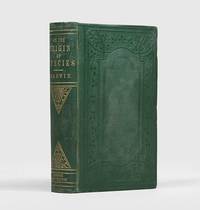
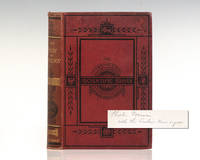
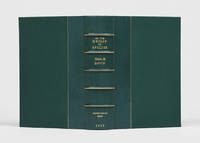
1859172148London: John Murray 1859. Presented to his botanical counterpart in France who prefigured Darwin's theory of adaptation First edition presentation copy inscribed on the front free endpaper in a secretarial hand "Dr Weddell Bagnères de Bigorre from the author". This is a premier copy: Weddell is one of the earliest named recipients on Darwin's list of presentation copies. Darwin and Weddell who had comparable experience as scientists aboard major expeditions to South America exchanged findings plant specimens and presentation copies throughout their careers. Though born in England Hugh Algernon Weddell 1819-1877 was raised in France and qualified as a physician there in 1841. He joined the Castelnau scientific expedition to South America the following year aged 23 before leaving in 1845 to concentrate on his own plant collecting in the Andes. He returned to France in 1848 having discovered coca and cinchona among other plants and collected over 5000 specimens. These travels and a later trip to Bolivia established him as a specialist in South American flora. He served as an assistant naturalist at the Muséum d'histoire naturelle in Paris from 1850 to 1857 before settling in Bagnères-de-Bigorre and later in Poitiers. Histoire naturelle des quinquinas ou monographie du genre 1849 the two-volume Chloris Andina 1855-57 and Monographie de la famille des Urticés 1856 are among his most noted publications. "Weddell was the first to demonstrate scientifically the medical importance of coca. as well as the dangers attached to its misuse. His work contributed to the cultivation of cinchona in the Dutch East Indies and other tropical regions and earned him the Order of the Netherlands Lion in 1855 a rare distinction for a foreigner. His observations on the fossils of Tarija in Bolivia and on the different varieties of cinchona led him to elaborate between 1850 and 1860 a theory of adaptation that anticipated Darwin at least in France" Natural History Museum. In 1858 Darwin and Hooker consulted the new data in Weddell's 1856 monograph to calculate the number of species and varieties in large and small genera. Weddell sent Darwin a copy of his paper on the Cynomorium plant in 1860 and two years later Darwin responded in kind by gifting Weddell a copy of Orchids on page 19 of which he cites Weddell's work on the "naturally produced" hybrids of Aceras. Weddell is also included on Darwin's presentation list for "Two forms in species of Linum" 1863 which prompted a written correspondence on pollination mechanisms. In his letter of 13 May 1863 DCP-LETT-4161 Weddell apologizes to Darwin for being unable to find the requested samples of Ophrys apifera bee orchids in his local area: "If at any future period I am more lucky I shall not fail to observe a sufficient number of them as respects their manner of fertilisation and make you acquainted with the results". The final exchange between Darwin and Weddell concerned membership of the Académie des Sciences. Darwin applied twice to become a corresponding member of its botanical section but it was not until after Weddell's death that the Académie offered the newly vacant place to him DCP-LETT-11640A. Darwin drafted his list of recipients of presentation copies of the Origin between August and October 1859. Weddell appears on the first page of the list as "Dr. Weddell Bagneres de Bigorres Haute Pyrenees" Correspondence Vol. 8 p. 555. "There are no known author's presentation copies of the first edition inscribed in Darwin's hand" Norman. Subsequent provenance: Louis Devergne likely the archpriest 1891-1941 at Loudon some 40 miles from Poitiers where Weddell died his neat ink ownership inscription on front free endpaper; private French collector. Octavo. Folding diagram lithographed by W. West. 32-page publisher's catalogue at rear dated June 1859. Original green cloth spine lettered and decorated in gilt Freeman variant b no priority brown endpapers. Housed in a green quarter morocco solander box by the Chelsea Bindery. Extremities rubbed and bumped cloth and gilt bright small patch of dampstain at upper edge of rear cover with resulting area visible at gutter of rear endpapers contents notably clean bar very occasional faint spotting and soiling neatly repaired closed tear at fore edge of G5 tiny nick at fore edge of P5: a fine copy. Freeman 373; Garrison-Morton 220; Horblit 23b; Norman 593; Printing and the Mind of Man 344b. "Appendix III - Presentation copies of Origin" in Frederick Burkhardt & James Second eds The Correspondence of Charles Darwin Volume 8: 1860 1993. hardcover
1859116380London: John Murray 1859. First edition of "certainly the most important biological book ever written" Freeman one of 1250 copies. Octavo bound in original cloth half-title one folding lithographed diagram without advertisements. In fine condition with a touch of shelfwear. Housed in a custom clamshell box. An exceptional example of this landmark work one of the nicest extant. Darwin "revolutionized our methods of thinking and our outlook on the natural order of things. The recognition that constant change is the order of the universe had been finally established and a vast step forward in the uniformity of nature had been taken" PMM 344. "Without question a watershed work in the history of modern life sciences Darwin's Origin elaborated a proposition that species slowly evolve from common ancestors through the mechanism of natural selection. As he himself expected Darwin's theory became and continues to be in some circles the object of intense controversy" American Philosophical Society. "The five years of Darwin's voyage on the Beagle were the most important event in Darwin's intellectual life and in the history of biological science. Darwin sailed with no formal training. He returned a hard-headed man of science. The experiences of his five years in the Beagle how he dealt with them and what they led to built up into a process of epoch-making importance in the history of thought" PMM. John Murray hardcover books
1859116380London: John Murray 1859. First edition of "certainly the most important biological book ever written" Freeman one of 1250 copies. Octavo bound in original cloth half-title one folding lithographed diagram without advertisements. In very good condition with cracks to inner hinges and a touch of shelfwear. Housed in a custom clamshell box. A fine example of this landmark work. Darwin “revolutionized our methods of thinking and our outlook on the natural order of things. The recognition that constant change is the order of the universe had been finally established and a vast step forward in the uniformity of nature had been taken†PMM 344. “Without question a watershed work in the history of modern life sciences Darwin’s Origin elaborated a proposition that species slowly evolve from common ancestors through the mechanism of natural selection. As he himself expected Darwin’s theory became and continues to be in some circles the object of intense controversy†American Philosophical Society. “The five years of Darwin’s voyage on the Beagle were the most important event in Darwin’s intellectual life and in the history of biological science. Darwin sailed with no formal training. He returned a hard-headed man of science… The experiences of his five years in the Beagle how he dealt with them and what they led to built up into a process of epoch-making importance in the history of thought†PMM. John Murray hardcover
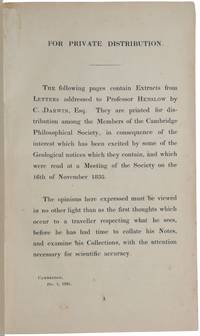
367831 pp. 8vo bound in attractive green morocco-backed cloth over boards. Cambridge: "Printed for Distribution among the Members of the Cambridge Philosophical Society" 1 December 1835. First edition of Darwin's first separately printed work and of the greatest rarity. This unauthorized pamphlet contains extracts from ten letters written to John Stevens Henslow 1796-1861 by Darwin during his five-year voyage on the Beagle. Henslow had been Darwin's botany professor at Cambridge and their friendship "was one of the most influential circumstances in his Darwin's early life."-ODNB. It was Henslow who obtained for him the post of naturalist on the Beagle. Darwin's letters were published without his knowledge; Henslow had read some of them before the Cambridge Philosophical Society and was responsible for printing this small pamphlet of extracts. The present work did introduce Darwin's name and some important observations to a small but influential group of scientists and when he arrived back in England in the autumn of 1836 he carried with him something of a reputation as a geologist. Fine copy preserved in a green morocco-backed box. From the library of Robert Crewe-Milnes 1st Marquess of Crewe 1858-1945 British statesman and author note on pastedown stating that the book was purchased by Maggs Bros. from the Crewe library. Accompanied by the 1960 privately printed facsimile. ❧ Freeman 1. hardcover books
18593310London: John Murray 1859. First edition. Very Good . Octavo. Original green diagonal-wave-grain cloth binder's ticket of Edmonds & Remnant to rear pastedown spine lettered and decorated in gilt covers ornamentally blocked in blind pale brown coated endpapers. Folding diagram lithographed by W. West. 32-page publisher's catalogue at rear dated June 1859. Engraved bookplate of Thomas Cope Huyton to front pastedown; later ownership inscriptions of George Taylor and Alexander Glass Darien CT the latter dated 4-15-62 to half-title a few small pencil marks in margins. Cloth lightly marked on front cover spine ends and inner hinges neatly restored a little light spotting to early leaves chiefly marginal overall a very good copy. House in a green cloth bookform slipcase and chemise. <br/><br/>First edition of "the most influential scientific book of the 19th century" Horblit and "certainly the most important biological book every written" Freeman. Only 1250 copies were printed. With the provenance of Thomas Cope 1827-1884 a prosperous manufacturer of cigars and tobacco products in Liverpool in the mid-19th century. He was the first person in England to hire women to make cigars and was speaker of the Liverpool Parliamentary debating society. <br/><br/>Dibner 199. Freeman 373 binding variant b advertisements variant 2 no priority. Garrison-Morton 220. Horblit 23b. Norman 593. PMM 344b. Very Good . John Murray unknown books
18356395Cambridge: the University Press for the Cambridge Philosophical Society 1835. First edition. <p>First edition very rare of Darwin's first separately printed work - the thirty-one-page pamphlet in which John Stevens Henslow Cambridge Regius Professor of Botany and the mentor who had placed him aboard the Beagle printed extracts from ten of Darwin's letters from South America for private distribution to the Cambridge Philosophical Society on 1 December 1835. Darwin was then in the South Pacific and would not learn for six months that the pamphlet existed. Extracts had already been read aloud - at the Cambridge Philosophical Society on 16 November and two days later at the Geological Society of London by Adam Sedgwick with Charles Lyell serving his first term as President in the audience. By the time the Beagle docked at Falmouth in October 1836 his reputation had been made in his absence. This is the document by which Darwin was first introduced to the scientific community - twenty-four years before the Origin of Species a career before the books that would carry his name around the world.</p>. The Pamphlet that Made Darwin's Reputation before He Knew It Existed. <p>First edition very rare of Darwin's first separately printed work - the thirty-one-page pamphlet in which John Stevens Henslow Cambridge Regius Professor of Botany Darwin's mentor and the man who had secured him his berth on the Beagle printed selected passages from Darwin's letters home for private distribution to the Fellows of the Cambridge Philosophical Society on 1 December 1835. Darwin was then in the South Pacific had just called at Tahiti and would not learn for almost half a year that the pamphlet existed. He did not see a copy until October 1836 when he was back in England. In those intervening months the pamphlet circulated rapidly through the British geological establishment and the verdict was already being returned. This is the document by which the public naturalist of the following quarter-century was first introduced to the scientific community - twenty-four years before the Origin of Species thirty-six before the Descent of Man and a career before the books which would carry his name around the world. It is his first separately printed work and the first of the ninety-five entries in Freeman's bibliography.</p> <br /> <br /> <p>The pamphlet was the printed form of extracts that had already been read aloud. On 16 November 1835 at the Cambridge Philosophical Society's meeting chaired by the president the Rev. Dr William Clark Henslow read extracts from ten of Darwin's letters from South America with remarks contributed by Adam Sedgwick. Two days later at the Geological Society of London in Somerset House Sedgwick read further extracts and introduced them as a very great mass of information connected with almost every branch of natural history - from which he would for the present occasion confine himself to the geology. The Athenaeum summarised the Geological Society session in its number of 21 November and by Caroline Darwin's transcription of that report Sedgwick had given specific notice of her brother's observations on the tertiary formation of Patagonia & Chili & on the changes of level between land & sea and of the description of the Uspallata Pass with its tertiary and igneous alternations and its veins of true granite gold and other metals. Charles Lyell then serving his first term as President of the Geological Society 1835-1837 was in the audience for this reading; so was Henslow's friend Leonard Jenyns the Cambridgeshire naturalist who had himself been offered and declined the Beagle berth four years earlier. By the time the Beagle docked at Falmouth in early October 1836 Darwin's scientific reputation in Britain had been made in his absence.</p> <br /> <br /> <p>Henslow was then thirty-nine a Regius Professor of Botany who had previously held the chair of mineralogy and was in several respects the architect of Cambridge natural science in the 1830s: he had been a founder of the Cambridge Philosophical Society in 1819 had taught the botany course that Darwin took at Christ's College for three years running had conducted the Saturday field excursions at which Darwin had done most of his undergraduate natural-history apprenticeship and had presided over the Friday Evening scientific soirées in his own drawing-room at which Darwin as an undergraduate met Sedgwick Whewell Peacock and the senior figures of the University's scientific community. Darwin himself in the Autobiography of 1876 described the friendship with Henslow as the circumstance that had influenced his whole career more than any other and remembered being called by some of the dons "the man who walks with Henslow." When in August 1831 the Beaufort-Peacock-FitzRoy search for a gentleman naturalist to sail on the Beagle reached Henslow's desk - Peacock writing from Cambridge on behalf of his friend Francis Beaufort Hydrographer of the Navy - Henslow first considered going himself declined on account of his wife and family and having first offered and been declined by Leonard Jenyns wrote the letter of recommendation that determined the rest of Darwin's life.</p> <br /> <br /> <p>Darwin sailed from Plymouth on 27 December 1831 as the self-funded naturalist of the Beagle's second survey voyage at a salary of nothing and at the age of twenty-two. Henslow had proposed him for the berth - the best qualified person he knew of - and in the five years following was the recipient of Darwin's scientific letters from the field ten of which survive as the source of the present extracts. The topics the letters ranged over were already those of the later career: the geology of the South American coast from Patagonia to the equator fossil mammals from the pampas the Megatherium bones that Richard Owen would soon describe the gradual uplift of the Chilean shore that Darwin had witnessed directly in the Concepción earthquake of February 1835 the transect across the Andes from Mendoza to the Pacific at which he had found marine shells at twelve thousand feet and petrified trees standing upright through successive sandstones. The emphasis is geological throughout. The South American palaeontology that would drive his incipient evolutionary thinking is present only in outline and the word species does not yet appear as a theoretical term. But the habit of sustained observation under a unifying theory - Charles Lyell's uniformitarian Principles of Geology whose three volumes Darwin had taken with him on the Beagle and whose second volume had reached him at Montevideo in 1832 - is already formed and the pamphlet is the first public trace of its formation.</p> <br /> <br /> <p>The immediate precipitating occasion was a field-geological one. Darwin's long letter of April 1835 describing the cross-Cordillera transect at the Puquenas and Portillo passes and the upright petrified trees at Uspallata had reached Henslow at Cambridge in the autumn of 1835 and had been at once seen by Sedgwick to be a finding of the first importance. After the 16 November Cambridge reading and the 18 November Geological Society reading the Council of the Cambridge Philosophical Society resolved on 30 November that the printing of certain extracts from Mr Darwin's correspondence be submitted to Mr Whewell Mr Peacock and Prof. Henslow - William Whewell Fellow of Trinity College who had resigned the chair of mineralogy in 1832 and two years earlier had coined the word scientist George Peacock Fellow and tutor at Trinity who would be appointed Lowndean Professor of Astronomy two years later and Henslow himself. The pamphlet was in press the following day. Its preface dated 1 December 1835 and signed by Henslow explains the occasion and carries a disclaimer that must be read as the botanist's gentle protection of his absent correspondent: the opinions expressed are presented only as first thoughts of a traveller respecting what he sees before he has had time to collate his notes and examine his collections with the attention necessary for scientific accuracy.</p> <br /> <br /> <p>Darwin for his part was for some weeks horrified. The first hint of the pamphlet reached him at the Cape of Good Hope on 1 June 1836 in a letter of 29 January from his youngest sister Catherine mentioning in passing the little books with the Extracts from your Letters. He replied from the Cape on 3 June confessing himself "a good deal horrified" by the sentence protesting that he had written to Henslow in the same careless manner as to his own family and that to print what had been written without care or accuracy was to play with edge tools. He could only quote the Spaniard's proverb - no hay remedio there is no remedy. The horror was converted into a different feeling when on the next leg northwards a November 1835 letter from his sister Susan caught up with him at Ascension Island in mid-July with the news that Sedgwick himself had predicted he would have a great name among the naturalists of Europe. Darwin later recalled the effect of reading Sedgwick's estimate on a volcanic island in the middle of the Atlantic: he had clambered over the mountains of Ascension with a bounding step and made the volcanic rocks resound under his geological hammer.</p> <br /> <br /> <p>The reader of the 1835 pamphlet however encounters a Darwin who is still entirely a geologist. His first theoretical book would be a geological one - The Structure and Distribution of Coral Reefs 1842 developed from the theory he had worked out in the South Pacific of the subsidence that had produced the oceanic atolls; his second and third the geological volumes of the Beagle series 1844 1846 would remain within the Lyellian framework. The transition from the Lyellian geologist of 1835 to the evolutionary biologist of 1859 is the subject of the two decades between the pamphlet and the Origin of Species. The present pamphlet is where that career begins in print and it begins as the career of a field geologist already competent enough for Sedgwick at Cambridge and Lyell in London to take his observations seriously the moment they arrived. The evolutionary Darwin who would reach French readers in Clémence Royer's translation of 1862 German readers in H. G. Bronn's of the same year American readers in Asa Gray's editions from 1860 and eventually Japanese readers in Tachibana SenzaburÅ's of 1896 begins his printed career as the geological Darwin whose Andes transect is the climax of the letters excerpted here.</p> <br /> <br /> <p>Its influence in its own year was out of all proportion to its size. It was most consequentially through the pamphlet that Charles Lyell took Darwin seriously as a geologist. Presiding over the Geological Society from the chair at Somerset House on 18 November 1835 Lyell heard Darwin's Chilean and Andean observations as the first empirical vindication of the Principles of Geology from a working field geologist in the Southern Hemisphere: direct observation of ongoing elevation of the land along the Chilean coast of marine shells at twelve thousand feet in the Andes of tertiary formations at altitudes where on the Lyellian account one would expect to find them. Lyell wrote to Henslow early in 1836 asking for every scrap of further Darwin material that came in. When the Beagle finally docked at Falmouth in October 1836 Lyell called on Darwin within a fortnight of his arrival in London. The friendship that followed - Lyell's unreserved support for Darwin's early geological work of 1838-1846 Lyell's reluctant acceptance in 1859 of the argument of the Origin after twenty years of friendly resistance to it Darwin's description of Lyell in the Autobiography as the man to whom he owed more scientifically than any other - begins at this reading of the pamphlet in November 1835.</p> <br /> <br /> <p>Henslow for his part sent copies to the Darwin family on Christmas Day 1835 with a note hoping that Darwin would soon be back to take his position among the first Naturalists of the day. Dr Robert Waring Darwin the traveller's father who had had doubts about his son's career in natural history read it through in one sitting. Caroline Darwin wrote to her brother on 29 December: their father "did not move from his seat till he had read every word" had been very much gratified had liked the simple clear way in which the information was conveyed and had particularly admired the frank and unhackneyed manner of his son's writing. He wrote at once to Henslow to thank him observing that his son's letters carried their own natural good-humoured energy. Earlier at the end of November their sister Susan had also forwarded the news that Sedgwick writing to Dr Butler at Shrewsbury had reported that the former schoolboy was doing admirably in South America and would take his place among the naturalists of Europe: a prediction carrying particular weight in a household that had once worried its son might become an idle man. Dr Darwin gave copies of the pamphlet to friends and relatives; Henslow sent six to Samuel Butler headmaster at Shrewsbury where Darwin had been at school; Tom Eyton and William Darwin Fox received further copies. By the end of January 1836 the pamphlet was already circulating well beyond the membership of the Cambridge Philosophical Society for whom it had been produced.</p> <br /> <br /> <p>Henslow's selection is quotation not summary. It runs through ten of Darwin's letters from the voyage from 18 May 1832 written at Botafogo near Rio de Janeiro four months after leaving England to 18 April 1835 the long letter from ValparaÃso describing the double transect of the Andes. A further letter of 12 August 1835 from Lima was received by Henslow too late for inclusion. The sequence moves from the tropical forests of Brazil through the pampas and Patagonia to Tierra del Fuego and the Falklands; up the Chilean coast; and across the Andes. Embedded in the geology and the zoology are the first printed passages of Darwin as a writer - the observations of the Fuegian Yahgan in contrast to the anglicised Jemmy Button aboard the Beagle; the description at Rio de Janeiro of the young naturalist whose servant Syms Covington had just been taught to skin birds and quadrupeds; the ironic grumble from Montevideo that Alcide d'Orbigny might collect the cream of the good things first; the note again from Montevideo of Juan Manuel de Rosas's war of extermination against the Indians; and everywhere the sustained geological attention that would be elaborated for the next decade in the Beagle geological volumes. It is the voice of the mature Darwin in formation.</p> <br /> <br /> <p>The edition is among the rarest of Darwin items. Freeman states that fewer than one hundred copies were printed and that although it has always been assumed that the pamphlet was issued to members of the Cambridge Philosophical Society in December 1835 he had not seen a copy with a dated ownership inscription or accession stamp for that year; the surviving evidence for a December 1835 issue is a letter from Dr Robert Waring Darwin to Henslow of 28 December 1835. A proof copy with some twenty pencil corrections appeared at Sotheby's on 13 March 1973 lot 404; since then according to American Book Prices Current only four copies have sold at auction the most recent at Christie's New York on 19 June 2014 sale 2861 $221000. One of the recorded auction copies had been presented by Henslow himself to the Ashmolean Natural History Society at Oxford. Institutional holdings are concentrated in Cambridge the Cambridge Philosophical Society's own copy the University Library and Christ's College where Darwin had been an undergraduate with further copies at the British Library the American Philosophical Society and Down House where Darwin's own copy is preserved. A close facsimile was issued by the Cambridge Philosophical Society in 1960 with a new preface by Sydney Smith reproducing the Society's minutes of 16 and 30 November 1835 to mark the centenary of the Origin of Species; that reprint and the original are easily distinguished and cause no confusion.</p> <br /> <br /> <p>References: Freeman 1; Norman 583; Garrison-Morton 8920. Standard scholarly treatment of the pamphlet's production and reception is in Frederick Burkhardt ed. The Correspondence of Charles Darwin vol. 1: 1821-1836 Cambridge 1985 pp. 468-472 and 507-511; see also Janet Browne Charles Darwin: Voyaging New York 1995 pp. 340-343 and Susannah Gibson The Spirit of Inquiry: How One Extraordinary Society Shaped Modern Science Oxford 2019 pp. 86-92.</p> <br /> <br /> <br/> <br/> <br /> <p>8vo 217 × 142 mm: pp. 1-3 4-31 1 blank; a single gathering of 16 leaves signatures A-Bâ¸; printed by the University Press Cambridge on wove paper edges untrimmed. Original plain pale grey paper wrappers as issued sewn without printed lettering. A remarkably fresh copy of a famously fragile pamphlet: wrappers bright with only light age-toning and a few faint surface marks; the preface leaf lightly foxed at the head; the text block clean and crisp throughout.</p> . [the University Press for the Cambridge Philosophical Society unknown
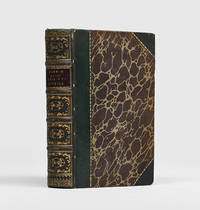
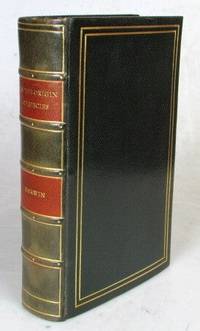
1859184317London: John Murray 1859. Ushering in a new era of thought about the nature of man First edition of "the most influential scientific work of the 19th century" Horblit and "certainly the most important biological book ever written" Freeman. The initial 1250 copies of Darwin's magnum opus prompted an intellectual revolution comparable to that of Newton or Copernicus. While recognizable theories of evolution had been developing since at least the mid-1750s the Origin introduces the critical mechanism of natural selection to explain the direction of the process. When married with Mendelian genetics natural selection became the foundation of modern evolutionary theory: "every modern discussion of man's future the population explosion the struggle for existence the purpose of man and the universe and man's place in nature rests on Darwin" Mayr pp. vii-xxviii. Octavo 187 x 114 mm. Folding diagram lithographed by W. West. Bound with half-title and without publisher's advertisements as often. Near-contemporary green half calf spine and covers decorated in gilt spine with dark red calf label marbled sides endpapers and edges. Housed in custom green half morocco cloth box. Ornithological bookplate of the zoologist Brunsdon Yapp 1909-1990 author of a study of bird illustrations in medieval texts. Infrequent 20th-century pencil annotations to margins. Light wear faint ghosting to front endpapers minor browning and foxing to contents short closed tears to upper margin of O10 and S2 the latter touching text and short split to fold of diagram: a very good copy. Dibner 199; Freeman 373; Garrison-Morton 220; Grolier/Horblit 23b; Norman 593; Printing and the Mind of Man 344b. Ernst Mayr introduction to the Harvard University facsimile edition 1964. hardcover
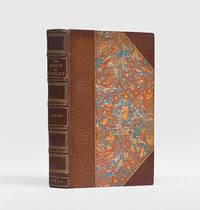
1859372885London: John Murray 1859. First Edition one of only 1250 copies. 1 vols. 8vo. Bound with half-title and without publisher's adverts. Folding diagram lithographed by W. West. Late 19th-century half brown morocco by Zaehnsdorf spine lettered and ruled in gilt raised bands marbled sides and endpapers top edge gilt brown silk bookmarker. Red morocco book label of Valentine Hollingsworth 1883-1942. Front joint repaired. Light rubbing slight darkening to spine a few light spots of foxing to preliminaries but otherwise crisp and clean tiny closed tear at foot of title page folding diagram with short closed tear and neat repair at foot: a very good smartly bound copy. First Edition one of only 1250 copies. 1 vols. 8vo. "The most important single work in science brought man to his true place in nature" Heralds of Science 199. <br /> <br /> Darwin "revolutionized our methods of thinking and our outlook on the natural order of things. The recognition that constant change is the order of the universe had been finally established and a vast step forward in the uniformity of nature had been taken" PMM 344. <br /> <br /> "The publication of the Origin of Species ushered in a new era in our thinking about the nature of man. The intellectual revolution it caused and the impact it had on man's concept of himself and the world were greater than those caused by the works of Copernicus Newton and the great physicists of more recent times. Every modern discussion of man's future the population explosion the struggle for existence the purpose of man and the universe and man's place in nature rests on Darwin" Mayr. Freeman 373; PMM 344; Norman 593; Garrison-Morton 220; Grolier/Horblit 23b; Brent Charles Darwin p. 427 John Murray unknown
18801104188vo. London: John Murray 1880. 8vo x 592 32 ads dated May 1878 pp. Illustrated with 196 in-text woodcuts. Original green blind-stamped cloth backstrip titled in gilt brown coated endpapers hinges cracked a little wear to crown and foot of backstrip text block edges but not pages stained an unsophisticated copy. § First edition first issue inscribed in Charles Darwin’s hand “Elizabeth Darwin From her Fatherâ€. Presentation copies from Darwin in his own hand are exceptionally rare most presentation copies were inscribed “from the author†by the publisher; a copy inscribed to a family member by Darwin himself is extraordinarily so. Elizabeth Darwin known as Bessy was Charles and Emma Darwin’s youngest daughter who lived at home until the death of her mother and died in 1926. Very little is known about her. “Despite her constant presence in the house only very occasionally does her name appear in any of the mountain of family letters†Bowlby Charles Darwin: A New Life 408. After her mother’s death Elizabeth moved to a small house in Cambridge where she lived to be 78. The book is an extension of Darwin’s work on movement in climbing plants to show that the same mechanisms hold true for flowering plants in general. Darwin was assisted by his son Francis who had become an accomplished botanist. The book was well reviewed and immediately sold 1500 copies. Freeman 1325. John Murray hardcover books
18801104181880. London: John Murray 1880. <br /> <br /> 8vo x 592 32 ads dated May 1878 pp. Illustrated with 196 in-text woodcuts. Original green blind-stamped cloth backstrip titled in gilt brown coated endpapers hinges cracked a little wear to crown and foot of backstrip text block edges but not pages stained an unsophisticated copy. <br /> <br /> § § First edition first issue inscribed in Charles Darwin's hand "Elizabeth Darwin From her Father." Presentation copies from Darwin in his own hand are exceptionally rare most presentation copies were inscribed "from the author" by the publisher; a copy inscribed to a family member by Darwin himself is extraordinarily so. <br /> <br /> Elizabeth Darwin known as Bessy was Charles and Emma Darwin's youngest daughter and perhaps the most enigmatic of all their ten children. She is remembered as a quiet soul who lived in the family home until the death of her mother and then in a cottage on her own near her three brothers until her death in 1926. The book which Darwin has inscribed to her was written with the assistance of her brother Francis who had himself become an accomplished botanist. It is an extension of Darwin's earlier work on movement in climbing plants showing that the same mechanisms hold true for flowering plants in general. It was well reviewed and immediately sold 1500 copies.<br /> <br /> Darwin was an exceptionally affectionate father whose anxious feelings for his own children greatly spurred his study of inherited characteristics and of evolution. He and his wife Emma were first cousins a genetic liability that tormented him. This book written in partnership with one of his children and presented to another is a potent testament to the intertwining of scientific genius and fatherhood that so characterized Darwin and catalyzed his momentous career. Books inscribed by Darwin to his children are extremely rare on the market. The last such book at auction - a copy of The Descent of Man and Selection in Relation to Sex inscribed by Darwin to his daughter Henrietta who had edited the book - sold for £90000 at Sotheby's in 2015. unknown
1873141586London: Henry S. King & Co 1873. First edition association copy of famed English philosopher Herbert Spencer's classic work on the evolution of society; presented and inscribed by him to Charles Darwin. Octavo original publisher's cloth with gilt titles to the spine dark green endpapers. Association copy inscribed by the author on the title page "Charles Darwin with the Author's kind regards." English philosopher biologist sociologist and anthropologist Herbert Spencer invented the expression "survival of the fittest" which he coined in his Principles of Biology 1864 after reading Charles Darwin's On the Origin of Species 1859. A description of the mechanism of natural selection in Principles of Biology Spencer drew parallels between his own economic theories and Darwin's biological ones: "This survival of the fittest which I have here sought to express in mechanical terms is that which Mr. Darwin has called 'natural selection' or the preservation of favoured races in the struggle for life." Darwin responded positively to Alfred Russel Wallace's suggestion of using Spencer's new phrase "survival of the fittest" as an alternative to "natural selection" and adopted the phrase in The Variation of Animals and Plants Under Domestication published in 1868. In On the Origin of Species he introduced the phrase in the fifth edition published in 1869 intending it to mean "better designed for an immediate local environment" Gould. Darwin wrote on page 6 of The Variation of Animals and Plants Under Domestication published in 1868 "This preservation during the battle for life of varieties which possess any advantage in structure constitution or instinct I have called Natural Selection; and Mr. Herbert Spencer has well expressed the same idea by the Survival of the Fittest. The term 'natural selection' is in some respects a bad one as it seems to imply conscious choice; but this will be disregarded after a little familiarity." He defended his analogy as similar to language used in chemistry and to astronomers depicting the "attraction of gravity as ruling the movements of the planets" or the way in which "agriculturists speak of man making domestic races by his power of selection." Spencer and Darwin were occasional correspondents and would regularly send each other copies of their latest works. Accompanied by an autograph letter signed by Charles Darwin's great grandson Edward Darwin gifting the book to a relative dated November 27th 1969. In very good condition. Housed in a custom half morocco clamshell box by the Harcourt Bindery. Books from Darwin's library are very rare to the market. Spencer developed an all-embracing conception of evolution as the progressive development of the physical world biological organisms the human mind and human culture and societies. “It is a function that no one has performed since†DSB. During his lifetime he was considered "the single most famous European intellectual" Eriksen 37. "The only other English philosopher to have achieved anything like such widespread popularity was Bertrand Russell and that was in the 20th century" Richards. Spencer's philosophies were heavily influenced by Darwin he cites Darwin several times in this book and references On the Origin of Species as "one of the most influential scientific publications of recent times." Given the primacy which Spencer placed on evolution his sociology might be described as social Darwinism mixed with Lamarckism. However despite its popularity this view of Spencer's sociology is mistaken. While his political and ethical writings had themes consistent with social Darwinism such themes are absent in Spencer's sociological works which focus on how processes of societal growth and differentiation lead to changing degrees of complexity in social organization. The evolutionary progression from simple undifferentiated homogeneity to complex differentiated heterogeneity was exemplified Spencer argued by the development of society. He developed a theory of two types of society the militant and the industrial which corresponded to this evolutionary progression. Militant society structured around relationships of hierarchy and obedience was simple and undifferentiated; industrial society based on voluntary contractually assumed social obligations was complex and differentiated. Society which Spencer conceptualised as a 'social organism' evolved from the simpler state to the more complex according to the universal law of evolution. Moreover industrial society was the direct descendant of the ideal society developed in Social Statics although Spencer now equivocated over whether the evolution of society would result in anarchism as he had first believed or whether it pointed to a continued role for the state albeit one reduced to the minimal functions of the enforcement of contracts and external defense. Henry S. King & Co hardcover
185951915London: John Murray 1859. First edition. 8vo. iii-x 502 28 pp bound without the half title but with all the advertisement leaves barring the final two. Early 20th century green full morocco spine with raised bands twin gilt lettered red labels marbled endpapers bookplate of K.F. Russell to the front pastedown and with a long note in his hand on the flyleaf describing the volume's provenance. Folding table mounted on linen. Slight sunning to the spine an attractive copy. The first printing of one of the most important books in the history of scientific thought. "Darwin not only drew an entirely new picture of the workings of organic nature; he revolutionised our methods of thinking and our outlook on the natural order of things. the theory of evolution became with Darwin an interpretation of nature and eventually a causal theory affecting every department of scientific research" Printing and the Mind of Man 344. Kenneth Fitzpatrick Russell 1911-87 was an eminent Australian academic. He was made Chair of Anatomy and Medical History by the University of Melbourne in 1969 having previously been conferred with a DLitt by them - an exceptional award for a science graduate. In 1963 he published "British Anatomy 1525-1800: A Bibliography" a testament to his erudition and one of the standard works on the subject. Russell's handwritten note to the front of the volume states that he bought it in the bookshop Quaine's of Melbourne in 1935. He found the original covers in a parlous state with the spine and upper cover missing and the rear board torn in half this damage clearly also accounting for the absence of the half title and the final advertisement leaves. Russell notes that he had the volume rebound thus by the binder Green paying slightly more for the restoration work than he had done for the book itself. Freeman 373 and pp. 75-77. With the misprint "speceies" on page 20 and the full whale-bear story to page 184. The first page of the advertisements is dated June 1859 as required. London: John Murray unknown
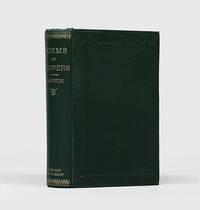
1877164452London: John Murray 1877. Presentation copy inscribed in Darwin's own hand First edition presentation copy inscribed on the title page "With the compliments of the author". The inscription is in Darwin's own hand rather than one of Murray's clerks. Different Forms of Flowers was published in a first edition of 1250 copies on 9 July 1877. There was only a single issue with the publisher's catalogue dated either January or March 1877 here the latter without priority. Darwin explained in his autobiography that "this book consists chiefly of the several papers on heterostyled flowers originally published by the Linnean Society corrected with much new matter added together with observations on some other cases in which the same plant bears two kinds of flowers. As before remarked no little discovery of mine ever gave me so much pleasure as the making out the meaning of heterostyled flowers" Life and Letters I p. 78. Freeman remarks that "had Darwin not chosen such genetically complex examples he might have approached more nearly to an understanding of the laws of particulate inheritance". Regardless it remains a seminal text on plant reproduction adaptation and evolution. It was translated into French and German during Darwin's lifetime followed by four further languages after his death. Octavo. 15 woodcut illustrations and 38 tables within text. Publisher's 32-page catalogue dated March 1877 at rear. Original green cloth spine lettered in gilt decorative bands at ends in gilt covers blocked in blind dark brown coated endpapers Simpson & Renshaw binder's ticket on rear pastedown. Housed in a dark green quarter morocco solander box by the Chelsea Bindery. Spine ends gently bumped cloth bright binding very discreetly restored and recoloured endpapers slightly faded previous ownership signature on dedication page subsequently erased a handful of neat pencil marks annotation to p. 1 translating the title into French marginal crosses and lines to a few other pp. faint semicircular damp mark running through upper margins of first c.140 pages else the contents notably clean publisher's catalogue lightly foxed towards end: a near-fine copy. Freeman 1277; Norman 602. Francis Darwin ed. The Life and Letters of Charles Darwin 1887. hardcover
18643456104/11/1864. <blockquote><p>Darwin's work had profound implications for the relationship between science and religion and here he opposed anyone who would seek to profess religious over scientific faith</p><p> </p><p>Scientists Darwin felt should work in the spirit of seeking ""truth"" with no preconceived notions</p><p> </p><p>The adoption of the Theory of Evolution by scientists is ""the real cream of the enjoyment to me; indeed it is to me worth far more than any medal.""</p><p> </p><p>Significantly he hopes to continue his work in science</p><p> </p><p>One of the most important Darwin letters we have carried</p></blockquote><p><img class=""alignnone wp-image-34774 size-post-window"" src=""https://cdn.raabcollection.com/wp-content/uploads/20251016172859/Darwin-2-1-1600x1200.jpg"" alt="""" width=""1600"" height=""1200"" /></p><p>Charles Darwin's ""On the Origin of Species"" was one of the most important books of all time. When it was published in 1859 there was skepticism within as well as without the scientific community about the central premise that species changed through time by a process Darwin labeled natural selection. The idea that human beings evolved from other previous species struck at the heart of the generally accepted belief that humans were different from other animals and that species were fixed or immutable. Everyone had learned the story of creation from the Bible and Darwin's ideas presented a challenge to those who looked at the question through a literal religious perspective. But Darwin hoped that scientists as well as others would be able to accommodate adopt an essentially new view and accept evolution. Yet at the same time he realized that many who had grown up in the previous scientific school would have a hard time doing so. It seemed that perhaps a new generation of scientists might have to rise before his work was generally accepted.</p><p>The Copley Medal the highest award of the Royal Society is given for “sustained outstanding achievements in any field of scienceâ€. In 1864 Darwin was nominated to receive the medal and was awarded it ""For his important researches in geology zoology and botanical physiologyâ€. Previous winners included scientists like Benjamin Franklin William Herschel Alessandro Volta Humphry Davy and Michael Faraday.</p><p>Hugh Falconer was a paleontologist and botanist who was an admirer of Darwin though not a convert to his theory of evolution. He seconded the nomination of Darwin for the medal and Darwin wrote to thank him for doing so. In his letter Darwin made some points of great importance: 1. That more and more scientists were becoming converts to his theory of evolution; 2. That he hopes to continue his work in science despite advancing age; 3. That scientists should work in the spirit of seeking truth with no preconceived notions and 4. That the support of scientists he respected like Falconer meant more than the medal to him.</p><p>Falconer was outraged by a petition that was circulating within Britain’s learned societies that attempted to limit the bounds of scientific enquiry. The petition claimed that scientific research was being “‘perverted by some…into occasion for casting doubt upon the Truth and Authenticity of the Holy Scriptures†and was specifically aimed against evolutionary theory and investigations into the antiquity of man. Falconer made clear to Darwin that he aimed to ""protest against the profession of religious against scientific faithâ€.</p><p><img class=""alignnone wp-image-34775 size-post-window"" src=""https://cdn.raabcollection.com/wp-content/uploads/20251016172938/Darwin-4-1-1600x680.jpg"" alt="""" width=""1600"" height=""680"" /></p><p><strong>Autograph letter signed</strong> four pages with the addressed envelope Down House headed stationery Kent November 4 1864 to Hugh Falconer making all the important points cited above. <em>“What a good kind friend you are. I know well that this medal must have cost you a great deal of trouble. It is a very great honor to me but I declare that the knowledge that you & a few other friends here so much interested themselves in the subject is the real cream of the enjoyment to me; indeed it is to me worth far more than any medal. So accept my true and cordial thanks. I hope that I may yet have strength to do a little more work in natural science; shaky and old though I be.â€</em></p><p><em>“I have chuckled and triumphed over your postscript about poor M. Brullé and his young pupils. About a week ago I had a nearly similar account from Germany and at the same time I heard of some splendid converts in such men as Rudolf Leuckart Carl Gegenbaur &c. You may say what you like about yourself but I look at a man who treats Natural History in the spirit with which you do exactly as good for what I believe to be the truth as a convert. Farewell my good friend with sincere thanks your true friend Charles Darwin.â€</em></p><p>In mentioning M. Brullé Darwin alludes to an amusing story told by Falconer to him in a previous letter relaying the complaint of the entomologist Gaspard Auguste Brullé that he heard of nothing but Darwin from his students.</p><p>Darwin need not have worried about his future productivity in this 1864 letter. Afterwards he wrote several more books which include “The Variation of Animals and Plants Under Domestication†1868 which explored the principles of heredity and how variations occur in domesticated species; his famous “The Descent of Man†1871 applying the theory of natural selection to human evolution and discussing sexual selection; “The Expression of the Emotions in Man and Animals†1872 examining the evolutionary origins of emotions and facial expression; and “The Formation of Vegetable Mould through the action of worms"" 1881.</p><p>Falconer replied to Darwin’s letter on November 7 and the spirit with which he treated Natural History and the reason for his support for Darwin were evidenced in that reply. Falconer explained that he believed the award of the Copley medal to Darwin was doubly important: “1. As regards due appreciation of yourself. 2d. As a determined protest against the profession of religious against scientific faithâ€.</p><p>Falconer was right to be concerned about the reaction of the religious community and its sympathizers to the theory of evolution. Darwin’s ideas provoked a harsh response from religious leaders and their allies of which this petition was one example. As examples of the criticism of evolution England’s highest-ranking Catholic official Henry Cardinal Manning denounced Darwin’s views as “a brutal philosophy – to wit there is no God and the ape is our Adam.†And Samuel Wilberforce the Anglican Archbishop of Oxford and one of the most highly respected religious leaders in 19th-century England also condemned natural selection in a now-famous speech on what he deemed the theory’s deficiencies.</p><p>This is one of the most important Darwin letters we have carried dealing as it does with support for his theory of evolution his hopes for future work in science and the role of science in seeking truth.</p><p><img class=""alignnone wp-image-25018 size-post-window"" src=""https://cdn.raabcollection.com/wp-content/uploads/20231204144051/Folder-site-11-1600x1327.jpg"" alt="""" width=""1600"" height=""1327"" /></p> unknown
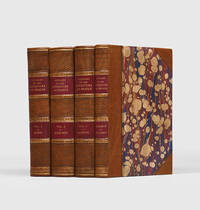
1839125508London: Henry Colburn 1839. First edition of the account of the most famous voyage in the history of biological science and modern thought volume III being the first issue of Darwin's Journal his first published book containing the observations and fieldwork that form the basis for On the Origin of Species. Octavo four volumes including Vol. II of the Appendix bound in three quarter morocco over marbled boards with morocco spine labels lettered in gilt half-titles present 7 engraved folding maps and charts 48 plates and charts and 6 in-text illustrations. From the library of the British Royal Navy's Office of the Admiralty this copy was borrowed by Captain Richard Charles Mayne and used on board the HMS Nassau during his survey expedition to the Straits of Magellan 1866-1869. With an annotated typed note laid in signed by Lieutenant Commander Andrew David of the Admiralty's Hydrographic Department which reads: The voyages of Adventure and Beagle was apparently used by Captain Richard Maybe of H.M.S. Nassau for his surveys of Magellan Strait which commenced in 1866. The corrections given in the Errata et Corrigenda were inserted in 1866. Some of the amendments to positions given in the appendix to volume II agree with those given in the Hydrographic archives from Nassau's observations and they both seem to be in the same handwriting. "ACF David" A.C.F. David Lieutenant Commander Hydrographic Department 28th July 1974 Other marginalia eg Vol II page 594 by G.H. Richards later Hydrographer. David has also added a later annotation to the note: "The pencil notation on page 325 of the Appendix to Vol 2 stating that Morrice Pocket Chronometer 6144 was also on the Nassau confirms my supposition below ACF David 25th August 1989." Upon learning of Mayne's planned for a survey expedition to the Straits of Magellan Darwin requested the Lords of the Admiralty to ask Capt. Mayne to collect several boatloads of fossil bones of extinct species of quadrupeds. Admiral Sir Bartholomew James Sulivan had previously discovered an astonishingly rich accumulation of fossil bones not far from the Straits which were found to have belonged to a more ancient period than the fossils collected by Darwin on HMS Beagle and therefore of great interest to science. In near fine condition. With the British Royal Navy's Office of the Admiralty Library stamp the Hydrographer's Office stamp and ACF David's bookplate to each volume. In very good condition. An exceptional example of this landmark work with noted provenance. "The five years of the voyage were the most important event in Darwin's intellectual life and in the history of biological science. Darwin sailed with no formal scientific training. He returned a hard-headed man of science knowing the importance of evidence almost convinced that species had not always been as they were since the creation but had undergone change. The experiences of his five years in the Beagle how he dealt with them and what they led to built up into a process of epoch-making importance in the history of thought" DSB. In his own words: 'The voyage of the Beagle has been by far the most important event in my life and has determined my whole career' Charles Darwin Life and Letters I p.61. Darwin's Journal "his first published book is undoubtedly the most often read and stands second only to On the Origin of Species as the most often printed" Freeman 31. It is "one of the most interesting records of natural history exploration ever written and is one of the most important for it was on this voyage that Darwin prepared for his lifework ultimately leading to The Origin of Species" Hill I:104-05. Volume I contains Captain King's account of the first expedition which surveyed the coasts of Patagonia and Tierra del Fuego; Volume II with its appendix volume is Captain Fitzroy's account of the second voyage of the Beagle. Complete with 44 plates four inserted charts and maps and eight folding maps. Folding charts and maps originally issued loose have been bound into their respective volumes at the rear. Bound with half titles. Bound without publisher's advertisements at rear of Appendix volume lacking the map of the Keeling Islands frontispiece and 4 plates to vol. I trimmed and mounted. Freeman 10. Norman 584. Hill I:104-05. Sabin 37826. Henry Colburn hardcover books
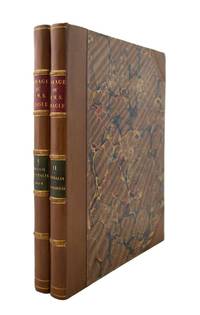
184614205London: Smith Elder and Co 1846. I: First edition. Includes a description of six species of corals from the Palaeozoic formation of Van Diemen’s Land by W. Lonsdale. “Darwin’s published work during this period secured his position as one of Britain’s foremost naturalists. His study of the volcanic islands visited during the Beagle <br /> voyage was based on a wide range of rock and mineral specimens including his own and considerable research into contemporary theories of volcanic activity mountain formation and the elevation of extensive tracts of land relative to the sea†Correspondence Vol. 3 p. 331.<br /> II: First edition. When Darwin sailed on the Beagle he had with him the first volume of Lyell’s Principles of geology which advanced a gradualist theory of geological evolution through elevation subsidence and erosion over an immense period of time contrary to the dominant catastrophist theory of sudden upheaval. Darwin was able to interpret the geology of South America according to Lyell’s principles and his book offered the first adequate geological investigation of the continent. His “demonstration of the origin of metamorphic rocks by deformation and of the distinction between cleavage and sedimentary bedding was a major contribution to geology†DSB. He also worked out an accurate model for fossil formation from which he demonstrated the erratic and incomplete nature of the fossil record.<br /> Freeman 272; 273. Smith, Elder and Co unknown
1839001512London: Henry Colburn 1839. First edition early issue 3 vols in 4 8vo ownership signature to half-title vol. I title vol. II half-title vol. III; 9 folding engraved maps by J. Gardner and J. & C. Walker; 47 etched plates after P. King A. Earle C. Martens R. Fitzroy and others original blue blind stamped cloth gilt glazed yellow endpapers vols I-III neatly recased preserving majority of original spines inner hinges of vols I-III neatly strengthened. This set with the following early issue points: the half-title to vol. III does not contain the initials F.R.S. after Darwin's name thus denoting an early printing of the preliminaries prior to Darwin becoming a Fellow of the Royal Society on 24th January 1839 all spines imprinted Colburn / London rather than London / Colburn each volume bears the author's name lacking from later issues this set without advertisements as sometimes and as noted by Freeman light foxing and stains to frontispiece and plates vol. II overall a good clean set with important Australian provenance. Darwin's first published and his most widely read book: the account of the most important 19th-century voyage. On this voyage Darwin prepare for his life's work ultimately leading to The Origin of the Species.From the library of Charles Joseph LaTrobe Superintendent of the Port Phillip District of New South Wales from 1839 to 1851 and from 1st July 1851 until his departure three years later the first Lieutenant-Governor of the Colony of Victoria; with his distinctive signature to all three volumes. An evangelical Christian his father was a leader of the Moravian Church LaTrobe spent fifteen years in the Australian colonies leaving in 1854 a disillusioned and dispirited man. His time in office coincided with a period of tremendous expansion with major infrastructure projects roads and sanitation being a priority however much of central Melbourne's green landscape can be put down to LaTrobe's foresight in preserving this land as open space. On his arrival in Port Phillip LaTrobe's first speech put him at odds with the settlers of the District. These pioneers were looking to better their lot expecting grants of land which would lead to the dispossession of the aboriginal peoples yet LaTrobe spoke of different priorities: 'It is not by individual aggrandisement by the possession of numerous flocks or herds or by costly acres that the people shall secure for the country enduring prosperity and happiness but by the acquisition and maintenance of sound religious and moral institutions without which no country can become truly great'. This clash of ideas was highlighted by Darwin in his Journal of The Voyages of HMS Beagle published a few months before LaTrobe made his speech. In it Darwin observed that in 'the wide extent of the Americas Polynesia the Cape of Good Hope and Australia' the native populations were being suppressed. 'The varieties of man' he noted 'seem to act on each other in the same way as different species of animals the stronger always extirpating the weaker.' This theory of the survival of the fittest became the justification for many colonists in the removal of indigenous peoples from their native land. Darwin was given the third volume The Voyages of HMS Beagle writing 'I am to have the third volume in which I intend giving a kind of journal of a naturalist not following however always the order of time but rather the order of position' The first volume contains King's account of the expedition in the Adventure made between 1826 and 1830 which surveyed the coasts of Patagonia and Tierra del Fuego; and the second and its appendix volume describes the narrative of the Beagle's second voyage under Capt. Fitzroy made between 1831 and 1836 to South America the Galapagos Islands Tahiti New Zealand Australia and other islands and countries. 'The five years of the voyage were the most important event in Darwin's intellectual life and in the history of biological science. Darwin sailed with no formal scientific training. He returned a hard-headed man of science knowing the importance of evidence almost convinced that species had not always been as they were since the creation but had undergone change . The experiences of his five years . and what they led to built up into a process of epoch-making importance in the history of thought' DSB. First Edition. Hardback. Good. 4to. Henry Colburn Hardcover
1869315466Down Beckenham Kent 1869. 3 pp. Bifolium of Down Bromley Kent stationery with "Bromley" crossed out and corrected to Beckenham. 1 vols. 8vo. Fine. 3 pp. Bifolium of Down Bromley Kent stationery with "Bromley" crossed out and corrected to Beckenham. 1 vols. 8vo. Unpublished.<br /> <br /> Charles Darwin 1809-1882 writes to Charles Layton London agent for Appleton about bringing out a revised and expanded second American edition of On the Origin of Species. The letter is a reply to Layton's of the day before in which he'd inquired after stereotyped plates of the English edition. In part:<br /> <br /> "The last or 5th Edit. of the Origin was printed off some months ago & it is impossible to supply stereotypes. I hope that you will inform Mr. Appleton of what I have said of the increased size of this last & 5th Edit. As 2000 copies of this Edit were printed there will not be a new Edit. for a considerable time . If Mr. Appleton will reprint this 5th Edition . I will pledge myself to endevour to persuade Mr. Murray to supply stereotype plates of my new book on the Descent of Man; but as I never before heard of such such a scheme I have no idea whether he will comply. At any rate I will please myself on the above conditions & on the terms suggested in your letter to send over the sheets as printed & stereotype casts of the woodcuts. But please remember my new book will not got to press for many months."<br /> <br /> Appleton had published the first American edition of Origin in 1860 from Murray's second English edition. In keeping with the terms of the present letter Appleton published the second American edition based on the 5th English edition in 1870 followed by the first American edition of The Descent of Man in 1871.<br /> See Darwin Correspondence Project DCP-LETT-7003 for Layton to Darwin 22 November 1869. unknown
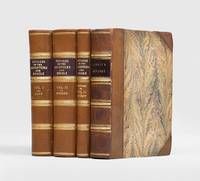
1839169069London: Henry Colburn 1839. From the Wedgwood family library First edition association copy with the inscription "Wedgwood Maer" faintly pencilled on the half-title of Darwin's volume itself the first issue of his first published book. The prominent Wedgwood family were relatives; he frequently visited their Staffordshire home Maer Hall and consulted them about the publication of his account of the Beagle's voyage. The Darwin and Wedgwood families became intertwined in the 18th century linked by friendships business dealings and a number of first- and second-cousin marriages. Charles's grandfathers were the renowned pottery entrepreneur Josiah Wedgwood and the physician Erasmus Darwin and Charles himself married his cousin Emma Wedgwood in 1839. He corresponded with several members of the Wedgwood family about the publication of his volume the Journal and Remarks now popularly known as The Voyage of the Beagle and invited them to read the manuscript notebook of his travels upon which the work was based. Fanny and Hensleigh Wedgwood were specifically asked to provide feedback which the latter gave in a letter dated 20 December 1836 describing it as a "very interesting journal" Darwin Correspondence Project. Darwin also discussed the possibility of his account being accompanied by that of Fitzroy with his sister Caroline Wedgwood. At the time of publication Maer Hall was owned by Josiah Wedgwood II and the rector of Maer parish church was John Allen Wedgwood. We have been unable to attribute the inscription to any one individual member of the family. Maer Hall was sold in 1843 suggesting that this copy was incorporated into the Wedgwood library before this date. These four volumes on the voyages of HMS Adventure and Beagle including Darwin's Journal and Remarks are "famous as the genesis of his theory of evolutionary biology" Hill. Darwin's volume is an outstanding account of natural history exploration describing the fieldwork that ultimately led to the publication of On the Origin of Species 1859. As Freeman notes of Darwin's books this "is undoubtedly the most often read and stands second only to On the Origin of Species as the most often printed" p. 31. Darwin himself would state that "the voyage of the 'Beagle' has been by far the most important event in my life and has determined my whole career. I have always felt that I owe to the voyage the first real training or education of my mind; I was led to attend closely to several branches of natural history and thus my powers of observation were improved" Life and Letters I p. 61. The Journal and Remarks was printed before the end of January 1839 the month Darwin was elected to the Royal Society and so his name appears without the letters "F.R.S." on the second title. Volume I contains Phillip Parker King's account of the expedition on the Adventure made between 1826 and 1830 surveying the coasts of Patagonia and Tierra del Fuego. In Volume II and its appendix bound separately as issued Captain FitzRoy describes the Beagle's second voyage between 1831 and 1836 to South America the Galapagos Islands Tahiti New Zealand and Australia and other countries. Volume III is Darwin's account of his time aboard the Beagle. The popularity of the latter exceeded its companion volumes leading to Colburn bringing out a separate edition in the same year. 3 vols in 4 vols I-III and appendix to vol. II octavo 225 x 142 mm. With 47 engraved plates after P. King A. Earle C. Martens R. Fitzroy and others by T. Landseer S. Bull T. Prior and others 9 folding engraved maps by J. Gardner and J. and C. Walker 8 bound in and 1 loose in pocket at rear pastedown of vol. II numerous diagrams and tables within text. Rebound to style in brown half calf twin red morocco spine labels compartments and raised bands elaborately tooled in blind and gilt respectively marbled sides and edges brown endpapers. Vol. I bound without half-title. Binding presenting smartly; contents generally fresh and clean occasional neat pencil marginal annotations and small ink "90" to half-titles upper margin of vol. I sig. 2D8 creased and nicked at edge; plates and maps foxed closed tears to latter repaired with no loss and in most cases discreetly faint damp stain along top edge of first map in vol. I second map of same sometime reattached with cloth tape. Overall a handsome set in very good condition. Freeman 10; Hill I pp. 104-5; Norman 584; Sabin 37826. Francis Darwin ed. The Life and Letters of Charles Darwin 1887; Darwin Correspondence Project letter 7 December 1836 to Caroline Darwin ref. DCP-LETT-325; 20 December 1836 from Hensleigh Wedgwood ref. DCP-LETT-332. hardcover
1870266381870. <blockquote><p>Our first Darwin signed photograph in all these years</p></blockquote><p>Charles Darwin English naturalist whose scientific theory of evolution by natural selection became the foundation of modern biology and evolutionary studies. Darwin's explanation for the great unfolding of life through time - evolution by natural selection - transformed our understanding of the living world and focused attention on the cumulative inherited change in a population of organisms through time leading to the appearance of new forms: the process by which new species or populations of living things develop from preexisting forms through successive generations. Darwin revolutionized the understanding of the development of living things as Einstein revolutionized our understanding of the physical universe.</p><p>An attractive<strong> Carte de Visite signed</strong> <em>""Ch. Darwinâ€</em> circa late 1870s very good condition though with a few small adhesive tape marks. The photograph was taken by Elliott & Fry 56 Baker Street London and has their front and back stamps. For a century after its founding in 1863 the firm’s core business was taking and publishing photographs of the Victorian public and social artistic scientific and political luminaries. Among the notables known to have sat for a photograph by Elliott & Fry were Prime Minister William Gladstone Alfred Lord Tennyson W.S. Gilbert Rudyard Kipling Oliver Wendell Holmes Sr. Florence Nightingale and Charles Darwin.</p><p>In all our years in the field we have seen just a handful of Darwin signed photographs and have never ourselves had one. This is indeed a rarity. But the provenance is just as fascinating as finding a signed Darwin photograph with provenance is perhaps unique.</p><p>William Bateson was a British biologist who founded and named the science of genetics and whose experiments provided evidence basic to the modern understanding of heredity. He was a dedicated evolutionist and his early works on the mechanisms of biological evolution were strongly influenced by Charles Darwin though he believed that Darwin’s theory of evolution required a firmer base in heredity. Bateson also became the foremost champion of Gregor Mendel’s work on genetics. Darwin died in 1882 when Bateson was at college and though Bateson may have written Darwin such letter is unknown. Bateson and his wife did however correspond with Darwin’s family in later years as “Darwin Online†indicates.</p><p>This CDV comes with an <strong>autograph letter signed</strong> from Darwin’s granddaughter Margaret Keynes dated January 23 1929 addressed to Sir George Buckston Browne proposing an alternative date for her and her husband Dr. Geoffrey Keynes to come for lunch expressing gladness that Browne wanted <em>""the Bateson letter and the other things""</em> and acknowledging that he attended the same school as Dr. Keynes. Browne had bought Darwin's old home so lunch there would have been a homecoming of sorts for Margaret. Finding the CDV and letter together we would conjecture that this CDV was the property - one of <em>“the other thingsâ€</em> - of Margaret that she mentioned in the letter that she was glad Browne wanted and had descended in the family to her along with the Bateson letter. Thus this CDV was apparently property of the Darwin family the most important provenance imaginable.</p><p><img class=""alignnone wp-image-25018 size-post-window"" src=""https://cdn.raabcollection.com/wp-content/uploads/20231204144051/Folder-site-11-1600x1327.jpg"" alt="""" width=""1600"" height=""1327"" /></p> unknown
1839317725London: Henry Colburn 1839. First edition. xxviii 4 597; xiv 2 694 1; xiv 615; viii 352 pp. including half titles in three primary volumes plus forty-six plates including two frontispieces one plan and nine folding maps and charts. 4 vols. 8vo. Bound in period half dark green morocco and marbled boards spines gilt t.e.g. Repaired tear on half-title of vol. I maps backed with japanese tissue. Bound without publisher's ads at end of appendix volume which are often lacking. Fine. First edition. xxviii 4 597; xiv 2 694 1; xiv 615; viii 352 pp. including half titles in three primary volumes plus forty-six plates including two frontispieces one plan and nine folding maps and charts. 4 vols. 8vo. Darwin's First Book. The account of the Beagle's two voyages edited by Robert Fitzroy who served as commander of both voyages. Volume three of this work represents the first edition of Darwin's account of the voyage which provided the basis for his work on the origin of species found here in its second issue entitled JOURNAL OF RESEARCHES INTO THE GEOLOGY AND NATURAL HISTORY OF THE VARIOUS COUNTRIES VISITED BY H.M.S. BEAGLE. "The third volume contains Darwin's account of the voyage now famous as the genesis of his theory of evolutionary biology. The demand for Darwin's JOURNAL immediately exceeded that for the companion volumes of the NARRATIVE. Colburn therefore brought out a separate edition of it in the same year" - Hill. Freeman notes that Darwin's "first published book is undoubtedly the most often read and stands second only to ON THE ORIGIN OF SPECIES as the most often printed. It is an important travel book in its own right and its relation to the background of his evolutionary ideas has often been stressed." The first volume contains Captain King's account of the first coastal surveys of Patagonia and Terra del Fuego produced on the first expedition between 1826 and 1830. The other volumes comprise the account of the second voyage of the Beagle. Between 1831 and 1836 the ship visited Brazil Argentina Terra del Fuego Chile Peru the Galapagos Islands Tahiti New Zealand and Australia. The appendix to the second volume bound here as the fourth volume of this set includes a meteorological journal official instructions correspondence and notes. Four of the six plates in the appendix volume consist of sixteen separate illustrations of various cloud formations. A fine attractive set of a landmark of scientific exploration one of the most important Pacific voyages and Darwin's first substantial book publication. Hill 607; Freeman 10 pp. 31-39; Borba de Moraes p. 247; Sabin 37826 Henry Colburn unknown books
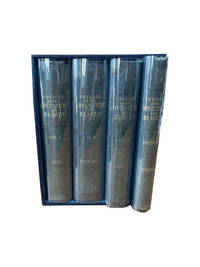
18391226633 vols. London: Henry Colburn 1839. 3 vols. in 4 vol. 2 having a separate appendix 8vo xxviii iv 1-559 556-597 pp. with 17 engraved plates and 3 folding maps; xiv 2 1-694 2 pp. with 25 engraved plates and 2 folding maps; viii 352 pp. with 6 engraved plates and 2 folding maps; iii-xiv 629 1 609-615 pp. with 2 folding maps. In total 9 folding maps all now bound in and 48 plates and charts. A very good copy with minimal wear and a few repaired tears to the folding maps rebound sympathetically and well in half speckled calf and marbled boards backstrips elaborately gilt with morocco labels and raised bands in two slipcases. § First edition first issue of the account of the most famous voyage in the history biological science. Volume III is the first issue of Darwin's Journal his first published book containing the observations and fieldwork that would form the basis for On The Origin of Species. "The five years of the voyage were the most important event in Darwin's intellectual life and in the history of biological science. Darwin sailed with no formal scientific training. He returned a hard-headed man of science knowing the importance of evidence almost convinced that species had not always been as they were since the creation but had undergone change. DSB III 566. Darwin's Journal "is one of the most interesting records of natural history exploration ever written and is one of the most important for it was on this voyage that Darwin prepared for his lifework ultimately leading to On The Origin of Species" Hill 104-5. Vol.1 contains Captain King's account of the first voyage which surveyed the coasts of Patagonia and Tierra del Fuego; Vol 2. with the appendix contains Captain Fitzroy's account of the second voyage of the Beagle which visited Brazil Argentina Tierra del Fuego Chile Peru the Galapagos Islands Tahiti New Zealand Australia among other islands and countries. A beautiful copy of these incomparably important books. Freeman 10. Hill 104-105. Norman 584. Henry Colburn hardcover books
1839189657London: Henry Colburn 1839. An outstanding account of natural history exploration First edition of the Voyage of the Beagle with the third volume Darwin's Journal of Researches being the first separate edition of his account. The popularity of Darwin's contribution to the series meant that his volume was reissued three months later as a standalone publication the version present in this set. The first issue of Darwin's Journal appeared in May 1839 as Volume III of the Narrative under the title Journal and Remarks Freeman 10. The second issue was published in August printed from the same sheets but with variant preliminaries Freeman 11. It "is undoubtedly the most often read and stands second only to On the Origin of Species as the most often printed" of Darwin's works Freeman p. 31. Volume I of the Narrative contains King's account of the expedition on the Adventure made between 1826 and 1830 surveying the coasts of Patagonia and Tierra del Fuego. In Volume II its appendix bound separately as issued FitzRoy describes the narrative of the Beagle's second voyage between 1831 and 1836 to South America the Galapagos Islands Tahiti New Zealand and Australia. 3 vols in 4 vols I-III and appendix to vol. II octavo 224 x 145 mm; 219 x 137 mm. With 47 engraved plates 9 folding engraved maps 3 bound in and 6 linen-backed and loose in front pockets diagrams and tables within text. Recent and late 19th-century vol. III half calf spines lettered and ruled in gilt spine labels marbled sides and edges buff endpapers. Contemporary ownership signature of one I. S. G. Smith on title page of vol. III partially obscured during binding process; 1950s unattributed inscription on first blank of vol. I; ownership signatures of one Thomas Leighton dated 1979 on vol. I II and appendix blanks; 20th-century bookplates of one Richard Campbell perhaps of the Campbells of Kildalloig and later Carmarthenshire. Wear to vol. III extremities spine of same a little darkened foxing to maps plates and occasionally to contents tear to half-title of vol. I closed tears to map folds repairs to folding map facing p. 463 vol. I and both maps in vol. III first of which creased and standing a little proud: overall in very good condition. Freeman 10 Narrative vols I & II & 11 Journal. Francis Darwin ed. The Life and Letters of Charles Darwin 1887. unknown
18661259011866. Signed. DARWIN Charles. Autograph letter signed. Down Beckenham Kent: Dec 17 1866. One leaf of black-edged mourning stationery measuring 4-1/2 by 7 inches penned on recto for one page; floated matted and framed with an early photographic card; entire piece measures 17 by 14 inches. $29500.Fine unpublished 1866 autograph letter written by Charles Darwin answering the questions of an anonymous correspondent concerning editions of his landmark work On the Origin of Species boldly signed by him with his full name ""Charles Darwin"" he often used ""C."" or ""Ch."" instead of his full given name. Beautifully framed with an early photographic card.The letter reads in full: ""Down Beckenham Kent Dec. 17th. Dear Sir Four editions of the Origin have appeared; that published last month is considerably added to & can be procured through any bookseller. I am glad to hear that you are interested in the subject. Dear sir yours faithfully Charles Darwin."" In November Darwin had copies of the substantially revised and augmented fourth edition of the Origin sent to Huxley and Wallace among others; their letters acknowledging receipt and praising the new edition are dated November 11 and November 19 respectively. The mourning stationery reflects the death of Darwin's sister Susan Elizabeth Darwin in October; another sister Emily Catherine Langton had died in January that year. See ""Darwin in letters 1866; Survival of the Fittest"" Darwin Correspondence Project online. Darwin Correspondence Project 5310F summary only. Very faint fold marks. Darwin's full signature bold and fine. Letters in which Darwin discusses his landmark work are particularly scarce and desirable. unknown
183869522London: Smith Elder and Co 1838. OWEN Richard. WATERHOUSE George R. The Zoology of the Voyage of the H.M.S. Beagle. Under the Command of Captain Fitzroy R.N. During the Years 1832 to 1836. Part I II. Mammalia. London: Smith Elder and Co. 1838.<br> <br> Full Description:<br> <br> DARWIN Charles. OWEN Richard. WATERHOUSE George R. The Zoology of the Voyage of the H.M.S. Beagle. Under the Command of Captain Fitzroy R.N. During the Years 1832 to 1836. Part I II. Mammalia. London: Smith Elder and Co. 1838-1840.<br> <br> First editions of Part I and Part II of Mammalia in two quarto volumes 12 1/8 x 9 1/2 inches; 307 x 241 mm.<br> <br> Part I. Owen Richard. Fossil Mammalia. 1838-1840. 2 iv iv 111 1 colophon pp. Complete with thirty-two lithographic plates by G. Scharf one of which is folding and two which are double paged. With the preface to the whole work and a geological introduction by Charles Darwin. Bound without the half-title but with the additional fly-title.<br> <br> Part II. Waterhouse George Robert. Mammailia. 1839. 4 xii 97 3 blank pp. Complete with thirty-two hand-colored lithographic plates and three numbered engraved plates. With the errata slip bound in before B1. Bound without the half-title but with the additional fly-title. This volume with a geographical introduction and notes by Darwin.<br> <br> Two volumes uniformly bound in half tan calf over contemporary marble boards. Spines each with red and green morocco spine labels lettered in gilt. Contemporary endpapers. All edges speckled red. Some repairs to inner hinges. Text is very clean. The final three plates in volume II with some foxing otherwise all plates are very clean. Overall a very good copy of these two volumes.<br> <br> These first two volumes out of the complete work in 5 volumes are the only two volumes to be published with introductions by Charles Darwin. In the first volume he writes a Geological Introduction and in the second volume he writes a Geographical Introduction. "Darwin contributed a geological introduction to Part I the Fossil Mammalia pp. 3-12 and a geographical introduction to Part II the Mammalia pp. i-iv." Freeman p 26.<br> <br> In 1832 Captain Robert Fitzroy of the Royal British Navy undertook a five-year circumnavigation of the earth. Fitzroy who was only twenty-seven at the time asked a young Charles Darwin to be the naturalist for the voyage. The five-year journey included passing the coastlines of South America and particularly the Galapagos Islands near Ecuador. Darwin collected numerous specimens and data from this now famous area and these became the basis for his theory of natural selection which was a key component in his masterful theory of evolution.<br> <br> "The lavish scientific record of Darwin's collecting endeavours during the five-year voyage of the Beagle originally issued in 19 numbers. The 166 plates 82 finely hand-colouredof the complete works were due to the tireless energy and flair which the relatively untrained ship's scientist put first into the collection of specimens and then into ensuring that the zoological specialists duly reported on them after his return. The cost of the plates was covered by a treasury grant of one thousand pounds but to complete the work for Smith and Elder who were publishers of large illustrated books and government publications Darwin had to persevere as steadily with his pen as with his gun and geological hammer turning himself into a considerable authority during the course of five years spent editing the work of others." Christies<br> <br> "He superintended the Zoology's text wrote introductions for the different parts and added notes from his various Beagle records about animal behaviour and habitats wherever appropriate while also supervising the printers proofreading the sheets arranging artists for the plates chivying the experts and keeping them all moving forward within a tight self-imposed budget" Janet Browne Charles Darwin: Voyaging 2003 p. 370.<br> <br> Freeman Darwin 9.1 & 9.2. Nissen IVB 384. Nissen ZBI 1391. Sabin 18649.<br> <br> HBS 69522.<br> <br> $25000. Smith, Elder and Co unknown