Huxley, Thomas HAntiquariat.de

1 159 résultats
1896953185Braunschweig: Friedr. Vieweg und Sohn, 1896. XIV; 144 S. Halblederband.
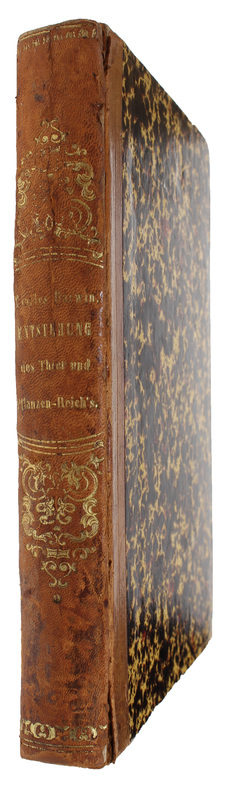
186050927Stuttgart, E. Schweizerbart'sche Verlagshandlung und Druckerei, 1860. 8vo. Bound in contemporary half calf with gilt lettering and ornamentation to spine. Small stamp and previous owner signature to title page. Leather on lower part of spine with a tear and part detached. Hinges weak but book-block firmly attached. VIII (including half, 520, (6) pp + 1 plate.
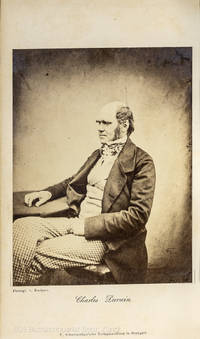
18627863CB1862. Zweite verbesserte und sehr vermehrte Auflage. Stuttgart Schweizerbart 18621863. 8°. VIII 551 S. Mit einem fotografischen Portrait und einer Tafel. Halblederband der Zeit. Freeman 673. Zweite deutsche Ausgabe. Nur dieser Ausgabe hinzugefügt die Porträt-Fotografie von Carl Johann Sigmund Bucher. Das Papier durchgehend gebräunt und stockfleckig. Der Einband berieben. unknown
1899436968Stuttgart : E. Schweizerbart'sche Verlagshandlung 1899. First Edition. Hardcover. Very good copy in the original gilt-blocked cloth. Spine bands and panel edges somewhat dust-toned and rubbed as with age. Remains quite well-preserved overall. Physical description; vi 578 p. : ill. ; 23 cm. Notes; Index : p. 566-578. Subjects; Evolution. Natural selection. Stuttgart : E. Schweizerbart'sche Verlagshandlung hardcover
1884900Stuttgart Germany: E. Schweizerbart'sche Verlagshandlung E. Koch 1884. 6" x 9" pp. vi 578; text in the German language. Hardcover bound in green cloth boards with gold stamping on spine. Boards are scuffed at corners with a few minor tears without loss. Minor break at front free end paper but attached. Text is lightly toned at edges but otherwise sound. Good.<br /> <br /> A German language 7th edition of Charles Darwin's famous "On the Origin of Species" work outlining the modern premises of evolutionary science. E. Schweizerbart'sche Verlagshandlung (E. Koch) unknown
186050927Stuttgart E. Schweizerbart'sche Verlagshandlung und Druckerei 1860. 8vo. Bound in contemporary half calf with gilt lettering and ornamentation to spine. Small stamp and previous owner signature to title page. Leather on lower part of spine with a tear and part detached. Hinges weak but book-block firmly attached. VIII including half 520 6 pp 1 plate. <br/><br/><em>The very scarce first edition of the highly important first German translation which appeared just months after the original.This translation came to play a tremendous role in the spreading of Darwinism in Germany and Northern Europe in general. It was through this translation that Darwinian thought reached most of the German scientists and thinkers of the period and it was this translation that challenged German scholars to think in new ways about morphology systematics paleontology and other biological disciplines. It was from this translation that Ernst Haeckel Darwin's most famous nineteenth-century proponent and popularizer in Germany got his Darwinism and was able to further spread the new ideas in his own country. The German translation of Darwin's "The Origin of Species" appeared in 1860 just months after the original thanks to Heinrich Georg Bronn a distinguished German paleontologist whose work in some ways paralleled Darwin's. Bronn's version of the book with his own notes and commentary appended did much to determine how Darwin's theory was understood and applied by German biologists for the translation process involved more than the mere substitution of German words for English."Its Origin of Species greatest impact on German biological practice lay in the introduction of historical modes of explanation for the observable phenomena of living nature. The historical approach to nature was rejected not only by the opponents of evolution but also by the idealist evolutionist. Whether they favored a teleological or a reductionist biology the idealists could not see the point of a theory that emphasized the irregularities and exceptions in the organic world. In the timeless real of idealist thinking unchanging laws worked out an inevitable destiny. But Darwin taught his followers to look at living beings one by one. Thus prompted they recognized as if for the first time the surprising fact of anomaly and the wisdom of an open-ended theory." Glick The Comparative Reception of Darwinism. "Darwin was not happy about the first German translation. It was done from the second English edition by H.G. Bronn who had at Darwin's suggestion added an appendix of the difficulties which occurred to him; but he had also excised bits of which he did not approve. This edition also contains the historical sketch in its shorter and earlier form." Freeman.Freeman No 672 - Freeman does not mention the lithographed plate. </em> hardcover
187714434London and New York: Macmillan and Co. 1877. FIRST EDITION. Half-calf and marbled boards; an excellent copy with the bookplate of Charles Edward Fewster of Hull. First printing of Darwin’s original paper discussing sexual selection in his 1871 work Descent of man stating that the case of the “brightly-coloured hinder ends and adjoining parts of certain monkeys†was the most interesting and perplexing to him. He quotes a work by Johan von Fischer partly published in Der zool. Garten. April 1876 dealing with the expression of monkeys under various emotions “which is well worthy of study by any one interested in the subject.†An interesting article on an interesting subject.<br /> <br /> Also included in this volume are two reviews of Darwin books as follows: 1 Review of the second edition of Geological observations on the volcanic islands and parts of South America London Smith Elder and Co. 1876 by John W. Judd. pp. 289-290; and 2 Review of The effects of cross- and self-fertilisation in the vegetable kingdom London Murray 1876 by W. T. Thiselton Dyer pp. 329-332.<br /> <br /> In addition there are two testimonials to Darwin. The first p. 356 is a testimonial on Darwin’s sixty-ninth birthday a mistake in that he was sixty-eight in February 1877 from a group of 154 men of science of Germany presenting to him an album of their photographs. Darwin also received an album with the photographs of 217 distinguished professors and lovers of science from Holland. The second testimonial pp. 410-412 comes from Prof. P. Harting of Utrecht University also on the occasion of Darwin’s birthday who has sent a letter along with the photograph album referred to above from the Directors of the Netherlands Zoological Society and includes Darwin’s reply. <br /> <br /> The volume includes articles by many of the most important scientists of the day.<br /> Freeman 1773; Freeman 1776. Macmillan and Co. unknown
183869522London: Smith Elder and Co 1838. OWEN Richard. WATERHOUSE George R. The Zoology of the Voyage of the H.M.S. Beagle. Under the Command of Captain Fitzroy R.N. During the Years 1832 to 1836. Part I II. Mammalia. London: Smith Elder and Co. 1838.<br> <br> Full Description:<br> <br> DARWIN Charles. OWEN Richard. WATERHOUSE George R. The Zoology of the Voyage of the H.M.S. Beagle. Under the Command of Captain Fitzroy R.N. During the Years 1832 to 1836. Part I II. Mammalia. London: Smith Elder and Co. 1838-1840.<br> <br> First editions of Part I and Part II of Mammalia in two quarto volumes 12 1/8 x 9 1/2 inches; 307 x 241 mm.<br> <br> Part I. Owen Richard. Fossil Mammalia. 1838-1840. 2 iv iv 111 1 colophon pp. Complete with thirty-two lithographic plates by G. Scharf one of which is folding and two which are double paged. With the preface to the whole work and a geological introduction by Charles Darwin. Bound without the half-title but with the additional fly-title.<br> <br> Part II. Waterhouse George Robert. Mammailia. 1839. 4 xii 97 3 blank pp. Complete with thirty-two hand-colored lithographic plates and three numbered engraved plates. With the errata slip bound in before B1. Bound without the half-title but with the additional fly-title. This volume with a geographical introduction and notes by Darwin.<br> <br> Two volumes uniformly bound in half tan calf over contemporary marble boards. Spines each with red and green morocco spine labels lettered in gilt. Contemporary endpapers. All edges speckled red. Some repairs to inner hinges. Text is very clean. The final three plates in volume II with some foxing otherwise all plates are very clean. Overall a very good copy of these two volumes.<br> <br> These first two volumes out of the complete work in 5 volumes are the only two volumes to be published with introductions by Charles Darwin. In the first volume he writes a Geological Introduction and in the second volume he writes a Geographical Introduction. "Darwin contributed a geological introduction to Part I the Fossil Mammalia pp. 3-12 and a geographical introduction to Part II the Mammalia pp. i-iv." Freeman p 26.<br> <br> In 1832 Captain Robert Fitzroy of the Royal British Navy undertook a five-year circumnavigation of the earth. Fitzroy who was only twenty-seven at the time asked a young Charles Darwin to be the naturalist for the voyage. The five-year journey included passing the coastlines of South America and particularly the Galapagos Islands near Ecuador. Darwin collected numerous specimens and data from this now famous area and these became the basis for his theory of natural selection which was a key component in his masterful theory of evolution.<br> <br> "The lavish scientific record of Darwin's collecting endeavours during the five-year voyage of the Beagle originally issued in 19 numbers. The 166 plates 82 finely hand-colouredof the complete works were due to the tireless energy and flair which the relatively untrained ship's scientist put first into the collection of specimens and then into ensuring that the zoological specialists duly reported on them after his return. The cost of the plates was covered by a treasury grant of one thousand pounds but to complete the work for Smith and Elder who were publishers of large illustrated books and government publications Darwin had to persevere as steadily with his pen as with his gun and geological hammer turning himself into a considerable authority during the course of five years spent editing the work of others." Christies<br> <br> "He superintended the Zoology's text wrote introductions for the different parts and added notes from his various Beagle records about animal behaviour and habitats wherever appropriate while also supervising the printers proofreading the sheets arranging artists for the plates chivying the experts and keeping them all moving forward within a tight self-imposed budget" Janet Browne Charles Darwin: Voyaging 2003 p. 370.<br> <br> Freeman Darwin 9.1 & 9.2. Nissen IVB 384. Nissen ZBI 1391. Sabin 18649.<br> <br> HBS 69522.<br> <br> $25000. Smith, Elder and Co unknown
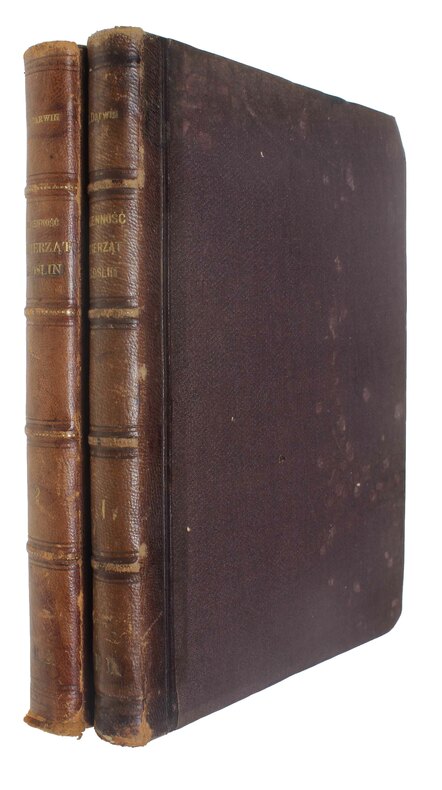
188853153Warszawa, Wydawnictwo Przegladu Tygodnio, 1888-1889. Large8vo. In two uniform contemporary half calf bindings with four raised bands and gilt lettering to spine. Top right corner (app. 3 x 5 cm) of both title pages cut off" volume 1 not affecting text, volume 2 missing the n in 'Darwin'. Light wear to extremities, otherwise a fine set. (2), X, 11-357, III" (2), 379, IV, VIII, V pp.
188853153Warszawa Wydawnictwo Przegladu Tygodnio 1888-1889. Large8vo. In two uniform contemporary half calf bindings with four raised bands and gilt lettering to spine. Top right corner app. 3 x 5 cm of both title pages cut off; volume 1 not affecting text volume 2 missing the n in 'Darwin'. Light wear to extremities otherwise a fine set. 2 X 11-357 III; 2 379 IV VIII V pp. <br/><br/><em>Rare first Polish translation of Darwin's extensive work 'The Variation of Animals and Plants under Domestication'. It is the longest work and being so detailed was never a very successful one selling only about five thousand copies in his life time and eight before the end of the century" R.B. Freeman. Freeman 922. </em> hardcover
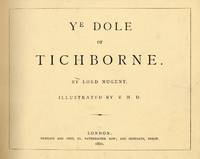
18712200159<p><i>Oblong 8vo pp. 4 with nine anastatic plates by 'V H D'arwin the first folding and with poetic verses facing two leaves of introduction in the original publisher's bind stamped green cloth upper board lettered in gilt inner joints lightly cracked else a very good sound copy.</i></p><p>Published to capitalise on the infamous Tichborne case then beginning to run its course through the courts.</p><p>The poem recounts the history of the Tichborne dole of bread a charity festival active until the 1790's and held at the village of Tichborne in Hampshire during the Feast of the Annunciation. The tale concerns a curse by twelfth century Lady Mabella Tichborne on her descendants. This predicted that should the dole stop the family would produce only daughters and die out which indeed did happen with the male issue cut down by early death and shipwreck all of which paved the way to the interminable Tichborne claimant cause.</p><p>The illustrations are very clearly in the style of Richard Doyle's <i>The Manners and Customs of Ye Englyshe</i> which first appeared in <i>Punch</i> in 1849 they capture many of the more absurd parts of the tale in a mock medieval manuscript technique replete with a border of a dragon.</p><p>The illustrator Violetta Harriot Darwin 1826-1880 was a half cousin to the famous Charles both sharing Erasmus Darwin as a grandfather. Although Charles descended through Erasmus' first wife Polly and Violetta through his second wife Elizabeth the cousins despite being near contemporaries appear to have had very little contact. A number of Violetta's anastactic topographical views were published in the 1860's and her illustrated version of Southey's <i>Bishop Hatto: a legend of the Mouse-Tower on the Rhine</i> in 1861 but these are both in a quite different style.</p><p>The author of the poems Lord Nugent unlike many of the Grenville clan supported the cause of anti-slavery parliamentary reform religious liberty penal reform and the amelioration of the condition of the rural poor. He also inherited an aptitude for literary and scholarly pursuits as well as their tendency to corpulence and financial ineptitude. He was not a great poet however some of his smaller works found a willing space in the 'Annuals'. Under the less antiquated title 'The Dole of Tichborne' the poem first appeared first in the 1830 volume of <i>The Gem</i>.</p><p>OCLC records only a second edition at the National library of Wales only.</p> Bemrose and Sons
1871627197London: Bemrose and Sons 1871. 9 pp. 16.5 x 22 cm. Green cloth covered boards with decorative stamping in blind and gilt titling to cover; illustrated with nine plates and one folded plate as frontispiece. Rubbing to spine ends with a 14 x 5 mm chip to tail of spine edge of front cover. Starting to front joint at both head and tail but it appears that the tail split has been repaired with glue. Light bumping and light wear to corners of boards. Splitting along both front and rear hinges. Dampstaining along tail of front and rear endpapers but not to text or plates. Some foxing to initial and final pages. All plates intact with two of them still possessing their tissue guards. Overall a fairly decent copy of a scarce telling of the story of the Dole of Tichborne which has been illustrated by the half-cousin of Charles Darwin. . Hard Cover. Good. Bemrose and Sons Hardcover
187292501872. Aus d. Engl. Einzig vom Verfasser autorisirte deutsche Ausgabe. - Leipzig 1872 Kl.8° 80 pp. orig. Broschur. in Halbleinenband. d. Zt.; St. verso Tit. unknown
1880771Berlin, Gebr. Bornträger, 1880. Zweite, verbesserte und vermehrte Aufl. ; XIV, 639 S. : Mit 392 Holzschnitten im Text und 11 Tafeln. Gr.-8°, rotbraune Org.-Lwd. mit gold. Rücken- u. Deckeltitel, reicher schwarz-gold. Rücken- und schwarzer Deckelornamentik
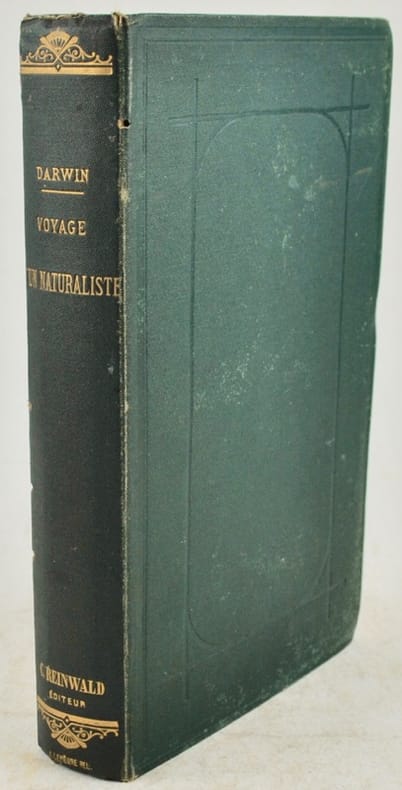
187542914Paris, C. Reinwald, 1875. In-8 de 2 ff.n.ch. VIII-552 pp. et 20 pp. de catalogue, percaline verte de l'éditeur.
187593115Paris, C. Reinwald, 1875, in-8, [4]-VIII-552 pp, 22-[1] pp. de cat. éd, Percaline verte de l'éditeur, Quelques figures dans le texte. Édition originale de la traduction française du Journal of Researches into the Geology and Natural History of the Various Countries paru en 1839. Il s'agit du premier ouvrage de Darwin et le plus lu, après l'Origine des espèces. Il forme une relation de voyage importante en soi et par son rapport avec les idées de l'auteur sur l'évolution. La seconde édition anglaise, parue en 1845, a servi de base pour les diverses traductions. La version française, par Edmond Barbier (le troisième traducteur de l'Origine des espèces) est tardive : elle paraît plus de 30 ans après l'originale anglaise. Darwin voyage à bord du Beagle de 1831 à 1836, ce qui lui permet de faire un grand nombre d'observations géologiques. Il récolte des organismes vivants ou fossiles, et conserve une riche collection de spécimens, dont il envoie certains spécimens à Cambridge, accompagnés de lettres sur ses découvertes. Selon ses propres mots, ce voyage "a été de loin l'événement le plus important de [sa] vie et a déterminé toute [sa] carrière" (Charles Darwin, Autobiographie). Non rogné. Étiquette ex-libris du Comte de Saint-Périer : René de Saint-Périer (1877-1950), archéologue et préhistorien français, qui fit les fouilles de la grotte de Lespugue Fente dans toute la longueur du plat supérieur. Rousseurs claires. O'Reilly, Tahiti, 916. Couverture rigide
187594478Paris, C. Reinwald, 1875, in-8, [4]-VIII-552 pp, Percaline verte de l'éditeur [Lenègre], Quelques figures dans le texte. Édition originale de la traduction française du Journal of Researches into the Geology and Natural History of the Various Countries paru en 1839. Il s'agit du premier ouvrage de Darwin et le plus lu, après l'Origine des espèces. Il forme une relation de voyage importante en soi et par son rapport avec les idées de l'auteur sur l'évolution. La seconde édition anglaise, parue en 1845, a servi de base pour les diverses traductions. Cette version française, par Edmond Barbier (le troisième traducteur de l'Origine des espèces) est tardive : elle paraît plus de 30 ans après l'originale anglaise. Darwin voyage à bord du Beagle de 1831 à 1836, emportant avec lui les Principes de géologie de Charles Lyell, contradicteur de Lamarck. Le navire, commandé par le très conservateur Robert FitzRoy, quitte l'Angleterre en décembre 1831, vogue vers le Cap-Vert, puis vers le Brésil et l'Amérique du Sud; il reste plusieurs mois à Valparaiso; en septembre - octobre 1835, il est aux Galapagos, puis il reprend la navigation vers Tahiti, la Nouvelle-Zélande et l'Australie, les îles Cocos et le Cap de Bonne Espérance; il fait la route de retour en passant de nouveau par Bahia et le Cap-Vert; le voyage s'achève le 2 octobre 1836. Il "a été de loin l'événement le plus important de ma vie et a déterminé toute ma carrière" (Charles Darwin, Autobiographie). Le futur auteur de l'Origine des espèces y fait un grand nombre d'observations géologiques, récolte des organismes vivants ou fossiles et conserve une riche collection de spécimens, dont il envoie certains à Cambridge, accompagnés de lettres sur ses découvertes. Il s'insurge contre le douloureux spectacle de l'esclavage, qu'il observe au Brésil, et demeurera en raison de ce souvenir réticent à admettre l'homme comme une espèce vivante "domestiquée". Ex-libris gravé aux armes des ducs de Rivoli sur le contreplat, avec la devise "Victor et fidelis". Rousseurs, dos usé. O'Reilly, Tahiti, 916. Couverture rigide
1883101186Paris, C. Reinwald, 1883, in-8, [4]-VIII-552 pp, 20 pp. de cat. éd, Percaline verte de l'éditeur, Quelques figures dans le texte. Nouvelle édition de la traduction française du Journal of Researches into the Geology and Natural History of the Various Countries paru en 1839. La seconde édition anglaise, parue en 1845, a servi de base pour les diverses traductions. La version française, par Edmond Barbier (le troisième traducteur de l'Origine des espèces) est tardive : elle paraît en 1875, soit plus de 30 ans après l'originale anglaise. Un retirage est publié en 1881. Il s'agit du premier ouvrage de Darwin et le plus lu, après l'Origine des espèces. Il forme une relation de voyage importante en soi et par son rapport avec les idées de l'auteur sur l'évolution. Darwin voyage à bord du Beagle de 1831 à 1836, ce qui lui permet de faire un grand nombre d'observations géologiques. Il récolte des organismes vivants ou fossiles, et conserve une riche collection de spécimens, dont il envoie certains spécimens à Cambridge, accompagnés de lettres sur ses découvertes. Selon ses propres mots, ce voyage "a été de loin l'événement le plus important de [sa] vie et a déterminé toute [sa] carrière" (Charles Darwin, Autobiographie). In fine : Catalogue des livres du fonds de C. Reinwald pour octobre 1883. Rousseurs. Légers frottements, coins un peu usés. Freeman Bibliographical Database, F183 [en ligne : Darwin on line]. O'Reilly, Tahiti, 917. Couverture rigide
187253225Torino, Tipografico-Editrice Torinese, (1872). Large8vo. In publisher's original full green cloth. Embossed title with gilt lettering to spine and front board. Corners of binding bumped and lower part of back hindge with a small tear. An overall very fine and clean copy. (2), 464 pp.
187253225Torino Tipografico-Editrice Torinese 1872. Large8vo. In publisher's original full green cloth. Embossed title with gilt lettering to spine and front board. Corners of binding bumped and lower part of back hindge with a small tear. An overall very fine and clean copy. 2 464 pp. <br/><br/><em>First Italian translation of Darwin's Journal of researches now known as Voyage of the Beagle being his first published book. As Darwin later recalled in his autobiography 'The voyage of the Beagle has been by far the most important event in my life and has determined my whole career'. "On its first appearance in its own right also in 1839 it was called Journal of researches into the geology and natural history etc. The second edition of 1845 transposes 'geology' and 'natural history' to read Journal of researches into the natural history and geology etc. and the spine title is Naturalist's voyage. The final definitive text of 1860 has the same wording on the title page but the spine readsNaturalist's voyage round the world and the fourteenth thousand of 1879 places A naturalist's voyage on the title page. The voyage of the Beagle first appears as a title in the Harmsworth Library edition of 1905. It is a bad title: she was only a floating home for Darwin on which in spite of good companionship he was cramped and miserably sea-sick; whilst the book is almost entirely about his expeditions on land." FreemanThe first edition appeared in German in 1844 at the instigation of Baron von Humboldt and the second in Danish French German Italian Russian and Swedish in Darwin's lifetimeFreeman 211 </em> hardcover
18811504737John Murray 1881. 2nd Edition. Hardcover. Very Good. Printing part of the Four thousand as stated on the title page. Same year as small first printing. Very good in original green cloth. Some light foxing on first few pages but otherwise very clean. John Murray hardcover books
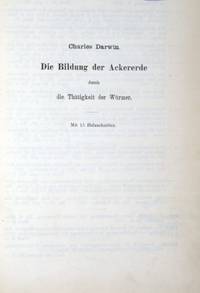
1882feb02686<p>1882. First German Edition of Vegetable Mould and Worms by Charles Darwin.<br /><br />Die Bildung der Ackererde durch die Thätigkeit der Würmer</p><p>Used book For more details and availability please contact me</p> E. Schweizerbartsche Verlagshandlung hardcover
1882feb02685<p>1882. First French Edition of Vegetable Mould and Worms by Charles Darwin<br /><br />Role des vers de terre dans la formation de la terre végétale</p><p>Used book For more details and availability please contact me</p> C. Reinwald hardcover
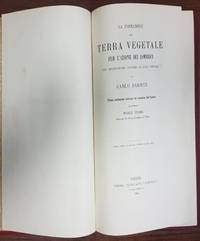
1882feb111961<p>1882. First French Edition of Vegetable Mould and Worms by Charles Darwin<br /><br />La formazione della terra vegetale per l'azione dei lombrici con osservazioni intorno ai loro costumi<br /><br />Used. For more details please contact me</p> Torino hardcover
18811504737John Murray 1881. 2nd Edition. Hardcover. Very Good. Printing part of the Four thousand as stated on the title page. Same year as small first printing. Very good in original green cloth. Some light foxing on first few pages but otherwise very clean. John Murray hardcover