1 301 résultats
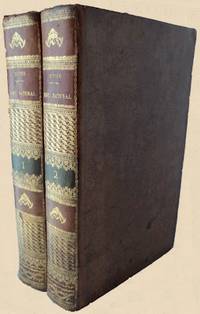
66962Paris Garnier Frères no date but 1854. In two volumes. 4to 26.2 x 17.5 cm. 1358 pp. 684; 674; 30 17; 13 finely hand-coloured steel-engravings. Contemporary uniform half morocco over marbled boards. Spines with five raised bands gilt title. Marbled endpapers speckled edges. = The works of Buffon Cuvier and De Lacépède went through many editions of varying quality. This edition is exceptional: it has excellent newly engraved and hand-coloured images and is in this respect superior to 18th century editions. Published in four parts with 50 plates in total these are the third and fourth final volumes with thirty plates. Together they contain all the fish descriptions and illustrations. The 16 pp. introduction is not included because it was part of the second volume. A few light spots otherwise a very good clean set. This edition neither in Dean nor in Nissen. hardcover
1804815London: Alexander Tilloch 1804. 1st Edition. BOUND FIRST EDITION OF A LETTER ON THE ATOMIC THEORY IN CHEMISTRY FROM JOHN DALTON to Alexander Tilloch founder of the journal in which this paper is published. Also included are papers of import by Gay-Lussac Biot and Cuvier.<br /> <br /> John Dalton 1766-1844 was an English chemist meteorologist and physicist best known for his pioneering work in the development of modern atomic theory the atomic theory in chemistry.<br /> <br /> "Dalton applied the Laws of Conservation of Mass and Definite Composition to explain his Atomic Theory. He developed the chemical theory in 1803 and told Thomas Thomson University of Edinburgh about it in 1804" Greenberg A Chemical History 172. <br /> <br /> This paper is Dalton's response to a conclusion the chemist and professor Thomas Thomson leveled regarding Dalton's Atomic Theory; specifically: in the 2nd edition of his influential A System of Chemistry Thomson wrote "that air is a chemical compound"; he then offered four reasons for his conclusion. <br /> Dalton believed that he had already well-proven "the absurdity of the notion of atmospherical air being a chemical compound of azotic and oxygens gases" Dalton On the Supposed 19 1804 p. 79. The object of the Dalton paper offered here then is to show the "insufficiency" of Thomson's four reasons; to do so Dalton debunks each of Thomson's four ‘reasons' one by one.<br /> <br /> ALSO INCLUDED: An exceedingly rare first edition in English of Jean-Baptiste Biot's paper "Account of an Aerostatic Voyage" describing his landmark balloon ascent with Louis-Joseph Gay-Lussac. The scientific readings that Biot and Gay-Lussac took during their ascent established that the Earth's magnetic field extends into the atmosphere. "The ascent was notable in that it was undertaken entirely for scientific purposes. The primary purpose was to find whether the magnetic intensity of the earth decreased at great altitudes as had been suggested by Horace de Saussure's experiments in the Alps. From their experiments in which they timed the oscillations of a magnetized needle at various altitudes Biot and Gay-Lussac concluded that up to 4000 meters there was not change" DSB II p. 134-135. <br /> <br /> ALSO INCLUDED: "Osteological Description of the one-horned Rhinoceros" is the first English edition of the first part of an important paper by the celebrated zoologist and naturalist Georges Cuvier on the one-horned rhinoceros one-horned Indian rhinoceros; Rhinoceros unicornis. It has been said that Georges Cuvier possessed one of the finest minds in history. Almost single-handedly he founded vertebrate paleontology as a scientific discipline and created the comparative method of organismal biology an incredibly powerful tool. It was Cuvier who firmly established the fact of the extinction of past life forms. CONDITION & DETAILS: London: Alexander Tilloch. Complete volume. 8vo. 8.25 x 5.25 inches. 4 400 pages. Illustration: Nine copper-engraved plates with light to moderate age toning and foxing. Tightly and very solidly bound in contemporary quarter calf over marbled boards. Gilt-lettered and ruled at the spine. The leather on spine is a bit scuffed and the spine tips are rubbed. Binding is tight and sturdy and overall in very good condition. Interior: Title page is moderately foxed. Light to moderate foxing from preliminaries through page 20; moderate foxing on the final few plates. The remainder of interior including all papers of import is very clean. Very good condition. Alexander Tilloch hardcover
1020716029.Ghardcover. Good. Access codes and supplements are not guaranteed with used items. May be an ex-library book. hardcover
1022832816.Gpaperback. Good. Access codes and supplements are not guaranteed with used items. May be an ex-library book. paperback
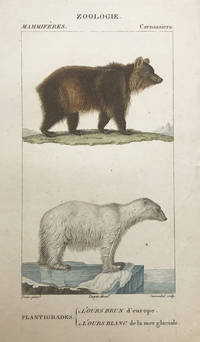
1630Flo472<p>Very good print of bears from the <em>Dictionary of Natural Sciences</em></p><p>Polar bear and brown bear</p><p>Stipple copperplate engraving with superb colour in very good condition</p><p>Brown bear Ursus arctos arctos and polar bear Ursus maritimus vulnerable.</p><p>Illustration by Jean-Gabriel Prêtre under the direction of Pierre Jean François Turpin engraved by Carnonkel</p><p>Jean-Gabriel Prêtre 1768-1849 was a Swiss-French natural history painter who illustrated a large number of books for Cuvier Louis Pierre Vieillot René Primevère Lesson Comte de Lacépède Richard Achille and many other French zoologists.</p><p>Pierre Jean François Turpin 1775-1840 was a French botanist and illustrator. He is considered one of the greatest floral and botanical illustrators during the Napoleonic Era and after.</p> F. G. Levrault hardcover
38526Paris ca. 1815. Single sheet 21.2 x 14.5 cm of thick paper. An oval engraved portrait. Engraved surface ca 15 x 10 cm. = Portrait by the famous French engraver and cartographer Ambroise Tardieu 1788-1841. "Today he is best remembered for the over 800 engraved portraits produced during his career many of which render famous scientists from that period" Curtis Shuh's bibliography of mineralogy. This portrait shows Cuvier 1769-1832 the famous French "polygraphe" founder of vertebrate palaeontology member of the Académie Française and Secretary to the Academy of Sciences. He also established the Mollusca as a class and therefore he is the founder of malacology. On this portrait Cuvier can be seen wearing a Napoleonic Legion d'honneur medal. Provenance: library stamp of the Dr. F. A. Leesenberg Kupferstich- und Portrait-Sammlung on verso. Some light foxing otherwise a very good copy with broad margins. unknown
184042750London: George A. Doo 1840. George A. Doo unknown
180547764Paris: De L'Imprimerie Impériale 1805. First complete French edition. Hardcover. vg- to vg. Quartos. Vol.1: xcvii 528pp 31pp. Vol.2: 460pp 84pp. Black leather over dark blue marbled paper boards. Gilt lettering and ruling on the spines. The first full French translation of compiled research from the Asiatic Society of Bengal originally published in English as the periodical journal "Asiatick Researches" from 1788- 1839. <br /> <br /> The text throughout contains a vast array of information in various realms of scientific historical philosophical religious and/or cultural topics from different authors. Volume 1 contains a total of 33 plates of copperplate engravings including 2 fold-out while volume 2 contains 11 plates plus 2 folding tables one one which a table of Persian grammatical influence on North India printed on blue-toned Arches papers measuring 22 1/4 x 28". Some of these plates contain illustrations while others contain geometric figures mathematical calculations astrological charts and samples of texts in various Asian scripts including Sanskrit Arabic and Chinese. In addition to the numbered plates there are many other un-numbered examples in-text as well as statistical tables some full page. The text throughout is accompanied by copious scholarly footnotes. Of special note is a sections of beautifully rendered plates containing images of various Hindu deities. Also includes a large fold out steel-plate engraved Hindu Zodiac with 27 images. The final section of volume one contains corrections and additions followed by tables of meteorological data also included in vol.2. <br /> <br /> This French edition notably has been revised and supplemented with various additional notes from a number of distinguished French scholars and scientists of the era including zoologist Georges Cuvier 1769 – 1832 mathematician and astronomer Jean Baptiste Joseph Delambre 1749 – 1822 naturalist Jean-Baptiste Lamarck 1744 -1829 and entomologist Guillaume-Antoine Olivier 1756-1814. <br /> <br /> Text in French.<br /> <br /> Bindings with some light rubbing and/or bumping to extremities. Light scratches to the covers. Interiors with minor sporadic foxing and/or water stains to the margins of a few pages throughout although in general the pages are surprisingly clean and vibrant. Book blocks quite tight. Bindings in very good- interiors in very good condition overall. About the society:<br /> The "The Asiatic Society of Bengal" now simply known as the Asiatic Society was founded in Calcutta in 1784 by British scholar philologist and civil civil Sir William Jones 1746-1794 in the early years of the British Raj. Its purpose as set forth was the furthering of Oriental research of all kinds as well as the collection of manuscripts and other relevant materials. It began publishing the work and research of its members all distinguished scholars in its periodical journal "Asiatick Researches". A museum set up to house and display its holdings as well as act as a hub or research was established in 1814. At first only Europeans could become members but starting in 1829 Indian were allowed to join as well. De L'Imprimerie Impériale hardcover
0266150527.Gpaperback. Good. Access codes and supplements are not guaranteed with used items. May be an ex-library book. paperback
0260072613.Ghardcover. Good. Access codes and supplements are not guaranteed with used items. May be an ex-library book. hardcover
1020146486.Ghardcover. Good. Access codes and supplements are not guaranteed with used items. May be an ex-library book. hardcover
1006JC059<p>POR Mr. CUVIER. TRADUZIDO EM PORTUGUEZ E OFFERECIDO A S. A. R. O PRINCIPE R. N. S. POR ANTONIO D'ALMEIDA CAVALLEIRO DA ORDEM DE CHRISTO CIRURGIÃO DA REAL CAMARA LENTE D'OPERAÇOENS NO HOSPITAL REAL DE S. JOZE EM LISBOA E MEMBRO EFFECTIVO DO REAL COLLEGIO DOS CIRURGIOENS DE LONDRES. LONDRES: IMPRESSO POR H. BRYER BRIDGE STREET BLACKFRIARS. Anno 1815.</p>_x000d_<p>Obra em 2 volumes. In 8.º de 21x12 cm. Com xix 458 e 424 xxix págs. Encadernações da época inteiras de pele com finos ferros a ouro nas lombadas.</p>_x000d_<p>Profusamente ilustrado com 14 litografias. O 2º volume apresenta um carimbo oleográfico de posse na folha de rosto. As folhas de rosto de ambos os volumes com leves vestígios de acidulação.</p>_x000d_<p>Ilustrações. No 1º volume: 7 estampas litografadas de J. Walker com aspectos anatómicos que permitem a classificação dos mamíferos e aves. 1 tabela desdobrável com a classificação geral das classes dos animais 1 tabela desdobrável com a classificação dos mamíferos 1 tabela desdobrável com a classificação das aves 1 tabela desdobrável com a classificação dos répteis 1 tabela desdobrável com a classificação dos peixes. No 2º volume: 7 estampas litografadas de J. Walker com aspectos anatómicos que permitem a classificação de outros animais tais como insectos e inclusivamente dos corais. 1 tabela desdobrável com a classificação dos moluscos 1 tabela desdobrável coma classificação dos insectos 1 tabela com a classificação dos crustáceos 1 tabela desdobrável com a classificação dos zoófitos incluindo os corais. No final da obra apresentam-se 3 índices das classes ordens e géneros respectivamente em língua portuguesa em nomes latinos e em língua francesa.</p>_x000d_<p>A importância desta obra reside exactamente nestes índices e em toda a nomenclatura portuguesa introduzida na obra que foi da inteira responsabilidade de Félix de Avelar Brotero. Deste modo a obra possui dois prefácios: o prefácio do tradutor António d´Almeida e o prefácio do nomenclador português Avelar Brotero que por ordem superior foi encarregado de juntar os nomes portugueses aos nomes franceses e latinos tarefa segundo o mesmo muito difícil devido ao estado da ciência em Portugal e ao período das Invasões Napoleónicas de que resultava não existirem nem obras portuguesas nem zoólogos em Portugal para esta tarefa. A ciência portuguesa tinha-se baseado no profundo conhecimento prático das espécies trazidas das colónias e na sua acumulação em colecções sendo arrumadas o melhor possível dentro das classificações lineanas. Nesta obra Brotero afirma que reviu corrigiu e anotou esta obra de Cuvier procurando não desfigurar a versão portuguesa com galicismos e efectuando uma investigação aos vocabulários portugueses. Esta obra de Zoologia publicada em 1797-98 em França foi a mais reputada na sua época tendo portanto a sua tradução para português resultado do interesse de António d´Almeida durante o período que residiu em Londres e do patrocínio régio através do embaixador português em Inglaterra - o Conde do Funchal que requereu os serviços de Félix Avelar Brotero.</p>_x000d_<p>Inocêncio I 83 e II 262 ANTONIO DE ALMEIDA Comendador da Ordem de Cristo Cirurgião da Real Câmara Lente de operações no Hospital Real de S. José Membro do Real Colégio dos Cirurgiões de Londres etc. - Ignoro por agora o que diz respeito à sua naturalidade e data do nascimento constando-me apenas que era da província da Beira filho do Doutor José Diogo e de sua mulher D. Ana de Almeida. Morreu no Campo Grande próximo de Lisboa a 30 de Julho de 1822. Quadro Elementar da Historia dos Animauis por Mr. Cuvier traduzido em portuguez. Londres por H. Bryer 1815. 8.º gr. 2 volumes com estampas. - Esta tradução foi empreendida por conselho e a instâncias do Conde do Funchal embaixador em Londres onde Almeida também se achava naquele tempo. A nomenclatura portuguesa é toda do Doutor Brotero que dela se encarregou por ordem superior como ele próprio adverte em uma prefação colocada no princípio do tomo I.</p>_x000d_<p>BROTERO: Afora estes trabalhos é sua a Nomenclatura portuguesa que fez para o Quadro elementar da Hist. natural dos Animaes de Cuvier traduzido por A. de Almeida.</p>_x000d_<p>EN 2 volumes. In octavo. 21x12 cm. xix-458 and 424-xxix pp.</p>_x000d_<p>Contemporary full leather binding with fine gold tooling on the spines.</p>_x000d_<p>Profusely illustrated with 14 lithographs. The 2nd volume has an oleographic ownership stamp on the title page. The title pages of both volumes with light traces of acidulation.</p>_x000d_<p>Illustrations. In the 1st volume: 7 lithographed prints by J. Walker with anatomical aspects allowing the classification of mammals and birds. 1 fold-out table with the general classification of the classes of animals 1 fold-out table with the classification of mammals 1 fold-out table with the classification of birds 1 fold-out table with the classification of reptiles 1 fold-out table with the classification of fishes. In the 2nd volume: 7 lithographed prints by J. Walker with anatomical aspects that allow the classification of other animals such as insects and even corals. 1 fold-out table with the classification of molluscs 1 fold-out table with the classification of insects 1 table with the classification of crustaceans 1 fold-out table with the classification of zoophytes including corals. At the end of the book there are three indexes of classes orders and types in Portuguese Latin names and French respectively.</p>_x000d_<p>The importance of this work lies exactly in these indexes and in all the Portuguese nomenclature introduced in the work which was entirely the responsibility of Félix de Avelar Brotero. Thus the work has two prefaces: the preface by the translator António d"Almeida and the preface by the Portuguese nomenclator Avelar Brotero who 'by superior order was charged with joining the Portuguese names to the French and Latin names' a task according to him very difficult due to the state of science in Portugal and the period of the Napoleonic Invasions which resulted in there being neither Portuguese works nor zoologists in Portugal for this task. Portuguese science had been based on a deep practical knowledge of the species brought from the colonies and their accumulation in collections being 'arranged' as best as possible within the Linean classifications. In this work Brotero states that he revised corrected and annotated Cuvier"s work trying not to disfigure the Portuguese version with Gallicisms and carrying out research into Portuguese vocabularies. This work of Zoology published in 1797-98 in France was the most reputed in its time and its translation into Portuguese resulted from the interest of António d"Almeida during the period he lived in London and from the royal patronage through the Portuguese ambassador in England - the Count of Funchal - who requested the services of Félix Avelar Brotero.</p>_x000d_<p>Inocencio I 83 and II 262 'ANTONIO DE ALMEIDA Commander of the Order of Christ Surgeon of the Royal Chamber Professor of Operations at the Royal Hospital of St. Joseph Member of the Royal College of Surgeons of London etc. - I don"t know for the moment what concerns his birthplace and date of birth but I only know that he was from the province of Beira son of Doctor José Diogo and his wife D. Ana de Almeida. He died in Campo Grande near Lisbon on July 30th 1822. Quadro Elementar da Historia dos Animais by Mr. Cuvier translated into Portuguese. London by H. Bryer 1815. 8th gr. 2 volumes with prints. - This translation was undertaken on the advice and at the instigation of the Count of Funchal ambassador in London where Almeida was also at the time. The Portuguese nomenclature is all by Dr. Brotero who was in charge of it by superior order as he himself warns in a foreword placed at the beginning of volume I.</p>_x000d_<p>BROTERO: Besides these works is his Portuguese Nomenclature which he made for the elementary Table of the Natural History of Animals by Cuvier translated by A. de Almeida.</p>_x000d_<p>Referências/References:</p>_x000d_<p>Inocencio I 83 and II 262. Cordier BI. 1817. Pritzel 5637. Stafleu-C. 5038. Sousa da Câmara 1738. 'Estimada e pouco vulgar Esteemed and unusual.'</p> M-16-D-31 hardcover
1828156631828. A Paris chez VerdiÂre et Ladrange 1828. Un vol. au format in-8 217 x 139 mm de 1 f. bl. vi - 364 pp. et 1 f. bl. brochÂŽ sous couverture d'attente de l'ÂŽpoque de plein papier taupe. ''On espÂre que le respect pour les savants ˆ qui nous devons tant de dÂŽcouvertes et le dÂŽsir de rendre justice ˆ leurs travaux et d'en faire sentir l'utilitÂŽ aussi bien que les difficultÂŽs s'y montreront ici partout'' Table : Chimie - MÂŽtÂŽorologie - Hydrologie - MinÂŽralogie - GÂŽologie - Physiologie - Anatomie - Botanique - Zoologie - MÂŽdecine - Agriculture - Technologie. Louandre et Bourquelot III La LittÂŽrature franÂaise contemporaine p. 121. LÂŽgÂres marques d'usage affectant dos et plats. Manque en tÂte du dos. InÂŽglaes rousseurs dans le texte. Du reste bonne condition. b42961 unknown
1810241880Paris: Imperiale 1810. paperback. very good. xvi 299pp. 4to wrappers. Paris: L'Imprimerie Imperiale 1810. Large Paper edition. Very good.<br/> <br/> Report on zoology chemistry meteorology and medicine by the noted zoologist and scientist.<br/> <br/> Imperiale unknown
181079759Paris: Imperiale 1810. First Edition. hardcover. very good. xvi 394 1 pages. 8vo 1/2 brown calf rubbed. Paris: L'Imprimerie Imperiale 1810. Very good.<br/> <br/> Report on zoology chemistry meteorology and medicine by the noted zoologist and scientist.<br/> <br/> Imperiale unknown
1810015392Paris: L'imprimerie Imperiale 1810. Book. Very Good. Rebound. First Edition. Book has been rebound in a light grey cloth. Interior is ocassionally foxed. L'imprimerie Imperiale Hardcover
182821573Paris: Verdière & Lagrange 1828. Fine. Verdière & Lagrange Paris 1828 13.50 x 21.50 cm broché New edition. Some light foxing joints slightly cracked at head and foot. Copy presented in its original wrappers spine sunned with label bearing the author's name title and publication date of the work. Verdière & Lagrange unknown
1024326608.Ghardcover. Good. Access codes and supplements are not guaranteed with used items. May be an ex-library book. hardcover
1024331741.Gpaperback. Good. Access codes and supplements are not guaranteed with used items. May be an ex-library book. paperback
1175689335.Gpaperback. Good. Access codes and supplements are not guaranteed with used items. May be an ex-library book. paperback
005076Hardcover. Good. 4to 4th. enlarged edition Paris 1836. pps.94 with 145 of 161 engraved plates. Plates in good clean condition those missing supplied in facsimile bound in order. . Contemporary binding lacks back strip First atlas volume of two only <br/> <br/> hardcover
182557403Paris: Dufour et E. D'Ocagne 1825. Third edition. Quarto 32cm. Seven volumes complete in modern half black morocco green cloth over boards titled in gilt on spines and fronts; modern marbled endpapers; vol. I: vi194340pp; vol. II part I: ivIV2371229-232pp; vol. II part 2: iv239-648pp; vol. III: iv412pp; vol. IV: iv514pp; vol. V part 1: iv4051pp; vol. V part 2: iv 5471pp; 277 engraved plates including frontispiece one plate with hand color and 2 maps 1 letterpress folding table. Straight and sound with occasional scattered browning and soil a few page corners neatly restored one plate margin trimmed close to image area but largely clean and bright: Very Good. Third edition of the work in which Cuvier demonstrated the reality of extinction through detailed examination of fossils; a cornerstone work in paleontology biology and geology. Earlier editions appeared in 1812 and 1821-24. When Cuvier began his research in the late eighteenth century it was generally believed that no species had ever gone extinct. "Taking for his field the little-known fossil quadrupeds and applying to them the principles of comparative anatomy Cuvier astonished the world by reconstructing prehistoric forms of animal life whose existence had never been suspected" Glass Temkin & Straus Forerunners of Darwin 253. He established extinction as a fact demonstrated that the age of the earth was greater than six thousand years and did much to establish the fields of comparative anatomy and paleontology. <br /> <br /> However Cuvier forcefully opposed pre-Darwinian theories of evolution. In the introduction to Ossemens Fossiles later published separately as Discours sur les révolutions de la surface du globe 1826 Cuvier argued in favor of catastrophism-the theory that violent catastrophes like the Biblical flood had caused extinction events and shaped geological features. This theory left room for contemporaries to infer a divine force that caused catastrophes and created new species; thus his research "provided a safety valve . . . between the push of geology and the drag of theology" Forerunners 255. His theories were in part disproven by Darwin and Lyell who demonstrated that both species and geological formations undergo gradual change over time; but Cuvier's ideas about catastrophism were vindicated by more recent research into mass extinction events caused by volanic eruptions and asteroids. This edition not in Ward/Carozzi. Dufour et E. D'Ocagne unknown
1020605979.Ghardcover. Good. Access codes and supplements are not guaranteed with used items. May be an ex-library book. hardcover
102042639X.Ghardcover. Good. Access codes and supplements are not guaranteed with used items. May be an ex-library book. hardcover
102232084X.Gpaperback. Good. Access codes and supplements are not guaranteed with used items. May be an ex-library book. paperback