"CUVIER, G.Livre Rare Book

9 résultats
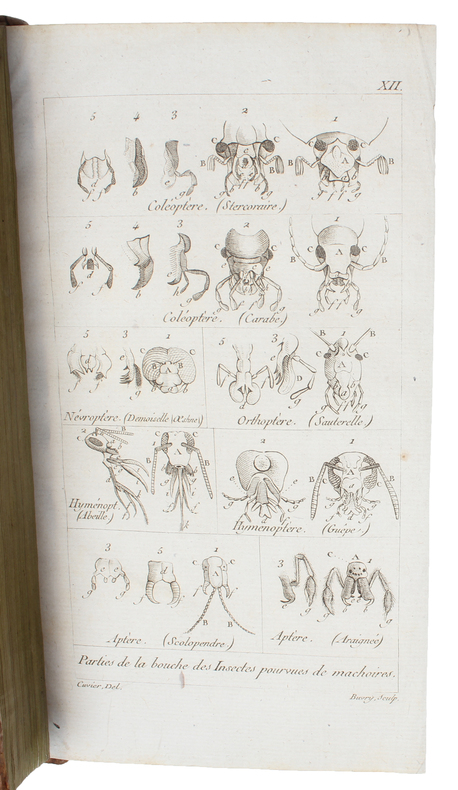
179829881Paris, Baudouin, An 6 (1798). 8vo. Nice cont. full mottled calf. Richly gilt back. Light wear to lower part of back and a small hole in leather at lower hinge. Red leather titlelabel. XVI,710 pp. and 14 engraved plates with many figs. A large clean copy.
179838049Paris, Baudouin, An 6 (1798). 8vo. Contemp. hcalf, richly gilt back. Titlelabel with gilt lettering. Corners a bit bumped, otherwise fine. XVI,710 pp. and 14 engraved plates with many figs. A few scattered brownspots. Printed on good paper.
1798871798 Paris, Baudouin, 1798 ; in-8 de xvi-710 pp., 14 pl., demi-basane, dos lisse orné, pièce rouge, tranches mouchetées (reliure de l'époque).
179862600Paris, Baudouin, 1798, in-8, XVI-710 pp, 14 pl, Demi-basane blonde, dos lisse et orné, pièce de titre noire, Édition originale du premier ouvrage de Cuvier, fondé sur les lectures qu'il fit à l'école du Panthéon l'an précédent. Dans sa Notice historique sur les ouvrages et la vie de M. le baron Cuvier Duvernoy écrit les "immenses services que M. Cuvier a rendus à la partie systématique de l'histoire naturelle, en introduisant dans les classifications zoologiques la méthode de l'ensemble des rapports; en distribuant dans un mot, le règne animal... M. Cuvier publia en 1798 sous le titre Tableau élémentaire de l'histoire naturelle des animaux, le premier exemple de cette distribution, telle que son génie avait conçue". Bien complet. Les feuillets liminaires (préface et explication des figures), ainsi que les planches sont reliés dans le désordre. Charnières fendillées. Nissen n° 1012. Couverture rigide
179829881Paris Baudouin An 6 1798. 8vo. Nice cont. full mottled calf. Richly gilt back. Light wear to lower part of back and a small hole in leather at lower hinge. Red leather titlelabel. XVI710 pp. and 14 engraved plates with many figs. A large clean copy. <br/><br/><em>First edition of Cuvier’s first work on comparative zoology being one of the foundational texts of modern zoology and comparative anatomy. "Cuvier’s Tableau élémentaire – his first separate work – contains the first general statement of his natural classification of the animal kingdom" Norman. The book thus constitutes the first systematic expression of a theory that would dominate zoological thought in the early nineteenth century. For later theorists it provided the essential morphological basis for tracing evolutionary continuity between extinct and living species. Based on the course of lectures delivered at the École du Panthéon Cuvier’s â€Tableau élémentaire presents for the first time his natural classification of the animal kingdom establishing the four great divisions of the animal world: Vertebrata Mollusca Articulata and Radiata – according to anatomical structure rather than superficial resemblance. It was from these studies of structural affinity between living forms that Cuvier developed the principles of comparative anatomy which in turn laid the groundwork for palaeontology as a scientific discipline. Milestone of Science No. 44 Wood p. 307. </em> hardcover
179838049Paris Baudouin An 6 1798. 8vo. Contemp. hcalf richly gilt back. Titlelabel with gilt lettering. Corners a bit bumped otherwise fine. XVI710 pp. and 14 engraved plates with many figs. A few scattered brownspots. Printed on good paper. <br/><br/><em>First editiuon of Cuvier's first work on comparative zoology in which he showed the affinities and similarities in the structure of present forms of animals researches which resulted in comparison with older forms and thereby giving the material for other theorists to suggest evolutionary lines and links. Cuvier is considered as the founder of modern palaeontology by this and his later published work "Recherches sur les ossemens fossiles.""Cuvier's first separate work "Tableau.1798" is based on a course of lectures he had delivered at l'Ecole du Pantheon. It wa the first general statement of his naltural classification of the aninal kingdom.He established the four great classes vertebrates molluscs articulates and radiates and classified the animals according to the anatomical structure." Milestones of Science No. 44 - Wood p. 307. </em> unknown
179844687Paris: Baudouin 1798. First edition 8vo pp. xvi 710; 14 folding engraved plates; full contemporary sheep upper cover a bit discolored gilt spine all edges red; binding rubbed lacking spine label; contemporary school prize manuscript inscription on front free endpaper; a very good copy internally about fine. "The first considerable work on zoology written by the celebrated Baron Cuvier. It has been frequently translated and formed a foundation for future editions and other treatises" Wood. Nissen 1012; Milestones of Science 44. <br/><br/> Baudouin unknown books
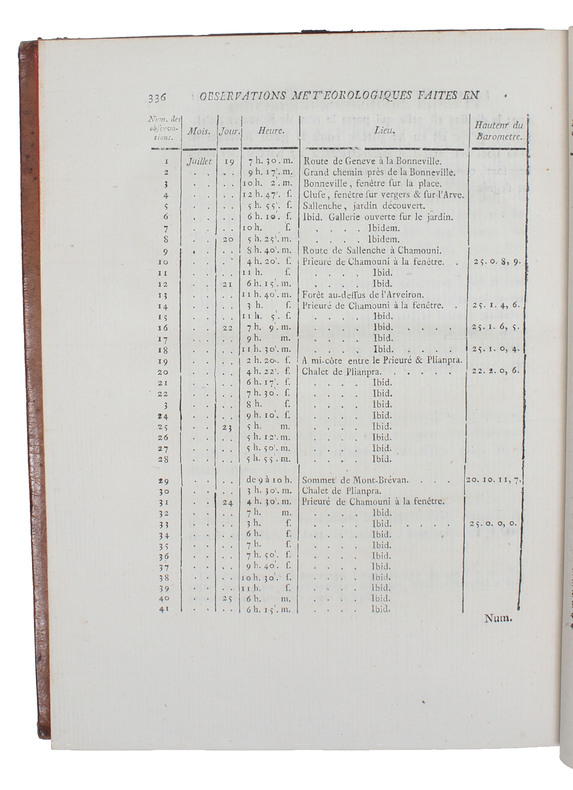
178344413Neuchatel, Samuel Fauche, 1783. 4to. Bound in fine contemp. full sprinckled calf, raised bands and richly gilt spine. Wear to head of spine. Without the 2 free endpapers. Halftitle present and with stamps. XXIV,367 pp., 2 engraved plates (1 folded). The folded plate depicts his two types of Hair-Hygrometers a. 1 engraved vignette. A fine clean and wide-margined copy.
178344413Neuchatel Samuel Fauche 1783. 4to. Bound in fine contemp. full sprinckled calf raised bands and richly gilt spine. Wear to head of spine. Without the 2 free endpapers. Halftitle present and with stamps. XXIV367 pp. 2 engraved plates 1 folded. The folded plate depicts his two types of Hair-Hygrometers a. 1 engraved vignette. A fine clean and wide-margined copy. <br/><br/><em>First edition of a fundamental work in Meteorology in which Saussure describes how to construct a hygrometer from human hair that can measure the relative humidity and discussing the principles behind it. Cuvier regarded this book as one of the greatest contributions to science of the eighteenth century."A milestone work in chemistry physics and meteorology which established hygrometry as an exact science. Primarely a geologist who explored and published on the Alps Saussure 1740-1788 was the first to prove that air expands and becomes less dense the more humidity it contains. In these Essais the work offered he describes his experiments with the hair hygrometer of his invention and his theory of the evaporation and hygrometry with their applications to meteorology. he also enunciates his theory of the evaporation of water in hydrogen carbon dioxide and other gases."Neville II p. 427 a."In his essay on the theoretical principles of hygrometry which he conceives as "the art of measuring the absolute quantity of water suspended in the air" De Saussure distinguishes three classes of methods of determining humidity which respectively utilize i observations of changes in the weight dimensions or shape of a hygroscopic body; ii observations of the capacity of the air for taking up water; and iii observations of the quantity of water condensing from the air under given conditions on a cold surface or of the degree of cold necessary to start such an condensation."Wolf "A History of Science Technology & Philosophy in the 18th Century" I p. 326 ff.Partington III 763. - Partington "Breakthroughs" 1783 M - Poggendorff II 755-56. </em> hardcover