1 254 résultats
1956ZB644042American Society of Limnology and Oceanography 1956. Volume 1-50 lacks volume 33 partly bound minor library markings else text clean & bindings tight. - If you are reading this this item is actually physically in our stock and ready for shipment once ordered. We are not bookjackers. Buyer is responsible for any additional duties taxes or fees required by recipient's country. Photos available upon request. American Society of Limnology and Oceanography unknown
In 4, pp. XII + 602. M. tl. coeva. Lievi segni d'uso agli ang. Ang. inf. delle prime 3 cc. riparato. Qualche marm. a poche pp. Rarissima edizione di questo che viene considerato il primo portolano realizzato del Mare Adriatico e che andava a corredo della Carta di Cabotaggio del Mare Adriatico realizzata tra 1822 e il 25 da Campana, Bordiga e dallo stesso Marieni. Questi importante lavoro, iniziato gia' sotto la dominazione francese dal Deposito dell guerra, trasformato, dopo la restaurazione in Istituto geografico militare, vide la collaborazione tra i governi del regno delle due Sicilie, quello Lombardo Veneto e gli ufficiali di Sua Maesta' britannica diretti dal Capitano Smyth. Nel 1845 verra' pubblicata una seconda edizione, anch'essa di grande rarita'. Comunque questo portolano verra' utilizzato per tutto il XIXo secolo. Le ultime 4 pp. contenenti le correzioni ed aggiunte pur essendo in continuita' di numerazione, furono stampate nel 1837, come riportato in calce. In fine sono indicati latitudine e longtudine di centinaia di luoghi costieri e isole. Vengono quindi descritte le coste tra Venezia e Trieste, dell'Istria, Quarnaro, Dalmazia, Albania, Epiro. la parte tra Venezia e il Porto di Primaro e sino ad Ancona, poi da Ancona al Gargano, le Tremiti, Pianosa e Pelagosa e sino a S. Maria di Leuca
In 8, pp. (12) + 123 + (1b) con diagrammi n.t. Legatura in cart. di fine XVIII sec. Rarissima ediz. orig. di questo importante trattato sul moto dei mari e dei venti dell'erudito ugonotto olandese Isaac Voss (Leida, 1618-Londra, 1689). A seguito della crescente importanza dei commerci marittimi e delle esplorazioni via mare, cominciarono ad essere studiate le cause delle maree. Voss respinge l'influenza della luna e delle stelle, sostenendo che e' il calore del sole a generare venti, maree e correnti oceaniche. Attribuisce infatti al riscaldamento solare l'aumento del livello del mare nella regione equatoriale con la conseguente formazione di maree e correnti. In maniera corretta sostiene che la circolazione del Nord Atlantico sia in senso orario. Il testo include riferimenti a vari luoghi del Nord e Sud America, fra i quali California, Florida, Virginia. Vossel, nel 1649, si trasferi' a Stoccolma, dove divenne bibliotecario ed insegnante di greco di Cristina di Svezia. Poi ando' in Inghilterra dove rimase fino alla morte. Qui fu canonico dei Windsor. Appassionato collezionista di libri ed egli stesso autore di opere di svariato genere (letteratura classica, geografia, cronologia biblica), lascio' alla morte una fra le piu' grandi biblioteche private del mondo. Sotheram, 5133.
In 4, cc. (4) + 37 + (7). Gora a 10 cc. interne. P. pg. coeva. Edizione originale poco comune di quest'opera dedicata ai fenomeni legati ai quattro elementi: fuoco, aere, acqua e terra. Poco si sofferma sui primi due, il fuoco viene diviso in due categorie: l'elemento puro, senza alcuna mistura, cagione dell'essere, l'altro e' cagione di corruzione. Grazie al fuoco si generano le piante, tempera la fredda influenza della luna ecc. Si sostiene poi che il fuoco celeste non consuma alcuna cosa mentre il nostro terrestre consuma la materia cui si appiglia, risolve le pietre in metalli, riduce l'arse pietre in calcina ecc. L'aere viene definito 'sottile ma d'una sottigliezza ottusa', l'aere col movimento si raffredda, non c'e' cosa che piu' riempa che l'aere il quale stando fermo si corrompe. Questo e' diviso in tre regioni: soprana, bassa e mezzana. Tratta poi delle generazione dei venti -.l'aura si genera dalle humide fumosita' che salgon dai fiumi o dalle valli .ma sormontando il sole si consuma e svanisce.-. L'acqua signoreggia a tutti gli altri elementi, dice Breventano, questa ha 3 proprieta': di stendersi, giova a figurar forme artificiali, ultimo fa feconda la terra mollificando la sua durezza. Spiega poi l'origine delle piogge con l'evaporazione dell'acqua del mare e che i pesci si nutrono di acqua ma mescolata con gli altri tre elementi. Tratta poi le acque termali spiegando la genesi con il passare su fene metallifere, solforose, nitrose ecc. e ognuna da' giovamento a parti diverse del corpo, profondendosi in molti esempi (Abano, Lucca, Acqui ma anche Chio, Ethiopia, Schiavonia ecc.). Vengono descritte, peraltro, le acque presenti nelle Valli Bergamasche e Bresciane che generano il gozzo (quio denominato gavacciolo). Dopo le fonti l'autore descrive i laghi citando il Maggiore come caratterizzato da grande pescosita' e pericolosita' per le tempeste, quello di Garda come popolato da carpioni che si nutrono di sabbie dorate. Cita il Po' che nasce dal Monte Vesulo e il Timavo che scorre sottoterra. Cita poi il fiume Imera in Sicilia, che si divide in 2 rami e uno e' di acqua salata e i casi in cui un teremoto puo' far nascere un fiume come farlo scomparire. Termina con l'acqua dei pozzi e con gli effetti delle varie acque sul corpo. L'ultimo elemento descritto e' la terra che Breventano divide anch'essa in 3 parti. La parte piu' pura dice trovarsi al centro -.grave, soda et immobile. se si potesse far un buco in essa che riuscisse dall'uno hemisferio all'altro et entro si gittasse un sasso, quando questo fusse arrivato al mezzo si fermerebbe.- Passa poi ad una descrizione geografica affermando la terra essere tutta abitata come dimostrato dalle esplorazioni delle Americhe, tratta dell'Africa ecc. La parte finale e' dedicata alla geologia, descrivendo le varie tipologie di roccie e gli effetti di queste sui terreni e sulle piante ma sopprattutto, i fenomeni vulcanici, come l'Etna, le Isole Eolie sulle quali si dilunga, e una quantita' di fenomeni vulcanici in Italia e altrove (Rieti, Pozzuoli ma anche la Frigia, Scozia ecc.). L'utima parte e' dedicata ai terremoti che egli sostiene essere generati dall'aria che cerca d'uscire dalle vene della terra e di questi descrive i vari effetti. Del Breventano e' nota un'opera rimasta manoscritta interamente dedicata ai terremoti e che nella sostanza non si discosta da quanto affermato in queste pagine. Bidello dell'Accademia degli Affidati in Pavia, e' noto per una storia di questa citta' e per altre opere di carattere scientifico.

2016125674University of Georgia Press. New. 2016. Hardcover. 0820349356 . FREE UPGRADE to Courier/Priority Shipping Upon Request - IN STOCK AND IMMEDIATELY AVAILABLE FOR SHIPMENT - Flawless copy brand new pristine never opened. -- with a bonus offer-- . University of Georgia Press hardcover
44154various various. Ca. 1918 - 1936. Most items loose disbound. PARTIAL COLLECTION with at least one element a 1919 diary known to be elsewhere. Two letters quite toned and brittle; evidence of photo album removal to verso of postcards and occasional other items including 6 RPPCs affixed to full leaf; slight mustiness. Some photographs poorly developed and/or lightly soiled. Overall text is clean legible and images are sharp. About Very Good. Total of 83 manuscript and 2 typescript letters plus 1 V-mail comprising 250 pp; of these 54 are from Arthur to various friends etc. 155 pp and 29 are from Arthur's parents and 3 are from others 97 pp. "Notes" folder: 64 ruled leaves 1 blank manuscript text to recto only. Scrapbook album: 46 tan construction paper leaves several blank and/or noticeably missing items. Numerous loose ephemera. Over 250 b/w photographs ranging in size from ~2-1/4" x 1-1/4" to 8" x 10" including many official Navy photos. Also 8 b/w RPPCs 2 half-tones and various negatives color printed certificates postcards etc. Most text on 10-1/2" x 8" leaves. <br/><br/>A collection of material detailing career sailor and struggling writer Arthur Gordon’s attempts to find work in the Merchant Marine during the height of the Great Depression as well as his considerable efforts to set aside time for writing and honing his craft. Gordon served as a lieutenant in the Navy during WWI as Chief Writer on the U.S. Coast and Geodetic Survey Oceanographer during the early 1930s and again as an officer in the U.S. Navy during WWII eventually attaining the rank of commander; his stories of sea life were published in various popular magazines primarily during the 1940s. Gordon is an introspective writer with a good if sometimes uneven sense of how to turn his experiences and thoughts into an often humorous and lightly self-mocking story particularly in "Notes upon leaving the Coast Survey and looking for employment as a Merchant Mate Jan 5 - June 14 1935" a 63 pp autobiography of these experiences written in the third person. "Notes" offers a highly detailed account of Gordon's experiences as an unemployed seaman during the Depression and life aboard an oil tanker when his attempt to gain a position as a 3rd Mate didn't work out: "Las Piedras is an oil tank town with a single narrow dock extending from the shore providing bollards for tying up the ships and supports for the pipe lines. The town is small and I think exists only because of the oil tanks for the location has no charm otherwise. The white oil men live as colonials in an impoverished outpost. They take what stores they need from the steward's supplies aboard ship. Loading is done by gravity since the storage tanks ashore are on the cliff." The letters roughly divided between copies of correspondence sent from Arthur to his friends and letters sent to Arthur from his parents show Gordon to be an enthusiastic and encouraging friend to multiple young men and a few women as well as a dutiful son whose unemployed parents relied heavily on his earnings. Of some note as well are a handful of thoughtful if conflicted references to homosexuality with at least one of Gordon's male friends appearing to have a crush on him and hints that Gordon may have been in gay relationships himself and/or struggled with his sexuality: "…. I quite fully agree with you concerning the chemical make-up of man and the push and pull of attraction or dislike. I have had occasion to study what it is that draws me to which I react most noticeably and I am continually dismayed that usually it is the ‘wrong’ thing. . I’m skeptical of any kind of relation that presupposes permanency. Knowing myself I feel that ‘vows’ would soon be broken. I cannot stand constant association. Routine maddens me. The merest suggestion of ‘chain’ of compulsory anything and I’m off. I don’t think hetero marriages are particularly successful and I don’t think homo are either for almost the same reasons. I don’t mind the companionate idea with women. With men I fight shy. I am getting to the age where in others I condemn homo as degeneracy. I mean that among young people it seems almost natural as a manifestation of excess love as an overflow which can be handled without social consequences. At 45 it’s greasy and quite awful. Consider the advanced homos you know . . . Am I right I am not dictating here; nor dogmatizing. I hope to start a discussion. Homos are interesting to me because I find that along with it is usually an unidentified awareness and an understanding of life unequalled in the stolid conventionites. I do not think they are God’s elected but I don’t think that about any one….” All-in-all in interesting multilayered primary source account of one man's experiences at sea during the Depression and his deep engagement with his correspondents with heavy overtones of a writer's bildungsroman traveling seeking new experiences etc. unknown books
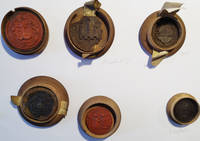
bookfair 30<p>43 seals from 16th possibly 15th to the 18th century. Between 2.5 and 6.5 cm. Most in black and red. Some uncoloured. In specially made wooden boxes. Mostly German. Six of them are chipped or broken. Warrants further study. We have some pictures for you. <br /></p><p><br /></p><p><br /></p>
3545Gravenhage, Compagnie, 1786, un volume in folio relié en demi-basane (reliure de l'époque), (dos et plats frottés, coiffes et coins usés), 1 FRONTISPICE, (3), 26pp., 216pp., 52 PLANCHES numérotées 1 à 12 et 1 à 40
16642940Amsterdam, ex officina Elzeviriana, 1664 ; in-16 ; plein vélin à recouvrements, titre manuscrit au dos, tranches mouchetées (reliure de l’époque) ; (20) ff. (titre gravé, lettre dédicatoire, index des chapitres et propositions), 748 pp., 4 tableaux dépliants et 1 planche dépliante.
Grande manoscritto su carta intelata (112x 89 cm), bordo di tessuto verde, stemmi araldici.
In 8, pp. XIV + 296 + (2) di errata con 12 tavv. sinott. rip., 19 tavv. in lit. f.t., 1 cartina su doppia pagina a colori f.t., ill. xilogr. n.t. Ex libris al controp. ant. Aloni al dorso. Legatura in mz. pg. coeva con tassello al dorso. Raro manuale di talassografia con moltissime illustraz., tabelle, classificazioni.
SLIVCN-9781594544804NOVA SCIENCE PUBLISHERS INC (7/2014)
New New English Original bdg. Dust wrapper. In publisher's special box. 4to. (30 x 22 cm). In Persian and a short abstract (synopsis and descriptive texts of illustrations) in English. 20, 843 p., many color ills. Encyclopaedia of seals and engravings in Iran.= Dânishnâmah-i muhr va hakkâkî dar Irân. A very heavy volume.
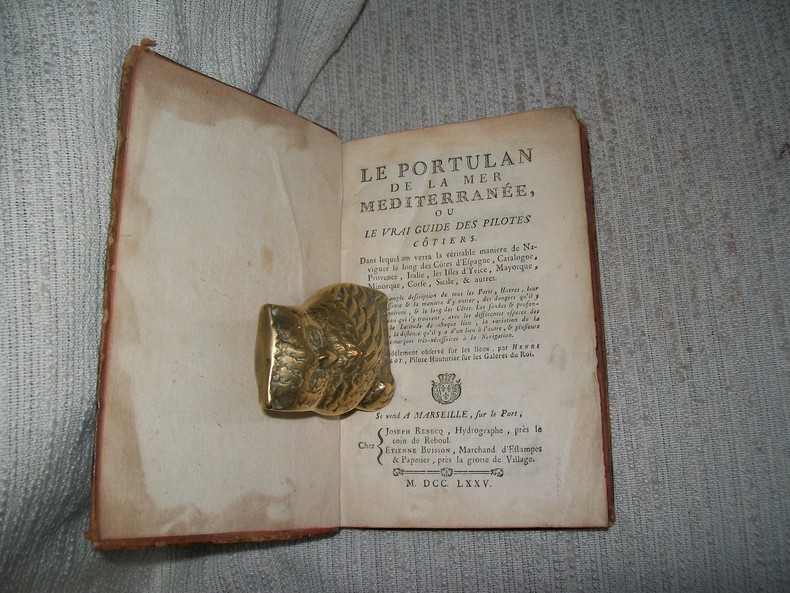
1775GITa720Se vend à Marseille sur le Port chez Joseph Rebecq, Etienne Buisson 1775. In-8 3ff n ch VII-XVI 1-397pp. Pleine basane fauve, dos à nerfs orné de compartiments à fleurettes dorés, pièce de titre havane, tranches brique, rel époque. Coiffes usées, intérieur frais. Bel exemplaire.
407 pages. A *massive* compilation of almost eighty songs performed by the great 1970s duo of Seals and Crofts. Includes such hits as Diamond Girl, Hummingbird, I'll Play for You; We May Never Pass This Way Again, and so many more. Average wear. Unmarked. A sound vintage copy of this precious Seals & Crofts memento. Book
186542430(London, Taylor & Francis, 1865) Large 4to. Without wrappers. Extracted from ""Philosophical Transactions of the Royal Society of London."", 1865, Vol. 155. Pp. 203-262. Clean and fine.
186542430London Taylor & Francis 1865 Large 4to. Without wrappers. Extracted from "Philosophical Transactions of the Royal Society of London." 1865 Vol. 155. Pp. 203-262. Clean and fine. <br/><br/><em>First printing of Forchhammer's - the father of Danish geology - pioneer-work in oceanography and hydrography as it is the first scientific investigation in this field of research. This large paper grew out of the Danish publication "Om Søvandets Bestanddele og deres Fordeling i Havet." 1859 but is much enlarged augmented with new facts acquired by many new samples of sea-water from all ower the world. "It contains a determination as complete as possible of the distribution of the saline substances at the surfaces of the different parts of the sea and in different depths at the same place."Forchhammer."Forchhammer's fundamental researches on the composition of seawater brought him international acclaim. He began this work in 1843 more as a geologist than as a chemist to explain the phenomena that give rise to the deposits on the sea floor.He carried out analyses of over 160 samples collected for him over a twenty-year period by the Danish and British navies. He measures chlorine sulfur magnesium calcium and potassium gravimetrically with 100-pound samples obtaining sodium from the differences.Forchhammer also posed in an elegant form the "geochemical balance problem" arising from the major sedimentary cycle: "Thus the quantity of the different elements in seawater is not proportional to the quantity of the elements which the river waters put into the sea but inversely proportional to the facility with which the elements are made insoluble by general or organo-chemical action in the sea"" DSB V: p. 72. The work was translated into English as "On the Components of Sea Water" 1865 in Phil. Transactions. </em> unknown
192295695Braunschweig, Friedr. Vieweg, 1922. VIII, 144 S. (= Die Wissenschaft. Einzeldarst. aus d. Naturwissenschaft und d. Technik, Bd. 66). 22 cm. OHLn., Farbkopfschnitt,
1889R200059387ALFRED MAME ET FILS. 1889. In-4. Relié demi-cuir. Bon état, Couv. convenable, Dos satisfaisant, Quelques rousseurs. 400 pages - Frontispice en noir et blanc - Plats et contre-plats jaspés - Auteur, titre, fleuron et filets dorés - Coins frottés - Nombreuses illustrations en noir et blanc dans et hors-texte - Quelques rousseurs natureleles n'altérant pas à la lecture - 2 PHOTOS DISPONIBLES.. . . . Classification Dewey : 551.46-Océanographie
197730622New York: Alfred A. Knopf 1977. Hardcover. Stated First Edition First Printing. 6.75 x 9.5in. 532pp. Publisher's printed boards. NEAR FINE in Very Good dust jacket. The book itself shows marginal shelf rubbing along the extremities else Fine/As New. The dust jacket shows the spine lightly toned otherwise is not price-clipped remaining Fine/As New. As pictured. Alfred A. Knopf hardcover
21299Dated from Versailles. 1789. 2pp 4to. On leaf tipped-in onto a piece of light-green card from an album at head of which is attached a printed slip: 'BARENTIN C. L. F. de P. Born 1738. Died 1819. KEEPER OF THE SEALS TO LOUIS XVI.' The letter is undated but the year '1789' has been added in pencil in a nineteenth-century hand. That same year following the Storming of the Bastille Barentin was dismissed by the king. Nineteen lines of closely-written text. Addressed at bottom left of first leaf to 'M le P Gl' Monsieur le Procureur général. The hand is difficult but the letter would appear to concern a 'crime' committed by 'Gièvna' and Barentin's desire to appeal to the king for clemency. Towards the end he requests 'un detail des faits que je puise mettre aussitot sous les yeux de sa majesté' the 'malheureux' being 'digne de pitié'. Dated from Versailles. [1789] unknown
2017x-1138193321Taylor & Francis 2017. Hardcover. New. 272 pages. 9.25x6.25x0.75 inches. Taylor & Francis hardcover
8vo 331 p..15 pl.An oceanographic survey to test & perfect Maury's findings and to search for doubtful vigias & other dangers. Hardcover Very good condition, spine frayed
2018x-1138479950Taylor & Francis 2018. Hardcover. New. 236 pages. 9.02x5.98x0.59 inches. Taylor & Francis hardcover
527p, 61p. Hardcover Ex-library, Good condition, hinges cracked