PENA, Petrus ; LOBEL, Mathia de ; [ PENA, Pierre ; LOBEL, Matthias de ; L'OBEL, Mathias de ]Livre Rare Book
13 résultats
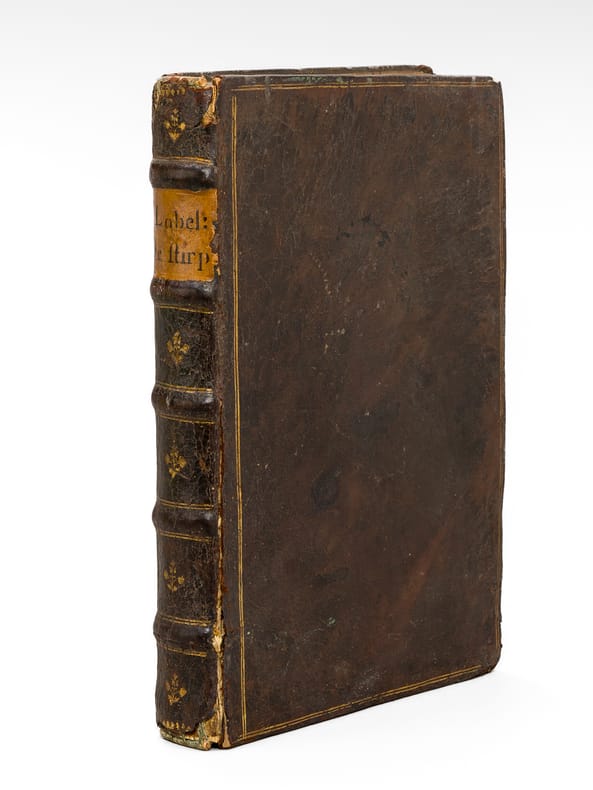
1570666651 vol. in-folio reliure de l'époque plein cuir brun, dos à 5 nerfs orné, double filet doré d'encadrement en plats, Excudebat prelum Thomæ Purfœtij [ Thomas Purfoot ], Londinis [ London ], 1570 - 1571 [ titlepage and privilege dated 1570, colophon dated 1571 ], 4 ff. (dont titre gravé), 455 pp., 7 ff. n. ch.
156138894Venegia (Venice), Vincenzo Valgrisi, 1561. Small 8vo. Contemp. full vellum. Covers a bit soiled and with remains of ink-writing on both covers. Small nicks to edges. Endpapers renewed with old paper. Old written owners name on titlepage: Antonio Cappini. 304,(32) pp. A few stains and a few scattered brownspots. Faint browning to lower margin of some leaves. Fine woodcut initials throughout.
15342839<p>WITH MANUSCRIPT ANNOTATIONS IN PORTUGUESE MENTIONING BRAZIL</p><p>8vo 14.4 x 9.6 cm 180 ff. with 151 large woodcut illustrations of which 149 are of plants. Bound somewhat tightly in later vellum over boards covers gilt-ruled spine gilt with morocco title pieces a.e.g. Some marginalia cropped at time of re-binding as well as 2 pages of manuscript annotations in Portuguese. Minor tear repaired at edge of title just touching woodcut border; some minor soiling but generally a fresh copy with dark strikes of the woodcuts.</p><p>Rare second Italian-language edition first 1522 of the <em>Herbarius latinus</em> important for the dissemination of botanical/medical knowledge in popular culture and particularly for the adoption of this originally German-printed Latin work for readers in the Veneto. The second section with 96 chapters includes information on laxatives aromatics fruits seeds gums and resins salts minerals goose-grease cheese honey ivory and much more. Anderson notes that this section probably contributed to the book's success: "It was concerned with the materials of medicine that were commonly available in the shops of apothecaries and spice merchants. Through the use of the <em>Herbarius</em> the average man could easily find what drugs to use and purchase them in most towns."</p><p>According to Anderson "the <em>Herbarius</em> sold as well in Italy if not better. There its second section may have contributed to its success for it was concerned with the materials of medicine that were commonly available in the shops of apothecaries and spice merchants. Through the use of the <em>Herbarius</em> the average man could easily find what drugs to use and purchase them in most towns. The second section has 96 chapters though many of them are very brief. They deal with the following: laxatives; aromatics; fruits seeds and plants of garden and orchard; gums and resins; salts; minerals and stones; and a variety of animals and their products such as goose-grease cheese honey and ivory" Anderson <em>Illustrated History of the Herbal</em> pp. 86-7. The last chapter CLI <em>de Vino e Aceto</em> is illustrated with a woodcut showing wine barels in a cellar. According to Hunt the woodcut on the title-page showing Saints Cosmos and Damian appears here for the first time.</p><p>Our copy has 2 full page and numerious marginal early 17th c. annotations in Portuguese mentioning Brazil in one case and giving the date of 1630 in another. There are two mentions of experiments in planting and cultivating cotton and ginger "brought from Brazil"--one of them dated 1643 f. aa6 r and f. Y6 r. In 1577 the Portuguese prohibited the cultivation of ginger in Bahia due to their interests in the India trade. However Bahian colonists ignored the law and continued to grow it selling it in secret to the Dutch and the English among others. The use of lead for treating bladder ulcers is also discussed f. Y6 r. Most curious is a recipe for avoiding and curing hemorroids by "Father Manoel da Anunciação Capuchino in the year 1630". The recipe involves frying small frogs in oil without salt "until the oil stops making noise. Once they are fried take them out of the oil and put the oil in a bottle and apply this liquid with your fingers on the bone and on the hemmorhoids and they will heal quickly" f. Y6 v.</p><p> Hunt I.34; Mortimer I.228 1520 Latin; Anderson <em>Illustrated History of the Herbal</em> pp. 86-7; Schwartz <em>Sovereignty and Society in Colonial Brazil</em> esp. pp. 158-9.</p> Giovanni Andrea Vavassore hardcover
156540332DBParis, Frederic Morel, 1565. 8°. (8) Bl., 267 S., (12) S. Neuer Halbpergamentband. + Wichtig: Für unsere Kunden in der EU erfolgt der Versand alle 14 Tage verzollt ab Deutschland / Postbank-Konto in Deutschland vorhanden +, A|B [2 Warenabbildungen]
156540332DBParis, Frederic Morel, 1565. 8°. (8) Bl., 267 S., (12) S. Neuer Halbpergamentband.
1590R300001385FRANCOFURTI AD MOENUM. 1590. In-4. Broché. A restaurer, Livré sans Couverture, Dos abîmé, Papier jauni. Plus de 1100 planches en noir et blanc. Tamponnée d'une bibliothèque originaire de langon (33). Dos absent. Coin supérieur droit partiellement brulé.. . . . Classification Dewey : 580-Botanique
154243218Trecis (Troyes), Apud Nicolaum Paris (On les vend à Troyes chez Maistre Nicole Paris), 1542. In-12 de 118-(18) pp. (sig. A-H8 I4), basane brune, dos à trois nerfs, signet (reliure à l'imitation).
153429859(Colophon: Basel, apud Andream Cratandrum, 1534). Folio. Nice hcalf from ab. 1750, richly gilt back, gilt title-label. Corners a bit bumped. Slightly rubbed. Woodcut printer's device to title and last leaf. (28),264,(2) pp. With many smaller and larger woodcut initials. Small stamp at lower corner of the first 2 leaves. Some, rather faint, dampstainings to first and last leaves, otherwise clean and with broad margins. Engraved book-plate inside front board (Bibliotheque du comte Le Moyne de Martigny).
1571015795Venetiis Venice: In Officina Valgrisiana 1571. Illustrated with many hundreds of half-page woodcuts. pp 14 922 13 the title page is laid down and has slight losses the next leaf is restored at the corner with no loss of text the preliminary index is a bit thumbed and marked a little marginal staining to the last hundred pages a little marginal staining and marking on occasional pages but overall very firm and tight and in better condition than many copies. There are very neat early manuscript notes on many pages mainly limited to the common English names. Contemporary simple lined calf rebacked and with new endpapers in the early twentieth century with the original spine laid down. An inked paper title label on the spine. The Hartland Library copy with labels and manuscript notes attached to the front endpapers. RARE. The Library was formed by Edwin Sydney Hartland and was a diverse but major collection of herbals archaeology and anthropology. It was donated to Gloucestershire County Council in 1936 and was eventually dispersed around 2010. This the first edition of a digest of Mattioli's commentaries on Dioscorides expressed in the form of an encyclopedia of plants giving synonyms classification description locale and medicinal qualities and uses. A careful student of botany he described 100 new plants and coordinated the medical botany of his time in his Discorsi "Commentaries" on the Materia Medica of Dioscorides. The first edition of Mattioli's work appeared in 1544 in Italian. In addition to identifying the plants originally described by Dioscorides Mattioli added descriptions of some plants not in Dioscorides and not of any known medical use thus marking a transition from the study of plants as a field of medicine to a study of interest in its own right. In addition the woodcuts in Mattioli's work were of a high standard allowing recognition of the plant even when the text was obscure. A noteworthy inclusion is an early variety of tomato the first documented example of the vegetable being grown and eaten in Europe. There is also an early illustration of a coconut. First Edition. Full-Leather. Good. In Officina Valgrisiana Hardcover
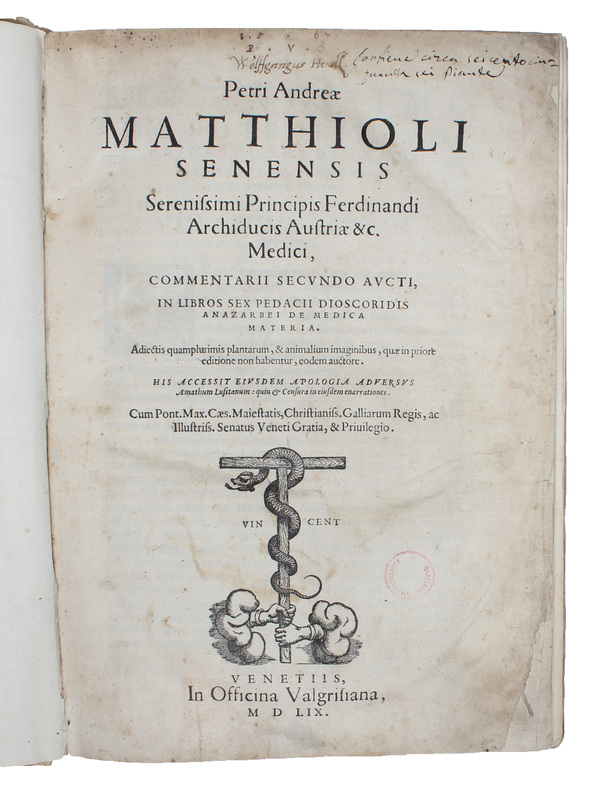
155935571Venetiis, In Officina Valgrisiana, 1559. Folio. (31,5x22,5 cm) Contemporary full Italian vellum. (100),776 pp. + Apologia (having its own title page) 46,(1) pp. Printers woodcut-device at both titles and on last leaf verso. With more than 700 fine wood-cuts in the text (of animals and plants). Light browning to title page, 2 corners repaired, no loss of text, 6 last leaves strengthened in outer margins, no loss of text. A few scattered brown spots and a few marginal notes. In general fine and clean, printed on good paper. Old name on title, Wolffgangus Hendl, 1564 P.V.Q.
15842836FBLugduni [Lyon], Apud Iunta [Jacopo de Giunta], 1584. 8°. 16,5 x 11,5 cm. 424 Seiten. Pergamentband der Zeit. [7 Warenabbildungen]
156540332ABParis, Frederic Morel, 1565. 8°. 8 n.n. Bl., 267 S., 12 n.n. S. Neuer Halbpergamentband.
156540332ABParis, Frederic Morel, 1565. 8°. 8 n.n. Bl., 267 S., 12 n.n. S. Neuer Halbpergamentband.