382 résultats
1890NATW0941Bln., Bornträger 1890. gr.-8°, XII, 468 S., mit 573 Abb., OLn., Kanten etwas berieben, Rückenkanten leicht zerschlissen, auf Vorsätzen u. Innentit.mehrere Stempel, Inhaltsverz. mit einigen Flecken, ab Seite 435 bis zum Rückendeckel im ob. Randbereich gebr. Wasserränder, Schnitt verstaubt u. etwas fl., innen schwach gebr., einige Rotstiftunterstr. im Index. Dr. Eugen Warming, Professor der Botanik an der Universität Kopenhagen.
1900X5751Fürth i. B, Verlag von G. Löwensohn 1900. Pappband, 8°, 80 S., mit 6 Tafeln und 34 Abbildungen in farbigem Kunstdruck
189025590Bad Ems, Druck und Verlag Sommer 1890. X, 64 + XI, 329 S., Abb., Tafeln, Halbleder, nachebundene Ausgabe, Rückenschild ohne Beschriftung, sonst Exemplar in gutem Erhaltungszustand
18482245RfFrankfurt/Main, Literarische Anstalt (J. Rütten), 1848. 1 lithogr. Tafel, 330 S; 245 S., 2 in 1 Band. geprägter Lederband mit Rückenvergoldung, marmorierter Schnitt. Zustand 2, berieben und bestoßen, durchgehend gebräunt u. stockfleckig.
186991216Berlin: Lüderitz`sche Verlagsbuchhandlung Charisius, 1866 bis 1869. 8°, gebunden, Leinen mit goldgeprägtem Rückentitel;
188343042Berlin : Paul Parey 1883. 1273 Seiten, mit 1416 in Text gedruckten Holzschnitten Gebundene Ausgabe, grüner Halblederband, Rücken bräunlich ausgeblichen, Seiten und Schnitt alters- und papierbedingt gebräunt, sonst guter Zustand
180510453Klagenfurt, Leon, 1805. 14 Bll., 818 S., 1 Bl. Kl.-8°. HLdr. der Zeit mit Rückenschild (etw. fleckig, leicht bestoßen und berieben).
180560993Klagenfurt, J. J. Leon, 1805. 8°. 15 Bll., 818 S., Marmor. Ppbde. d. Zt. m. goldgepr. Rückenschild.
18916044789Prag, Rivnac 1891-1891. 8°. (10), IX, 676 pp; XX, 404 pp. Spõtere Halbleinwand. Schlicht. Solide. Stempel verso Titel. Sonst ordentlich.
1838167701Paris: Ladvocat 1838. The most important French socialist-feminist of the 1830s and 1840s Second edition published the same year as the first of the radical philosopher's only novel vividly articulating her goal of social revolution through female emancipation. Méphis is uncommonly met with; we trace only one previous auction listing for any edition. The philosophy of Flora Tristan 1803-1844 linked the nascent socialist theories of class struggles with the contested position of women in contemporary society. Following the mixed reception of her previous political works in Méphis she employs the conventions of the novel to visualise her conception of social reform. The work centres on the titular protagonist's relationships with two aristocratic women and the tensions implicit therein - both in his proletariat origins and in the broader patriarchal conventions weighing on them. Tristan draws several "vivid evocations of feminist role models" Cross & Gray p. 2 thereby winning the novel "a secure place in French Romantic literature" Puech quoted in Cross & Gray p. 2. The work gained further notoriety due to the events surrounding its publication. In 1838 Tristan's estranged husband - a failed artist enraged by her literary success - shot her in the street in broad daylight. Miraculously she was not seriously injured and the resulting trial boosted her sales considerably. Tristan's socialist-feminist philosophy anticipates several aspects of Marx and Engels: she most notably coined the term "Workers of the world unite" a full five years before they deployed it in the Communist Manifesto. She is consequently considered "the most important French socialist-feminist of the 1830s and 1840s" Collins & Weil-Sayre p. 229. The second volume includes two of Tristan's articles on the history of western art which had formerly appeared in L'Artiste. 2 vols octavo 209 x 131 mm pp. iv vii 1 365 1; pp. iv 390 2. Wood-engraved vignette to title pages. Contemporary red quarter sheep spines lettered ruled and elaborately decorated in gilt red marbled sides marbled endpapers edges sprinkled black blue silk bookmarkers. Moderate rubbing faint sunning to spines light sporadic foxing and marginal damp staining to contents: a very good copy. Marie M. Collins and Sylvie Weil-Sayre "Flora Tristan: Forgotten Feminist and Socialist" Nineteenth-Century French Studies vol. 1 no. 4 1973; Màire Cross and Tim Gray The Feminism of Flora Tristan 1992. unknown
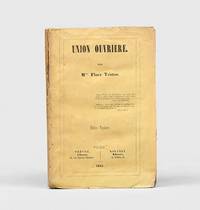
1843150437Paris: Prévot and Rouanet 1843. Coining the slogan "workers of the world unite!" five years before the Communist Manifesto First edition of the revolutionary French socialist's most famous work urging the working class to unite a call for international emancipation which appeared five years before the Communist Manifesto. Tristan is "perhaps the most celebrated of all 19th-century French feminists" Moses p. 107. Tristan's struggles as both the poverty-stricken illegitimate daughter of a Peruvian noble and as the wife of a violently abusive husband forced her to travel at various points in her life to England as a ladies' companion and Peru in the hopes of re-establishing her family ties. Upon returning to Paris in 1835 Tristan fought her husband André Chazal for custody of her two surviving children and succeeded in regards to her daughter. It was not until 1836 after Chazal shot Tristan that she was granted legal separation and the right to take back the name Tristan. Both as respite from and because of this domestic turmoil Tristan became enthusiastically involved in a number of feminist and socialist groups and activities - she published pamphlets on female immigration petitioned in favour of divorce and for the abolishment of capital punishment attended meetings of the Gazette des femmes group and engaged with the utopian socialism of the Fourierists. "In Union ouvrière Tristan rallies the French working class urging them to create a national organization that would be financed by subscriptions from the twenty-five million workers. She believed that any change among the working class must be initiated by the workers themselves: 'Now the day has come when one must act and it is up to you and only you to act in the interest of your own cause'. Despite her call to action Tristan maintained a firm stance against violence and called only for passive resistance; she believed that destructive acts would only heighten workers' problems. She tried to enlist the bourgeoisie in her plan on the basis that it would help prevent begging and theft. The second part of Tristan's crusade was her attempt to improve the position of women within the workplace and society. She argued that all classes of women should participate in the Workers' Union to lobby simultaneously for feminism and socialism. Her third chapter entitled 'Why I Mention Women' aims to establish continuity between the desires of the workers and those of women" Orlando. Unable to find a publisher willing to print the unorthodox tract she funded the book's publication herself through donations from friends acquaintances and public appeal. From these donations 14000 copies of this first edition were printed stated as "Edition populaire" which she sold for 50 centimes each. In Lyons the fundraising efforts of her working-class followers underwrote a further printing of 10000 copies. Such circulation was very high for the time: the print run of the Communist Manifesto in 1848 by contrast was 2000 copies. "Increasing scholarly attention is revealing her as a pivotal figure in the shift from early nineteenth-century utopian to Marxist economic socialism. Her insistence on the inextricability of class and gender oppression makes her a foundational socialist feminist theorist" ibid. Duodecimo. Uncut in original yellow wrappers printed in black. Housed in quarter calf chemise and slipcase. Slight split to front joint but holding wrappers and contents clean a very good well-preserved copy. Claire Goldberg Moses French Feminism in the Nineteenth Century 1984. unknown
1855NATW1400Leipzig, R. Weigel 1855. gr.-8°, VI S. (Schmutztit. Tit. u. Vorw.), 1 Bl. (Inh.), 72 S. OKart. m. schwarzgedr., eingerahmten Tit. auf Vorderdeckel. Rücken mit Pergaminstreifen gefestigt. Im Text papierbedingt gebräunt, vereinzelt etw. fingerfleckig. Pritzel 9486, ADB Bd. XXXVIII, 588-591. Erste Ausgabe dieser Abhandlung über die Anwendung des Holzschnittes in botanischen Ansichtswerken; anhand bedeutender Vertreter von den Anfängen an bis zur Mitte des 19. Jahrhunderts aufgezeigt (Leonhard Fuchs, Conrad Gesner etc.). Der dt. Botaniker L. C. Treviranus (1779-1864), der zunächst in Bremen und Rostock als Professor tätig war, folgte 1816 einem Ruf nach Breslau, wo er den Lehrstuhl für Botanik sowie die Direktion des botanischen Gartens übernahm. 1830 ging er schließlich nach Bonn, woselbst er über 30 Jahre, bis an sein Lebensende wirkte. Für die Wissenschaft von Bedeutung waren vor allem seine pflanzenanatomischen Arbeiten. "Dennoch beseelte ihn ein lebendiges Gefühl für das Schöne, auch in Kunst und Dichtung, und so führte ihn diese Freude an künstlerischen Schöpfungen zum Studium der Geschichte der Xylographie, worüber in seinem trefflichen kleinen Werke 'Die Anwendung des Holzschnittes zur bildlichen Darstellung von Pflanzen' Auskunft gab." (vgl. dazu ADB).
18253809Wien, Selbstverlag, 1825. 2 Hefte in 1 Bd. 12 Bll. (ohne die Textblätter des zweiten Heftes, diese in Faksimile auf altem Papier eingebunden). 24 Kupfertafeln. Gr.-8°. HLdr. der Zeit mit Rückenvergoldung und Rückenschild (etw.bestoßen und beschabt).
18198322Wien, Strauss, 1819. 13 S. 80 größtenteils kolorierte (vereinzelt auch in Farben gedruckte) Kupfertafeln. Fol. HLdr. der Zeit mit Rückentitel (etw. fleckig und beschabt).
1887S685Berlin, Verlag von Julius Springer, 1887. Halbleinen, 8°, 331 S. mit zahlr. In den Text gedruckten Abbildungen und Register (XXXXIV S:), in der Zusammenstellung sind 1065 Arten in 167 Gattungen beschrieben
190014571ABStgt, Lutz 1900-07. Zweite, umgearbeitete Auflage. 15 Bände. Kl.8°. Illustr. OHLwd. Kanten etwas berieben. Ein Rücken mit kl. Fehlstelle am Kapital, ein Rücken repariert, Fehlstelle dort ersetzt. Ein Rücken einseitig lose. (=Schriften des Deutschen Lehrer-Vereins für Naturkunde VI-XIX, XXI). 2
19008492ABStgt, Lutz 1900-07. Kl.8°. Illustr. OHLwd. Kanten etwas berieben. Ecken etwas bestoßen. (=Schriften des Deutschen Lehrer-Vereins für Naturkunde VI-XIX, XXI). [2 Warenabbildungen] 2
188644862Freytag, Lpz. 1886. Mit 71 chromolith. Tafeln u. 106 Holzstichen. XVII,490 S. Dunkelbrauner OLwd. mit Farbprägung, Rundumgoldschnitt, reicher Rückengoldprägung u. Schmuckvorsätzen. Leicht fleckig.
188444859Freytag, Lpz. 1884. Mit 77 chromolith. Tafeln u. 124 Holzstichen. XVI,429 S. Dunkelbrauner OLwd. mit Farbprägung, Rundumgoldschnitt, reicher Rückengoldprägung u. Schmuckvorsätzen. Leicht fleckig.
189724760New York: The Macmillan Company 1897. First edition. Hardcover. Orig. blue cloth front cover and spine lettered and decorated in gilt. Teg. Near fine. 155 pages. 17 x 12 cm. The book set in Calcutta India delves into the intricate dynamics of personal relationships and societal expectations. She lived in British India for 22 years. Bright clean interior. The Macmillan Company hardcover
1896110464The Macmillan Company 1896. Hardcover. Very good. The Macmillan Company c1896 1897 printing. 475pp. 6pp. publisher's catalog. 8vo. Decorative green cloth with red and gold titles on front cover and spine upper edge gilt. Previous owner's name stamped on title-page "B. Wyeth". Inscription on first page "Maud Wyeth Wyndham with the compliments of J.H.S. March 1897" B. Wyeth stamped on the lower edge of textblock. from the estate of Stuart Wyeth Campbell. Spine somewhat darkened Very Good attractive hardcover. The Macmillan Company hardcover
1897Y339London: William Heinemann 1897. 1st edition first issue . Hardback. V.g. rubbed/No Jacket. 8vo. viii 432pp 32 pub. reviews and adspp. A story and history of the Indian Rebellion 1857. Attractive decorative green cloth with black titles and a cover depicting a river and trees with birds blocked in silver and black. LACKS FRONT F.E.P. 8pp appendix at the rear of the text. Please email for photo. No print numbers so presumed a first edition 1st issue <br/> <br/> William Heinemann hardcover
189477151London:: Macmillan and Co. 1894. publisher's cloth with printed paper label on spine. . Some light foxing; spine label tanned with tiny chips at edges; lower corners bumped. Tight and sound. 8vo. With Illustrations by J. Lockwood Kipling. Notes by R. C. Temple. Macmillan and Co., hardcover
190021243New York: The Macmillan Company. Very Good- with no dust jacket; Spine darkened ink front endpaper & . pencil on half-title page 2 pages stained. 1900. First Edition. Hardcover. A novel of India.; 8vo; 418 pages . The Macmillan Company hardcover