ENTOMOLOGYABAA
3 résultats
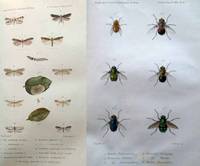
1859802881859. ENTOMOLOGY ANNALES DE LA SOCIETE ENTOMOLOGIQUE DE FRANCE INTERRUPTED RUN 1859 - 1920 BOUND VOLUMES AND ORIGINAL WRAPPERS. Societe Entomologique de France. Over 150 color plates hundreds morte monochrome/tinted plates. Offered as a lot. 24 bound volumes the rest in parts in original wrappers. Condition good to excellent. A few covers are detached or spines split in the paper issues and spines of a few of the bound volumes are chipped and backstrip is detached 1859 volume. Very few plates are flawed: a few may have partial dampstaining. Overall the color plates are delicate and vivid in excellent condition. As follows: Series 3 1859-60 2 volumes Series 4 1861-67 1869-70 9 volumes Series 5 1872-1879 8 volumes Series 6 1883-1890 8 volumes 1891-1895 1897-1899 1902-1903 1906 1909 1913-1920 LX - LXXXIX 20 volumes 1895 vol LXIV lacks part 3. Complete list available upon request. unknown books
1926221313London Ontario 1926. 10 vols. Large 8vo. Bound in three quarter leather original wrappers bound in. 10 vols. Large 8vo. unknown books
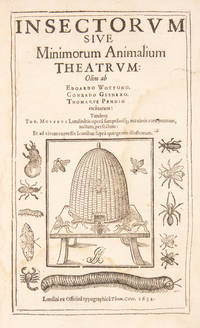
16343993<p>London: ex Officina typographica Thom. Cotes. Et venales extant apud Guiliel. Hope ad insigne Chirothechae prope regium Excambium 1634. </p><p>Price: $14000.00 </p><p>Folio: 29.4 x 19.5 cm. A6 a4 B-Z6 Aa-Dd6 Ee4 </p><p>FIRST EDITION of the "true foundation of modern entomology"Raven English Naturalists from Neckham to Ray 1947.</p><p>A very fine copy bound in contemporary vellum spine restored. The text is in excellent crisp condition with a few scattered rust spots a few lightly spotted leaves and one natural paper flaw leaf X3 with no loss. Illustrated with a decorative woodcut title vignette and over 500 individual woodcuts of insects. Very uncommon in such fine original condition.</p><p><br /></p><p>The 'Insectorvm Sive Minimorum Animalium Theatrvm' Theater of Insects the Smallest of Animals is the first substantial scientific treatise devoted exclusively to entomology and the first original treatise devoted to natural history composed in England. At its nucleus is the research of no less than Conrad Gessner who failed to complete a volume on insects for his vast and revolutionary zoological encyclopedia. Gessner's work was carried to fruition by two English naturalists Thomas Penny and his colleague Thomas Moffet with the invaluable assistance of an international network of contacts. In its final form the "Theater of Insects" brought together information from sources in Asia England Europe Africa and the Americas conducted over the course of two generations from the age of the great taxonomic researches of Aldrovandi and Gessner to the age of Bacon and the early modern scientific revolution.</p><p><br /></p><p>The book's importance is thus two-fold: first as a watershed in the study of insects and second as a record of and testament to a remarkable collaborative effort by an international group of scientists physicians artists and laymen many unknown to each other but all drawn into association as contributors to the entomological studies of Penny and Moffet.</p><p><br /></p><p>"In putting together the materials that would eventually be published as 'Theatrum Insectorum' Penny and Moffet amassed a large collection of information specimens and images of insects from contacts and correspondents with widely varying backgrounds. The members of this group ranged from some of the most learned naturalists of sixteenth-century Europe to gentlemen collectors in England to friends and travelers to foreign lands whose interest in insects led them to endure ferocious bites and filthy ditches to unnamed individuals who were paid to make observations of insects… </p><p><br /></p><p>"Moffet and Penny probably formed their friendship while Moffet was a student at Trinity College Cambridge. The materials on insects that formed the nucleus of their book were obtained by Penny during his travels in Europe from 1565 to 1569 during which time his interest in natural history was stimulated and encouraged. Penny arrived in Zurich in 1565 to meet Conrad Gessner and presented him with drawings and specimens of English plants… In exchange for these botanical materials Gessner made Penny a gift of the pictures and notes on insects that he had been gathering over the years." Neri The Insect and the Image: Visualizing Nature in Early Modern Europe 1500-1700</p><p><br /></p><p>During this time abroad Penny cultivated contacts and correspondents within Gessner's international network of naturalists among them Carolus Clusius Mathias L'Obel and Jean Bauhin and when he turned from botanical studies to work in earnest on the study of insects he drew upon these same contacts for specimens information and drawings.</p><p><br /></p><p>"Over the years Penny received several unusual flies a moth a butterfly four rare beetles and an African mantis from Clusius. Camerarius sent an unusual fly several beetles and a caterpillar. In some cases the text of the 'Theatrum' specifically notes that Penny received an image as opposed to a specimen as in the case of the rare 'horse-nose beetle' which 'Clusius sent painted from Vienna."Ibid.</p><p><br /></p><p>In England Penny acquired the notes on insects made by Edward Wotton of Oxford; among those who sent Moffet specimens and illustrations was John White the Virginian pioneer who contributed the drawing for the swallowtail butterfly Pailio glaucus L. a woodcut of which occupies three quarters of page 98 in the printed text. </p><p><br /></p><p>When Penny died Moffet finding himself in a position analogous to that in which Penny found himself when he was given Gessner's notes was tasked with completing the work. "In taking up the project of bringing Penny's unpublished research to publication Moffet was tasked with organizing and paring down what seems to have been a very large amount of material something Penny was not able to accomplish during his own lifetime."Ibid. </p><p><br /></p><p>According to Moffet Penny left his draft and other documents "in a confused heap." Moffet also tells us that they were about to be thrown away by Penny's executors when Moffet redeemed them for "a great sum of money." By 1590 Moffet had finished editing the work and was negotiating for publication in The Hague. That fell through however and Moffet was unable to find a printer in England. After Moffet's death the apothecary known as "Mr. Darnell" sold the manuscript to the physician Theodore de Mayerne who eventually published it in 1634.</p><p><br /></p><p>"The 'Theatrum insectorum' itself is a systematic treatise dealing with the habits habitat breeding and economic importance of insects beginning with bees which are accorded the most detailed treatments. The observations and illustrations… are of considerable interest. Moffet usually described the larval and adult forms separately and was aware that 'There are so many kindes of Butter-flies as there are of Cankerwormes'. He further discussed the emergence of either butterflies or 'ordinarie Flyes' now known to be parasitic wasps from similar pupae and described both the depredations wrought by locusts in Europe and their use as food. He also recorded observations of the movement of the tongue of the chameleon in feeding." DSB.</p><p>Garrison-Morton 288; Lisney pp. 4-9; Norman 1528; Raven English naturalists ch. 10; STC 17993a; Huntington Catalogue p. 297; Nissen 2852; Horn.-Schenkl. III 15547; Hagen I 553</p><p><br /></p><p><br /></p> ex Officina typographica Thom. Cotes. Et venales extant apud Guiliel. Hope, ad insigne Chirothechae, prope regium Excambium, books