9 789 résultats
193259832Paris, 1932. 8vo. Original grey printed wrappers with signs of reading, but overall very good. A bit of wear along hinges (with very neat, barely noticeable professional restoration), a few smaller creases to front wrapper and an old owner's inscription in red crayon. A small closed tear to back wrapper. Many notes and underlinings (by Mijolla - see note below) and inlaid are sevaral leaves with notes. Inscribed to half-title. (14), XIII, (1), 381, (3) pp. Housed in a custom-made blue cloth box with see-through front board and gilt lettering to spine.
Paris, 1932. 8vo. Original grey printed wrappers with signs of reading, but overall very good. A bit of wear along hinges (with very neat, barely noticeable professional restoration), a few smaller creases to front wrapper and an old owner's inscription in red crayon. A small closed tear to back wrapper. Many notes and underlinings (by Mijolla - see note below) and inlaid are sevaral leaves with notes. Inscribed to half-title. (14), XIII, (1), 381, (3) pp. Housed in a custom-made blue cloth box with see-through front board and gilt lettering to spine.
181362589London, 1813 (-1816). (Part I:) Cadell and Davies by Richard Taylor and Co., 1813 (Part II:) for Cadell and Davies, and Murray by Richard and Arthur Taylor, 1813 (Parts III & IV:) (Printed by Richard and Arthur Taylor), (1816). 8vo. Lovely contemporary full calf boards with blindstamped frames made of single lines and ornamental corner-pieces. Double gilt line-border to boards. Gilding on front board very vague. Ornamental blindstamped inner dentelles. Neatly rebacked in style of the boards, with gilt ornamentation ond gilt red morocco title-label. End-papers renewed. 24 (VI),39 pp." 1 f. (blank), 124 pp. Both half-titles to part III & IV included in the pagination. Some leaves evenly browned, but overall a very nice and clean copy (possibly washed).
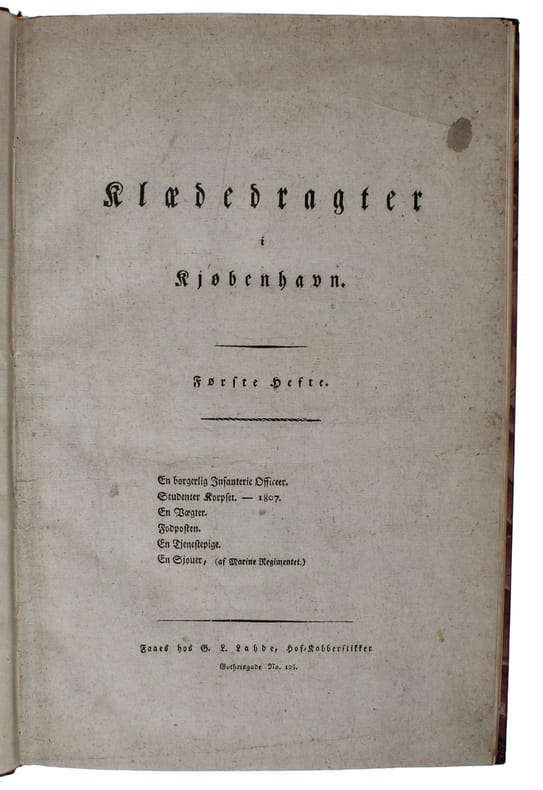
180660268Lahde, (1806 - ca. 1814) + (ca. 1818-20 for the final three plates). Small folio (binding: 31,7 x 20,6 cm). Bound in an elegant pastiche half calf by Anker Kyster, with lovely gilt spine, old marbled paper boards and beautiful hand-made patterned end-papers. Bound with four of the exceedingly scarce title-pages/front wrappers for issues one, one/two three, and five, stating which plates were in the issue in question. Complete with all 34 magnificent engraved plates of costumes, all on large, good paper and in exquisite, precise original handcolouring. Most of the leaves measure 31 x 20,2 cm, one (En Brand Officer) measures 28x19,5. At the end are withbound the three final plates that were issued a bit later, with the complete ediiton of 1820. Thus making the final plate count 37. The three final plates all measure 28x20 cm. The two first plates have been neatly restored at upper right corner, far from affecting image. Otherwise, the copy is in magnificent condition. With the ex-libris of Oskar Davidsen to verso of front free end-paper.
Lahde, (1806 - ca. 1814) + (ca. 1818-20 for the final three plates). Small folio (binding: 31,7 x 20,6 cm). Bound in an elegant pastiche half calf by Anker Kyster, with lovely gilt spine, old marbled paper boards and beautiful hand-made patterned end-papers. Bound with four of the exceedingly scarce title-pages/front wrappers for issues one, one/two three, and five, stating which plates were in the issue in question. Complete with all 34 magnificent engraved plates of costumes, all on large, good paper and in exquisite, precise original handcolouring. Most of the leaves measure 31 x 20,2 cm, one (En Brand Officer) measures 28x19,5. At the end are withbound the three final plates that were issued a bit later, with the complete ediiton of 1820. Thus making the final plate count 37. The three final plates all measure 28x20 cm. The two first plates have been neatly restored at upper right corner, far from affecting image. Otherwise, the copy is in magnificent condition. With the ex-libris of Oskar Davidsen to verso of front free end-paper.
Hudson, (New York), 1806. Small folio (30,4 x 23,7 cm). The entire May 13th issue, consisting of four leaves, with a blue marbled paper back-strip housed in magnificent custom-make full morocco box of Prussian Blue goatwith a morocco-onlay of an iconic cocktail-glass on the front board. The cocktail-glass is richly gilt with a geometric pattern in art-deco-like style and with an onlay of turquoise green representing and olive, with a black stick through it. Black lettering (""THE FIRST COCKTAIL"") to the spine and the year ""1806"" turquise to the foot. Beautiul light blue- and gold patterned silk-lining to the inside. A bit of brownspotting and some of the print a bit vague, due to the paper quality.
Paris, Michel Lévy Frères, 1872. Lex 8vo (24,8 x 16 cm). Bound uncut and with the original front wrapper in a nice early/mid 19th century green half morocco binding with five raised bands and gilt lettering to spine. Very light wear to edges and to raised bands. Front wrapper a little dusty and partly mounted on a piece of paper. Two small nicks to outer blank margin and with handwritten pencil-annotation to blank top as well as pencil-inderlining of the author, title, and year and with the publisher information lightly crossed out, also in pencil (all indicating layout-corrections, perhaps for following issues). A nice and clean copy. (4), 177 pp. 4-line Handwritten presentation-inscription to half-title, ""à Regnière"", dated 12 Febryary 1873 and signed ""A Dumas.""
ORD-8423Edition remaniée par l'éditeur J. F. BERNARD; qui reprend pour l'essentiel les sujets de la 1ère édition et contient presque autant de gravures que cette dernière. Amsterdam. J. F. Bernard. 1735. 1728. 1739. 1733. 1736. 1737. 5 tomes en 6 volumes in-f°(270 x 402mm) (le tome 2 est en 2 volumes) dos basane brune à 5 nerfs, fleurons et dentelles or, pièces de titre et de tomaison maroquin rouge, plats et gardes marbrés (reliures postérieures), 194 belles planches hors texte en très beau tirage pour la plupart, certaines sur double page. Il manque la planche 26 (double pagode de la Chine) au tome II, 1ère partie, le tome 4 présente une planche supplémentaire non prévue à la table. Qq. rares rousseurs ayant épargné les gravures, coin inférieur du 2e plat du tome 5 cassé mais présent, tomaison des reliures fantaisiste, sinon bel exemplaire. Edition ignorée par Brunet (I, 1742), Cohen (134), Quérard (VII, 137), Graesse (II, 104), Dorbon (663, 664) et Caillet (8644-8646) qui n'y font pas la moindre allusion.
26159Paris, Jorry, Lambert et Duchesne, 1758. Text printed within woodcut border. [ii] (series title dated 1763), xxii, [ii], 244, 88; 48 (the pagination of the six supplements is continuous) pp. 8vo in 4s. Finely bound in late nineteenth century crushed blue morocco, spine in compartments, gilt-lettering directly to spine, tooled with theatrical mask to spine and to all four corners of upper and lower board, upper edge gilt, gilt dentelles, partly uncut, a fine copy. Grand-Carteret (Almanachs Français) 192; Dufour, Bibliographie de Paris, p. 395; Soleinne, IV, 283; OCLC locates a number of copies of the main work, but only Dutch Royal Library, Lyon and Bibliotheque Nationale for the full complement of supplements. First edition, very rare with all six supplements present, of this detailed account of French theatre up to the middle of the eighteenth century. The supplements, which were published separately over the course of six years, are very rarely present. Here they are collected with a general title page, dated 1763, published 'at the expense of the author', and bound in a fine 'theatrical' binding. The Tablettes dramatiques are a most valuable source for the history of French theatre, covering first the history of the theatre, the history of the foundation of specific theatres, an inventory of plays performed or printed for the period 1552 to 1752, with critical commentary, and finally a biographical dictionary of authors and actors. The supplements generally follow the same format and give information on new plays, a performance calendar for the period in question, details of ballets, and biographical information on new emerging actors. A fascinating overview of French or more specifically Parisian theatre history, documenting the transition from medieval theatre to the highly organised and politicised drama up the middle of the eighteenth century.The chevalier de Mouhy (1701-84), was a playwright and prolific author on the theatre, he also published an Histoire du theatre français depuis son origine jusqu'en 1780.
27138In 's Graven-Hage, Gedruckt voor den Autheur, ende by hem ende syne te koop, op de Turf-Marckt, inde drie Leer-Konsten, 1635. With engraved additional title, large woodcut allegorical vignette on letterpress title, 12 fine half page engravings in the text. (16), 280 pp. 4to. Nineteenth-century half calf, spine gilt with raised bands, label with gilt lettering, marbled boards Hollstein XXXV nos. 438-445. First edition of this humorous depiction of 17th-century life in The Hague by the great Dutch painter, Adriaen van de Venne. The fine frontispiece and plates were engraved following his drawings by Daniél van Bremden, Pieter de Jode the Younger, Pieter Serwouters, and others. Several of the engravings had appeared the previous year in van de Venne's Sinne-droom, also published in The Hague. Van de Venne was one of the most prolific illustrators of Dutch 17th-century emblem books, most notably those composed by Jacob Cats. There are two issues of page 1: one spells "krijghen" in line 3, the other "krijgen" (as here). This is a beautifully illustrated "mirror" of Dutch seventeenth-century life. Based upon genre scenes at the annual The Hague Fair, van de Venne captured attitudes and human behaviour that were designed as a guide for proper manners and morals. The work (the title is sometimes also translated as "Scenes of the Laughable World") comments on the attractions and various types of visitors at the famous annual fair in The Hague and is probably the best example of his work as an author, as well as including some of his finest book illustrations. The theme is explored largely through the device of a dialogue between the young farmer Tamme Lubbert (Soft Johnny) and his sweetheart. They comment on the attractions and visitors at the famous annual fair in The Hague, with a sidebar containing moralizing proverbs and sayings printed in the columns on the outer margins.Painter, draftsman, and poet, Adriaen van de Venne rejected the international grand manner based on antique models and created a new style based on Holland's own idioms. Although largely self-taught, he also studied with local painters who may have taught him the grisaille technique--painting in shades of gray--that characterizes his later work. By 1614 he was in Middelburg, where his earliest dated paintings show the influence of the Flemish Jan Brueghel the Elder's landscapes and of Jan's father Pieter Bruegel the Elder's satirical, moralizing peasant vignettes. Van de Venne began working as a book illustrator, print designer, political propagandist, and poet, collaborating with his brother Jan, a well-known publisher and art dealer. Holland's leading writers employed Van de Venne, whose illustrations contributed greatly to the popularity of Dutch emblem books, which combined pictures and prose to present a moral lesson. After moving to The Hague and joining the Guild of Saint Luke in 1625, Van de Venne was probably employed at court. In 1640 he became the guild's dean. He continued his book and printmaking projects and painted most of his well-known grisaille paintings, many depicting the destitute and maimed. - Somewhat browned and spotted throughout, a few pages with a faint stain in the lower half, mainly confined to the lower blank margin, a handwritten exlibris with the date 1656 in the blank lower margin of the title-page, copy with good margins and fine impressions.
26492Paris, Chez Delespinasse, Delaunay, Nepveu, Et chez l'Auteur, de l'Imprimerie de J. Gille fils, 1813. With 8 numbered engraved plates. xxiv, 93, (1) pp. 12mo. Contemporary marbled wrappers, uncut, as issued. Foster, Bibliography of Skating, 35. The rare first edition of the first French book describing ice-skating as an artisic and gracious form of moving, emphasizing grace and form, illustrated with 8 engraved plates: one as a frontispiece giving an overall view of a skating rink, engraved by Ambroise Tardieu, and 7 further engravings of individual skaters in a different pose. It is one of the first separate works in any language devoted to ice-skating. The book was published when ice skating became something fashionable to do for the members of the European aristocracy.Garcin, as opposed to the English approach, compared skating with dancing and stressed grace and artistry. The work was dedicated to Mademoiselle Gosselin, principal dancer at the Académie Imperial de Musique. In France, its was Marie-Antoinette who introduced skating to the court, and she seems to have been a rather accomplished skater herself. In England the first club was founded in Scotland, Edinburgh, in 1742, the Edinburgh Skating Club. At the end a short dictionary of ice-skater's terminology is added. The work also gives suggestions as to the choice of skates, how to tie them, and the like; the skaters depicted in various positions have names such as "Le Beau Narcisse", "L'Apollon", l'Adonis", etc. Garcin's work remained unique and was reprinted some 40 years later, when ice-skating started to attract the attention (and participation) of the general public. - Small hole in page 81/2 affecting a few letters, plate 7 bound between plates 3 and 4, plate 8 bound between plates 5 and 6. Ownership's stamp in blank portion of half-title: Max Machey - Epernay.
ORD-7888Recueil politique, religieux, philosophique et littéraire. Montpellier. Tournel. 1831 - 1834. Gérants Chambon puis Garnier. Collection complète. 12 tomes en 12 volumes.in-8 (133 x 207mm) dos lisses parchemin écru, pièces de titre maroquin rose ou rouge, plats jaunes mouchetés soit de brun soit de rose, tranches jaunes, 420, 420, 416, 328, 420, 424, 420, 420 et XX + XX (tables des matières des tomes 1 à 8, 416, 416, 436 et 448 et XX pages (tables 9 à 12).(Le tome 1er porte la mention de 2°édition). Outre leur discours politique, les Mélanges consacrent de nombreux articles aux événements de la région. Petits défauts mais bel exemplaire. Très rare complet.
ORD-19490Paris. Madame Vve Lepetit. 1812 - 1826.- Exceptionnelle suite, sans doute complète, de 15 volumes in-16 (ca 88 x 108 mm), brochés, couvrant les années 1812 (1re année) à 1826, sans interruption. Brochures en mauvais état, couvertures d'attente en papier, étiquette postérieure collée sur le 1er plat de chaque volume, nombreuses piqûres, quelques taches, gravures restantes: 1812 sans couverture, papier dominoté au dos, 2 édition, 6 gravures hors texte, complet, 1813, 3 gr., 1814, 3 gr., 1815, 3 gr., 1816, 0 gr., 1817, 3 gr., 1818, 2 gr., 1819, 1 gr., 1820, 1gr., 1821, 1 gr., 1822, 1 gr., 1823, 1 gr., 1824, 1 gr., 1825, 1 gr., 1826, 0 gr. De 1818 à 1825 la gravure en frontispice est rempliée parfois plusieurs fois. Rare. Dorbon, 3820 et 3821 pour 1821 et 1823. Pas trouvé à Caillet, Nisard, Hatin ni Grand Carteret.
183362953[Leipzig, Industrie-Comptoir / Baumgärtner etc.], (1833-1856). Small queer-folio (22 x 28,5) cm. Nice later light brown half calf from ca. 1900 with five raised bands and gilt lines to spine (Carl Petersens Enke). Slight wear to extremities. 100 engraved plates, in contemporary colouring. A bit of even browning and occasional offsetting. A few plates with more browning. Some plates with tiny holes in blank margin, from original stiching (having been vertically bound with text-leaves). Occasional light creasing. One plate with a tear (no loss). A few plates signed A. Brückner, most plates numbered and dated, and some plates having ""Extra-Kupfer"" or ""Les Modes Parisiennes Réunis"" (the last five) underneath.
26930Tot Amsteldam, (By de Weduwe van Jan Jacobsz Schipper), 1681. With engraved title preceding the printed title, and 92 half-page copperplate engravings after A. van de Venne in the text. Four parts in two volumes, bound in one. (14, including the engraved title), 320 pp.; 447, (5, last blank) pp. 4to. Contemporary blind tooled vellum with raised bands. Praz 390; Landwehr, Emblem Books in the Low Countries, 309. Third and last edition (first published in 1644) of this collection of amorous, moralizing, and dramatic poetry.The first print in this work, (on page 11), has been attributed to Rembrandt for a long time, but consensus now attributes the print to Ferdinand Bol. Not only of great artistic value because of the fine plates, but also of great literary interest. Some of the plates are by G. Donck after A. van de Venne. There are 43 copperplates of emblematical interest depicting everyday life in the seventeenth century.Van de Venne began working as a book illustrator, print designer, political propagandist, and poet, collaborating with his brother Jan, a well-known publisher and art dealer. Holland's leading writers employed Van de Venne, whose illustrations contributed greatly to the popularity of Dutch emblem books, which combined pictures and prose to present a moral lesson. After moving to The Hague and joining the Guild of Saint Luke in 1625, Van de Venne was probably employed at court. In 1640 he became the guild's dean. He continued his book and printmaking projects and painted most of his well-known grisaille paintings, many depicting the destitute and maimed. A real master-piece of the Dutch Golden Age. - Quire I in last part slightly misbound.
ORD-963Dieu, les Bourbons et les Gens de Bien. Paris. Direction du Conservateur. Avril 1828 - Juin 1830. Collection complète (Hatin, 362). 9 tomes en 8 volumes in-8 (133 x 206mm) dos lisses parchemin écru, pièces de titre veau rose, plats mouchetés, gardes jaunes, plus de 3000 pages. Qq. rousseurs et menus défauts mais bel exemplaire. Rare.
ORD-3946Paris. Pierre Le Petit. 1667 - 1668. 2 volumes in-f°(255 x 385mm) pleine basane brune, dos à 6 nerfs, titre, tomaison et caissons or, tranches mouchetées de rouge, tome 1: 8ff., 772, (51) pages, vignette sur le titre, 21 bandeaux, 21 lettrines et 19 culs-de-lampe gravés, 1 planche hors texte et 5 gravures dans le texte; tome 2: 8ff., XXXVI pages (vie de Joseph), 520, (28) pages, vignette sur le titre, 14 bandeaux et lettrines et 11 culs-de-lampe. Bien complet des 2 grandes cartes rempliées. Certaines gravures portent la signature de Chauveau. Défauts à la reliure qui reste solide, qq. pâles rousseurs mais bel exemplaire, bien complet des illustrations.
18586Parisiis, apud Ludovicum Billaine, 1678. (8), 565, (1) pp. 12mo. Contemporary vellum, handwritten title and date on spine. BMSTC, French Books 1601-1700, M-643 (first edition from 1618); Bourgeois & André 255. Second edition. Important posthumous geographic work on the rivers and waterways of France by Jean Papire Masson (1544-1611), celebrated French historian, biographer, literary critic and lawyer. The result of many years of research, the work presents descriptions and all the information that the author was able to discover concerning the principal navigable waterways of France: the Loire, Seine, Rhône, Garonne, etc., with descriptions of the regions and cities. In the printed side-notes are given the vernacular French names of the regions described in the Latin text. 'Dans l'oeuvre immense de l'infatigable historien, critique et jurisconsulte, la Description des fleuves de la Gaule, publiée après sa mort par son frère Jean Masson, doit être mise à part. L'auteur ne se borne pas à décrire sèchement le cours des principales rivières (la Loire, la Seine, le Rhône, la Garonne); il étudie en même temps les contrées que celles-ci traversent et les peuples riverains. Les renseignements sont généralement précis: on relève parfois des inexactitudes, mais elles sont peu graves' (Bourgeois & André). - Some very light occasional browning, short tear in outer blank margin of pages 59-60.
27102A Paris, Chez H.J. Jansen et Comp. (vols I & II), chez Gide (last volume), 1793-1803. With 3 engraved frontispieces, 3 title vignettes, engraved head- and tailpieces, many fine half-page engravings and 65 engraved plates. Two volumes bound in three. cii, 695, [1] pp.; [4], 692 pp.; [4], 405, [3] pp. 4to. Nineteenth century blind and gilt tooled calf, spines with raised bands, gilt lettering, inside dentelles, marbled edges, joints and extremities a bit shaved, first two volumes with short splits to joints but firmly holding. Brunet v, col. 1463: "Bonne édition, dont les 2 prem. volumes parurent d'abord en 1793, sous le titre Oeuvres de Winckelmann"; Graesse, Trésor de Livres Rares et Précieux, vol. vi, p. 461. "The most influential voice in the Enlightenment reassessment and valorization of ancient Greek art, Winckelmann also shaped two disciplines that emerged in the eighteenth century, art history and archaeology. (.....) Winckelmann's growing reputation as the foremost classical scholar, as well as his appointments and personal connections, put him at the center of an influential circle of art connoisseurs, artists, and intellectuals. (.....) History of Ancient Art, groundbreaking because of its historical, developmental account of the origins and development of art in various periods and cultures, largely viewed Roman art, by contrast to that of the Greeks, as imitative in a negative sense, a decadent fall from the perfection of the Greek ideal. (.....) Artistic styles, as Winckelmann argued, developed in response to factors such as climate and social and political structures conducive to freedom. Since, as he saw it, these external conditions were ideal in ancient Greece, Greek art had developed in perfect harmony with nature" (Encyclopedia of the Enlightenment, vol. iv, pp. 259 ff.) From 1758 on, Winckelmann was employed as a librarian and curator by Cardinal Alessandro Albani, founder of one of the most important eighteenth-century collections of classical antiquities. He was also librarian at the Vatican and prefect of Roman antiquities. Winckelmann's interpretations of ancient arts were enormously influential and his influence can be traced among numerous German thinkers -including Johann Gottfried Herder, Goethe, Friedrich and August Wilhelm Schlegel, and Hegel. - The half-titles of the first two volumes entitled "Oeuvres Complettes de Winckelmann" as indicated by Brunet. Some pages a bit browned or spotted, but only ocassionally, a nice copy on good paper and with ample margins.
17498Paris, EDHIS 1981. Bound together in 7 volumes. 8vo. Imitation leather. All published. Well executed reprint of this rare and important revolutionary journal. The organ of the 'Cercle Social', defenders of the 'tribuns' of the people. The primary function was to reprint the minutes of the Cercle Social meetings and discuss issues relevant to the club's concerns. Worthy of special mention are Fauchet's weekly commentaries on Rousseau's Contrat Social, many of Etta Palm's feminist writings, speeches by Condorcet on political matters, a debate over Voltaire's place among the Revolutionary patriarchs, and a letter by Madame Roland advocating inheritance law reform. During the spring of 1791, the journal reprinted many documents from the burgeoning democratic movement, including several Cordeliers Club petitions. Among the other authors published in this journal were Cloots and Thomas Paine (Historical Dictionary of the French Revolution, 1789-1799, vol. 1, p. 112).
ORD-19267Éditions Opta/André Sauret. 1976. In-4 (214 x 275 mm), reliure plein cuir brun de l'éditeur, illustrée à froid, sur le 1er plat et le dos, de motifs ésotériques de Philippe Druillet, gardes peignée, tête dorée, étui, 248, (2) pages, frontispice en couleurs et nombreuses illustrations dans et hors texte dont 8 en couleurs. Tirage limité à 2000 exemplaires numérotés, celui-ci n°985. Dos très légèrement égratigné sinon excellent état.
7094Paris, Michel Lévy frères, 1856. xxi, (1, blank), 456, (1, errata) pp. 8vo. Modern blue half calf, marbled boards, corners, gilt lettering to spine. Weulersse, i, xviii; Einaudi 5631. First edition, printed in 2000 copies which sold out in less than two months. Standard work which had enormous influence on contemporary social thought and which has been a standard textbook of the social sciences since its publication. It was almost immediately translated into English and has since been translated into every major language of the Western world and is even still printed and circulated today.Tocqueville (1805-59) is of course best known, particularly in the USA, for De la Démocratie en Amérique (1835-40). In that, the first impartial and systematic study of American institutions, he concluded that the trend of history was irresistibly toward equality, and that the future of the Western world lay in the acceptance of democratic principles. It seems only natural that Tocqueville should have next turned his attention to the other great movement toward democracy of the period, the French Revolution. He conceived a work in three sections: l'ancien régime; a history of the events of the Revolution itself; and a life of Napoleon. He only lived to complete the first part. L'ancien régime, which is based upon extensive research into official and municipal records, studies the social and political fabric of France before the Revolution and attempts to explain why the Revolution broke out in that country rather than anywhere else in Europe. The success of L'ancien régime was almost as great as that of De la Démocratie. If Tocqueville had completed all three sections, it seems likely that his work on France would have eclipsed his work on America in importance (see: Harvey and Heseltine, The Oxford Companion to French Literature). - Somewhat spotted.
23192No place, 1726. Titles printed in red and black. 3 parts in one volume. (18), 200 pp.; (6), 200 pp.; (6), 224 pp. 8vo. Contemporary polished calf, spine richly gilt with red label and gilt lettering, all edges red, front joint split but solid, head and foot of spine damaged. INED 3346 (edition published in 1767); Conlon 25:572. Second edition, considerably augmented. The first edition, published the previous year in Cologne, had one volume only (see Conlon). A celebrated work by the Anglophile Swiss author Beat de Muralt (1665-1749) who influenced Voltaire, Rousseau, and Albrecht von Haller. Although the book had circulated widely in manuscript before publication, it proved to be a pioneer work in shifting Swiss and German interests from French classicism to English achievements and attitudes. Muralt had in fact travelled in France and England as early as 1694-1695. While in England he picked up some deistic views which on his return to Bern caused his banishment. It is one of the earliest detailed portraits in French of English society, it provides the reader with a vibrant foreigner's-eye view of late 17th century social life in England and France (but mainly of course in London and Paris) and it questions the perceived intellectual superiority of the French and in a sense this book preceeds the 'Anglomania' which surfaced during the century.The work was refuted by the abbé Desfontaines (in 1726) who wrote an Apologie du caractère des Français et des Anglais.Stamp neatly erased from first title-page, the first title-page has added in a contemporary hand the name of the author, the last title-page contains only the title, not giving the year of publication.
ORD-14553Pour servir de Plan à ceux qui lisent l'Histoire sacrée. Paris. Denys Thierry. 1682. Edition originale, rare, de cet ingénieux ouvrage difficile à décrire. Couverture lgt abîmée, signatures manuscrites sur le titre, sinon assez bon état. In-12 (107 x 166mm) basane brune, dos muet à 5 nerfs, caissons et fleurons or, gardes peignées, tranches dorées, 1 tableau dépliant (le catalogue attaché à la couverture du livre), gravure en frontispice, titre, 4ff.n.ch. (Adresse au Roi, Préface, Instructions pour l'usage de ces Tablettes, catalogue de livres, avertissement), suivent les Tablettes de l'Histoire ecclésiastique divisées en dix-sept Siècles. Chaque siècle contient 4 pages, dont les 2 premières suivent la disposition d'une petite règle qui porte un Catalogue de plusieurs matières, & demeure toujours attachée à la couverture du livre: les 2 autres qui suivent immédiatement sont remplies de Conciles distinguez par l'ordre du temps & la durée des Pontificats. Soit 17 x 4pp. et 25pp. contenant les Schismes et l'ordre alphabétique des sujets.
24643A Paris, Chez Vente, (1775). Nine works bound in one volume. 82 pp.; 43, (1) pp.; 208 pp.; 26 pp.; 55, (1) pp.; 4 pp.; 27, (1) pp.; 8 pp.; 57, (1) pp. 8vo. Contemporary marbled calf, spine richly gilt with raised bands, label with gilt lettering, red edges. 1: Conlon 75:1685.First edition. 2: INED 4292; not in Kress; not in Goldsmiths; not in Higgs.First edition.'Apocryphe. .... Pour servir de suite à la Correspondance secrète et familière de M. de Maupeou avec M. de Sor***, par Pidansat de Mairobert. Lettre apocryphe attaquant Maupeou et la politique financière de Turgot. Allusion à un mémoire sur l'emploi des biens ecclésiastiques suivant le voeu de l'Église primitive' (INED). 3: Conlon 75:311, 167 pages only.4: Conlon 75:1002 (edition in 4to of 11 pages).5: Conlon 74:688.6: Not in Conlon.7: Conlon 71:587.First edition.Dated at end: 5 Juin 1771.8: Conlon 71:167.First edition.Declaration of 15 March, 1771.9: Conlon 75:453 (4to edition of 26 pages.)