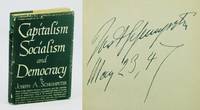
Schumpeter, Joseph A [Signed]Biblio.com
21 139 résultats
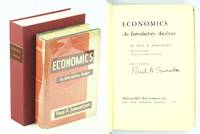
1947324H1607New York: Harper & Brothers Publishers. Good in Fair dust jacket. 1947. Second Edition. Hardcover. Boldly signed and dated without inscription by Schumpeter upon front free endpaper. A revision of the 1942 first edition with new material appraising the social changes wrought by WWII. p. xiv 411. Index. Bookplate of Leo Kramer inside front board. In these emergent days of AI robotics and blockchain technology Schumpeter's concept of creative destruction introduced in this work has never rung more true. Google Scholar states that a 2016 study by Professor Elliott Green determined this book to be the third most frequently cited work in the social sciences published before 1950. Blaug p.216 Pressman p.161 Fundaburk 9545 Swedberg chapter 7 Hutchinson 735 Hazlitt p.146 Augello S.011.; 8vo - over 7¾" - 9¾" tall; Capitalism Socialism and Democracy Schumpeter Joseph A. Signed Economics Political Economy Theory Process of Creative Destruction Harvard Industrial Mutation Progress Entrepreneurial Evolutionary Radical Innovation Schumpeter's gale Austrian Scho; Signed by Authors . Harper & Brothers Publishers hardcover
A Londres, Chez Fletcher Gyles, dans Holborn, 1755. 12mo (binding ab. 17x10 cm). Bound in a very nice, contemporary full mottled calf binding with five raised bands to richly gilt spine. All edges of boards with a single gilt line-decoration. Beautiful marbled edges. Very neat and professional restorations to hinges and upper capital. A single tiny worm-hole to middle of spine and a supeficial, barely noticeable, crack down the middle. Old paper-label to lower compartment of spine. One corner a bit worn. Small ex libris to inside of front board, ex libris stamp to half-title. Contemporary owner's name crossed out at title-page. Internally exceptionally nice and clean. Small worm-hole to inner margin of about 60 leaves towards the end, only just touching the edge of a very few letters, otherwise not affecting lettering at all. (4), 430, (6, -Table des Chapitres) pp.
Frankfurt a. M., 1845. 8vo. Contemporary black half calf. Professionally rebacked. Title-page somewhat dusty and re-hinged. VIII, 335, (1) pp.
Signed and inscribed by Henry George [1839-1897] upon first blank leaf. Publisher's brown blind-ruled cloth, gilt-lettered spine, floral endpapers; 4,xi,[3],512,[2],4,[4]pp. Moderate wear to extremities. Few light red pencil marks to four leaves. Trifles of ink writing atop front free endpaper and second blank leaf. Several thin ink lines on pages 138 and 241. Binding tight. 19 x 13 cm. George, an unknown printer in 1870's San Francisco, witnessed the city's evolution from rough encampment to wealthy metropolis, while at the same time observing the emergence of pauperism. He endeavored to discover why wealth grew simultaneously with poverty and, after years of study, produced this book, determining that a single tax on land value was the solution. Once early publishing difficulties were overcome, sales of the book skyrocketed into the millions internationally, exceeding all titles other than the bible in the 1890s. As a result, the Single Tax Movement was founded and George soon became the third most famous American, behind only Thomas Edison and Mark Twain. George inscribed this copy to Wm. B. Scott with whom he worked at The Standard, a weekly single-tax newspaper George founded and published from 1887 to 1890. An impressive signed association copy of what is considered the most influential of American works on economics. It is indeed ironic that, despite the exalted efforts of George, today's uber-wealth of San Francisco co-exists with a multitude of homeless souls cast upon her streets. Fundaburk 1451, Howes G-106, Batson p.87, Grolier - American One Hundred, #81, Hutchinson 694. Book
1948443j0499New York: McGraw-Hill Book Company Inc. Good in Good dust jacket. 1948. First Edition; First Printing. Hardcover. Signed without inscription by author upon title page. A first printing example of "the best-selling economics textbook of all time now in its 19th edition and having sold nearly four million copies in 40 languages. In 1970 Paul Samuelson 1915-2009 became the first American to win the Nobel Prize in Economic Sciences. Economic historian Randall E. Parker has called him the 'Father of Modern Economics' and the New York Times considers him to be the 'foremost academic economist of the 20th century'." - Wikipedia. Signature upon half-title appears to be that of Professor Emeritus and Rhodes Scholar G. Coleman Woodbury 1903-1994 "one of the three-person team which drafted the legislation establishing America's public housing program the Housing Act of 1937". - University of Wisconsin-Madison Faculty Document 1108. pp. xx 2-622. Tight clean and unmarked with moderate peripheral wear to publisher's original teale cloth brightly lettered in gilt. Few small bits of loss to edges of the rare unclipped dust jacket which otherwise bears average wear and is now in archival protection. Housed in attractive new custom two-color acid-free clamshell box with marbled paper lining and leather title label on spine. Fundaburk 2037 Pressman 2nd Edn p.243.; Sm 4to; Signed by Author . McGraw-Hill Book Company, Inc. hardcover
175562796A Londres, Chez Fletcher Gyles, dans Holborn, 1755. 12mo (17x10 cm). Bound in a nice, contemporary full mottled calf binding with five raised bands to richly gilt spine. All edges of boards with a single gilt line-decoration. Beautiful marbled edges. Very neat and professional restorations to hinges and upper capital. A single tiny worm-hole to middle of spine and a supeficial, barely noticeable, crack down the middle. Old paper-label to lower compartment of spine. One corner a bit worn. Small ex libris to inside of front board, ex libris stamp to half-title. Contemporary owner's name crossed out at title-page. Internally exceptionally nice and clean. Small worm-hole to inner margin of about 60 leaves towards the end, only just touching the edge of a very few letters, otherwise not affecting lettering at all. (4), 430, (6, -Table des Chapitres) pp.
60057[China, Hung-wu era, Printed during the reign of the first Ming emperor, Emperor Zhu Yuanzhang (Ming Taizu) (1368-98)] Folio (340 x 225 mm). Woodblock printed on grey mulberry paper. Uncirculated condition (UNC). Ornamentation and text faded, which happens naturally over time with mulberry paper, but legible. Lower left corner slightly rounded, which is also due to the quality of the paper and not due to use.1. Two red (vermilion) seal handstamps, one at each side, are located on the note. These stamps are typically not so clear, because they naturally fade over time. The seals of the notes are what signatures are to modern notes.The red imperial seal is applied on the reverse.2. At the top are six chinese characters ""Ta Ming t'ung Hsing Pao Cha's (Treasure Note of the Great Ming) in regular (K'ai Shu) style. Text is in black.3. The outer frame is ornated with dragon patterns surrounding the text. Ornamentation is in black.4. The upper center is printed with the face value ""1 Kuan"" (One string) in regular (K'ai Shu) style. ""One String"" was at this time equivalent to 1000 copper cash or one tael of purse silver or one-fourth tael of gold.5. The middle center is printed with diagram of ten piles containing ten copper coins, each coin representing the value of 10 cash (this equals 1000 copper cash).6. On both sides of the center are eight chines characters ""Ta Ming Pao Ch'ao, Tien Hsia T'ung Hsing"" (The Great Ming note, circulates everywhere) in real (Chuan Shu) style.7. The lower center is written in chinese and could be translated to ""This Ta Ming Pao Cha'o is printed with the approval of the Emperor through the Hu Pao and used side by side with the copper cash. Those who counterfeit Ta Ming Pai Cha'o will be beheaded while an informant will be rewarded with 250 taels of silver with confiscated property of the convicts into the bargain"".The size of the 1 Kuan note is the largest paper-money ever issued.
[China, Hung-wu era, Printed during the reign of the first Ming emperor, Emperor Zhu Yuanzhang (Ming Taizu) (1368-98)] Folio (340 x 225 mm). Woodblock printed on grey mulberry paper. Uncirculated condition (UNC). Ornamentation and text faded, which happens naturally over time with mulberry paper, but legible. Lower left corner slightly rounded, which is also due to the quality of the paper and not due to use.1. Two red (vermilion) seal handstamps, one at each side, are located on the note. These stamps are typically not so clear, because they naturally fade over time. The seals of the notes are what signatures are to modern notes.The red imperial seal is applied on the reverse.2. At the top are six chinese characters ""Ta Ming t'ung Hsing Pao Cha's (Treasure Note of the Great Ming) in regular (K'ai Shu) style. Text is in black.3. The outer frame is ornated with dragon patterns surrounding the text. Ornamentation is in black.4. The upper center is printed with the face value ""1 Kuan"" (One string) in regular (K'ai Shu) style. ""One String"" was at this time equivalent to 1000 copper cash or one tael of purse silver or one-fourth tael of gold.5. The middle center is printed with diagram of ten piles containing ten copper coins, each coin representing the value of 10 cash (this equals 1000 copper cash).6. On both sides of the center are eight chines characters ""Ta Ming Pao Ch'ao, Tien Hsia T'ung Hsing"" (The Great Ming note, circulates everywhere) in real (Chuan Shu) style.7. The lower center is written in chinese and could be translated to ""This Ta Ming Pao Cha'o is printed with the approval of the Emperor through the Hu Pao and used side by side with the copper cash. Those who counterfeit Ta Ming Pai Cha'o will be beheaded while an informant will be rewarded with 250 taels of silver with confiscated property of the convicts into the bargain"".The size of the 1 Kuan note is the largest paper-money ever issued.
1880169H4360New York: Henry George & Co. Good. 1880. Fourth Edition. Hardcover. Signed and inscribed by Henry George upon first blank leaf. George 1839-1897 an unknown printer in 1870's San Francisco witnessed the city's evolution from rough encampment to wealthy metropolis while at the same time observing the emergence of pauperism. He endeavored to discover why wealth grew simultaneously with poverty and after years of study produced this book determining that a single tax on land value was the solution. Once early publishing difficulties were overcome sales of the book skyrocketed into the millions internationally exceeding all titles other than the bible in the 1890s. As a result the Single Tax Movement was founded and George soon became the third most famous American behind only Thomas Edison and Mark Twain. George inscribed this copy to Wm. B. Scott with whom he worked at The Standard a weekly single-tax newspaper George founded and published from 1887 to 1890. Original brown blind-ruled cloth gilt-lettered spine floral endpapers; 4xi3512244 pp. Moderate wear to extremities. Few light red pencil marks to four leaves. Trifles of ink writing atop front free endpaper and second blank leaf. Several thin ink lines on pages 138 and 241. Binding tight. 19 x 13 cm. An impressive signed association copy of what is considered the most influential of American works on economics. Fundaburk 1451 Howes G-106 Batson p.87 Grolier - American One Hundred #81 Hutchinson 694.; 12mo - over 6¾" - 7¾" tall; Georgism Single Tax Movement Henry George Real Estate Tax Economics Progressive Era Political Economy; Signed by Authors . Henry George & Co. hardcover
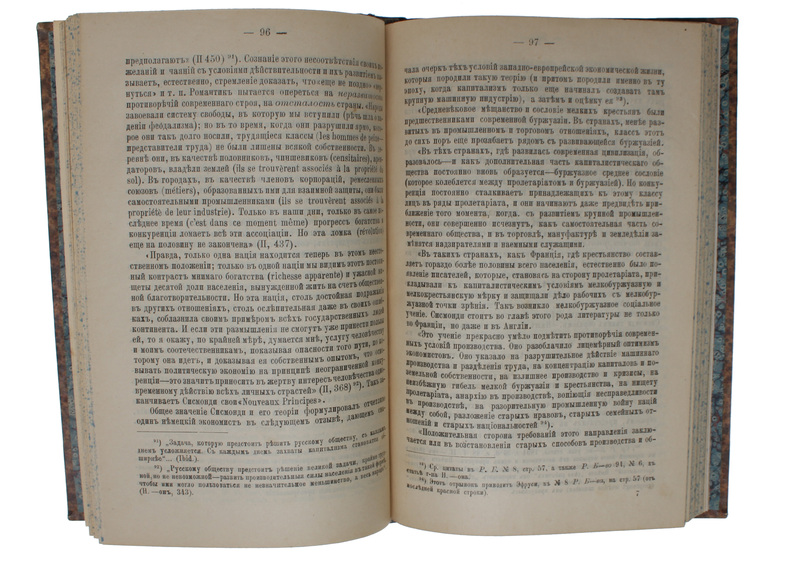
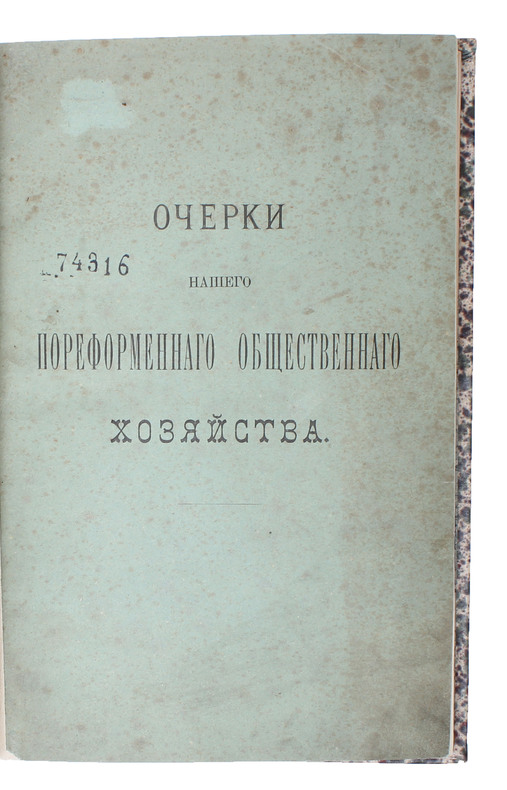
189958184S.-Petersburg, 1899 [recte October 1898]. 8vo. Bound in an excellent newer red half morocco in perfect contemporary style, with five raised bands and gilt author and year to spine. Marbled edges and beautiful marbled en-papers. Old owner's stamps to title-page (""Biblioteka Aleksandova, S. 1873 F."", ""Iz knig Avrutina M.V."", and the number ""21162""), otherwise also internally very nice and clean. (4), 290 pp.
S.-Petersburg, 1899 [recte October 1898]. 8vo. Bound in an excellent newer red half morocco in perfect contemporary style, with five raised bands and gilt author and year to spine. Marbled edges and beautiful marbled en-papers. Old owner's stamps to title-page (""Biblioteka Aleksandova, S. 1873 F."", ""Iz knig Avrutina M.V."", and the number ""21162""), otherwise also internally very nice and clean. (4), 290 pp.
London, The Modern Press, 1883. Royal8vo. Entire volume present, in the original olive green full cloth binding with gilt lettering to spine. Front board with black line-borders, black vignette, gilt lettering and gilt ornamentation depicting the sun. Spine with small mark and professional repairs to head and tail of spine. Light occassional brownspots to first leaves, otherwise a fine and clean copy. (Capital:) Pp. 57-68" 145-150. (Entire volume:) IV, 600 pp. Housed in a cloth clamshell box with gilt lettering to spine.
The Hague, Liebers & Co, (1881). 8vo. Uncut in the original printed wrappers. Spine missing some of the paper and upper part of front wrapper and lower part of back wrappers detached. Wrappers brownspotted and previous owner's name in pencil to upper margin of front wrapper. Pp. 37-40 missing some of the paper in upper margin - far from affecting text, otherwise internally fine and clean. VII, 82 pp.
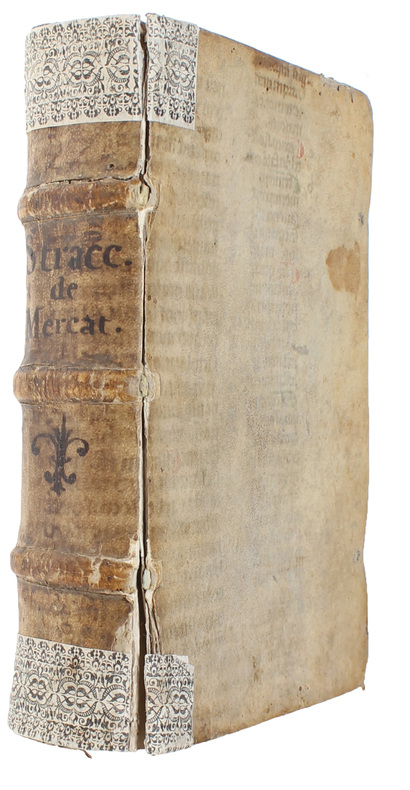
155350627Venetiis [Venice], Cum Preivilegio [Paolo Manuzio], 1553. 8vo. In a contemporary unrestored vellum binding with three raised bands. Later paper labels pasted on to upper and lower part of spine. ""Stracc. / de /Mercat."" written in contemporary hand to spine. Upper and lower part of front hinge slightly cracked. ""sum Marii D'Abbatis"" written in contemporary hand to pasted down front free end-paper. Early oval stamp on verso of title-page with monogram. Aldine woodcut device to title-page (Ahmanson-Murphy device no: B2). Occasional marginal annotations and very light occasional marginal water-staining. Tiny wormhole in blank outer margin not affecting text. A very nice, clean, and completely unrestored copy. (40), 287, (1) ff. (with the four blanks 5+6-8 and 2N8). As usual with the typopgraphical errors: ""63 '64', 85 '87', 87 '85', 102 '106', 165 '167', 174 '176', 176 '178'"". These errors are to be found in all published copies.
Venetiis [Venice], Cum Preivilegio [Paolo Manuzio], 1553. 8vo. In a contemporary unrestored vellum binding with three raised bands. Later paper labels pasted on to upper and lower part of spine. ""Stracc. / de /Mercat."" written in contemporary hand to spine. Upper and lower part of front hinge slightly cracked. ""sum Marii D'Abbatis"" written in contemporary hand to pasted down front free end-paper. Early oval stamp on verso of title-page with monogram. Aldine woodcut device to title-page (Ahmanson-Murphy device no: B2). Occasional marginal annotations and very light occasional marginal water-staining. Tiny wormhole in blank outer margin not affecting text. A very nice, clean, and completely unrestored copy. (40), 287, (1) ff. (with the four blanks 5+6-8 and 2N8). As usual with the typopgraphical errors: ""63 '64', 85 '87', 87 '85', 102 '106', 165 '167', 174 '176', 176 '178'"". These errors are to be found in all published copies.
190058355Wien & Leipzig, Wilheml Braumüller, 1900. 8vo. In contemporary half cloth with gilt lettering to spine. Endpapers brownspotted. Offprint from: ""Zeitschrift für Volkswirtschaft, Socialpolitik und Verwaltung"", Achter Band. 'Vom Verfasser' inscribed on upper right corner of title-page. With previous owner's dedication to pasted down front end-paper: ""An H. Furuja (Oct. 1947) / Seiichi Tobata Leipzig August 1928"", and to verso of front free end-paper: ""Zugleich / S. S. 129-360 von Eugen von Böhm -Bawerk: Kleine / Abhandlungenåuber Kapital und Zins, hrsg von / Franz X. Weiss. 1926 Wien und Leipzig"". A fine copy. (4), 127, (1) pp.
179155808Vienna, Ignazio Alberti, 1791. 4to. Magnificent contemporary full mottled calf with richly gilt spine. gilt ornamental borders to boards and large oval centre-pieces, each encircled by a floriated gilt border, inside which a female figures of polished calf, in Roman style - presumably predicting Minerva (the goddess of wisdom and war) on the front and Juventas (the goddess of youth) on the back board. All edges of boards gilt and inner gilt dentelles. All edges gilt. Bound by G.F. Kraus of Vienna, with gold-stamped binder's signature to inside of back board. A bit of wear (mostly coming from the acid used to mottle the calf in the 18th century). A magnificent copy that is also internally in splendid condition. It is printed on thick, heavy paper and with wide margins. There's an elegant stamp to the title-page, a crowned monogram that we have not been able to identify.
Wien & Leipzig, Wilheml Braumüller, 1900. 8vo. In contemporary half cloth with gilt lettering to spine. Endpapers brownspotted. Offprint from: ""Zeitschrift für Volkswirtschaft, Socialpolitik und Verwaltung"", Achter Band. 'Vom Verfasser' inscribed on upper right corner of title-page. With previous owner's dedication to pasted down front end-paper: ""An H. Furuja (Oct. 1947) / Seiichi Tobata Leipzig August 1928"", and to verso of front free end-paper: ""Zugleich / S. S. 129-360 von Eugen von Böhm -Bawerk: Kleine / Abhandlungenåuber Kapital und Zins, hrsg von / Franz X. Weiss. 1926 Wien und Leipzig"". A fine copy. (4), 127, (1) pp.
Vienna, Ignazio Alberti, 1791. 4to. Magnificent contemporary full mottled calf with richly gilt spine. gilt ornamental borders to boards and large oval centre-pieces, each encircled by a floriated gilt border, inside which a female figures of polished calf, in Roman style - presumably predicting Minerva (the goddess of wisdom and war) on the front and Juventas (the goddess of youth) on the back board. All edges of boards gilt and inner gilt dentelles. All edges gilt. Bound by G.F. Kraus of Vienna, with gold-stamped binder's signature to inside of back board. A bit of wear (mostly coming from the acid used to mottle the calf in the 18th century). A magnificent copy that is also internally in splendid condition. It is printed on thick, heavy paper and with wide margins. There's an elegant stamp to the title-page, a crowned monogram that we have not been able to identify.
Madrid, Ricardo Fé, 1887. 8vo. Contemporary brown half calf with gilt lettering and ornamentation to spine and red paper covered boards. Most leaves evenly browned (due to the quality of the paper) and some brownspotting to last few leaves. Overall a very good copy indeed of this otherwise fragile book. [Socialismo Utopico... :] pp. (1)-91, (1) + frontispiece of Engels" [La Ley de Los Salarios... :] pp. (1)-44 + frontiespiece of Guesde " [El Capital:] pp. (I)-LVI, 263 pp.
1966443h6104Princeton: Princeton University Press. Good in Fair dust jacket. 1966. Third Printing. Hardcover. Signed and inscribed by Milton Friedman upon half-title. "Uses historical time series and economic analysis to argue the then-novel proposition that changes in the money supply profoundly influenced the U.S. economy especially the behavior of economic fluctuations. The implication drawn is that changes in the money supply had unintended adverse effects and that sound monetary policy is necessary for economic stability. Orthodox economic historians see this as one of the most influential economics books of the century. Friedman 1912-2006 won the 1976 Nobel Prize in Economic Sciences. Upon his death The Economist described him as 'the most influential economist of the second half of the twentieth century. possibly all of it.'" - Wikipedia. Third printing of the 1963 first edition. Inscribed to John De Jong whose name is handwritten atop front free endpaper. No other markings. Dr. De Jong 1937-2018 was a member of the New York Municipal Analysts Society and contributed to the Dow Jones-Irwin Handbook of Municipal Bonds. Moderate wear to publisher's green cloth. pp. xxiv 860. Above-average wear and soiling to dust jacket now preserved in archival-grade Brodart. A special copy of this eminent study. Cohen 407 Pressman 2e p.242 Weems p.45. ; Sm 4to; Signed by Author . Princeton University Press hardcover
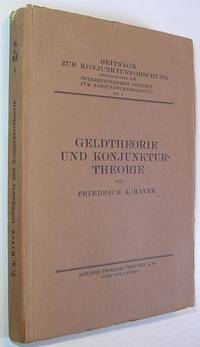
1929313a9146Germany: Holder-Pichler-Tempsky A.G. Good. 1929. First Edition. Paperback. xii 147 2 ads pp. Index. "Beitrage zur Konjunkturforschung - Herausgegeben vom Osterreichischen Institut fur Konjunkturforschung nr. 1" - front cover. Text in German. In 1933 this work appeared for the first time in English as "Monetary Theory and the Trade Cycle". Hayek went on to share the Nobel Prize in Economics in 1974. Moderate wear to original brown paper wrappers. Binding sound. Small chip from top of backstrip. Top corners of last five leaves were folded. Several mostly imperceptible pencil erasures in first 66 pages. A well-preserved example of the first edition of this Hayek's first book. Masui p.1277 Cohen 184 Cody & Ostrem B-1.; 8vo - over 7¾" - 9¾" tall; Geldtheorie Und Konjunkturtheorie Monetary Theory Trade Cycle Austrian School Economics Monetary Policy . Holder-Pichler-Tempsky A.G. paperback
1961159a8097Chicago: The University of Chicago Press. 1961. Third Impression. Hardcover. Good in Good dust jacket. Signed and inscribed by Hayek upon front free endpaper to Swedish journalist Arvid Fredborg. A National Review Panel ranked this work as the ninth best non-fiction book of the twentieth century. "A positive statement of the principles of society that in scope and breadth is more like a new Wealth of Nations. A thorough exposition of a social philosophy which ranges from ethics and anthropology through jurisprudence and the history of ideas to the economics of the modern welfare state." - Publisher. Third printing. x 570 p. Clean and unmarked with moderate wear. Binding intact. Light wear to unclipped dust jacket now in glossy new archival-grade protection. An attractive signed example of this influential work. Cody & Ostrem B-12 Pressman p.180.; 8vo - over 7¾" - 9¾" tall; LOC # 59-11618 Von Hayek Friedrich A. The Constitution of Liberty Arvid Fredborg social philosophy ethics anthropology jurisprudence history of ideas economics modern welfare State Arvid Fredborg; Signed by Author . The University of Chicago Press hardcover
Paris, Bossange père" " Londres, Martin Bossange et Comp., 1822 & 1823. 8vo. [Traité:] Two lovely contemporary, uniform half calf bindings with gilding and blindstamped ornamentations to spines. ""E. C."" in gilt lettering to top of spine on both volumes + [Sommaire:] a bit later red half cloth with marbled paper over boards. Gilt title to spine. [Traité]: signed by the author on verso of half-title in vol. 1: ""Ch Fourier"". Title-page of vol. 1 with a small light brown stain (probably candle-starin), far from affecting lettering. Both volumes in lovely condition, with only very light occassional brownspoting. LXXX, 592 pp." " VIII, 648 pp. [Sommaire:] Title-page slightly browned, evenly. Otherwise very nice, clean, and fresh. 16 pp, pp. (1329) -1448 + 4 ff. (= (A8 (unnumbered) - on two leaves, first recto and second verso blank) + B8, C8, D8, E8).A lovely set.
189348290S.-Petersburg, A Benke, 1893. 8vo. Bound with the original printed green front wrapper in a beautiful green half calf with gilt lettering to spine. Front wrapper brownspotted. Bottom 3 cm. of p.1-2 cut off, shaving a few lines off. A few underlinings to the first leaves. XVI, 353, (1) pp. + 29 tables, numbered I-XVI (with a,b,c's: IIIa-b, IVa-h, Va-c, VIa-b, VIIa-b, Xa-bXIIIa-b), on 16 leaves, 12 of which folded, most of them large + 2 leaves of explanation in between.