1 156 résultats
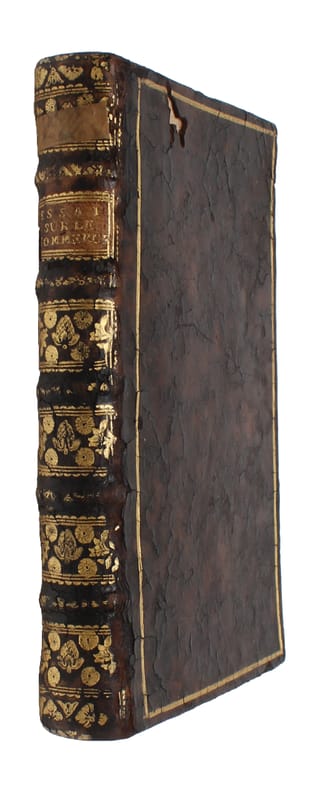
19185A Troyes, Chez Sainton, André, 1791-1792. Two volumes. (4), 518, (12) pp.; 429, (13) pp. 4to. Contemporary calf, spines gilt with red and green labels and gilt lettering, gilt fillets on sides, gilt inside dentelles, all edges gilt, some minor imperfections. Not in Martin & Walter; not in Monglond; Lecestre, p. 18 & p. 19. First edition. The first volume deals with the session from 3 November upto 15 December 1790 and dealt with a great variety of subjects: population du département, sur l'agriculture, sur l'industrie, sur le commerce, sur les arts, sur les grands communications, sur les rivières, sur les routs, travaux publics, ateliers de charité, encouragemens et secours de bienfaisance, biens nationaux, contribution patriotique, etc., etc. Henri Picot Dampierre was the president of the Assembly.The second volume covers the session that was held from 15 November upto 14 December 1791: this session covered a great variety of subjects: Frais d'administration, dépense de l'ordre judiciaire de l'année 1791, frais du culte, pensions et secours accordés aux ecclésiastiques et communautés religieuses, dépenses relatives aux travaux des routes, aux travaux de charité, au bien public, à la mendicité, population du département, sur l'agriculture, sur l'industrie, sur le commerce, sur les arts, sur les grands communications, sur les rivières, sur les routs, travaux publics, ateliers de charité, encouragemens et secours de bienfaisance, biens nationaux, contribution patriotique, etc., etc.The first volume has the gilt stamped name of H.P. Dampierre in the center of both sides with above a gilt stamped fleuron with the text "La Nation, la Loi et le Roi", the second volume has the gilt stamped name of T. Cobin, Pr. Général in center of both sides with above the gilt stamped fleuron 'Droits de l'Homme'. H.P Dampierre was the President of the Assembly.
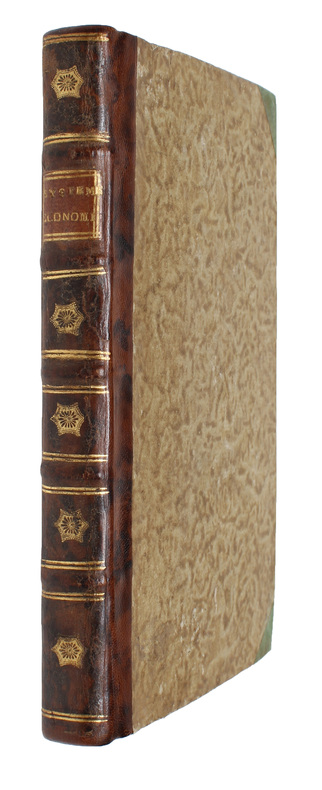
24339A Amsterdam, Chez Nicolas Viollet, 1702. Title printed in red and black. 108 unnumbered leaves. Small 4to. Later half marbled calf, marbled boards, corners somewhat bumped, short split in front joint at foot, small damage at foot of spine. Conlon, Prélude, 11055; not in Kress; not in Goldsmiths; not in Einaudi; not in INED. First edition, very rare, containing the letters 6 through 31. After the title-page is an 'Avertissement', followed by a 'Sommaire des Lettres provinciales, depuis la première, jusqu'à la vingt-cinquième' of two leaves containing the summaries of the first 8 letters and a part of the ninth, lacking whatever was published further, followed by the 'Sixième Lettre du Marchand de Province, &c' upto the 'Trente-et-unième Lettre Provinciale'. From the summary we can see that the first letters were published in 1699, and the 31st letter is dated October 31, 1701. Apparently the first six letters were published as 'Lettre du marchand de Province, .....', with the 7th letter the title becomes 'Lettre Provinciale ......' All letters have 4 leaves. They all deal with commerce and trade, finance and financial politics, religion and religious conflicts, and politics.This is possibly a collective edition of separately issued letters with a specialy printed title-page. The piece is very rare: the BN (l'Arsenal) has a copy with the first six letters, but containing 22 letters only, the letters 23-31 being absent.
19238(Paris, Imprimerie de l'Assemblée Nationale, 1848). 3 volumes in one. 376 pp.; 335, (1) pp.; 254 (misnumbered 252) pp. 4to. Contemporary red half morocco, corners, marbled boards, spine gilt with gilt lettering, top edge gilt. Bibliothèque Nationale. La Révolution de 1848, 866. Original edition. The events of May 15 deal with a large demonstration mounted by Parisian clubists and workers to pressure the Assembly to send troops to the aid of Poland which escalated into an invasion of the Assembly and the proclamation of a New Provisional Government, including Louis Blanc and other leftists. But the Executive Commission soon dispersed the demonstrators, arrested the most popular leaders -including Albert, Barbès and Blanqui- and suppressed many of the clubs. Draconian laws prohibited street gatherings, consequent mass arrests, and the Assembly's hostility to social reform created a situation electric with fear and anger. This was precipitated into insurrection by the Assembly's decision on 21 June to slash the rolls of the National Workshops. For four days, an unprecedented civil war tore the city in two. The June uprising started with several large gatherings at the Place de la Bastille and at the Pantheon on 22 June and the morning of June 23 and were followed by the erection of hundreds of barricades throughout eastern Paris. The June days then were an insurrection of Parisian workers against the government of the Second Republic which was crushed by the army in the bloodiest street figthing in Paris before the Commune of 1871. Alexis de Tocqueville noted the working-class character in the insurrection, and Karl Marx called the June Days the first great class struggle between the proletariat and the bourgeoisie. Very valuable source. The rapports contain a.o.: Documents relatifs à Louis Blanc. - Documents relatifs à M. Caussidiére. - Documents relatifs à l'affaire de Belgique. - Actes du Gouvernement provisoire. - Documents sur les Clubs. - Ateliers nationaux. - Documents fournis par les préfectures, etc. The leading man of this 'Commission d'Enquête' was A. Bauchart who was vehemently attacked by Victor Hugo and Louis Blanc. A major and fundamental source for the 1848 revolution. - Quire 10 in the third volume disbound but complete.
24695A Paris, De l'Imprimerie Royale, 1785. With three folding tables. (2), 106 pp. 4to. Modern boards. Conlon 85:615; not in Kress; not in Goldsmiths. First edition. Signed at end by Le Roy, Tillet and Desmarest.The contents can be best summarized by giving the drop-head title on page one: Rapport fait à l'Académie, Relativement à l'advis que le Parlement a demandé à cette Académie, par arrêt du 6 Septembre 1793. Sur la contestation qui s'est élevée à Rochefort, au sujet de la taxe du Pain; sur les Expériences qui ont été faites dans cette Ville à ce même sujet, en exécution d'un arrêt du Parlement du 7 Juin 1781; & sur les moyens d'établir le prix juste du Pain, proportionnément à celui du Blé, suivant la quantité de Farines différentes qu'une quantité de livres de Blé peut rendre, & suivant la quantité de Pain que ses Farines doivent donner. - Small brown spot in inner blank margin of title-page, else a fine copy.
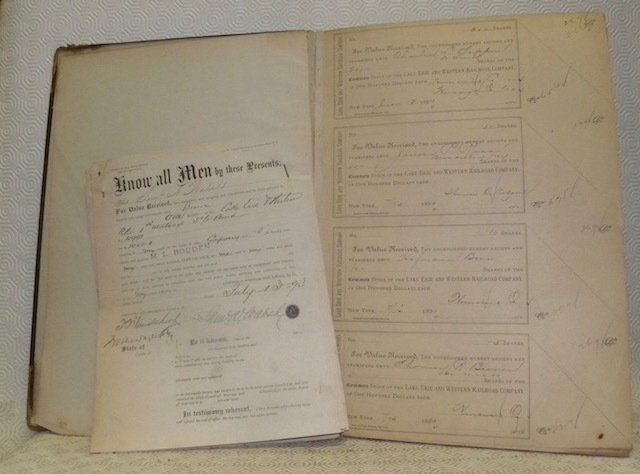
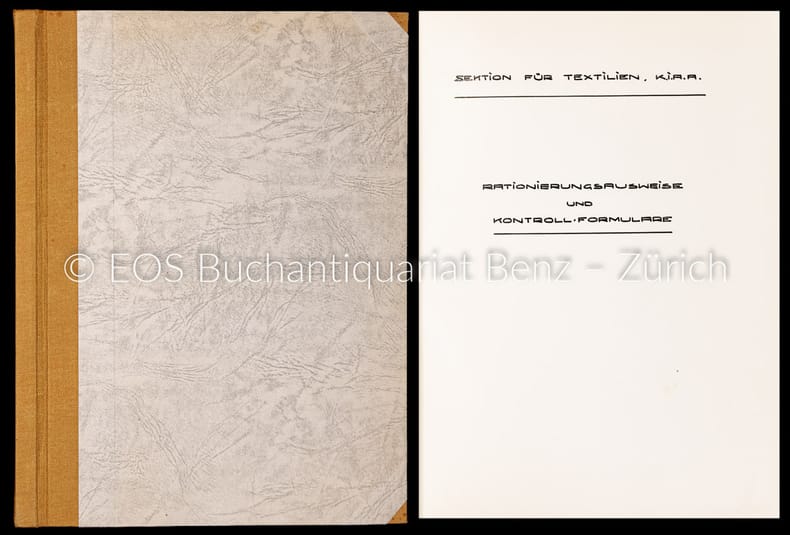
7060CB2 Teile in 1 Band. (30) Bl. Mit montierten Rationierungskarten, Coupons und Bezugscheinen. Halbleinenband der Zeit, gebunden in der Papeterie Hauser-Worni in Näfels.
16800A Paris, Chez la veuve Saugrain & P. Prault, 1714. 5 parts in 1. 184 pp.; 192 pp.; 140 pp.; 168 pp.; 32, (20) pp. 4to. Contemporary calf, spine gilt with raised bands, label with gilt lettering, somewhat damaged at foot of spine, lightly rubbed. Not in Kress; not in Goldsmiths; not in Gavet. - Copy from the library of Balincourt-Cabrières, with engraved bookplate, and with many contemporary marginal annotations on a number of leaves.
26196No place (Paris ?), (1752). 8 pp. 4to. Modern boards. Conlon 52:296. First edition. Account of an accident caused by work: as a result of a collapse of rocks in a quarry, two workmen are buried in the shaft. After nine days of rescue work, elaborately detailed here, the two are saved and freed from the shaft where they got stuck and are moved to the house of the "Sieur Trudon, ou ils sont l'objet de la visite et des bienfaits du public."
18028A Paris, Chez A.-J. Marchant, An XI (1803). With one folding table and a very charming engraved vignette on page 1. xvi, 175, (1), (8, publisher's catalogue) pp. 8vo. Modern marbled boards, red morocco label with gilt lettering. Musset-Pathay 1740; not in Kress; not in Goldsmiths; not in Einaudi. First French edition ? Musset-Pathay lists Barbé-Marbois as the translator. Deals with alfalfa, clover and sainfoin in the form of dialogues between Benjamin Jachère and Richard Trèfle (Mr. Fallow and Mr. Clover).
192326945ABZürich, Orell Füssli, (1923). 4°. 11 S. Mit 5 graphischen Darstellungen auf Tafeln und 16 Abb. auf Tafeln. Orig.-Pappband.
17043A Londres, 1775. With 1 folding map and 4 folding tables. viii, 293, (1) pp. 8vo. Contemporary marbled calf, spine gilt in compartments, red morocco label with gilt lettering, gilt triple fillets on sides, red edges. Kress 7170; Goldsmiths 11330; Einaudi 5517; INED 4798; Higgs 6403; Peignot, Livres Condamnés, i, p. 141. First edition. Severely prosecuted attack on the Fermiers-Généraux, forbidden already in 1776. 'Diatribe sanglante contre les fermiers généraux et les abus scandaleux de leurs agents. L'auteur met en scene un malheureux dont les 'suppôts de la ferme' ont ruiné la famille et fait périr le père de chagrin' (INED). According to a manuscript note in the Kress copy: '..... l'on croit que cette sanglante diatribe des fermiers généraux a été composée, imprimée et répandue sous les auspices du ministère actuel (celui de Turgot & Malesherbes).'This, in fact, is the first edition of a work which became better known under the title "L'Ami du Peuple François, ou Mémoire adressée à Mr. Turgot, ....." published at Limoges one year later (1776). Even the motto in both works is identical: "Ni Ferme ni regie: l'une et l'autre font la perte des Etats." The present work contains the same text as the "L'Ami du Peuple" (upto page 84, and then the pages 256-269) and contains in addition much detailed information about the taxes. It was probably deemed to complex or technical and was published again in 1776 as "L'Ami du Peuple François" this time omitting the detailed information about the taxes. The work suggests Turgot to abolish the tax system in use as it is injust and odious, of relatively little profit to the king but very profitable for the taxfarmers and hard-pressing on the population. The work describes in detail the various taxes in existence, their effects, the cruel practises of the taxfarmers, the uneven division of the taxes and the disastrous effects.It is told in the form of a story: the anonymous author recounts the story of his father and his family and how they were, little by little, driven to complete ruin. His father, responsible for the collecting of taxes in his village, is thrown in jail and his possessions confiscated by the taxfarmers because of his inability to raise the requested taxes from the other taxable inhabitants of his village.
15515Autun, Impr. de Dejussieu, (1810). 1 large folded leaf. 8vo. Modern boards, leather label with gilt lettering. Not in Kress; not in Goldsmiths. Printed recto and verso and giving the various exchange rates.
77982New York, no year, about 1820, 390x290mm, basil half-binding. Back of the book damaged.
13370No place, (1787) (Paris, EDHIS, 1976). 31, (1) pp. 8vo. Boards. Not in INED; not in Goldsmiths; not in Kress; Conlon 87:1288. Reprint of this very rare and important little work, editon limited to 150 numbered copies and 30 not destined for the trade, and since long out-of-print. The unknown author of this tract brings up the question of the defense of the interests of the lower classes of the population, those who have no property nor any other wealth, no status, no rights and who ask only this: to have work to do, the certainty that this work will enable them to live and not to be robbed by the taxes.
20769Amsterdam (France), 1767. (4), 474 pp. Small 8vo. Contemporary marbled calf, spine gilt in compartments, green label with gilt lettering. Hartig 59; Trousson pp. 161-162; Gove p. 356; INED 3858; cf.: Negley 979. Rare second issue of the first edition (1766) of this utopian novel in which, in the vein of Rousseau, the newly discovered people of an (Australian) island are praised for their political and social institutions (thereby condamning the European counterparts). Utopian account of which it is suggested that it is a translation from the English. The work is evidently inspired by the Physiocratic ideas and draws also inspiration from Rousseau's Contrat Social. Contains also political, economical and moral ideas, points to the importance of agriculture and population, and pleads for the nationalization of the trade. The Encyclopedists appear as the 'Pansophistes' and are criticized (pp. 146 and ff.) The main story is that the hero has sailed with Sir Francis Drake to South America and, through his narrative, to have inspired William Penn to found an ideal city in North America. For an extensive description of this interesting work see: Van Wijngaarden, Les Odyssées philosophiques en France entre 1616 et 1789, pp. 216-225.
178748069Kiøbenhavn, Gyldendals Forlag, 1787. Uden omslag. (4),29 pp.
175562796A Londres, Chez Fletcher Gyles, dans Holborn, 1755. 12mo (17x10 cm). Bound in a nice, contemporary full mottled calf binding with five raised bands to richly gilt spine. All edges of boards with a single gilt line-decoration. Beautiful marbled edges. Very neat and professional restorations to hinges and upper capital. A single tiny worm-hole to middle of spine and a supeficial, barely noticeable, crack down the middle. Old paper-label to lower compartment of spine. One corner a bit worn. Small ex libris to inside of front board, ex libris stamp to half-title. Contemporary owner's name crossed out at title-page. Internally exceptionally nice and clean. Small worm-hole to inner margin of about 60 leaves towards the end, only just touching the edge of a very few letters, otherwise not affecting lettering at all. (4), 430, (6, -Table des Chapitres) pp.
173560740Amsterdam, Changuion, 1735. 8vo. In contemporary full sprinkled calf with five raised bands with richly gilt spine. Gilt frame to boards and edges of boards gilt. Small paper label pasted on to upper compartment of spine. Extremities with wear, boards with scratches and missing small part of the leather. Internally very fine and clean. (14), 251 pp.
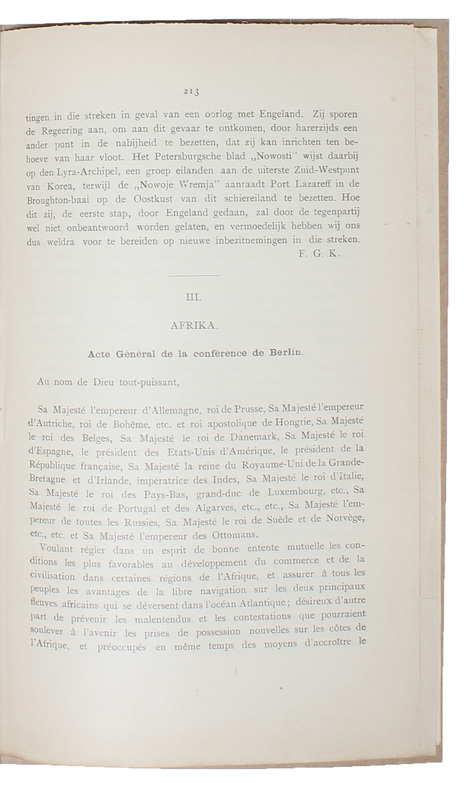
188550241Amsterdam, K.N.A.G., 1885. 8vo. In recent paper wrappers with brown title label pasted on the front wrappers. As extracted from ""Koninklijk Nederlands Aardrijkskundig Genootschap"". Vol. II. Very fine and clean. Pp. 213-228.
194450242Washington, U. S. Treasury, 1944. 8vo. Bound with the original wrappers in later half cloth. White library numbering to top left corner of front boards and front wrapper. ""Withdrawn"" stamp to front wrapper. Soiling to top right corner of front wrapper affecting first 20 leaves. Front wrapper creased. X, 88 pp.
60057[China, Hung-wu era, Printed during the reign of the first Ming emperor, Emperor Zhu Yuanzhang (Ming Taizu) (1368-98)] Folio (340 x 225 mm). Woodblock printed on grey mulberry paper. Uncirculated condition (UNC). Ornamentation and text faded, which happens naturally over time with mulberry paper, but legible. Lower left corner slightly rounded, which is also due to the quality of the paper and not due to use.1. Two red (vermilion) seal handstamps, one at each side, are located on the note. These stamps are typically not so clear, because they naturally fade over time. The seals of the notes are what signatures are to modern notes.The red imperial seal is applied on the reverse.2. At the top are six chinese characters ""Ta Ming t'ung Hsing Pao Cha's (Treasure Note of the Great Ming) in regular (K'ai Shu) style. Text is in black.3. The outer frame is ornated with dragon patterns surrounding the text. Ornamentation is in black.4. The upper center is printed with the face value ""1 Kuan"" (One string) in regular (K'ai Shu) style. ""One String"" was at this time equivalent to 1000 copper cash or one tael of purse silver or one-fourth tael of gold.5. The middle center is printed with diagram of ten piles containing ten copper coins, each coin representing the value of 10 cash (this equals 1000 copper cash).6. On both sides of the center are eight chines characters ""Ta Ming Pao Ch'ao, Tien Hsia T'ung Hsing"" (The Great Ming note, circulates everywhere) in real (Chuan Shu) style.7. The lower center is written in chinese and could be translated to ""This Ta Ming Pao Cha'o is printed with the approval of the Emperor through the Hu Pao and used side by side with the copper cash. Those who counterfeit Ta Ming Pai Cha'o will be beheaded while an informant will be rewarded with 250 taels of silver with confiscated property of the convicts into the bargain"".The size of the 1 Kuan note is the largest paper-money ever issued.
172748231London, J. Peele, 1727. 8vo. Without wrappers. A fine and clean copy. 72 pp.
178749558Geneve, Barde & Compagnie, 1787. 8vo. In a fine contemporary half calf binding with five raised bands, red leather title label with gilt lettering and gilt ornamentations to spine. Boards recently repaired An extraordinarily fine copy. VI, 294 pp.
177545685Firenze, Gaetano Cambiagi, 1775. Royal8vo. In patterned contemporary paper wrappers. Wrappers with some tears and minor loss. Internally very fine, clean, and fresh. 62, (2) pp.
187946867London, The Economist Office, 1879. Small folio. Bound in comtemporary half cloth. Entire volume 37, July - December, 1879, of The Economist. Minor wear to extremities and a few repairs to a few leaves, otherwise fine and clean. Pp. 761-1504.
177149572Kiøbenhavn, uden trykker, 1771. Indlagt i sener papomslag med exlibris og stempel fra ""Bergens offentlige Bibliothek"". Stemplet ""Utgått"" på bagsiden af titelbladet. 22 pp.