Giesbert Franz-OlivierLivre Rare Book

1 153 résultats
2013500281327J'ai lu 2013 224 pages 10 8x1 4x17 6cm. 2013. pocket_book. 224 pages.
17553Paris, Dentu, 1864. 96 pp. Small 8vo. Modern boards, original covers preserved. Against the 'associations ouvrières'. The author (of whom we could not trace any information) defends free enterprise and argues that 'Il faut laisser les patrons débattre librement le prix des salaires avec leurs ouvriers, et laisser l'ouvrier prélever, à son gré, sur son salaire, l'épargne qui sa prévoyance doit l'engager à faire ....' The workers may found small 'sociétés de secours mutuels'. As for the 'patrons': se sont eux qui, chefs d'usine, exposent leur fortune, leur personne, leur honneur même aux chances des affaires.
18217A Londres, et se trouve à Paris, Chez Dessain junior, 1767. (2), xii, 298 pp. 12mo. Contemporary marbled calf, spine gilt in compartments, label with gilt lettering, red edges, some light scratches, small repair to joint of rear cover, a fine copy. Kress 6453; Goldsmiths 10298; Einaudi 3048; INED 2349; Higgs 4197; Conlon 67:953; not in Mattioli. First (and only?) edition. The abbé Pierre Jaubert's opinions were more varied than those of Danguel and Plombaine, but similar in character. He accepted the opinion of Montesquieu, Forbonnais, and the agrarian writers that population tended to grow when men were assured the fruits of their labor and some comfort; and that failure to cultivate all available land, coupled with the great and inequitable tax burden was depressing agricultural production and retarding population growth. Therefore he advocated stimulation of the agricultural arts: protection of agriculturalists against their creditors; a redistribution of the tax burden; the use of idle urban workeers to perform the corvées; and restrictions upon the crop-destroying wild game which were raised and protected for the benefit of the nobility. He furthermore proposed that monasteries and nunneries be stripped of tax exemption and other privileges, he was critical, as were many writers, of the French hospital and penal system, he advocated an improved urban water supply, enlargement and frequent cleaning of the streets, daily filth removal, and the location of certain establishments (cemetries, tanneries, etc.) outside cities. Spengler considers his suggestions for the curtailment of celebacy and the counterbalancing of its effects, as most important. With his emphasis on agricultural arts he was in line with the Physiocrats (for a detailed analysis see: Spengler, French predecessors of Malthus, pp. 90-94). A very nice copy of a scarce and important work.
26243A Paris, De l'Imprimerie de Sébastien Jorry, 1768. Frontispice by Jean Massard after Charles Eisen representing the young Dauphin, the future Louis XVI, running after the shadow of his father, the Dauphin Louis, who died in 1765. xxxiv, 586, (2) pp. 8vo. Contemporary marbled calf, spine richly gilt with raised bands, label with gilt lettering, marbled edges, gilt triple fillet on sides, very lightly rubbed. INED 2163 (edition 1790 in 2 volumes in 12mo); Higgs 4522; Goldsmiths 11087 (the 1774 edition); Kress S.4524; not in Mattioli; Einaudi A.348 (the 1774 edition); Lichtenberger, Le Socialisme au XVIIIe Siècle, pp. 391-393. First edition of the major work by the Abbé Gros de Besplas, the preacher of Louis XV. While property, society and religion were subjected to violent attacks in the writings of the philosophes, only very few "abbé's" introduced the subject of political economy into their sermons, some even to the point where they were called to order by the ecclesiastical authorites. Among them, the Abbé Gros de Besplas, while not believing in the utility of important and profound reform, argued that public welfare, of which religion and the monarch were the principle guards, follows from possession of the "necessary", a certain abundance, and being subjected to work. Gros de Besplas strongly condamns celibacy, mendicity and "le luxe" which, he feels, must be suppressed by means of heavy taxes, deplores the fallow land for want of instruments and machines in the hands of those who work the land, and argues for a more even distribution of land in "accord avec la justice". The subjects of the monarch, or any ruler, have four important rights: the right to life, the right to be free, the right to own property, and the right to be protected. From this Gros de Besplas arrives at a socialist theory of property: the property of land belongs to society as it can not belong to any particular man. To his politically moderate ideas Gros de Besplan attaches more radical ideas concerning property.The engraved frontispiece is preceded by a leaf which contains verso an "Explication du Frontispiece." Rare: only Higgs and Kress have the original edition.
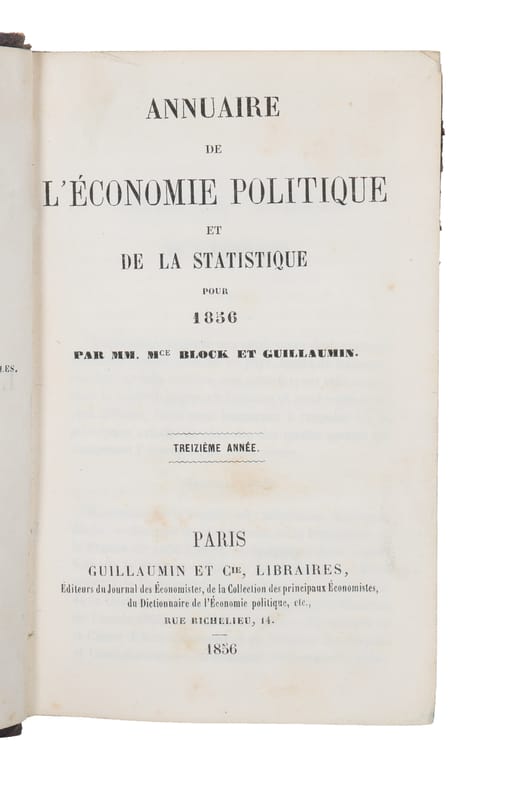
185653099Paris, Guillaumin, 1856. Small8vo. In a nice contemporary full calf binding with gilt lettering and ornamentation to spine and embossed front and back boards. In ""Annuaire de L'Economie Politique et de la Statistique"", 1856, Trezieme Annee. Entire volume offered. Wear to upper and lower part of spine and internally with light occassional brownspotting. A fine copy. Pp. 555-581. [Entire volume: VIII, 612 pp.].
175742375A La Haie, 1757. 12mo. Very nice marbled full calf with richly gilt spine. Gilt title-label to spine. All edges of boards gilt (gilding a bit worn). Marbled edges. Front and back end-papers with a few later annotations. Otherwise a very nice and clean copy. VIII, 278 pp.
174161030(No place, nor printer), 1741. 8vo. In contemporary full mottled calf with five raised bands and gilt lettering to spine. Small paper-label pasted on to top of spine. All edges coloured in red. A nice and clean copy. (16), 367 pp.
2006100138898Cambridge University Press 2006 356 pages in8. 2006. Cartonné jaquette. 356 pages.
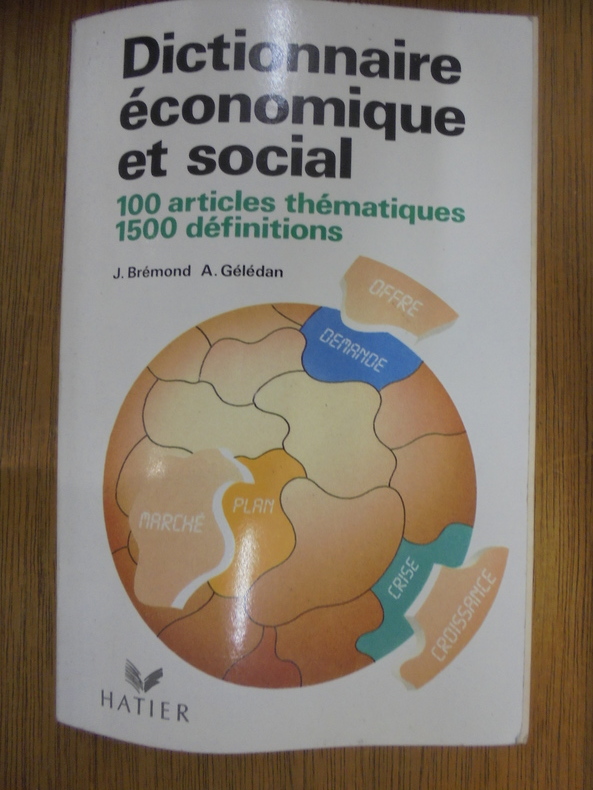
21021Hatier, 1993. Agréable petit in octavo broché, 475 pp., Important lexique sur deux colonnes (458-475).
14776Paris, Nancy, Berger-Levrault et Cie, 1889-1894. 2 volumes. Large thick 8vo. Contemporary half calf, marbled boards, spines with raised bands and gilt lettering, name of 'R. Denis' gilt stamped at foot of spines, some discolouring. First edition.
4449A Paris, Chez Ganeau, Bauche, les Frères Estienne, d'Houry, 1767. With numerous (over 200) illustrations in the text and 2 folding engraved plates. 3 volumes. (4), xvi, 959, (1, blank) pp.; (4), 919, (1, blank) pp.; (4), 909, (1, approbation, privilège du roi) pp. Folio. Contemporary marbled calf, spines with raised bands, labels with gilt lettering, bindings expertly repaired. Kress 6417; Goldsmiths 10261; Higgs 3976; Musset-Pathay 437; this edition not in Einaudi; Vicaire, Gastronomie, 173, Thiebaud, Chasse, 202-204. The best and entirely revised edition by De la Marre, incorporting the new discoveries by Duhamel and others. This was by far the most popular and important work on domestic economy in the 18th century, dealing with domestic chemistry, the keeping and caring of domestic animals, recipes for food and home-made medicine, beauty and health suggestions. It is of course also an attractive and illustrated dictionary on agriculture, gardening, botany, huntig, breading of animals, bee-keeping, vineyards, gastronomy, hunting, and so forth and alphabetically arranged. The work enables a person to be completely self-supporting and to produce for a market.'Le Dictionnaire oeconomique a joui d'une grande réputation. Il est même encore estimé aujourd'hui. Mais il faut considérer cet ouvrage dans deux états differens, tel qu'il était en 1709, lorsqu'il sortit des mains de l'auteur, agé alors de 76 ans, et tel qu'il parut en 1767 par les soins de M. de la Marre. Cette édition est préférable à la première et à celles qui ont paru entre ces deux époques, parceque l'éditeur a eu soin de la corriger et de l'enrichir des découvertes de Duhamel, etc.' (Musset-Pathay, who has a large article on Chomel and his work on page 300-301).
1990ECO034C162GARHatier / Bremond, 1990. 419 pp In-12°. Illustré avec plusieurs graphiques, tables et schémas dans texte.
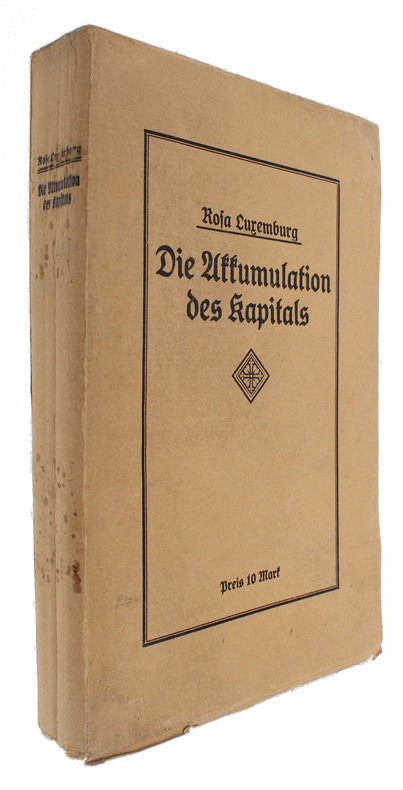
191353712Berlin, 1913. Royal 8vo. Uncut and partly unopened in original printed wrappers. A bit of spotting to original printed spine, but overall in magnificent condition. Completely original and as fresh as can be wished for. (8), 446, (2).
191356002Berlin, 1913. Royal 8vo. Uncut and partly unopened in original printed wrappers. Soiling to spine, vaguely affecting first and last leaf. Overall in a very fine condition. (8), 446, (2) pp.
193546711Berlin, Spaeth & Linde, 1935. 8vo. In the original printed wrappers. Small library label pasted on to lower part of spine. A few library stamps pasted on to the first few pages. Otherwise a fine copy. 522 pp.
186246672Dresden, Rudolf Kuntze, 1862-59. 8vo. Bound in 3 contemp. hcalf. Spines gilt and with gilt lettering. Spines a bit rubbed. XVIII,(2),872XII,850 pp. Texttables and 4 (on 2) tables in Anhang. Stamp on titles. Internally clean.
191651517Berlin, Verlag von Georg Reimer, 1916. Royal8vo. Bound in a nice contemporary half calf binding with five raised bands and gilt lettering to spine. Stamps to titlepage, otherwise fine. XX, 435 pp. + one folded plate.
183418336AB2. Aufl. Grimma, J. M. Gebhardt, 1834. 8°. XII, 252 S, 1 Bl, 37 Bl. Pp d.Zt.
67Berlin, Stettin und Leipzig, im Verlag Johann Heinrich Rüdigers, 1760. Woodcut head and tail-pieces and initials. (14), 488, (32) pp. 8vo. Contemporary boards, paper label to spine with handwritten title (label with some loss), spine a bit discoloured. Higgs 2415; Humpert 7492; Masui p. 916; Menger, column 51; not in Kress; not in Goldsmiths; not in Einaudi; not in Mattioli; uncommon: NUC, RLIN and OCLC list copies at Harvard, Chicago, and Columbia only. First edition of Justi's most explicit treatise on political philosophy. In this work 'Justi became a theoretician of the proper relation between state and civil society and postulated Polizey (administrative science) as the means of mediating between them. Increasingly, Justi derived state institutions and law not from natural law but from the social processes and individual psychological desires (for survival, self-aggrandizement, and happiness) that he thought animated society. That is, he shifted the foundation for his political philosophy from the state to civil society.Consequently, Justi advocated curtailing the reach of government in economic regulation, to ensure growth and prosperity; in private home, to protect the innocent freedom of individuals; in law, to remove superfluous moral or religious injunctions, and in censorship, to encourage the development of enlightened public opinion. (.....) Justi did describe the outlines of a liberal future by calling for the separation of powers, the principle of private property, major legal reform, and an independent judiciary (though his legal recommendations were less developed than those of many of his contemporaries), an economy liberalized for expansion, a temperate state, and an active sphere of public opinion. More remarkably, Justi anticipated many of the basic liberal assumptions regarding public and private domains, gender, sexuality, and education that were fully developed only in the nineteenth century. (.....) Perhaps Justi's greatest practical achievement was making cameral political theory accessible to literate Germans and thus helping to create a public capable of criticizing government on behalf of a civil society whose active sovereignty he only haltingly admitted' (Isabel V. Hull in: Encycopedia of the Enlightenment, vol. ii, pp 324-5). - A very nice copy, some scattered spotting, title-page lightly browned, entirely uncut.
13974Jena, Friedrich Mauke 1871. 19, (1) pp. 8vo. Sewn, original printed covers, edges frayed (Sonderdruck aus B. Hildebrand's Jahrbüchern für Nationalökonomie und Statistik Bd. XVI Heft 4 und 5). First edition of a lecture given on 29 April 1871 at the University of Leipzig. Knapp (1842-1926) studied in Munich, Berlin and Göttingen, and in 1867 became head of the statistical office of the municipality of Leipzig, in 1869 extraordinary professor of economics in Leipzig and in 1874 professor in Strasbourg. He was one of the leading German Kathedersozialisten (socialist professors), and co-founder of the Verein für Sozialpolitik.At the beginning of his career he carried out some important work in statistics: he was the first to develop a systematic theory of mortality measurement in his Über die Ermittlung der Sterblichkeit (1868). 'Opposing the viewpoints of Quételet and his followers, who claimed that man's behaviour is governed by statistical "laws," he viewed statistics simply as a tool in the realistic study of the manifold social phenomena and fully realized the limitations of statistical observations' (ESS).
1955G37449Weimar, Hermann Böhlaus Nachfolger 1955 xxiv + 270pp., most pages uncut, softcover, Very good, G37449
1966E73997Louvain / Paris, Nauwelaert / Béatrice-Nauwelaerts 1966 230pp.avec ills., 24cm., dans la série "Université Catholique de Louvain. Faculté des sciences économiqes et sociales. Nouvelle série" no.1, br.orig., bel état, E73997
1966E74002Louvain / Paris, Nauwelaerts / Béatrice-Nauwelaerts 1966 246pp.avec ills. + joint: 1p. "thèses", 24cm., dans la série "Université catholique de Louvain. Faculté des Sciences Economiques et Sociales. Nouvelle série" no.2, br.orig., bel état, [thèse académique], E74002
25858A Paris, De l'Imprimerie de Philippe-Denis Pierres, (1787). 16 pp. 4to. Disbound. Not in Kress; not in Goldsmiths; not in Stourm; not in Conlon. 'Le Roi apporte lui-même aujourd'hui à son Parlement un Edit qui ordonne l'ouverture des Emprunts successifs, destinés pendant la durée de cinq ans, à correspondre à ses engagements & à ramener l'ordre dans ses finances.' Malesherbes explains to Parliament the financial measures taken by the crown to remedy and improve the financial situation of the nation. While at it, Malesherbes explains in no uncertain terms that there will be no convocation for the Estates General to meet.
177149572Kiøbenhavn, uden trykker, 1771. Indlagt i sener papomslag med exlibris og stempel fra ""Bergens offentlige Bibliothek"". Stemplet ""Utgått"" på bagsiden af titelbladet. 22 pp.