Education JapanABAA

638 résultats
16646Photo Album Education Co-educational Primary School in Tokyo. Three-Wood Common Elementary School1941 during World War 2. Album of Gelatin silver print photos. Original textured paper wrapper. Album opens right to left. 6.9 x 9.75 in. Album cover is dated "March of the 15th year of the Showa Dynasty" in Japanese. 7 photographs measuring 4.5 x 6 in. Each class photo includes names of sitters printed on rice paper in Japanese. <br/><br/>Of note in the 6 class photographs of school children and faculty are the mix of men and women as teachers and the mix of girls and boys as students. In the first image of the entire school boys and girls are lined up next to each other although they stand in rows of their own single-gender classes. Two class photos have additional small portraits of students who were absent for picture day. In Japan at this time education was not compulsory beyond primary school but childhood was regarded as an important time to foster learning growth and intellectual curiosity for both boys and girls. Very good condition. unknown books
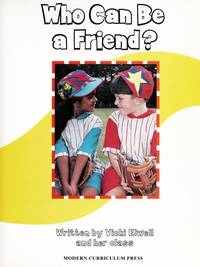
B05K-00437MODERN CURRICULUM PRESS. Used - Good. Good condition. A copy that has been read but remains intact. May contain markings such as bookplates stamps limited notes and highlighting or a few light stains. MODERN CURRICULUM PRESS unknown books
R13C-02324MODERN CURRICULUM PRESS. Used - Very Good. Very Good condition. MODERN CURRICULUM PRESS unknown books
16336Ragged schools and Hackney Juvenile Mission were bringing previously unavailable educational opportunities to poor children and young offenders. Original Broadside titled "Hackney Juvenile Mission and Ragged Schools"- dated Mar. 17 1871. From Hackney a district in East London England. Author Alfred Knight Hon. Treasurer Hackney Juvenile Mission and Ragged Schools founded in Well Street Hackney 17 March 1871 Bruce Hall and Lyme Grove Hall Mare Street Hackney London: Printed handbill circular of the 'Hackney Juvenile Mission and Ragged Schools' with list of officers and a long poem titled 'Prayer and Potatoes' illustrated with two engravings. Ragged schools were charitable organizations dedicated to the free education of destitute children in 19th century Britain. The schools were developed in working-class districts. Ragged schools were intended for society's most destitute children. unknown books
17121Co-educational College Photo Album Original owner's name "UW" and "1911" handwritten on inside front cover. 115 photographs of various sizes from 1.5 x 3 in. to 5 x 7 in. Includes many images of outdoor recreation such as hiking and boating perhaps on Lake Mendota campus life and agricultural scenes. Most photos lack captions but some locations are labeled such as outings to the Flambeau River Park Falls WI; Ellsworth WI; and the Boise River. Images of Bascom Hill and North Hall on the historic University of Wisconsin campus. One real photograph postcard shows women students seated outside and is captioned "'The Sun Bath' Co-eds at UW". Some photographs show the inside of male dormitories on campus decorated with pennants for Wisconsin and Rose Polytechnic Institute Terre Haute IN. Includes several photos of manual and agricultural labor such as baling hay. <br/><br/>Founded when Wisconsin achieved statehood in 1848 University of Wisconsin-Madison was the first public university established in Wisconsin and remains the oldest and largest public university in the state. At the time this album was compiled research teaching and service at the UW was influenced by a tradition known as "the Wisconsin Idea" which holds that the boundaries of the university should be the boundaries of the state and that the research conducted at UW-Madison should be applied to solve problems and improve health quality of life the environment and agriculture for all citizens of the state. This Progressive-era policy applied the expertise of the state's university to social legislation that benefited all the state's citizens; it led to classic programs such as regulation of utilities workers' compensation tax reform and university extension services; sometimes expressed in the maxim that "the boundaries of the university are the boundaries of the state". Glue reside from some removed photographs. 1 page detached. 5 photos loose. In good to very good condition. unknown books
15265Extensive correspondence collection 1920-1940s. 66 letters by various authors mostly women native to the Indian sub-continent all very unusual in the fact that they are highly educated and in the midst of further studies or early in their careers decades prior to Indian Independence. The letters are addressed to a young teacher Probha who was former classmate to most of the writers as well as a few to her sister Rani or to both and follows them as they finish school enter teacher training college and ultimately fan out over India as bearers of a new generation of independent Indian women. In 1931 Indian female literacy hovered at just under 3% making the experiences of these forerunners and their correspondence incredibly rare.<br/> <br/>Prior to Indian Independence from Britain Gandhi called for uplifting the status of women through education and recognition of their inherent worth as human beings. Determined to inculcate the equality of the sexes into Indian culture Gandhi publicly did household tasks that were traditionally women's work and declared that "the future is with women." Indeed other activists also equated India's independence with new freedoms for women. However by 1931 Indian female literacy hovered under 3% and was often lower in the rural provinces where schools were few child marriage was prevalent and patriarchal norms dominated society. On the cusp of vast cultural change educated women and female schoolteachers and professionals were the rare exception. <br/> <br/>These letters record the interactions between a rare group of highly educated women their thirst for personal and financial independence as well as their conflicting feelings regarding the traditions that defined their lives and restricted them. Their nexus was the Queen Victoria Girls' High School in Agra a small city in the rural northern province of Uttar Pradesh most notable for being the home of the world famous Taj Mahal a symbol of reverence to a much-loved wife of antiquity and of honor to the traditional woman. In its tall shadow young sisters Probha and Rani Thomas attended high school at "QVHS" in the late 1920s-early 1930s where lifelong friendships developed with female students Libawati Ivy Monica Lila Mercy Winnie among others. Most of them became teachers where the extraordinary nature of their achievement stood in stark relief to the lot of most other women "This year only one out of five girls has passed from our village schools." As their lives continued and they spread across the country education became the uniting factor that drove the young women forward and brought them back to each other. "Probha what are you going to do now I am going back to old Q.V. to become a teacher and I am feeling very sad as my dear old class girls won't be there. All these past years seem like a dream. So soon the parting took place.No more Tenthies no more H.M. Club. All have faded like a passing cloud.I shall never find such a jolly set again Probha. This future seems very hard." They were witness to an extraordinary moment in history when the world was changing particularly for women and with their education they are in a unique position to describe the change "It is funny that when it is time for us to be silent we have to look after our visitors and perform useless ceremonies-someday we'll change but not yet." One recalls a train ride in which she sat near "a bold Gandhi's follower.In his eloquent poetical language he was telling people that he had been to jail and was saying that for the love of country he can endure anything." Probha and Rani's father a judge had lessons for them about the danger of Revolutionary activities when one of their friends gets involved "Arel De is intelligent and emotional but he has no self control.You may write to him but make it plain that you will drop correspondence if he writes politics again. He is either already on Police books or will soon be." Though they shied away from direct involvement in politics they encapsulated Indian women's liberation in the early century: striving after independent employment deferring marriage yet with respect for their elders. In one letter Monica sadly reports to Probha "I am not coming back to school. Although I am feeling very bad but yes father has done what is good for me. I asked many times to let me go but he forced me to stay here." And in another poignant letter "Lovey" writes "Rani sis do you remember once we were talking about this problem of getting married Now very soon I shall be facing it. John wants to settle down after my working for one year only & I wish to work for at least two years. I think I shall have to do my parents will decide. Please pray that I may get a chance of working for at least two years."<br/> <br/>In tone the women are warm and sisterly to an extent not found in letters of Western cultural origin and also profoundly honest in reporting to one another their successes and failures; a good or bad test score the struggle to study while encountering difficulties such as lack of clean drinking water and large snakes and even having the security of their families placed on their young shoulders "May God help me. May I pass in the 3rd division only for it is difficult time for us two sisters. Our father's money is nearly spent and if I pass I go for training. Please remember us in your prayers that we may soon become independent." As one of the young women finds out who goes back to QVHS as a student teacher life becomes more complicated as time goes on "My examination result is so bad.my poor mother is working so hard at home. It was too much to disappoint her.I know you would ask me but why have you done so badly The only answer I can give you is that I got 7 periods a week to teach & being a slow writer the notes of lessons & the preparation took all my study time." What they share is a clarify on the value of their education to all their future lives: "All the Normal Students High School and the middle candidates.tell each one of them that I wish them a very brilliant success. Tell them that I remember each one of them in my prayers that they all may pass in the 1st Division with scholarships."<br/> <br/>Cultural references show the writers and recipients of these letters were generally native of India although they often went by Western cognoms. A few of the letters from British servicemen or coworkers offer an interesting perspective on intercultural understanding and friendship in the days when Indian Independence loomed so closely on the horizon. A serviceman befriended by Probha writes "In those days we were very ignorant. We knew nothing at all of the country or the people and their ways and customs. I think we were most surprised to find that you spoke English.We were astounded to see such bad conditions existed for some people and very upset to find such a feeling of bitterness between our two peoples." Reflecting the dichotomy inherent to the lives of these girls several letters are from their mother who simultaneously pushes them on to achieve independence and reminds them of their cultural anchor. anxious for them and resolute that they will have every opportunity possible. An intelligent woman in her own right Probha's mother offers advice on her exams "Your last quarterly should have had better marks. I wrote a few little hints in my last letter. Please keep them in mind.I'll send your saris in a day or two.I couldn't get even a bit of voil in the bazaar. There was no chance of getting it from any out station. I've used the bits I had at home.I pray God to be with my baby & help her to be a true hearted & brave soldier." <br/> <br/>The letters are in English except for a few brief passages in Hindi as English was the primary language of education and commerce prior to Independence. A few are from an object of romance; a male teacher who courts Probha with poetry but does not succeed in convincing her to give up her freedom as a single woman. A rare archive of letters from an extremely uncommon cross-section of pre-Independence society: the forerunner of the modern educated and independent woman of India. unknown books
15197Education Archive of 4 historical pieces documenting education from the mid-1800s to the turn of the century. Includes 2 course catalogs 1 alumni reunion anniversary program and 1 handwritten Chemistry lab notebook from the academic year 1904-1905 that is entirely filled with 220 handwritten pages of notes observations and drawings by student Frank Hanke. Hanke a student at "R.T. Crane High School" in Chicago IL carefully documented 65 experiments from his science class noting chemical equations and including three fold-out charts comparing "Metal alkalies" "Metals of the Calcium Group" and the "Iron Group." "I carefully slid over the opening of the receiver the glass slip just far enough to insert a burning splinter of wood. I thrust the plinter into the receiver and the flame immediately went out and the gas did not burn." Includes 16 hand-drawn scientific illustrations documenting procedures observations and results. 4 large full-page drawings of Bunsen Burner Luminous and Non-Luminous Flames and Davy's Safety Lamp. Comes with 13 loose sheets of additional notes in Hanke's hand. Original boards feature photo-illustrated image of school on front cover and student's name handwritten in red and black ink. <br/><br/>Comes with catalogues for Phillips Academy in Andover MA 1854 and the Theological Seminary in Bangor ME 1895; these catalogues list the current students and faculty and give brief overview of the institutions' histories and fields of study including course descriptions student events and first-hand student descriptions of life at school. Also includes a booklet 1884 celebrating the Thirty-Fifth Anniversary of the 1849 graduating class of Bowdoin College in Brunswick ME; this gives an overview of the students' lives since graduating including classmates who went on to serve as soldiers on opposing sides of the Civil War. Small tears and light stains and foxing to catalogue covers. Light toning and occasional foxing. All in very good to good condition. Collection provides a unique glimpse into the start of modern American education. R.T Crane High School Chemistry Notebook with handwritten student notes and drawings 1904-1905. Catalogue of the Trustees Instructors and Students of Philips Academy 1854. General Catalogue of the Theological Seminary Bangor Maine 1895. Bowdoin College The Thirty-Fifth Anniversary of the Class of 1849 1884. unknown books
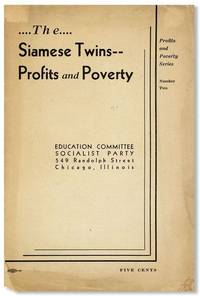
193627567Chicago: Education Committee Socialist Party n.d. ca. 1936. First Edition. Octavo 21.25cm.; decorative staplebound self-wrappers; 15pp. Wrappers darkened and brittle due to poor paper quality several small losses none affecting text the largest measuring approx. .5x.5 inches at top left-hand corner of upper wrapper. Good or better. Profits and Poverty Series no. 2. Education Committee, Socialist Party unknown books
1984230230Los Angeles: the museum 1984. Resource Packet" only. Eight fullpage color reproductions of less-common images plus introductory and terminal texts plates on coated paperstock measuring 11x10 inches texts same size all items laid into the pocket of a handsomely-printed folder which is edgeworn but still presentable. the museum unknown books
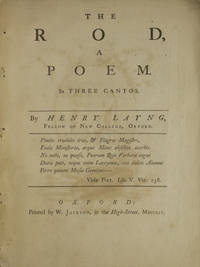
1754232533Oxford: Printed by W. Jackson 1754. First edition. Engraved frontispiece of "An Ass in the Greek Pallium Teaching" by James Green. 7 1 46 pp. 1 vols. 4to. Disbound. Stabholes remnants of original plain brown wrappers present. Frontispiece with some marginal paper flaws; some old dampstaining and soiling. First edition. Engraved frontispiece of "An Ass in the Greek Pallium Teaching" by James Green. 7 1 46 pp. 1 vols. 4to. The English Vice Castigated. A tree there is such was Apollo's will;<br/>That grows uncultur'd on the Muses' hill <br/>It's type in heav'n the blest immortals know<br/>There call'd the Tree of Science Birch below.<br/><br/>A mock epic satire on the use of punishment by educators. As the author notes in his Advertisement "my Design is plainly to recommend with Pleasantry and good Temper a more mild and amiable carriage to our Preceptors." The author evidently was one of Pope's assistants on the Odyssey. ESTC T2150 Printed by W. Jackson unknown books
194964575Johannesburg: The Education League Opvoedingsbond 1949. 2nd enlarged ed. Paperback. Very Good. 38p. Wrapper. 22cm. <br/><br/> The Education League (Opvoedingsbond) paperback books
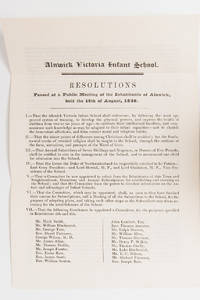
18382596Alnwick: M. Smith 1838. First edition. Fine. 3 page pamphet measuring 152 x 228mm. Trifolded with ownership signature of Wm. Dickson Esq to rear blank. Else an exceptionally clean and seemingly untouched copy of this rare pamphlet advocating for improvements in the early education of children. The only copy known on the market this title does not appear in the modern auction record or at any institutions according to OCLC.<br/><br/>A proposal and prospectus for an Infant School to serve the town of Alnwick and improve the overall level of education within the community. The pamphlet clarifies that the Duke of Northumberland is confirmed as the school's patron; and it outlines how donations and subsciptions from the town will add to the school's endowment. But more importantly it focuses on the communal benefits that will come from citizens' support for children's education regardless of their class. Touting the successes of other Infant Schools in England and abroad in providing "well-regulated nurseries for the children of the poorer classes" the committee also explains that " the most approved system of training will develop the physical powers and improve the health of children from two to six years of age -- to cultivate their intellectual faculties and communicate such knowledge as may be adapted to their infant capacities." The committee asserts that when the larger population begins sending children to school those children will be endowed with a desire to learn and "those attending will feel it as a punishment to be kept from the School" because school "is to the children what the actual business of life is to the man. Here the feelings are manifested and the character is developed" so that infants grow to intelligent and responsible members of the populace. Notably the committee also points out the short term benefits of developing an education system. "To the parents themselves many advantages will accrue from these Schools. Not only will their minds be relieved from much anxiety for the safety of their children but the mother free during the day from the necessity of watching over them will have an opportunity now denied to her of contributing by her labour to their support or of devoting more time to the promotion of their comfort at home." This acknowledgment reveals an important shift in thinking about the economic role of mothers and about women's need for time to accomplish their own work. A rare and important example of the spread of early childhood education and the arguments for its expansion. Fine. M. Smith unknown books
1710WRCLIT66407London: Printed for Jonah Bowyer 1710. 32p. Octavo. Sewn untrimmed. A bit dusty dime- size spot in extended fore-margin of first several leaves else very good. First edition printing in octavo format. Copies were also printed in 4to with altered pagination. Smalridge 1662 - 1719 later Bishop of Bristol was highly regarded as a poet and essayist -- he was among those suspected of having written A TALE OF A TUB and earned praise from both Swift and Johnson. ESTC N13204. GOLDSMITHS 4638. KRESS 2676. Printed for Jonah Bowyer unknown books
194035509Washington DC: National Education Association 1940. Lynd Ward. 8vo pp. 227. Index. Illustrations at chapter heads by Lynd Ward. Paper over boards. Cover somewhat soiled and worn interior VG. National Education Association unknown books
193647473Oxford: At the Clarendon Press 1936. A New Edition. 3 vols. 8vo. Blue cloth. Near Fine. A New Edition. 3 vols. 8vo. At the Clarendon Press unknown books
197114621Washington: USNSA United States National Student Association 1971. First Edition. Octavo 23cm. Original printed wrappers; 298pp. Ownership signature to front cover and title page; mild external wear and soil; Very Good. Collection of essays on educational reform including contributions by Carl rogers Rick Kean Gerald Farber James Nixon Peter Marin and others. USNSA [United States National Student Association] unknown books
199322407DC: Farragut Publishing Co 1993. 1st edition. Black cloth binding. Dust jacket. F/NF. 196 pp. 8vo. 23cm x 15.5cm. <br/><br/> Farragut Publishing Co hardcover books
183519147Springfield: Published by G. and C. Merriam 1835. Stated second edition. Spine and portions of the boards sunned and bleached to tan; offset to the title page from the frontispiece; a good copy. 12mo original diaper grain purple cloth gilt lettering 212 4 pages. Frontis. A fairly progressive and reform-minded guide to early childhood education including hints on sports exercise and educational toys. Evidently expanded over the 199-page edition of 1834. American Imprints 31444. Published by G. and C. Merriam, unknown books
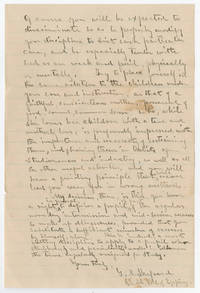
189125493<p>"<i>.neither have the right to inflict punishment or impose restrictions that will maim or injure the health of the children. As to the particular case under consideration I cannot believe that you are unduly severe or that your restrictions and exactions will hurt a robust stubborn pupil.</i>"</p> <b>EDUCATION. GEORGE N. SHEPARD.</b>Autograph Letter Signed as Chairman of the School Board to Mary D. Webster October 5 1891 West Epping New Hampshire. 2 pp. and envelope.<p><b><br /></b></p><p><b>Complete Transcript</b></p><p> <i>West Epping N.H.</i></p><p> <i>Oct. 5 1891</i></p><p><i>Dear Miss Webster</i></p><p> <i>Yours of the 3d inst. is at hand.</i></p><p> <i>Your school supplies as ordered are sent by mail this morning. We have no Swinton's Second Readers now on hand therefore I put in for you a McGuffy's Second Reader which I hope will serve your purpose.</i></p><p> <i>In relation to authority of teachers you perhaps already understand that they have the same as parents while the children are under their care and that neither have the right to inflict punishment or impose restrictions that will maim or injure the health of the children.</i></p><p> <i>As to the particular case under consideration I cannot believe that you are unduly severe or that your restrictions and exactions will hurt a robust stubborn pupil.</i> <2> <i>Of course you will be expected to discriminate so as to properly modify your discipline to suit each particular case and be especially tender with such as are weak and frail physically or mentally. Try to place yourself in the same relation to the children under your care and instruction as that of a faithful conscientious mother possessed of good sound common sense who while she loves her children with a true and motherly love is profoundly impressed with the importance and necessity of restraining them and of training them in habits of studiousness and industry as well as all the other useful activities and you will have a guiding principle that will never lead you very far in wrong methods.</i></p><p> <i>My decision then is this you have a right in general to deprive a pupil of part of the regular noonday intermission and mid-session recesses to make up delinquencies provided that you substitute a sufficient number of recesses by himself alone. This is indeed a most fitting discipline to apply to a pupil who stubbornly and persistently wastes in idleness the time regularly assigned for study.</i></p><p> <i>Yours truly</i></p><p> <i>G. N. Shepard</i></p><p> <i>Ch. Sch. Bd. of Epping.</i></p><p><b>George N. Shepard</b> 1824-1903 was born in Epping New Hampshire and educated in the public schools and at Hampton Academy. He married Rowena Lawrence Thyng 1823-1911 in 1845. He taught school was a land surveyor and served as a justice of the peace. By 1860 he was listed as a farmer living with his wife and four children. He represented West Epping in the state legislature from 1860 to 1862. During the Civil War he rose to the rank of captain in Company I of the 11th New Hampshire Infantry from 1862 to 1865. He was wounded at both the Battle of Fredericksburg and the Battle of Cold Harbor. Afterwards he returned to farming then engaged in the mercantile and lumber business. He was postmaster of West Epping from 1876 to at least 1895 and chairman of the school board from 1886 to at least 1895.</p><p><b>Mary D. Webster</b> 1854-1935 was born in New Hampshire. By 1870 both she and her older sister Sarah 1848-1929 were school teachers still living with their parents in West Epping Chester township southeastern New Hampshire. By 1910 the two unmarried sisters still lived together in Chester township but Mary listed her occupation as farming at home.</p> books
184719217New York: Published by A. S. Barnes & Co. 1847. First edition. Wrappers somewhat damp-stained; some light wear and soiling; a good to very good copy. Original printed wrappers 7.5 x 4.63 inches 36 12 pages. An entry in what came to be called "the war of histories" between the pioneering female educator Willard and the rival textbook author and critic Willson. Willson had made a detailed critical attack 1845 against eight of the leading American history textbooks of the day and subsequently published his own; Willard was the only author to rise to the bait asserting deliberate misreadings and plagiarism. For a recent detailed reassessment of the controversy see Peter B. Knupfer "How to Write a History Textbook: The WillardñWillson Debate over History Education in the Common School Era." History of Education Quarterly. 59:2 May 2019. Ink ownership signature and a few markings to the front wrapper dated June 1847. Published by A. S. Barnes & Co., unknown books
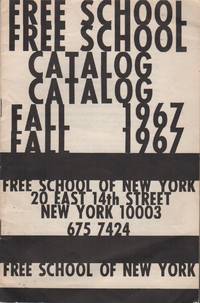
196717647New York: Free School of New York Fall 1967. First Edition. Wraps. Very good. 5.5" x 8.5" approx. saddle-stapled booklet. Touches of toning and wear at corners. Mailing information at rear wrap. Interior clean and bright. Very good. 12pp. <br/><br/>Catalog for the fall 1967 term at the Free School of New York also known as the Free University of New York. Established in 1965 as a reaction to traditional academia FUNY was in the tradition of 1960s protest movements run by committee with open enrollment and granting no degrees. This catalog which lists the school's 24 class offerings demonstrates a focus on the humanities with courses in filmmaking history fine arts and drama. Class offerings were predictably left-leaning with titles like "A Quest for Self" "The Thought of Mao Tse-Tung" and "Black Power and the "Ghetto Uprisings" and the faculty included counterculture figures such as Ed Sanders and Tuli Kupferberg. An ambitious and ephemeral offshoot of the 1960s counterculture movement FUNY closed after only a few years in operation. Free School of New York paperback books
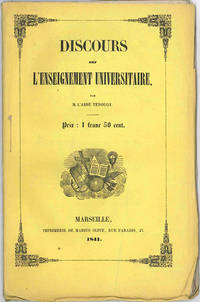
1841WRCLIT68439Marseille: Imprimerie de Marius Olive 1841. 96pp. Sewn printed wrappers. First edition. A fine unopened copy. Imprimerie de Marius Olive unknown books
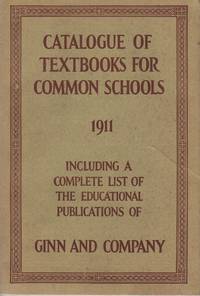
191120405Boston: Ginn and Company 1911. First Edition. Wraps. Very good. 12mo. Perfect-bound printed wraps. Very good. 1.5" tear to front cover; light edgewear. Mild dampstaining to edges of last third of pages but interior overall clean throughout if mildly toned. Binding sound. 287pp. <br/><br/>Catalogue of textbooks for the use of grade-schoolers with titles on English grammar orthography penmanship etc. and all other core classes in addition to titles on civics bookkeeping manual training conduct and morals as well as a section of Spanish-language versions of the same texts. Ginn and Company paperback books
1973198157Minneapolis: Emma Willard Task Force on Education 1973. 87p. very good in wraps 8.5x11 inches; errata slip laid in. Emma Willard Task Force on Education unknown books
16089FORSTER William E. 1818-1886 Liberal Statesman Carried the Elementary Education Act ALS Oct. 22 1877<br/><br/>Autograph Letter Signed to Miss Vernon thanking her for her note "Any printed documents you may have bearing on the Examination would be really useful to me . I am delighted to find I shall give a prize to my friend Mr Smith's daughter. I suppose all classes will be represented at the competition. Are there any daughters of working men" 2 sides 8vo. Wharfeside Burley-in-Wharfedale Leeds 22nd October 1877 <br/><br/>Son-in-law of Arnold of Rugby and nephew of Elizabeth Fry Forster carried the Endowed Schools Bill and the Elementary Schools Bill of 1870 which for the first time provided universal primary education the foundation of state schooling as we know it. unknown books