559 résultats
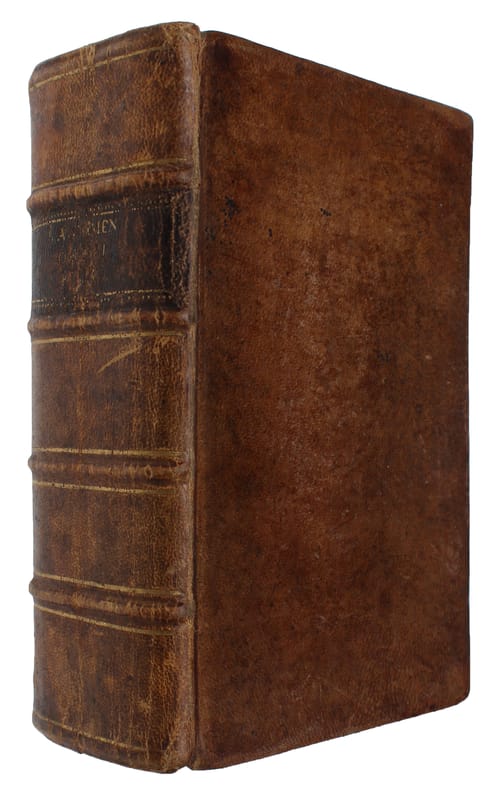
1749198564Leipzig, Müller, 1748-1749. 950 S., 6 Bl. Ppbd. m. Rsign. Einbd. leicht angeschmutz u. bestoßen. Sign. a. Vorsatz. Vereinzelt Unterstreich. Teils gebräunt.
17281308886Leipzig, untern schwartzen Bret, 1727 - 1728. Kl.-4to. Zus. 248 S. Ppbd d. Zeit (Rücken überklebt, Kanten bestoßen, hinteres Innengelenk gelockert, S. 177 mit Einriss, das letzte Heft = S. 201ff mit Nässespuren u. am Ende im Außenrand etwas sporfleckig, alter Stempel auf Titel).
17809230Schleswig, gedr. bei P. H. Holwein, ( 1780). 2 Bll. Unbeschnitten.
17211314654Leipzig, diverse Verlage, 1600-1721. Hprgtbd. Einbd. berieben. Rücken etwas rissig. Vord. Vorsatz erneuert. Teilw. stärker gebräunt. Ränder etwas scharf, vereinzelt unter Beschädigung d. obersten Zeile bzw. d. Randbuchstaben beschnitten.
175773278Coburg: George Otto. Good; Cover Boards Showing Wear Ex. Library Book. 1757. Hardback. George Otto hardcover
1799032601London: T. Egerton 1799. A large format book with red / burgundy leather boards with gilt tooling and lettering to spine and front & rear boards. Rubbing and bumping to corners edges spine ends and hinges. Grazing to hinges. A little general darkening to boards commensurate with age. Marbled fep with p/o bookplate. Some damp marks to top corner of first 5 pages and last 4 pages. Some foxing to first couple of end pages. Some image transfer from frontispiece to first page. Map between pages 16 & 17. A really beautiful copy of an exceedingly rare book. PLease contact for images. First Edition. Leather Boards. Very Good. T. Egerton Hardcover
17799260Schleswig, gedr. bei P. H. Hollwein, ( 1779). 2 Bll. Unbeschnitten.
1773171150Leipzig u. Dessau, Fritsch, 1771-1773. 2 Bl., 92, 122, 68, 48 S. Schlichter Ppbd. d. Zt. Einbd. bestoßen u. angeschmutzt. Rücken etwas beschäd. St. a. Tit. u. Vorsatz. Gebräunt, teils braunfl. Unbeschnitten.
176954520Nürnberg, Joh. Andr. Endt., 1769. 8vo. Contemp. full calf. Gilt spine. Titlelabel with gilt lettering. Gilding weak. Large engraved oval vignette on first titlepage. (22),315 pp. + Latin & German Indexes - (2),449 pp. + Latin & German Indexes. Profusely illustrated with more than 300 wood-engraved illustrations in the text, showing different trades, industries, occupations, geography, astronomy etc. etc.. A few minor brownspots. old name on title-page J.D. Tode.
177687761776 A Lyon, Jean- Marie Barret, et à Clermont-Ferrand, Antoine Delcros, 1776 ; in-12, pleine basane marbrée fauve de l' époque, dos à nerfs, titre doré "Ange" sur étiquette citron, tranches rouges; 596, (4)pp. En Frontispice " l'Ange gardien" avec au verso " Chrétien souviens-toi que tu as aujourd'hui..." et 35 vignettes dans le texte en bois pour les "Tableaux et Oraisons de la Sainte Messe". Les vignettes et surtout le frontispice, dont les bois ont beaucoup servi sont un peu palis.
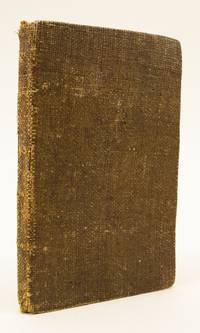
1797ST15599London: Printed for T. Longman B. Law F. & C. Rivington R. Baldwin G. & T. Wilkie and J. Walker 1797. 21st Edition. 150 x 93 mm. 5 7/8 x 3 5/8". viii 123 1 ads pp. <br/> Contemporary brown burlap flat spine. With allegorical vignette on title page and 25 half-page woodcuts illustrating items from the vocabulary lists. Pastedowns with traces of book label removal. ◆Spine slightly cocked short split to cloth on rear joint a little fraying at ends of spine but the insubstantial binding surprisingly solid. Two small stains to each pastedown where labels removed title page lightly browned leaves a shade less than bright due to paper quality other minor imperfections but an excellent copy internally clean and fresh with comfortable margins. All in all remarkably well preserved.<br/> <br/> First issued around 1711 this is the best-selling work of James Greenwood 1683-1737 an influential grammarian and a proponent of women's education. Arranged into 33 chapters the book divides vocabulary lists by topic beginning with "things" and proceeding through minerals plants animals humans and diseases to everyday items affairs of church and state the law the military and finally to the various parts of speech from verbs to conjunctions. Widely used the work was revised and reprinted until at least 1828. At about the time this work was originally issued Greenwood had founded a school in Essex where he accepted girls as well as boys as pupils; he was later recruited to serve as assistant headmaster at St. Paul's School in London. This volume is of particular interest because of its rarely seen utilitarian period binding. We would have expected it to have been worn to shreds long ago but against the odds it has withstood hard use by young pupils remarkably well and it gives us a glimpse of an important element of the English schoolroom at the turn of the 19th century. Printed for T. Longman, B. Law, F. & C. Rivington, R. Baldwin, G. & T. Wilkie, and J. Walker unknown
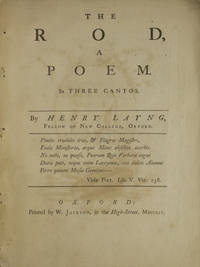
1754232533Oxford: Printed by W. Jackson 1754. First edition. Engraved frontispiece of "An Ass in the Greek Pallium Teaching" by James Green. 7 1 46 pp. 1 vols. 4to. Disbound. Stabholes remnants of original plain brown wrappers present. Frontispiece with some marginal paper flaws; some old dampstaining and soiling. First edition. Engraved frontispiece of "An Ass in the Greek Pallium Teaching" by James Green. 7 1 46 pp. 1 vols. 4to. A tree there is such was Apollo's will;<br /> That grows uncultur'd on the Muses' hill <br /> It's type in heav'n the blest immortals know<br /> There call'd the Tree of Science Birch below.<br /> <br /> A mock epic satire on the use of punishment by educators. As the author notes in his Advertisement "my Design is plainly to recommend with Pleasantry and good Temper a more mild and amiable carriage to our Preceptors." The author evidently was one of Pope's assistants on the Odyssey. ESTC T2150 Printed by W. Jackson unknown
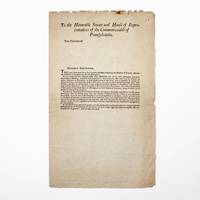
1797372917Philadelphia 1797. 1p. plus integral blank. Bifolium. Unbound. Old folds minor separations at fold repaired. Provenance: General Theological Seminary unmarked. 1p. plus integral blank. Bifolium. In 1797 the Pennsylvania Senate passed a bill related to establishing schools throughout the Commonwealth for public education. This petition here un-accomplished but designed for use by various denominational groups to collect signatures notes the passage of the legislation and argues that various religious group have already established schools that provide both secular and religious education: <br /> <br /> "We are convinced that Schools ought to be established but we are fully persuaded that their establishment should be conducted and regulated in such a manner that they may not become an injury nuisance or detriment to those good citizens of this State who as members of certain religious societies conscientiously think it their duty not only to confer useful knowledge upon their children but also to instruct them in the religious principles peculiar to themselves." <br /> <br /> The petition continues arguing that public funds earmarked for education should be provided for their denominational schools: "Should your Honourable House institute Schools according to the design expressed in the bills above mentioned then we humbly pray that our schools which are already erected or may hereafter be erected in and by any of the Congregations of our profession in this State may be endowed with a full share and portion of the monies to be raised by a Tax and of the funds to be appropriated to any of the Schools contemplated by the said bills and with this provision that such our Schools shall remain under the sold inspection and direction of persons appointed by our respective Congregations for that purpose." <br /> <br /> The petition concludes: "As the object of our petition is proper and just and founded on the principles of religious Liberty guaranteed by the Constitution of this State we have every right and reason to expect that our request will be granted: And we shall ever pray."<br /> <br /> This is the only example of this petition recorded by ESTC and we cannot locate an earlier example of a petition by a denominational group for public funding of religious education in the United States. ESTC W479053. Not in Evans or Bristol unknown
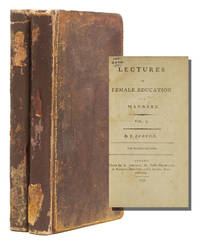
179348782London: Printed for J. Johnson J. Murray and J. Evans 1793. Second edition. 1 vols. 12mo. Contemporary mottled calf rebacked spines and corners worn ex-library with markings pockets and blindstamp on titles some light browning and offsetting of text upper corner of title on second volume torn to remove signature titles appear to be cancels endpapers browned some pencilled deletions and lines as well as comments with the stamp of J. L. Brandt and signature of Mary Warburton dated 1806. Second edition. 1 vols. 12mo. Burton lectures on the expected topics: obedience duties of a wife daughter etc. but he also strongly recommends reading for ladies as necessary to keep them from being insipid and to prepare them as interesting members of society. From the publisher of "Thoughts on the Education of Daughters" and "Vindication of the Rights of Women." In fact Mary Wollstonecraft was a reader for Johnson at the time of this publication. Printed for J. Johnson, J. Murray and J. Evans unknown
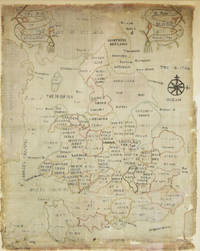
1786310835Bristol 1786. Colored silk and wool threads on linen signed "M. Hume". With compass rose and floral cartouche. 19 x 14-1/2 inches. Toning some wear around edges losses to lettering in several spots. In later frame. Colored silk and wool threads on linen signed "M. Hume". With compass rose and floral cartouche. 19 x 14-1/2 inches. A nice example of an embroidered map sampler which were an important component of girls' education in Britain and America from 1770-1840. This one meticulously labels all of the English counties the seas and channels and includes part of Scotland to the north and the east coast of Ireland and is signed by its maker one M. Hume of Bristol.<br /> <br /> "One academic subject that was consistently considered important for both boys and girls after reading writing and arithmetic was geography. Geography was considered a science at this time and . it was the first science taught to girls in the US . Many girls were taught to read but not write. With the exception of some diaries or letters or of marginalia there is little to tell us how children learned to read do arithmetic or write. Map samplers . by students are tangible examples of women's schoolwork. These were time-consuming projects normally framed and hung with pride to show a young lady's educational attainments" Tyner Stitching the World. unknown
1772620902Greifswald, A. F. Rose, 1772. Illustrierter gestochener Titel, 7 Bl., 256 S. Mit 1 gestochenen Kopfvignette. Einfacher Pappband d. Zeit mit handschriftlichem Rückenschild (berieben u. verstaubt, Ecken bestoßen). [2 Warenabbildungen]
179331381Paris: Imprimerie du Journal rue du Foin-Saint-Jacques 1793. 1793. Good. - Octavo 8-1/4 inches high by 5 inches wide. 60 issues bound together into contemporary full vellum with holographic title labels on the spine. Faded ink annotations on the covers would suggest that the vellum covers themselves were recycled at the time from even earlier documents. The covers are stained the labels are chipped and the bottom portion of the spine is heavily chipped. 480 pages in all each issue consisting of 8 pages with a banner title at the head of the first page of each issue and the publisher's credits printed at the bottom of the last page of each issue. The bottom front corners of the pages are heavily dampstained. There is minor worming with very slight loss to the first issue #222 and a very minor wormhole to issues 233 through 235 with occasional loss of a letter. A small piece torn from the bottom corner of the last leaf of issue #227 results in the loss of but one letter. Pages 5 and 6 of issue #244 are torn but without loss although there is some slight loss to pages 6 and 7 where the pages once stuck to each other. Several page corners are creased. There is some rare occasional underlining in ink with even fewer discreet marginal annotations. A good consecutive run of this scarce periodical covering the National Convention during the years it forged France's first republican constitution during the French Revolution. <p>Originally titled "Auditeur national journal de legislation de politique et de litterature" when it began publication in 1791 the sub-title was removed as of September 22 1792. - Ref.: Eugene Hatin's "Bibliographie historique et critique de la presse periodique francaise.".<p>This daily evening newspaper provides a day by day account of the events that took place during one of the most remarkable periods in French history. Among the important events of this period were the uprising of the Paris Commune against the Convention the formation of the Extraordinary Commission of Twelve Commission extraordinaire des Douze the revolt of June 2 1793 which led to the expulsion of the Girondists and the rise of the Jacobins the establishment of a maximum price for bread and most important the debate which ultimately led to the ratification on June 24 1793 of the new Constitution. This Constitution included the expanded "Declaration of the Rights of Man and Citizen" Declaration des droits de l'homme et du citoyen. It was this period of time that set the stage for the Reign of Terror.<p>The publication of the articles chapitres of the first republican constitution also known as the the "Montagnard" Constitution commences in the June 12 1793 issue of the newspaper No. 264. The 36 articles of the DECLARATION DES DROITS DE L'HOMME ET DU CITOYEN are published in the issues of June 24/25 1793. These rights expanded from the 1789 Declaration now included the abolition of slavery the right of rebellion the right to work to public education and public assistance and the right of association.<p>The writing of this constitution is often attributed to Marie-Jean Herault de Sechelles.<p>RARE. [Paris: Imprimerie du Journal, rue du Foin-Saint-Jacques, 1793. hardcover
1740100257<p>London: Printed for J. Hodges at the Looking-glass on London-Bridge MDCCXL 1740. 1740. Very good. - Octavo 6-5/8 inches high by 4 inches wide. Hardcover bound in full calf with a black leather title label and decorations in gilt within raised bands on the spine. The covers are slightly rubbed and bumped with a minor chip to the head of the spine and a portion of the title label chipped off. 4 346 & 14 pages illustrated with a portrait frontispiece engraved by George Bickham the Younger c. 1706–1771 and an engraved head-piece tail-piece and a formal decorated initial. There are two small pieces out of the front margin of page 3/4 without loss of text and a small tear in the margin of page 65/66 without loss of text. Very good.</p><p>Second edition published in the same year as the first.</p><p>From the library of Captain Colin Campbell of Kilberry with his armorial bookplate with the motto "Ne Oublie Pas" signed "R.M." R. Mountaine on the front pastedown and the ownership names of "Kilberry" and "Minard" handwritten at the head of the title page.</p><p>"CAMPBELL COLIN d. 1782 of Kilberry major of 100th foot obtained an unenviable notoriety in consequence of a fatal assault committed by him on Captain John McKaarg or Macharg a brother officer while stationed at the island of Martinico in 1762. The cause of difference is said to have originated at Jersey where Campbell at that time major-commandant of the 100th foot was obliged to take the payment of McKaarg's company out of his hands owing to the latter's pecuniary difficulties. On the arrival of the regiment at Martinico McKaarg took every opportunity of vilifying Campbell who demanded in writing an explanation. McKaarg replied in a curt letter. Campbell immediately proceeded to McKaarg's tent armed with a bayonet and a small-sword and demanded satisfaction. McKaarg having a broad sword only endeavoured to evade a meeting. Thereupon Campbell struck him several times with his sword. McKaarg was compelled by his antagonist to beg for his life and immediately expired. He had received eleven wounds two of which were mortal. Campbell was arrested and on 6 April 1762 was tried for murder by a general court-martial held at Fort Royal. He endeavoured to prove that McKaarg had fallen in a fair duel. On 14 April the court adjudged Campbell to be cashiered and declared him incapable of serving his majesty in any military employment whatsoever. Pending the king's consideration of the sentence Campbell escaped from the island. Owing to some informalities the proceedings were not confirmed but he was immediately dismissed from the army. . The relatives of Captain McKaarg subsequently brought an action of assythment against Campbell and ultimately damages. were awarded to them. Campbell chiefly resided in Edinburgh where he attracted notice by his foppery and was well known as an antiquated old beau. In the summer he visited Buxton and the other fashionable watering-places of the day. He died unmarried at Edinburgh in 1782 and his estate at Kilberry in Argyllshire descended to his nephew." Quoted from the Dictionary of National Biography volume 8 page 349. The Oxford Dictionary of Biography gives Campbell's death date as 1798.</p><p>"The action of assythment is now no more than a legal antiquity but in 1767 we find its scope and character were the subject of much discussion in the Court. It appears that while the 100th Regiment of Foot had been fighting the French in Martinique Captain Colin Campbell of Kilberry had killed Captain Macharg a brother officer in a quarrel. For this offence he was cashiered by sentence of court-martial. Captain Macharg's relatives brought an action of assythment in the Court of Session. In the defence of Captain Campbell it was pled that assythment was a proceeding for infliction of a fine and not for payment of damages and that Captain Campbell having already been tried and punished could be liable to no further legal proceedings for the same offence. Assythment was said apparently with reason to have been instituted to take the place of the right of private vengeance which early law allowed to the relatives of a murdered man and to have been regarded more as a criminal penalty than as a civil reparation. His counsel quoted Balfour's Practicks to the effect that assythment was paid 'to the kin bairins and freindis in contentation of their damnage and for pacifying of their rancor' and Bankton who had laid it down that assythment was given to the wife and nearest. of-kin 'that they might be reconciled to the manslayer.' Captain Macharg's relatives however were successful in maintaining on the other hand that assythment was an action for payment of reparation and not of a fine and the Court remitted to the Lord Ordinary to fix the amount." Quoted from "The Green Bag" 1889-1914 volume 15 page 442.</p> London: Printed for J. Hodges, at the Looking-glass on London-Bridge, MDCCXL [1740]. hardcover
176692101766 Paris, 1766; in-12, plein veau marbré époque, dos lisse orné, titre doré sur étiquette de maroquin brun, tranches rouges; (4),328,(4)pp. Petite tache rousse angulaire à quelques feuillets.
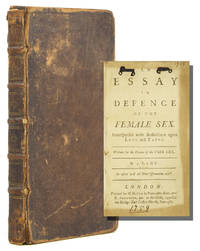
175013363London: printed for C. Hitch in Paternoster-Row and R. Akenhead jun. at the Globe opposite the Bridge-End Coffee-House Newcastle 1750. Fifth edition. 6 149 1 ad pp. 1 vols. 12mo. Contemporary calf. neatly rebacked flyleaves removed some light browning or spotting mostly marginal ink date 1759 at foot of title page a few pen or pencil marks on title and in margins. Fifth edition. 6 149 1 ad pp. 1 vols. 12mo. First published in two editions in 1696 and reprinted in 1697 1721 and the present edition ca. 1750 with changing subtitles. Variously attributed to Mary Astell Judith Drake and H. Wyatt.<br /> The present edition includes an ad for The Universal Library kept by Newcastle bookseller R. Akenhead jun. The date is conjectured from the R. Akenhead junior imprint which surfaces briefly in two other works dated 1750.<br /> A curious note on the verso of the dedication explains the lack of a subscriber's list. Apparently most of the "generous Encouragers" did not want to have their names included so "no List is printed lest Offence might be given."<br /> The author observes: "we are taught only our Mother-Tongue or perhaps French which is now very fashionable and almost as familiar amongst Women of Quality as Men; whereas the other Sex by means of a more extensive Education to the Knowledge of the Roman and Greek Languages have a vaster Field for their Imaginations to rove in and their Capacities thereby enlarged."<br /> <br /> RARE. ESTC T123106 BL NLS Smith College; Wing A 4058 printed for C. Hitch in Paternoster-Row, and R. Akenhead, jun. at the Globe, opposite the Bridge-End Coffee-House, Newcastle unknown
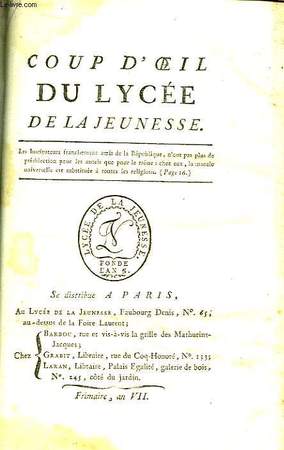
1799RO80067809BARBOU, GRABIT, LARAN. 1799. In-12. En feuillets. Etat d'usage, Livré sans Couverture, Dos satisfaisant, Intérieur acceptable. 16 pages extraites d'un ouvrage relié.. . . . Classification Dewey : 370-Education
17893826099J. Dodsley 1789. Volume 17. This is an ex-library book and may have the usual library/used-book markings inside. Front cover loose but present; spine splitting; backstrip torn; gold gilting to front cover and backstrip.This book has hardback covers. In poor condition suitable as a reading copy. Volume 17. Please note the Image in this listing is a stock photo and may not match the covers of the actual item750grams ISBN: J. Dodsley hardcover
17863826100J. Dodsley 1786. Volume 22. This is an ex-library book and may have the usual library/used-book markings inside. Front and back covers loose but present; backstrip missing.This book has hardback covers. In poor condition suitable as a reading copy. Please note the Image in this listing is a stock photo and may not match the covers of the actual item900grams ISBN: J. Dodsley hardcover
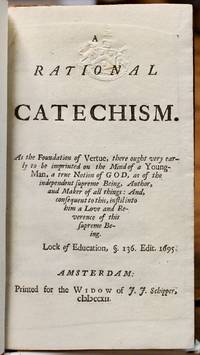
171215978<p>Amsterdam: Printed for the Widow of J.J. Schipper 1712 Second edition not so stated dedicated to the author's "dearest daughters" with a long quote from Locke's On Education on the title-page. The work is a significant distillation of the principles of toleration first published in 1687. . . Contemporary mottled calf. Gilt spine tooled in compartments yellow silk ribbon marker. . Twelvemo. Edges sprinkled red. Binding extremities slightly worn and boards a bit scratched. Front joint cracked but sound. The Macclesfield copy with the blindstamps shelf marks and the South Library bookplate. A very good copy clean copy. William Popple 1638-1708 was the nephew of Andrew Marvell and was educated under his guidance. He was a successful merchant in Hull before moving to Bordeaux where he lived from 1670 to 1688. After returning to London he met William Penn and became secretary of the Dry Club established by John Locke to debate issues of religious liberty. He also translated Locke's Letter on Toleration 1689 from the Latin. When Locke was appointed a commissioner of the Board of Trade in 1696 Popple became the board's secretary. Though this is a dialogue between a father and son the dedication to his daughters states: "I am desirous that it may be a common memorial of me unto all of you when I shall be no more I therefore make it yours also by this dedication: And for the same reason I have likewise added unto it a copy of that advice which I formerly gave him in such verse as my unpractised Muse then dictated.</p> Printed for the Widow of J.J. Schipper,
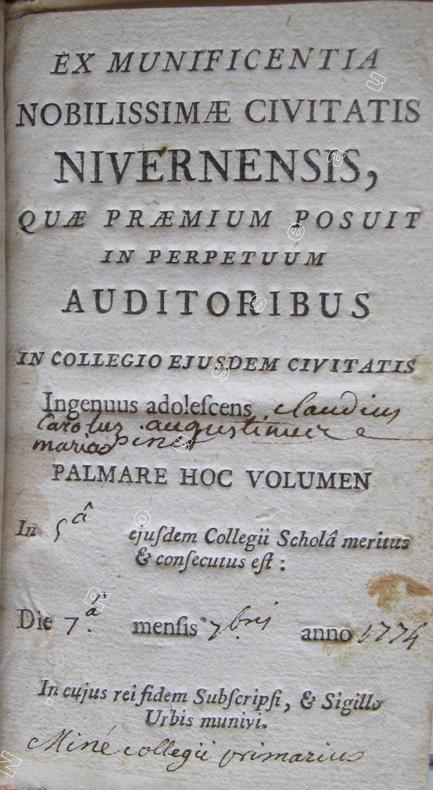
1774GF322031774 Chambery - Gorrin - 1774 - 1 volume in8 de 286 pages + feuillet d'errata + 4 planches dépliantes - Reliure pleine basane d'époque - Accroc à la coiffe supérieure - coiffe inférieure arasée - dos cinq nerfs - Bon état -