852 résultats
18812091202133201037Shinshichi Okajima and others 1881. Soft Cover. Fine. Number of books: 50 books in total Shinshichi Okajima and others paperback
187719616Montevideo: Imprenta a vapor de La Tribuna 1877. FIRST EDITION. Original printed wrappers. First printing. On May 15 1877 this first publication of the regulations of the medical school appeared in Montevideo establishing a five-year curriculum which included a course on hygiene in the second year and legal medicine and toxicology in the fourth. The professors who taught these courses were medical doctors of great renown. <br /> <br /> OCLC locates nocopies in America just a single copy at the BnF. Imprenta a vapor de La Tribuna unknown
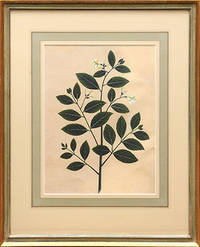
18602206161860. With Inscription and descriptive text in pencil. 1 vols. 19 x 14 inches 48.3 x 35.6 cm. Framed and glazed. Fine. With Inscription and descriptive text in pencil. 1 vols. 19 x 14 inches 48.3 x 35.6 cm. unknown
1860313321Albany 1860. 62 vintage albumen prints comprising 60 oval gem portraits 1-1/2 x 1 inches 1 larger oval portrait 2-1/8 x 1-5/8 inches and 1 full-length 3-1/2 x 2-1/2 inches. 2 vols. 8vo. Contemporary brown morocco autograph album stamped in gilt and blindW.B. Sprague blindstamp on ffep. A few portrait photos damaged or loose 2 inscriptions are without photos. 62 vintage albumen prints comprising 60 oval gem portraits 1-1/2 x 1 inches 1 larger oval portrait 2-1/8 x 1-5/8 inches and 1 full-length 3-1/2 x 2-1/2 inches. 2 vols. 8vo. Early Albany Law School Photographic Yearbook. A photographic yearbook from the Albany Law School class of 1860 assembled by student Horatio Colony 1835-1917.<br/>Opened in 1851 Albany Law School is the oldest independent law school in the United States. Many of its students in the 1850s and '60s became prominent lawyers and judges.<br/>As is the custom with the professionally produced college photograph yearbooks produced by George Kendall Warren starting in the late 1850s each photograph is inscribed beneath by the sitter with his name and hometown. The album opens with professors Ira Harris Amasa Parker Amos Dean Nathaniel Harris and Levi Chamberlain. Some notable students include Alexander P. Ketchum who became a Colonel and Chief Appraiser of the Port of New York; Clayton H. Delano 1836-1920 who served eight terms as the Town of Ticonderoga's Supervisor and was elected twice to the New York State Assembly; and William S. Opdyke general counsel of the Delaware and Hudson Company. <br/>Horatio Colony 1835-1917 whose picture appears last and is unfortunately obscured by damage assembled this album. The photograph of Levi Chamberlain is inscribed to "Horatio friend and pupil." He was admitted to the bar in New Hampshire and New York in 1860; in 1869 he along with his brother George took over the management of the family business the Faulkner and Colony Woolen Mill. He held several other civic and local government positions before his death in an automobile accident in 1917. His son Horatio Jr. 1900-1977 a poet and novelist established the Colony family home as a museum upon his death.<br/><br/>With: Autograph album containing autographs of acquaintances and some notable figures including Amos Bronson Alcott "A. Bronson Alcott" and Octavius Frothingham "O.B. Frothingham". In near matching black morocco autograph album stamped in blind and gilt extremities rubbed. With later inscription of C.W. Lawbert on front free endpaper. unknown books
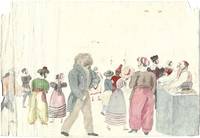
186018931860. Watercolor and pencil on cream wove J Whatman 1827 paper with a partial watermark 7 x 10 1/8 inches 176 x 256 mm the full sheet. The left sheet edge has significant wear; the result of its removal from a page in an album to which the sheet was tipped in. There is also a horizontal tear in the center left sheet edge which extends approximately one inch into the image through the image of the figure with outstretched arms. Small corner losses at the the top right and left sheet as well as a small 1/4 inch at the lower left corner. Colors are extensive and saturated. unknown
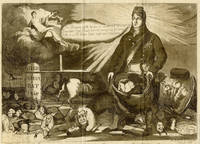
18111538London: The Satirist 1811. Etching with aquatint on buff wove paper with an 1808 watermark 9 3/4 x 13 inches 248 x 330 mm wide margins. Scattered paper repairs on the verso as well as four vertical hard creases and one horizontal crease in the lower quadrant of the sheet. Scattered uniform age tone. The Satirist or the Censor of the Times was a controversial 19th-century British newspaper which featured reports of scandals involving well known residents of London. It was published by Barnard Gregory who faced multiple libel charges and was later imprisoned due to its articles. The Satirist unknown
18602206161860. With Inscription and descriptive text in pencil. 1 vols. 19 x 14 inches 48.3 x 35.6 cm. Framed and glazed. Fine. With Inscription and descriptive text in pencil. 1 vols. 19 x 14 inches 48.3 x 35.6 cm. unknown books
183426035Italy 1834. Pen-and-ink watercolour and gouache painted black border titled and dated in white gouache in the lower margin within the border. Lovely 19th-century watercolour of Palermo.<br/> <br/> Catering to the foreigners flocking to the region on the Grand Tour this lovely watercolour shows the town of Palermo with its beautiful hills and mountains in the background with a large fort in the harbour with a British and French ship beside it. The sky is awash in pinks and blues displaying the incredible light of the region. unknown
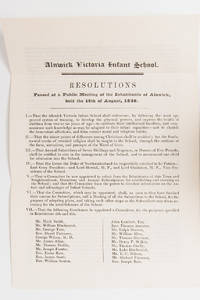
18382596Alnwick: M. Smith 1838. First edition. Fine. 3 page pamphet measuring 152 x 228mm. Trifolded with ownership signature of Wm. Dickson Esq to rear blank. Else an exceptionally clean and seemingly untouched copy of this rare pamphlet advocating for improvements in the early education of children. The only copy known on the market this title does not appear in the modern auction record or at any institutions according to OCLC.<br/><br/>A proposal and prospectus for an Infant School to serve the town of Alnwick and improve the overall level of education within the community. The pamphlet clarifies that the Duke of Northumberland is confirmed as the school's patron; and it outlines how donations and subsciptions from the town will add to the school's endowment. But more importantly it focuses on the communal benefits that will come from citizens' support for children's education regardless of their class. Touting the successes of other Infant Schools in England and abroad in providing "well-regulated nurseries for the children of the poorer classes" the committee also explains that " the most approved system of training will develop the physical powers and improve the health of children from two to six years of age -- to cultivate their intellectual faculties and communicate such knowledge as may be adapted to their infant capacities." The committee asserts that when the larger population begins sending children to school those children will be endowed with a desire to learn and "those attending will feel it as a punishment to be kept from the School" because school "is to the children what the actual business of life is to the man. Here the feelings are manifested and the character is developed" so that infants grow to intelligent and responsible members of the populace. Notably the committee also points out the short term benefits of developing an education system. "To the parents themselves many advantages will accrue from these Schools. Not only will their minds be relieved from much anxiety for the safety of their children but the mother free during the day from the necessity of watching over them will have an opportunity now denied to her of contributing by her labour to their support or of devoting more time to the promotion of their comfort at home." This acknowledgment reveals an important shift in thinking about the economic role of mothers and about women's need for time to accomplish their own work. A rare and important example of the spread of early childhood education and the arguments for its expansion. Fine. M. Smith unknown books
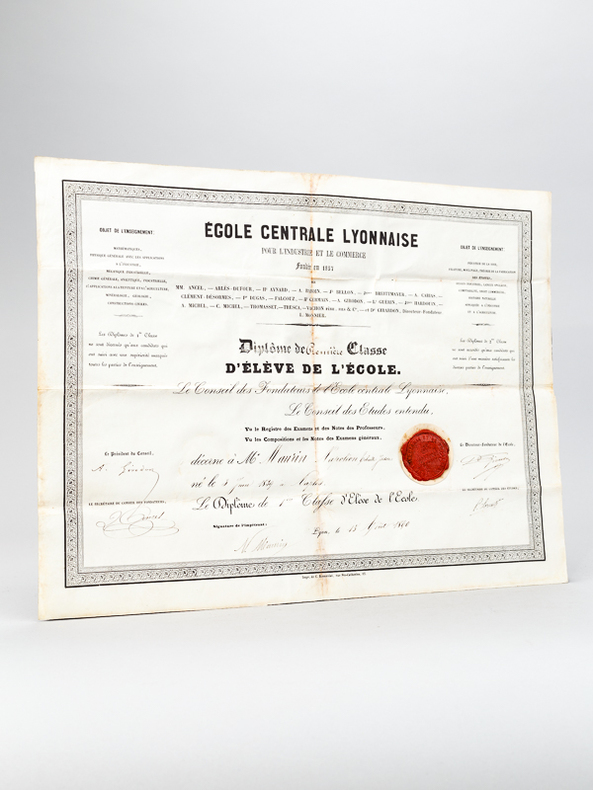
1860567491 diplôme sur vélin préimprimé format 42 x 31,5 cm avec beau sceau de cire, signé par l'impétrant, par le directeur-fondateur de l'école Désiré Girardon, par le Président du Conseil A. Girodon, et par le secrétaire du Conseil des Fondateurs Ancel, daté de Lyon, ke 15 août 1860. Rappel du titre complet : Ecole Centrale Lyonnaise pour l'Industrie et le Commerce fondée en 1857. Diplôme de Première Classe d'Elève de l'Ecole décerné à M. Maurin Napoléon Tibulle Isidore, né le 3 juin 1839 à Naples. [ Diplôme ancien de la première promotion de l'Ecole Centrale de Lyon, attribué le 15 août 1860 ]
18780008008Orillia Ontario. Good. 1878. On offer is a book containing minutes of the Board of Trustees Meetings of School Section No 4 covering the period from January 1878 to January 1897 that gives an insight of what issues the school board dealt with in those years including financial support expenses school building operation and selection of teachers. The book has 64 pages and includes minutes of 69 meetings two pages documenting payments to a school teacher for the year of 1879. The school was built in 1876 a little more than a year before this book was started and 7 years after Ryerson proposed his 1871 Education Act requiring adequate accommodation for students in every school section. The Meeting agenda usually included election of trustees and chair adoption of annual reports and approval of various expenses: "it was proposed by Mr. Brailey seconded by D. M. Kaughan that the sum of six dollars be appropriated for Prize that the Section do also procure at same time a Daily Register.that the Section be empowered to procure a copy of the amended School Law of Copp Clark and Co." More serious matters concerned repairs construction and school house insurance: ".a Petition to be sent into the council legalize the Muskoka road passing the school house." "Section will be instructed to issue tenders for digging a well at the school and also see to the repairing of the plaster at the School House". In 1880 the routine was interrupted when School's first headmaster Mr. Gardiner left his wife and eloped with an eighteen-year-old to Detroit telegraphing his resignation which made the Trustee Board urgently look for a new teacher: "Several applications for the position of teacher in the room of W. G. Gardiner who has scandalously absconded from the neighbourhood and deserted his post as Teacher were considered by the Trustees but action in the matter was deferred to the future meeting". Finding a new teacher was not an easy task: "The Trustees proceeded to examine three applications made for the position of Teacher in the Sec-n. none of which met their entire approval.proposed that the school be kept vacant till the end of the year that the Sec. 4 do insert advertisements in the Toronto papers for a male teacher at a salary of 300$ per annum". Only a month and a half later in the end of December they hired a new Master of the School at a salary of 260$. In addition to teaching schoolmaster's duties included lighting the fires and sweeping the school and also planting trees: "Mr. Smith teacher be allowed to plant shade trees in front of the school premises within the fence adjoining the Muskoka road and that he receive 50 c. per tree for planting the same with the understanding that in the event of any of the said trees dying during the year that he agrees to replace the same with fresh trees and it is understood that said trees shall be maple and balsam alternately.". The meeting of December 1882 approved 2$ contribution to the Ryerson Memorial Fund. In 1885 the Public School Inspection gave instructions on improvements and repairs to be done including "wood shed construction replastering of the school house increasing blackboard accommodation and fixing privies". The book contains names of School Board Trustees and teachers and of some local residents performing work for the school. Condition: Good regular age-related wear several pages are torn out and missing.; Manuscript; 8vo - over 7¾" - 9¾" tall; KEYWORDS: HISTORY OF EARLY SCHOOL HISTORY ORILLIA HIGH SCHOOL LOCAL SCHOOLS ONTARIO SCHOOL EDUCATION SCHOOL TRUSTEES ORILLIA HISTORY 19TH CENTURY CANADIAN HISTORY HISTORY OF SCHOOL EDUCATION ONTARIO SIMCOE COUNTY SCHOOLS HANDWRITTEN MANUSCRIPT MANUSCRIPTS SCHOOL BOARD MEETINGS MINUTES PUBLIC SCHOOLS INSPECTION SIMCOE COUNTY SCHOOL SECTORS SCHOOL SECTOR 4 ORILLIA TEACHERS TEACHER SALARIES 19TH CENTURY 1880S 1870S CANADIANA . unknown
1880630641880. 20-1/2 x 20-1/4 inches. Burl frame. 20-1/2 x 20-1/4 inches. unknown
1900127351India: c.1900. Company School or Company Painting is a term that defines a hybrid Indo-European style made by Indian artists in India under British rule during the 18th and 19th centuries. The style reflects the influences of Mughal style with some European techniques such as perspective or volume made mainly for a Western clientele. Company School style went into decline with the arrival of photography towards the end of the 19th century. Original watercolour on paper. Image size: 480 x 280 mm. Framed size: 615 x 500 mm. Very good condition. unknown
1900127362India c.1900. Company School or Company Painting is a term that defines a hybrid Indo-European style made by Indian artists in India under British rule during the 18th and 19th centuries. The style reflects the influences of Mughal style with some European techniques such as perspective or volume made mainly for a Western clientele. Company School style went into decline with the arrival of photography towards the end of the 19th century. Original watercolour on paper. Image size: 480 x 280 mm. Framed size: 615 x 500 mm. A closed tear on the top right hand corner otherwise in very good condition. unknown
1900127361India c.1900. Company School or Company Painting is a term that defines a hybrid Indo-European style made by Indian artists in India under British rule during the 18th and 19th centuries. The style reflects the influences of Mughal style with some European techniques such as perspective or volume made mainly for a Western clientele. Company School style went into decline with the arrival of photography towards the end of the 19th century. Original watercolour on paper. Image size: 480 x 280 mm. Framed size: 615 x 500 mm. Very good condition. unknown
18692111902160200041Mr. Hayashi's woodblock copy 1869. Soft Cover. Fine. Number of pages: 186 pages Size: 13.5cmx18.3cm Number of books: 1 Mr. Hayashi's woodblock copy paperback
185020700Paris 1850. Pencil pen and wash drawing with numerous sub-titles in ink signed "J. Litoux" A fascinating and beautiful architectural drawing - or 'rendu' of basic elements of house construction in cluding walls floors doorways roofs and ceilings.<br/> <br/> A fine drawing from an architectural student at the Ecole des Beaux-Arts in Paris the most influential architectural school in existence during much of the 18th century the whole of the 19th century and the first part of the 20th century. 'Students were eligible for the Ecole if they were at least fifteen years old or under thirty. They began with the seconde classe in which they competed in the concours d'émulation. These alternated between an esquisse - a rough sketch for which up to twelve hours was allowed - and a rendu - the large-scale finished drawing for which one to three months were allowed. Two to four years were usually required for a student to accumulate enough credits to enter the première classe. The same system was followed again usually for two to three years after which the student should have accumulated enough credits to compete for the Grand Prix de Rome. The winner of the Grand Prix was entitled to five years study under the auspices of the French Academy in Rome. For each of his first three years he was required to submit an analytical study of an ancient monument. For his fourth year he had to submit a complete reconstruction of a major classical work. For his fifth year he was required to submit an original work designed to a program of his own invention. In the seconde classe the student was required to attend a variety of lectures in theory history and construction and learned to prepare construction drawings. Work was done at ateliers located outside the precincts of the Ecole des Beaux-Arts. These were rented and organized by the students themselves and the students had the right to invite a teacher of their own choice to serve as their maître. The teacher himself did not have to be a member of the faculty of the Ecole nor - at least in principle - did he have to be a practicing architect.' Arthur Drexler. The Architecture of the Ecole des Beaux-Arts. New York MoMA 1977 p.8-9<br/> <br/> Arthur Drexler The Architecture of the Ecole des Beaux-Arts. New York MoMA 1977. unknown
185020700Paris 1850. Pencil pen and wash drawing with numerous sub-titles in ink signed "J. Litoux" A fascinating and beautiful architectural drawing - or 'rendu' of basic elements of house construction in cluding walls floors doorways roofs and ceilings.<br/> <br/>A fine drawing from an architectural student at the Ecole des Beaux-Arts in Paris the most influential architectural school in existence during much of the 18th century the whole of the 19th century and the first part of the 20th century. 'Students were eligible for the Ecole if they were at least fifteen years old or under thirty. They began with the seconde classe in which they competed in the concours d'émulation. These alternated between an esquisse - a rough sketch for which up to twelve hours was allowed - and a rendu - the large-scale finished drawing for which one to three months were allowed. Two to four years were usually required for a student to accumulate enough credits to enter the première classe. The same system was followed again usually for two to three years after which the student should have accumulated enough credits to compete for the Grand Prix de Rome. The winner of the Grand Prix was entitled to five years study under the auspices of the French Academy in Rome. For each of his first three years he was required to submit an analytical study of an ancient monument. For his fourth year he had to submit a complete reconstruction of a major classical work. For his fifth year he was required to submit an original work designed to a program of his own invention. In the seconde classe the student was required to attend a variety of lectures in theory history and construction and learned to prepare construction drawings. Work was done at ateliers located outside the precincts of the Ecole des Beaux-Arts. These were rented and organized by the students themselves and the students had the right to invite a teacher of their own choice to serve as their maître. The teacher himself did not have to be a member of the faculty of the Ecole nor - at least in principle - did he have to be a practicing architect.' Arthur Drexler. The Architecture of the Ecole des Beaux-Arts. New York MoMA 1977 p.8-9<br/> <br/>Arthur Drexler The Architecture of the Ecole des Beaux-Arts. New York MoMA 1977. unknown books
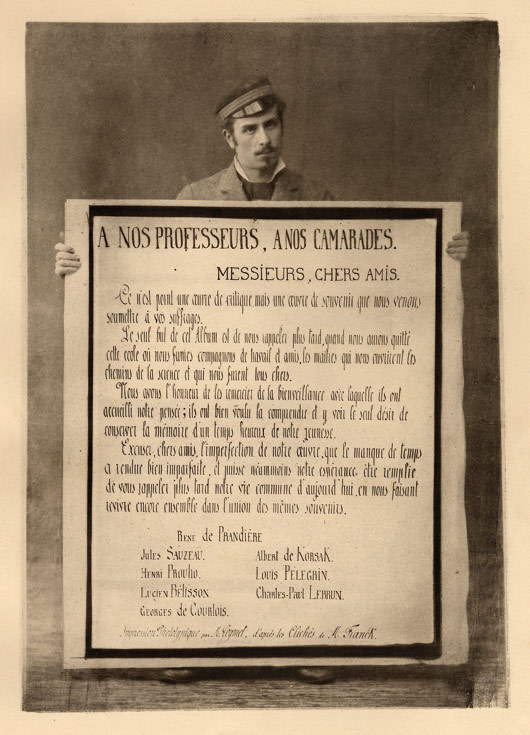
187714504Paris, Impression Phototypique de Gleymet d'après les clichés de M. Franck ; in-folio, demi-chagrin vert, faux-nerfs à froid et dorés, fleurons dorés, titre doré sur le plat, en arc, plats de percaline (reliure de l'époque) ; (51) ff. montés sur onglets dont le titre, composition emblématique : juchée sur le pare-chocs d'une locomotive, l'Ecole Centrale, représentée par une femme nue tenant haut une torche dont les rayons Arts, Métallurgie, Construction, Mécanique et Chimie symbolisent le Progrès qui bouscule et écrase le clergé, les Indiens, les Allemands à casque à pointe, les "ânes", les Musulmans, une sorte de Juif errant, les incrédules et les oies ; les phares de la locomotive sont triangulaires ! Viennent ensuite 50 photographies ou sympathiques caricatures des dirigeants et professeurs de l'Ecole ; identité imprimée sur des papillons collés au dos de chaque planche.
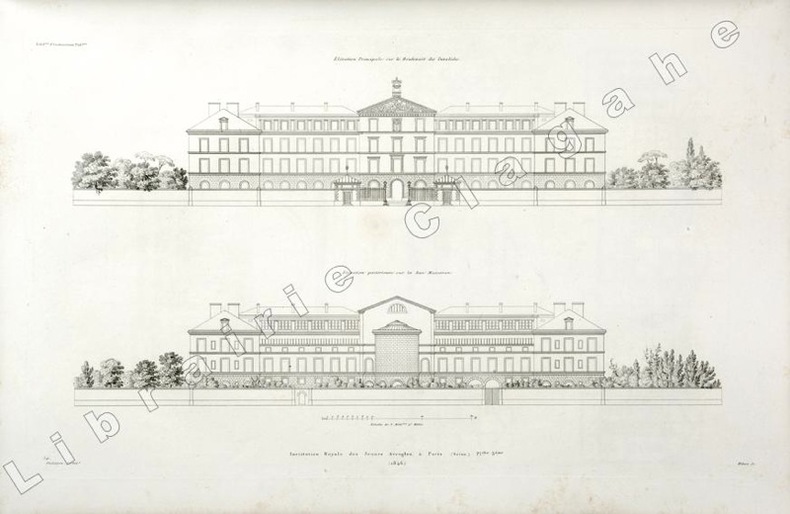
184619809(Paris, 1846) ; in folio, toile vert foncé, double encadrement de filets dorés maigre et gras, tranches dorées, titre doré en long ; papier de garde multicolore peigné (reliure de l’époque); [4], 6 planches gravées de plans des bâtiments et des jardins situés au N°56 du boulevard des Invalides à Paris.
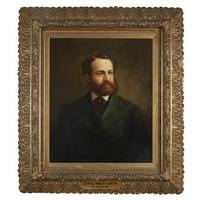
1870690701870. 30" x 24. 30" x 24" A Philadelphia Lawyer Who Served as Pennsylvania's Deputy Attorney General American School 19th Century. Smith Lewis Waln 1846-1881. Portrait of Lewis Waln Smith. Philadelphia c.1870. 24" x 30" image size. Oil on canvas in ornate nineteenth-century gilded wood frame. Some minor nicks and chips to frame gilding slightly dulled otherwise fine. $1800. Lewis Waln Smith was a lawyer who served as Deputy Attorney General for the State of Pennsylvania. This portrait belonged to the Philadelphia Bar Association. Founded in 1802 it is the oldest association of lawyers in the United States. Its library where this portrait was last displayed was renamed the Theodore F. Jenkins Memorial Law Library in 1967. unknown books
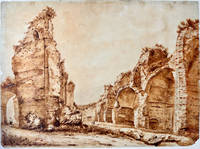
185212381852. Ink wash in brown ink on cream wove paper 9 7/8 x 13 inches 250 x 330 mm titled and dated in brown ink lower right. In fair condition with minor scattered soiling uniform age tone and edge 'nics;' all consistent with age. Laid down to archival mat board. unknown
189235864Paris France: Ecole Nationale Des Beaux-Arts. As New. 1892. Paperback. FREE UPGRADE to Courier/Priority Shipping Upon Request IN STOCK AND IMMEDIATELY AVAILABLE FOR SHIPMENT - Near mint condition. Text in French; 255 works catalogued none illustrated. Includes photo of Pelouse as frontispiece. Rare. -- with a bonus offer-- . Ecole Nationale Des Beaux-Arts paperback
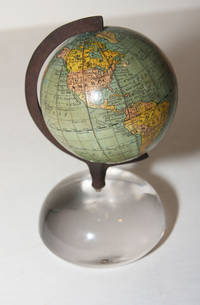
189110008Seneca Falls NY 1891. No Binding. Near Fine. 3-inch diameter globe anchored in magnifying glass as issued; 5 ½ inches total height. Color-printed wax-engraved gores; some fading of place names a few repair in extreme southern portion but overall remarkably little wear; overall excellent condition. An unrecorded delightful cartographic curiosity: a very good quality miniature globe with a magnifying paperweight as its base. Only two other globes by the American Globe and Supply Company are known: a six-inch terrestrial recorded by Rumsey dated 1892 and an eight-inch terrestrial cited in Rittenhouse dated 1891; see below. This Seneca Falls New York company was one of several for which Rand McNally supplied gores for the globes it produced. Rand McNally did not issue its first globe until 1887. Very nice condition for an object of this kind. Cf. Rumsey 5120; Rittenhouse Vol. 2 No. 1 p. 23. unknown
189110008Seneca Falls NY 1891. No Binding. Near Fine. 3-inch diameter globe anchored in magnifying glass as issued; 5 ½ inches total height. Color-printed wax-engraved gores; some fading of place names a few repair in extreme southern portion but overall remarkably little wear; overall excellent condition. An unrecorded delightful cartographic curiosity: a very good quality miniature globe with a magnifying paperweight as its base. Only two other globes by the American Globe and Supply Company are known: a six-inch terrestrial recorded by Rumsey dated 1892 and an eight-inch terrestrial cited in Rittenhouse dated 1891; see below. This Seneca Falls New York company was one of several for which Rand McNally supplied gores for the globes it produced. Rand McNally did not issue its first globe until 1887. Very nice condition for an object of this kind. Cf. Rumsey 5120; Rittenhouse Vol. 2 No. 1 p. 23. unknown books