395 résultats
18432110502151103632Suharaya Mohei 1843. Soft Cover. Fine. Number of books: 5 Suharaya Mohei paperback
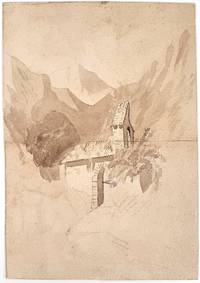
185022821850. Watercolor on cream laid paper laid down to archival board 5 5/8 x 7 7/8 inches 142 x 199 mm the full sheet. In excellent condition with a signature in graphite in the lower right image area that remains illegible. unknown
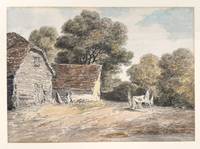
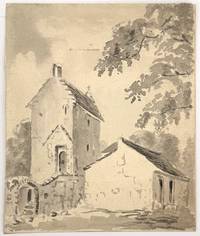
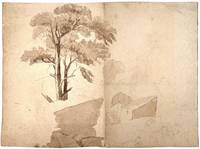
184025121840. Ink and wash on wove paper 6 x 5 inches 152 x 128 mm the full sheet. In very good condition with uniform toning and some paper tape tabs and pencil inscriptions on the verso. unknown
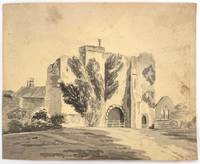
184025111840. Ink and wash on wove paper 5 1/8 x 6 1/2 inches 130 x 165 mm the full sheet. In very good condition with uniform toning some minor surface soiling and with the right sheet edge creased. unknown
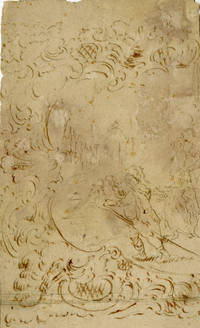
182014341820. Pen and sepia ink on cream laid paper 8 3/4 x 5 3/8 inches 222 x 136 mm. Scattered paper tape repairs on the verso in the area of the upper left corner and along the right sheet edge. Hard vertical crease along the bottom sheet edge approximately 1-inch from the bottom of the sheet. Pencil inscriptions on the verso. The image appears to have been trimmed in half with the left portion of the design lacking. unknown
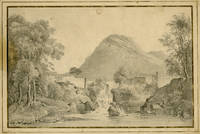
185114311851. Pencil on smooth cream wove paper with a window pane drawn in gold ink 8 3/8 x 11 3/4 inches 213 x 298 mm. Signed illegibly and dated in ink and again in pencil within the lower margin of the image area. Scattered staining and toning throughout. On the verso of the sheet appear some inscriptions including the enigmatic phrase "excruciating but lucid. unknown
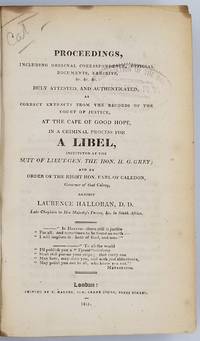
181123976London: T. Harper 1811. Hardcover. Good overall. By 1783 Halloran had had a checkered career charged with immorality and murder of a fellow midshipman. He made his way to South Africa as the English rector of a public school in Cape Town South Africa. He was charged wit libel for his satire 'Capabilities or South African Characteristics' mocking Lieutenant General H. G. Grey. Halloran was found guilty fined and banished from South Africa. He returned to England where he drifted in poverty. In 1818 he was charged with forging a tenpenny frank was found guilty and was sentenced to seven years transportation to Australia.<br /> <br /> On his arrival in Sydney he was immediately granted a ticket of leave by Gov. Macquarie. Simeon Lord and John Macarthur helped him establish a private school for "Classical Mathematical and Commercial Education" known as Sydney Grammar School which opened in 1820.<br /> <br /> 8vo 711pp. Deaccessed by the NY Association of the Bar Library with their stamp on the title page. Tan library cloth binding with leather gilt spine label and paper label. Cloth sunned at spine leather label chipped; slightly cracked inner front hinge; ffep partially detached. OCLC: 222398996 1 copy State Library of New South Wales. Trove 14295450. T. Harper hardcover
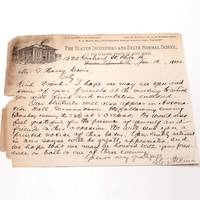
1900372178Philadelphia 1900. 1 page On Slater letterhead. Blank verso has paper residue where once mounted paper is quite tanned along left margin with creasing few short tears and small chips in blank margins else a good copy. 1 page On Slater letterhead. Dr. Simon Green Atkins the son of former slaves founded the Slater Industrial and State Normal School in 1892 in Winston-Salem North Carolina. The school became Winston-Salem Teacher's College in 1925 and it was the first African-American institute in America to offer degrees in elementary education.<br /> <br /> Reading in part: "Dear Friend- I hope we may see you and some of your friends at the meeting to which you will find and sic invitation enclosed not present.<br /> Our students will also appear in Association Hall Germantown the following evening.Your kindly interest in our cause will be greatlyt appreciated. unknown
18992082402113510863Not Available 1899. Soft Cover. Fine. Volume: 1 Not Available paperback
187029538Montgomery Alabama: John G. Stokes & Co. State Printers 1870. 7 1 blank pp. Stitched in original printed green wrappers. Light old folds wrappers lightly spotted Very Good. Contemporary inscription at head of front wrapper "Respects of G. Horton Mobile." A Bostonian who had moved to Mobile as a young man Horton was Mayor of Mobile at this time. Previously he had been an advocate of public education and had served on Mobile's school board. During the Civil War he was jailed for Unionist sympathies. During Reconstruction his advocacy of civil rights placed his life in constant danger.<br /> <br /> The Report is a chapter in Alabama's bitter Reconstruction strife. It attacks Dr. N.B. Cloud State Superintendent of Public Instruction who was regarded by unreconstructed Alabamans as a Scalawag for his support of Reconstruction and the Republican Party. The Report also attacks G.L. Putnam whom Cloud had named Mobile's superintendent of education an appointment which other Mobile educators refused to recognize. <br /> Cloud brokered a compromise-- for which he lacked authority-- by making Putnam superintendent of Emerson College known as the 'Blue School' a Negro school run by the American Missionary Association. The Report accuses Cloud and Putnam of illegally diverting public funds to the support of the Blue School.<br /> Ellison 1597. John G. Stokes & Co., State Printers unknown
187031292Montgomery 1870. 23 1 blank pp with original printed title wrappers. Text lightly dusted wrappers dirty stitched. <br /> <br /> This case is a chapter in Alabama's bitter Reconstruction history. Mobile School Commissioners claimed that George L. Putnam Superintendent of the Mobile schools had mishandled funds which were supposed to be used to support the free public schools. Putnam had been appointed Superintendent by N.B. Cloud State Superintendent of Public Instruction whom unreconstructed Alabamans considered a Scalawag. <br /> Putnam used public funds as authorized by Cloud for the support of a school for Negroes. The outcome of the case turned on whether the Commissioners were properly established under the laws and Reconstruction Constitution of Alabama. This brief reviews the history of the Mobile School System and the controversy. unknown
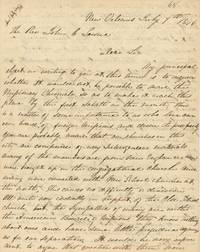
1846List2863New Orleans Louisiana 1846. Single letter three 8 x 10 inch pages. Torn at folds some tears repaired with archival tape; hole at location of seal; otherwise very good to excellent. John Holt Rice 1818–1878 was the son of a Presbyterian minister and nephew of Archibald Alexander founding professor of the Princeton Theological Seminary from which Rice graduated in 1845. When he wrote this letter he was working as a city missionary to the poor in New Orleans. Rice would spend his career ministering around the southern United States before his death from yellow fever. His correspondent is John Cameron Lowrie 1808–1900 a Scottish immigrant fellow Princeton graduate and a missionary in Colonial India. When his health became too precarious to remain abroad Lowrie returned to serve with the Board of Foreign Missions.<br /> <br /> The subject of missions boards was part of the Old School-New School controversy and schism in the Presbyterian Church particularly over whether missionary work should be primary the Old School view or secondary the New School view to the Church’s work.1 Those holding the latter view were satisfied with the work of the American Board of Commissioners for Foreign Missions ABCFM which was not a specifically Presbyterian body. Those of the former view believing that the Church’s missionary board ought to be itself Presbyterian formed the Western Foreign Missionary Society. When the Church’s second schism occurred in 1837 the Western society was <br /> renamed the Board of Foreign Missions BFM and headquartered in New York City.<br /> <br /> In this letter Rev. Rice finds himself in the delicate position of being an Old School supporter of the BFM ministering to Congregationalists and New School-raised supporters of the ABCFM. He writes to Rev. Lowrie requesting that copies of the BFM’s monthly Missionary Chronicle be sent to him in a timely manner as this was “a matter of some importance to us who love our own board of foreign missionsâ€:<br /> <br /> “You are probably aware that our churches in this city are composed of very heterogeneous materials many of the members are from New England and were brought up in the congregational church and many were connected with New School churches at the north. This causes no difficulty or division All unite very cordially in support of the Old School church but the sympathies of many are with the American Board of Missions. They know nothing about ours and have some little prejudice against us for our separation. It would be very impudent to argue that question with them now or attempt to convince them that our own board ought to be patronised by those connected with one of our churches rather than the American. But I feel certain that if they knew more of our operations they would take an interest in them.â€<br /> <br /> Rice also notes that he is an editor for the New Orleans Protestant newspaper and suggests that Lowrie send “something now and then†to excite “missionary zealâ€. Of interest to scholars of Presbyterian history especially the 19th-century Old School-New School schism.<br /> <br /> 1 Rev. Dr. Michael Parker “175 Years of Presbyterian World Mission†Presbyterian Historical Society archived November 1 2023 at https://web.archive.org/web/20231101183954/http://www.history.pcusa.org/history-online/topics-note/history-world-mission. unknown
18762092902143902162Chubei Ishida Kyoto Prefecture Kamigyo 2nd 5th district and others 1876. Soft Cover. Fine. Number of books: 2 Chubei Ishida (Kyoto Prefecture Kamigyo 2nd 5th district) and others paperback
18762092902143802198Chubei Ishida Kyoto Prefecture Kamigyo 2nd 5th district and others 1876. Soft Cover. Fine. Number of books: 2 Chubei Ishida (Kyoto Prefecture Kamigyo 2nd 5th district) and others paperback
184021491840. Graphite and ink and wash in sepia and brown ink on two sheets of heavyweight wove paper 8 1/8 x 11 inches 207 x 280 mm the full sheet. With a hard horizontal crease along the top sheet edge approximately 2-inches from the top. A strip of non-archival tape along the center sheet edge where the two sheets were joined. Minor uniform toning throughout consistent with age. unknown
185021481850. Graphite and wash in sepia and brown ink on two sheets of heavyweight wove paper 10 1/4 x 7 inches 260 x 178 mm the full sheet. Sheets adhered at the verso with a strip of non-archival tape minor uniform toning throughout consistent with age. unknown
188869473Majesty's 1888. Fourth Edition stated. Hardcover. Fair. COver has wear soilng bumped corners and tears to cloth. Somewhat shaken. vii 1 136 p. Includes: illustrations diagrams maps. Errata slip present! Some illustrations have color. LIV plates. This reflects the state of the art knowledge and practice in the mid to late Victorian period. From Wikipedia: "Military engineering is loosely defined as the art and practice of designing and building military works and maintaining lines of military transport and communications. This discipline of engineering is regarded as the oldest form of engineering and is also the precursor of the civil engineering discipline. While both of these disciplines of engineering are responsible for building the same types of projects their environments differ. Military engineers construct and maintain facilities that serve military servicemen on war-fronts. Military engineers are also responsible for logistics behind military tactics. Modern military engineering requires more than civil engineering techniques. In the 21st Century military engineering also includes other engineering disciplines such as mechanical and electrical engineering techniques. According to NATO "Military Engineering is that engineer activity undertaken regardless of component or service to shape the physical operating environment. ' Military Engineering incorporates support to manoeuvre and to the force as a whole including military engineering functions such as engineer support to Force Protection Counter-Improvised Explosive Devices Environmental Protection Engineer Intelligence and Military Search. Military Engineering does not encompass the activities undertaken by those 'engineers' who maintain repair and operate vehicles vessels aircraft weapon systems and equipment." Majesty's hardcover
183993770Ecole des Ponts-et-Chaussées 1839. Hardcover. <b>Livre en français</b>. Couverture rigide. Manuscrit reprographié. Cartonnage d'époque défraîchi coins usés. 193 pages. 24 x 38 cm. Légèrement défraîchi pages de garde tachées. <i>ref. 93770</i> Ecole des Ponts-et-Chaussées hardcover
183493769Ecole des Ponts-et-Chaussées 1834. Hardcover. <b>Livre en français</b>. Couverture rigide. 8 planches dépliantes. Manuscrit reprographié. Cartonnage d'époque légèrement défraîchi coins usés. 52 pages 8 planches. 24 x 38 cm. Quelques annotations en marge. Quelques petites taches d'encre. <i>ref. 93769</i> Ecole des Ponts-et-Chaussées hardcover
1873473422London : Yates Alexander & Shepheard 1873. First Edition. Hardcover. Fair copies with strong text blocks in contemporary full leather; three boards lacking with the remaining boards detached. Vol. 4 lacking spine cover. Remaining boards lightly scuffed with leather worn at corners and joints. Spines gilt-tooled with raised bands which are worn along with the endbands. Marbled endpapers. The text blocks remain uniformly strong showing only occasional and faint bleedthrough. A very serviceable set. Physical description; 3 volumes ; 33 cm. Contents; Vol 4. 10 Dec 1873 to 25 Nov 1874. Vol 14. Fourth board. 2nd year – part 1. 2 Dec 1880 to 26 May 1881. Vol 16. Fourth board. 3rd year – part 1. 1 Dec 1881 to 25 May 1882. Subjects; School Board for London. Education. Elementary education. School administration. Local government. London. 19th century. London : Yates Alexander & Shepheard hardcover
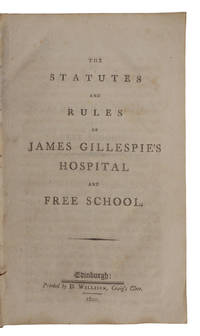
18026725Edinburgh: Printed by D. Willison 1802. FIRST EDITION 8vo pp. 37 i. Extracted from a volume. Lightly foxed some soiling at front and rear short tear to title-page. A rare account of the will of the wealthy tobacco merchant James Gillespie of Spylaw 1726-1797 who left a substantial bequest some £2700 to establish a school for poor boys and a further amount for a hospital for the elderly. The hospital later became workshops for the blind and was demolished in the 1970s but the school remains in operation though having moved premises several times as one of Edinburgh’s highest-ranking state high schools with alumni including Muriel Spark Ronnie Corbett and Alastair Sim. Printed by D. Willison unknown
18902090202122801530Matsunosuke Inokuchi 1890. Soft Cover. Fine. Number of books: 4 Matsunosuke Inokuchi paperback
18942091502135202387Shibata Genzaburo 1894. Soft Cover. Fine. Size: 20cm Number of books: 1 Shibata Genzaburo paperback
188429652Various places 1884-1958. Fine original condition. 73 letters from 43 correspondents including Lore Crewe Lord Curzon F. S. Kenyon Prince Louis of Battenberg Edward Lyttleton Lord Napier Lord Roseberry Sir Charles Trevelyan and others mostly pertaining to school events. unknown
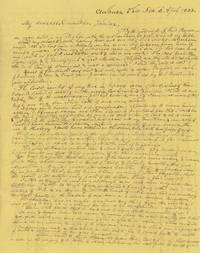
1832List3436Auburn New York 1832. Single four-page letter measuring 7 ¾ x 9 ¾ inches. Folded with very small tears at folds. Excellent to Near Fine. A letter written from the Auburn Theological Seminary in 1832 from the soon-to-be Reverend Thomas Reed Rawson 1803-1877 to his soon-to-be wife Louisa W. Dawes 1810–1849. Dawes who lived in Cummington Massachusetts was the older sister of Senator Henry Laurens Dawes best known for the 1887 Dawes Act.<br /> <br /> Rawson opens by commenting on the death of one of his students and his time spent in Oswego “visiting in the most fashionable familiesâ€; he felt this taught him a great deal about “human nature†which in Oswego is “peculiarâ€. He seems to have been particularly perplexed by the spiritual character he encountered in upstate New York a locus of the Christian revival movement now called the Second Great Awakening:<br /> <br /> “You know I expected that the spirit of the west was a more active . spirit than what was seen in the N.E. states & hoped by breathing this pure atmosphere to enjoy great spiritual health. How erroneous was the impression! How greatly have I been deceived! . I acted as though it was so – as though man was man only in certain latitudes. I acted as though face answered to face only when seen in the waters of N.E. & consequently that the heart of a N.E. man had no analogy to what beats in the bosom of one born in a more western longitude.â€<br /> <br /> Not only is Rawson nonplussed by New Yorkers’ religious qualities he is vehemently opposed to some of the new practices that arose from the religious revival there:<br /> <br /> “The state of things here I mean in all this country at the west is very peculiar. You have heard of ‘Old & New Measures’ I suppose. For myself I cannot approve of the latter. I find not a spirit in me to Fellowship them. Have been exceedingly tried by them as I have been in the midst of ‘new measures’ all winter. You can form but a faint idea of the excitement which is in this country in the religious community. In Oswego Co. the lay-men are going through the Co. holding meetings once a month in praying exhorting dispensing the duties of Clergymen &c. &c.; & it seems that the present state of things must result in a wide division in the churches. ‘A house divided against itself cannot stand.’ . As near as I can find out very sinister is the spirit that knows the new measures to that wild-pine which ran so extensively in the time of Edwards. The effects of it are seen in your town to this day.â€<br /> <br /> The “New Measures†were novel practices for American Christianity that came about during the Second Great Awakening mainly due to Presbyterian minister Charles Finney. These include very lengthy meetings public naming of sinners and public confessions of sin and were controversial with those who preferred a more orthodox and restrained service. Rawson accurately predicts that the new practices would lead to a schism; starting in 1837 the Old School-New School Controversy split the Presbyterian church along these lines. He later worries that such a division in the church would allow “Catholicism to take the advantage†and that “Satan is bringing this about as rapidly as possibleâ€. The appeal of a strong hierarchical Catholic church as opposed to a weak and divided Protestant one was a common worry among Protestants at the time.<br /> <br /> Rawson traces the “sinister spirit†of the new measures back to “the time of Edwardsâ€: Jonathan Edwards a key figure in the First Great Awakening of the 1730s and 40s. Given his reference to “your townâ€â€”Cummington Massachusetts—Rawson is probably referring to the so-called “New England theology†that arose from the First Great Awakening. Among other things New England theology proposed new views on man’s free will and responsibility; similar views would create controversy in Rawson’s time as he explains:<br /> <br /> “I see my own heart to be depraved & wicked beyond all observation but the fruits of the spirit I think I do love & hope they are sweeter & more sweet to my taste. I say taste the New measure-men are not taste-men but believe in the ‘motive scheme’ — By taste is meant the implantation of a new principle – love to God & is affected by the Holy Spirit. The ‘motive scheme’ implies that the sinner turns himself about in by motive merely.â€<br /> <br /> He is objecting to the idea that a sinner could redeem himself through an act of his own will—by his own ‘motives.’ Old School Presbyterianism holds a more orthodox Calvinist view wherein the redemption of the sinner is not up to the sinner’s will at all. Rawson makes an interesting comparison between New School views on the matter and states’ rights in the context of the then-ongoing nullification crisis:<br /> <br /> “The signs of the times declare most plainly to him who has wiped up his eyes that ‘the end has come upon the four corners of this earth’ i.e. the end of peaceful days for the present. Never was our Republic brought to a crisis like this. Nullification in the Political world is the same with Denunciation in the Religious world. This is my opinion; don’t know as have heard others say so.â€<br /> <br /> The nullification crisis arose when South Carolina declared that several import tariffs were unconstitutional and thus nullified them under the states’ rights doctrine of state nullification. Rawson seems to be drawing a parallel between the revivalists’ idea of the role of one’s motives in salvation and states’ rights advocates’ idea of the relationship between the states’ wills and the federal government’s. Of course the states’ rights issue would soon reach an apotheosis.<br /> Rawson closes with some affectionate lines for Dawes and advice about her own teaching job; the crossed text updates her on the Christian conversions within his family. Overall the letter provides detailed insights into the views of a more conservative theology student on the Presbyterian controversy that was soon to come to a head. unknown