395 résultats
1880630641880. 20-1/2 x 20-1/4 inches. Burl frame. 20-1/2 x 20-1/4 inches. unknown
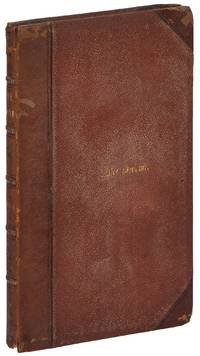
18780008008Orillia Ontario. Good. 1878. On offer is a book containing minutes of the Board of Trustees Meetings of School Section No 4 covering the period from January 1878 to January 1897 that gives an insight of what issues the school board dealt with in those years including financial support expenses school building operation and selection of teachers. The book has 64 pages and includes minutes of 69 meetings two pages documenting payments to a school teacher for the year of 1879. The school was built in 1876 a little more than a year before this book was started and 7 years after Ryerson proposed his 1871 Education Act requiring adequate accommodation for students in every school section. The Meeting agenda usually included election of trustees and chair adoption of annual reports and approval of various expenses: "it was proposed by Mr. Brailey seconded by D. M. Kaughan that the sum of six dollars be appropriated for Prize that the Section do also procure at same time a Daily Register.that the Section be empowered to procure a copy of the amended School Law of Copp Clark and Co." More serious matters concerned repairs construction and school house insurance: ".a Petition to be sent into the council legalize the Muskoka road passing the school house." "Section will be instructed to issue tenders for digging a well at the school and also see to the repairing of the plaster at the School House". In 1880 the routine was interrupted when School's first headmaster Mr. Gardiner left his wife and eloped with an eighteen-year-old to Detroit telegraphing his resignation which made the Trustee Board urgently look for a new teacher: "Several applications for the position of teacher in the room of W. G. Gardiner who has scandalously absconded from the neighbourhood and deserted his post as Teacher were considered by the Trustees but action in the matter was deferred to the future meeting". Finding a new teacher was not an easy task: "The Trustees proceeded to examine three applications made for the position of Teacher in the Sec-n. none of which met their entire approval.proposed that the school be kept vacant till the end of the year that the Sec. 4 do insert advertisements in the Toronto papers for a male teacher at a salary of 300$ per annum". Only a month and a half later in the end of December they hired a new Master of the School at a salary of 260$. In addition to teaching schoolmaster's duties included lighting the fires and sweeping the school and also planting trees: "Mr. Smith teacher be allowed to plant shade trees in front of the school premises within the fence adjoining the Muskoka road and that he receive 50 c. per tree for planting the same with the understanding that in the event of any of the said trees dying during the year that he agrees to replace the same with fresh trees and it is understood that said trees shall be maple and balsam alternately.". The meeting of December 1882 approved 2$ contribution to the Ryerson Memorial Fund. In 1885 the Public School Inspection gave instructions on improvements and repairs to be done including "wood shed construction replastering of the school house increasing blackboard accommodation and fixing privies". The book contains names of School Board Trustees and teachers and of some local residents performing work for the school. Condition: Good regular age-related wear several pages are torn out and missing.; Manuscript; 8vo - over 7¾" - 9¾" tall; KEYWORDS: HISTORY OF EARLY SCHOOL HISTORY ORILLIA HIGH SCHOOL LOCAL SCHOOLS ONTARIO SCHOOL EDUCATION SCHOOL TRUSTEES ORILLIA HISTORY 19TH CENTURY CANADIAN HISTORY HISTORY OF SCHOOL EDUCATION ONTARIO SIMCOE COUNTY SCHOOLS HANDWRITTEN MANUSCRIPT MANUSCRIPTS SCHOOL BOARD MEETINGS MINUTES PUBLIC SCHOOLS INSPECTION SIMCOE COUNTY SCHOOL SECTORS SCHOOL SECTOR 4 ORILLIA TEACHERS TEACHER SALARIES 19TH CENTURY 1880S 1870S CANADIANA . unknown
18602206161860. With Inscription and descriptive text in pencil. 1 vols. 19 x 14 inches 48.3 x 35.6 cm. Framed and glazed. Fine. With Inscription and descriptive text in pencil. 1 vols. 19 x 14 inches 48.3 x 35.6 cm. unknown
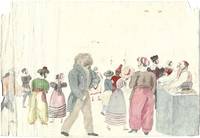
186018931860. Watercolor and pencil on cream wove J Whatman 1827 paper with a partial watermark 7 x 10 1/8 inches 176 x 256 mm the full sheet. The left sheet edge has significant wear; the result of its removal from a page in an album to which the sheet was tipped in. There is also a horizontal tear in the center left sheet edge which extends approximately one inch into the image through the image of the figure with outstretched arms. Small corner losses at the the top right and left sheet as well as a small 1/4 inch at the lower left corner. Colors are extensive and saturated. unknown
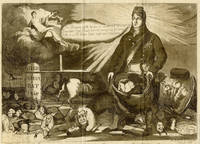
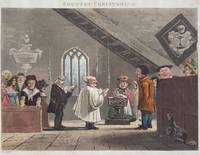
18111538London: The Satirist 1811. Etching with aquatint on buff wove paper with an 1808 watermark 9 3/4 x 13 inches 248 x 330 mm wide margins. Scattered paper repairs on the verso as well as four vertical hard creases and one horizontal crease in the lower quadrant of the sheet. Scattered uniform age tone. The Satirist or the Censor of the Times was a controversial 19th-century British newspaper which featured reports of scandals involving well known residents of London. It was published by Barnard Gregory who faced multiple libel charges and was later imprisoned due to its articles. The Satirist unknown
183426035Italy 1834. Pen-and-ink watercolour and gouache painted black border titled and dated in white gouache in the lower margin within the border. Lovely 19th-century watercolour of Palermo.<br/> <br/> Catering to the foreigners flocking to the region on the Grand Tour this lovely watercolour shows the town of Palermo with its beautiful hills and mountains in the background with a large fort in the harbour with a British and French ship beside it. The sky is awash in pinks and blues displaying the incredible light of the region. unknown
187719616Montevideo: Imprenta a vapor de La Tribuna 1877. FIRST EDITION. Original printed wrappers. First printing. On May 15 1877 this first publication of the regulations of the medical school appeared in Montevideo establishing a five-year curriculum which included a course on hygiene in the second year and legal medicine and toxicology in the fourth. The professors who taught these courses were medical doctors of great renown. <br /> <br /> OCLC locates nocopies in America just a single copy at the BnF. Imprenta a vapor de La Tribuna unknown
18812091202133201037Shinshichi Okajima and others 1881. Soft Cover. Fine. Number of books: 50 books in total Shinshichi Okajima and others paperback
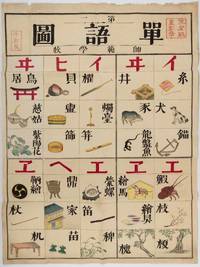
1873214113Japan. Meiji 6 1873. Four very attractive colour folded woodblock school posters 60 x 78cm each with accompanying woodblock printed textbook 32 double-folded leaves 22.5 x 15cm. Edges of posters worn with some minimal loss at margins the accompanying textbook is worn at edges with some thumb marks at lower corners but sound and generally clean. Overall good. Offers a fascinating glimpse into the beginnings of modern Japanese education. A wonderful collection of four primary school colour posters and a teacher's textbook dating to the very beginning of modern school education in Japan. The four posters contain sets of beautifully coloured and delicately printed pictures illustrating key words which children would be taught to read together with the corresponding kanji characters. The posters are divided by theme - one showing parts of the body and clothes; one showing crockery and cooking utensils; one with animals plants and tools; and one household items including a clock chair and abacus. They are particularly interesting for their combination of traditional Japanese and western items. The accompanying woodblock print text book 師範学校小学教授法 Shihan gakkō shōgaku kyōjuhō was published in Meiji 6 1873 and show how to explain each item in the classroom. <br> <br>The posters have the chops of Chikuma Prefecture current Nagano Prefecture and 1000 limited copies at the top. . hardcover
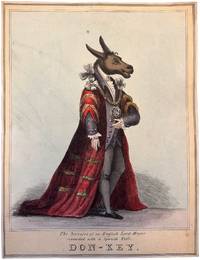
18301891London 1830. Lithograph with hand coloring in watercolor on cream wove paper 12 1/4 x 9 5/16 inches 312 x 235 mm full margins. In good condition with some light areas of minor foxing throughout. Hand coloring is extensive and vibrant. An ass wears his Lord Mayor's gown and chain over court dress with big bows on his shoulders. Published in November 1830 this anthropomorphic satirical caricature is of Sir John Key 1st Baronet 16 August 1794 - 14 July 1858 who was a wholesale stationer and Whig politician in England. He was elected Sheriff of the City of London in 1824 and Lord Mayor of London for two years from 1830 to 1832. <br /> <br /> An uncolored impression of this work may be found in the permanent collection of the British Museum accession No. 16302. unknown
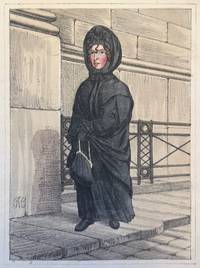
18201889London 1820. Lithograph with handcoloring in watercolor 9 x 6 1/2 inches 230 x 165 mm full margins. Light pencil inscriptions in the lower margins which are largely illegible. Light handling wear and some surface soiling otherwise in good condition with beautiful saturated watercolor work in the area of the subject's face. Whitehead's brother Philip was employed by the Bank of England from 1797 to 1810. During his employment at the Bank Philip Whitehead "adopted an extravagant lifestyle" and evidence came to light that he had defrauded Robarts & Co. by "forging an acceptance to a Bill." He was charged with forgery in 1811 and executed on 29 January 1812. The news of her brother's conviction was kept from his sister Sarah as long as possible. Learning of the execution Sarah Whitehead's mental health became unstable and she began to visit the Bank daily asking if Phillip was there. This continued until 1818 when the Directors offered Whitehead a financial grant on the condition that she stopped coming to the bank. Whitehead wore black crepe clothing which was a sign of mourning and as a result became known as the "Black Nun." To this day Whitehead's ghost reputedly haunts the Bank of England as well as the area on Threadneedle Street nearby. The myth of Whitehead's ghost appears in the poem New Year Letter by W. H. Auden. unknown
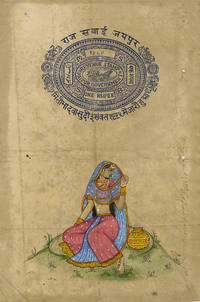
189513361895. Ink and gouache with gold heightening on fibrous brown laid paper with a Jaipur Court Fee tax stamp in purple ink 13 3/8 x 8 3/4 inches 340 x 222 mm. Toning handling creases and minor scattered surface soiling throughout. A typed and signed court order dated 1891 in reference to a landlord/tenant dispute appears on the verso as well as the purple blindstamp of the Treasury of Jaipur. There are scattered coeval Hindi inscriptions in ink on the recto. The following text appears typed on the verso:<br /> <br /> "Maloom order of 2nd July 1891 and 5 party No. b applied to the P.I.B. Department for redress.<br /> <br /> The P.W. Member opined that party No. b is entitled to live in the quarters which had been continually occupied by them and party No.a should not interfere with the other party in respect of the quarters which should be restored to the latter. <br /> <br /> Resolution No.34. <br /> <br /> Resolved that the proposal of the P.W.Member be accepted.<br /> <br /> TRUE COPY<br /> <br /> Registrar<br /> <br /> Mahakma Khas Jaipur."<br /> <br /> <br /> The first revenue stamps in India were issued in the mid-nineteenth century during the Raj and they are still being issued to this day. Apart from issues for the whole of India many princely states provinces and other states also had or still have their own revenue stamp issues. <br /> <br /> Before independence Indian revenue stamps were closely modeled on similar designs from Great Britain as is the case with this carriage motif stamp from Jaipur. The stamps were issued to denote various denominations including rupees and annas. An anna or Änna was a currency unit formerly used in British India equal to 1â„16 of a rupee. It was subdivided into four old Paisa or twelve pies thus there were 192 pies in a rupee. When the rupee was decimalized and subdivided into 100 new paise one anna was therefore equivalent to 6.25 paise. This particular stamp was used as evidence of court taxes remitted for property dealings. unknown
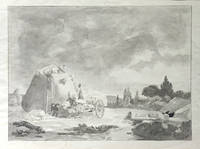
188083103c.1880. Charming country scene showing the river Thames with Windsor Castle in the background. Original watercolour. Size: 360 x 520 mm Excellent condition. unknown
1882123261882. 233x354mm. 9¼x14". h. 1882-1830. 233 x 354mm. Pluma y aguada gris anverso y pluma reverso sobre papel avitelado amarillento Inscrito; "France" en el reverso. unknown
18482111902160201131Manuscript by Michishige Ochi 1848. Soft Cover. Fine. Volume: 1 Manuscript by Michishige Ochi paperback
18432111902153000124Seigankaku 1843. Soft Cover. Fine. Number of books: 6 Seigankaku paperback
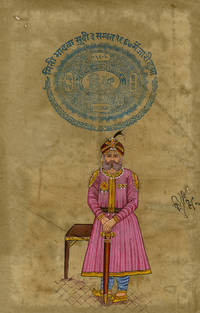
189013401890. Ink and gouache with gold heightening on fibrous brown laid paper with a Jaipur Court Fee tax stamp in purple ink on the recto 12 1/2 x 9 inches 318 x 230 mm. Toning handling creases and minor scattered surface soiling throughout. There are scattered coeval inscriptions in ink on the recto and verso. The first revenue stamps in India were issued in the mid-nineteenth century during the Raj and they are still being issued to this day. Apart from issues for the whole of India many princely states provinces and other states also had or still have their own revenue stamp issues. Before independence Indian revenue stamps were closely modeled on similar designs from Great Britain as is the case with this carriage motif stamp from Jaipur. <br /> <br /> The stamps were issued to denote various denominations including rupees and annas. An anna or Änna was a currency unit formerly used in British India equal to 1â„16 of a rupee. It was subdivided into four old Paisa or twelve pies thus there were 192 pies in a rupee. When the rupee was decimalized and subdivided into 100 new paise one anna was therefore equivalent to 6.25 paise. This particular stamp was used as evidence of court taxes remitted for property dealings. unknown
1870433066Germantown Ohio: Germantown High School 1870. Hardcover. Very Good. First edition. Tall octavo. 153pp. Half sheep and pebbled cloth. Top edge gilt. Owner's name in gilt on front board Alice Dechant co-editor of several issues joints a little tender faint staining on the boards modest foxing in the text a good or better copy. The full run of this high school newspaper issued together with a preface. According to the preface the book was published as: "limited to a few copies perhaps a score or two" thus presumably 40 or fewer copies likely published as a souvenir for the graduates probably in 1870 or very slightly later. OCLC locates two copies both in Ohio. Germantown High School hardcover
18732111902156202536Not Available 1873. Soft Cover. Fine. Number of books: 3 Not Available paperback
18508857Paris 1850. Pencil pen and wash drawing with numerous detailed measurements. A fascinating and beautiful drawing--or "rendu"--of an ancient Roman sarcophagus.<br/> <br/> A fine drawing from an architectural student at the Ecole des Beaux-Arts in Paris the most influential architectural school in existence during much of the 18th century the whole of the 19th century and the first part of the 20th century. 'Students were eligible for the Ecole if they were at least fifteen years old or under thirty. They began with the seconde classe in which they competed in the concours d'émulation. These alternated between an esquisse --a rough sketch for which up to twelve hours was allowed--and a rendu --the large-scale finished drawing for which one to three months were allowed.Two to four years were usually required for a student to accumulate enough credits to enter the première classe. The same system was followed again usually for two to three years after which the student should have accumulated enough credits to compete for the Grand Prix de Rome. The winner of the Grand Prix was entitled to five years study under the auspices of the French Academy in Rome. For each of his first three years he was required to submit an analytical study of an ancient monument. For his fourth year he had to submit a complete reconstruction of a major classical work. For his fifth year he was required to submit an original work designed to a program of his own invention. "This study of the sarcophagus of Lucius Cornelius Scipio Barbatus was part of an Ecole de Beaux Arts student's portfolio. The sarcophagus was one of many in the Scipio family tomb on the Via Appia just outside of Roma and it dates from c. 290 B.C. The obituary text reads English "Lucius Cornelius Scipio Barbatus son of Gnaeus a valiant gentleman and wise whose fine form matched his bravery very well was aedile consul and censor among you he conquered Taurasia and Cisauna in fact Samnium he overcame all the Lucanian lands and brought back hostages."<br/> <br/> Arthur Drexler The Architecture of the Ecole des Beaux-Arts. New York MoMA 1977. unknown
18302092902141205848Suharaya Mohei and others 1830. Soft Cover. Fine. Number of books: 4 Suharaya Mohei and others paperback
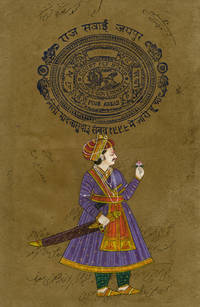
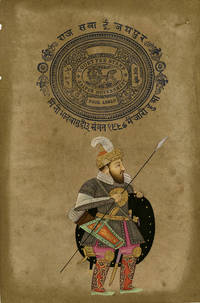
189013381890. Ink and gouache with yellow heightening on fibrous brown laid paper with a Jaipur Court Fee tax stamp in blue ink 13 1/2 x 8 3/4 inches 343 x 222 mm. Toning handling creases and minor scattered surface soiling throughout. There are scattered coeval Hindi inscriptions in ink on the recto. Raja Mahan Singh Mirpuri 1810 - 1844 was a famous general in the Sikh Khalsa Army. He was conferred by Maharaja Ranjit Singh the title of Raja for his conquests of Haripur Nowshera and Peshawar. The town of Mansehra derives its name from him. Singh was murdered by his own soldiers in 1844 when mutiny broke out in the Sikh Khalsa Army. His death was avenged by his son Chhattar Singh who was himself killed soon after.<br /> <br /> The first revenue stamps in India were issued in the mid-nineteenth century during the Raj and they are still being issued to this day. Apart from issues for the whole of India many princely states provinces and other states also had or still have their own revenue stamp issues. Before independence Indian revenue stamps were closely modeled on similar designs from Great Britain as is the case with this carriage motif stamp from Jaipur. The stamps were issued to denote various denominations including rupees and annas. An anna or Änna was a currency unit formerly used in British India equal to 1â„16 of a rupee. It was subdivided into four old Paisa or twelve pies thus there were 192 pies in a rupee. When the rupee was decimalized and subdivided into 100 new paise one anna was therefore equivalent to 6.25 paise. This particular stamp was used as evidence of court taxes remitted for property dealings. unknown
18251890London: Thomas McLean 1825. Aquatint with engraving and handcoloring in watercolor on wove paper 8 7/8 x 10 3/4 inches 225 x 272 mm wide margins. Light handling wear and four small dots of adhesive residue at each of the four corners on the verso. Coloring is extensive and fresh. Thomas McLean unknown
189013371890. Ink and gouache with gold heightening on fibrous brown laid paper with a Jaipur Court Fee tax stamp in gray ink and the 1889 Jaipur State Council stamp in black ink 13 1/4 x 8 3/4 inches 335 x 222 mm. Toning handling creases and minor scattered surface soiling throughout. There are scattered coeval Hindi inscriptions in ink on the recto. "A ragamala translated from Sanskrit as "garland of ragas" is a series of paintings depicting a range of musical melodies known as ragas. Its root word raga means color mood and delight and the depiction of these moods was a favored subject in later Indian court paintings. The celebration of music in painting is a distinctly Indian preoccupation. Ragamalas were first identified as a specific painting genre in the second half of the fifteenth century but their ancestry can be traced to the fifth- to seventh-century Brihaddeshi treatise which states: "A raga is called by the learned that kind of composition which is adorned with musical notes . . . which have the effect of coloring the hearts of men." Often the mood or raga is also written as poetry on the margins of the painting. These works thus evocatively express the intersections of painting poetry and music in Indian court art." <br /> <br /> -The Metropolitan Museum of Art Exhibition Overview Ragamala: Picturing Sound December 2014.<br /> <br /> The first revenue stamps in India were issued in the mid-nineteenth century during the Raj and they are still being issued to this day. Apart from issues for the whole of India many princely states provinces and other states also had or still have their own revenue stamp issues. Before independence Indian revenue stamps were closely modeled on similar designs from Great Britain as is the case with this carriage motif stamp from Jaipur. The stamps were issued to denote various denominations including rupees and annas. An anna or Änna was a currency unit formerly used in British India equal to 1â„16 of a rupee. It was subdivided into four old Paisa or twelve pies thus there were 192 pies in a rupee. When the rupee was decimalized and subdivided into 100 new paise one anna was therefore equivalent to 6.25 paise. This particular stamp was used as evidence of court taxes remitted for property dealings. unknown
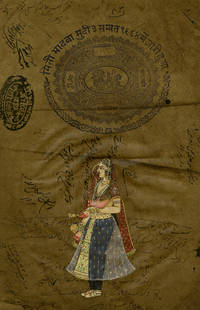
189013351890. Ink and gouache with gold heightening on fibrous brown laid paper with a Jaipur Court Fee tax stamp in black ink 13 3/8 x 8 3/4 inches 340 x 222 mm. Toning handling creases and minor scattered surface soiling throughout. Scattered coeval Hindi inscriptions in ink on the verso as well as the embossed blindstamp of the Treasury of Jaipur. The first revenue stamps in India were issued in the mid-nineteenth century during the Raj and they are still being issued to this day. Apart from issues for the whole of India many princely states provinces and other states also had or still have their own revenue stamp issues. <br /> <br /> Before independence Indian revenue stamps were closely modeled on similar designs from Great Britain as is the case with this carriage motif stamp from Jaipur. The stamps were issued to denote various denominations including rupees and annas. An anna or Änna was a currency unit formerly used in British India equal to 1â„16 of a rupee. It was subdivided into four old Paisa or twelve pies thus there were 192 pies in a rupee. When the rupee was decimalized and subdivided into 100 new paise one anna was therefore equivalent to 6.25 paise. This particular stamp was used as evidence of court taxes remitted for property dealings. unknown