487 résultats
1951215511Decatur AL: Decatur Negro High School 1951. 3.75x5 inch folded invitation card and card-holder smaller 4-panel invitation bound-in with the invitation printed in script on cover school motto roll flower and color on inner panel tiny name plate printed with the name Vendetta Jackson Marks set in die-cut fold embossed cover bound with wide blue satin ribbon very good. Decatur Negro High School unknown books
1800225275England 1800. Watercolor drawing. 31.8 x 45.7 cm. 12-1/2 x 18 inches. Framed and matted. Watercolor drawing. 31.8 x 45.7 cm. 12-1/2 x 18 inches. Superb hilltop view of the old port in this village in North Devon showing several large frigates anchored in the bay sloops moored in the harbor cattle grazing on the slopes sea and sky in the distance. unknown books
180427384New Haven: Printed for Simeon Jocelin. From Sidney's Press 1804. First edition. Disbound. Lacking the wrappers some light dampstaining to the top edge else about very good. 46 pp. 8vo. Simeon Jocelyn 1746-1823 was the publisher of the Chorister's Companion 1782-3 where he followed Andrew Law's approach to mix English and American and the new and the old composers. In 1787 he published A Collection of Favorite Psalm Tunes. Neither Sabin nor Shaw and Shoemaker list Jocelin as the author. Scarce. OCLC & RLIN show 10 copies. Sabin 50494. Shaw and Shoemaker 6820. Printed for Simeon Jocelin... From Sidney's Press unknown books
1935130770Nashville: State Department of Education 1935. 22p. revised edition near-fine in wraps. State Department of Education unknown books
1938017447Chicago: DuSable. 1938. First Edition. Paperback. Wraps 4pp an invitation to the commencement is laid in. . DuSable paperback books
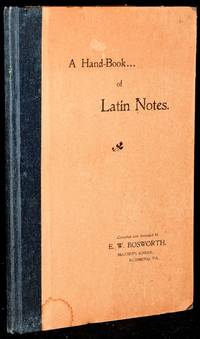
1899271407Richmond VA: Whittet & Shepperson 1899. First Edition. Hard Cover. Very Good binding. A Latin primer prepared by E. W. Bosworth of the McGuire's School in Richmond presumably for the use of the students at the school. An uncommon Richmond item. Very Good binding. Whittet & Shepperson unknown books
19661964Salt Lake City: Student Association of East High School 1966. 143pp. Sextodecimo 15.5 cm White side-stapled wrappers. A handful of manuscript notes and scribbles otherwise very good. Handbook and directory printed for students that contains a brief history of the school traditions mascot emblems colors etc. which is followed by a directory. Presumed rare.<br/><br/>"You have started another year of high school to continue to establish a record by which you will be known. Your record will be a reliable indicator of what people can expect from your performance as you meet the challenges of living." - from the Principal's Welcome. Student Association of East High School unknown books
19681944Salt Lake City: Student Association of East High School 1968. 112pp. Sextodecimo 15.5 cm Spiral bound printed covers. A handful of manuscript notes and scribbles lacks pages 105/106 and 107/108 otherwise very good. Handbook and directory printed for students that contains a brief history of the school traditions mascot emblems colors etc. which is followed by a directory. Presumed rare.<br/><br/>"The Handbook is a key to the interesting phases of school life which give every student opportunity to express himself through service. It is invaluable aid to the new students since it gives information concerning all departments and activities of East High. Students should read this carefully." - p.19. Student Association of East High School unknown books
18508857Paris 1850. Pencil pen and wash drawing with numerous detailed measurements. A fascinating and beautiful drawing--or "rendu"--of an ancient Roman sarcophagus.<br/> <br/>A fine drawing from an architectural student at the Ecole des Beaux-Arts in Paris the most influential architectural school in existence during much of the 18th century the whole of the 19th century and the first part of the 20th century. 'Students were eligible for the Ecole if they were at least fifteen years old or under thirty. They began with the seconde classe in which they competed in the concours d'émulation. These alternated between an esquisse --a rough sketch for which up to twelve hours was allowed--and a rendu --the large-scale finished drawing for which one to three months were allowed.Two to four years were usually required for a student to accumulate enough credits to enter the première classe. The same system was followed again usually for two to three years after which the student should have accumulated enough credits to compete for the Grand Prix de Rome. The winner of the Grand Prix was entitled to five years study under the auspices of the French Academy in Rome. For each of his first three years he was required to submit an analytical study of an ancient monument. For his fourth year he had to submit a complete reconstruction of a major classical work. For his fifth year he was required to submit an original work designed to a program of his own invention. "This study of the sarcophagus of Lucius Cornelius Scipio Barbatus was part of an Ecole de Beaux Arts student's portfolio. The sarcophagus was one of many in the Scipio family tomb on the Via Appia just outside of Roma and it dates from c. 290 B.C. The obituary text reads English "Lucius Cornelius Scipio Barbatus son of Gnaeus a valiant gentleman and wise whose fine form matched his bravery very well was aedile consul and censor among you he conquered Taurasia and Cisauna in fact Samnium he overcame all the Lucanian lands and brought back hostages."<br/> <br/>Arthur Drexler The Architecture of the Ecole des Beaux-Arts. New York MoMA 1977. unknown books
185020700Paris 1850. Pencil pen and wash drawing with numerous sub-titles in ink signed "J. Litoux" A fascinating and beautiful architectural drawing - or 'rendu' of basic elements of house construction in cluding walls floors doorways roofs and ceilings.<br/> <br/>A fine drawing from an architectural student at the Ecole des Beaux-Arts in Paris the most influential architectural school in existence during much of the 18th century the whole of the 19th century and the first part of the 20th century. 'Students were eligible for the Ecole if they were at least fifteen years old or under thirty. They began with the seconde classe in which they competed in the concours d'émulation. These alternated between an esquisse - a rough sketch for which up to twelve hours was allowed - and a rendu - the large-scale finished drawing for which one to three months were allowed. Two to four years were usually required for a student to accumulate enough credits to enter the première classe. The same system was followed again usually for two to three years after which the student should have accumulated enough credits to compete for the Grand Prix de Rome. The winner of the Grand Prix was entitled to five years study under the auspices of the French Academy in Rome. For each of his first three years he was required to submit an analytical study of an ancient monument. For his fourth year he had to submit a complete reconstruction of a major classical work. For his fifth year he was required to submit an original work designed to a program of his own invention. In the seconde classe the student was required to attend a variety of lectures in theory history and construction and learned to prepare construction drawings. Work was done at ateliers located outside the precincts of the Ecole des Beaux-Arts. These were rented and organized by the students themselves and the students had the right to invite a teacher of their own choice to serve as their maître. The teacher himself did not have to be a member of the faculty of the Ecole nor - at least in principle - did he have to be a practicing architect.' Arthur Drexler. The Architecture of the Ecole des Beaux-Arts. New York MoMA 1977 p.8-9<br/> <br/>Arthur Drexler The Architecture of the Ecole des Beaux-Arts. New York MoMA 1977. unknown books
188371784Paris: E. Leroux 1883. Hardcover. Fair. lv 577p. Contemporary 1/4 leather. 27cm. Covers quite scuffed. Contents reasonably sound but browned and rather brittle a few corner chips and tears. Ex lib. Title and most text in French. <br/><br/> E. Leroux hardcover books
1959132252Paris: Ecole Estienne 1959. Softcover. Good inscribed by Krol. spine cracked dent to rear. White wraps with color illustration. 4 color and several bw plates. Text in French. Ecole Estienne paperback books
1966132289Paris: Editions Estienne 1966. Softcover. VG- page cutting error bump to corner and spine. White wraps with color illustration. Unpaginated. 49 plates 13 full color. Text in French. Preface by Robert Ranc. Editions Estienne paperback books
1968045479Paris: Ãcole Française d'Athènes 1968. Préface de Georges Daux. x 214p. plus 5 b/w plates of coins b/w illus. folded maps original blue cloth. Ãcole Française d'Athènes unknown books
1987036792Rome: Ãcole Française de Rome 1987. xii 155 2p. original stiff printed wrappers. Ãcole Française de Rome unknown books
1981179195Rome: Ecole française de Rome 1981. Softcover. Good foxing to block shelfwear to wraps. Light blue wraps with black lettering red and white dust jacket with bw illustration and red lettering 371 pp illustrated in bw. Text in French and Italian with summaries in French. Includes bibliographical references and indexes. Ecole française de Rome unknown books
192931289Paris: Vincent Freal & Cie 1929. First edition. Cloth. Ex-library with usual markings withdrawn stamp rebound with text and plates bound in part of text block loose hinges re-enforced plates clean and all present a good- copy. 46 pp. Plates. Illus. with 137 b/w plates some folding. 4to. Includes Marcel Chappey's first prize for "Ensemble naval et architectural destine a la propagande artistique et scientifique de la France a l'etranger" 8 plates and excellent plans for a multi-story auto-garage. Vincent, Freal & Cie hardcover books
1925000882Paris: Auguste Vincent 1925. Presumed First Edition. Unbound. Very Good/No Jacket as Issued. 34 page pamphlet stapled spine followed by 161 plates of designs plans and diagrams. In hinged twp panel case cloth spine marbleized boards cloth ties. Auguste Vincent unknown books
1895223921Paris: Gauthier-Villars et Fils 1895. First. hardcover. fine. Illustrated throughout with nicely printed portraits and other historical reproductions. 3 volumes. lxviii 519; 572; 646pp. Very thick short 4tos beautifully rebound by Stroobants in older 3/4 tan morocco over marbled boards; ornate gilt-stamped spines with burgundy leather labels; uncut edges t.e.g. original wrappers bound-in marbled board slipcase worn. Paris: Gauthier-Villars et Fils 1895-1897.<br/><br/> Fore-edges foxed and also some light foxing throughout the first volume otherwise a fine copy in a lovely binding.<br/><br/> Gauthier-Villars et Fils unknown books
1984BL3821Palaiseau France:: Ecole Polytechnique 1984. 1984. Sm. 8vo. 148 pp. Illus. Printed wrappers. Fine. ISBN: 2730200797 Ecole Polytechnique, 1984. unknown books
190173241Burlington Vt 1901. Hardcover. Very Good. photos 74 22p. Deep blue cloth. Oblong 28 x 20cm. Some bubbling and darkening of cover cloth. High School Annual or Year Book. <br/><br/> hardcover books
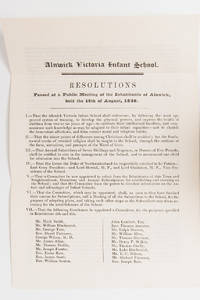
18382596Alnwick: M. Smith 1838. First edition. Fine. 3 page pamphet measuring 152 x 228mm. Trifolded with ownership signature of Wm. Dickson Esq to rear blank. Else an exceptionally clean and seemingly untouched copy of this rare pamphlet advocating for improvements in the early education of children. The only copy known on the market this title does not appear in the modern auction record or at any institutions according to OCLC.<br/><br/>A proposal and prospectus for an Infant School to serve the town of Alnwick and improve the overall level of education within the community. The pamphlet clarifies that the Duke of Northumberland is confirmed as the school's patron; and it outlines how donations and subsciptions from the town will add to the school's endowment. But more importantly it focuses on the communal benefits that will come from citizens' support for children's education regardless of their class. Touting the successes of other Infant Schools in England and abroad in providing "well-regulated nurseries for the children of the poorer classes" the committee also explains that " the most approved system of training will develop the physical powers and improve the health of children from two to six years of age -- to cultivate their intellectual faculties and communicate such knowledge as may be adapted to their infant capacities." The committee asserts that when the larger population begins sending children to school those children will be endowed with a desire to learn and "those attending will feel it as a punishment to be kept from the School" because school "is to the children what the actual business of life is to the man. Here the feelings are manifested and the character is developed" so that infants grow to intelligent and responsible members of the populace. Notably the committee also points out the short term benefits of developing an education system. "To the parents themselves many advantages will accrue from these Schools. Not only will their minds be relieved from much anxiety for the safety of their children but the mother free during the day from the necessity of watching over them will have an opportunity now denied to her of contributing by her labour to their support or of devoting more time to the promotion of their comfort at home." This acknowledgment reveals an important shift in thinking about the economic role of mothers and about women's need for time to accomplish their own work. A rare and important example of the spread of early childhood education and the arguments for its expansion. Fine. M. Smith unknown books
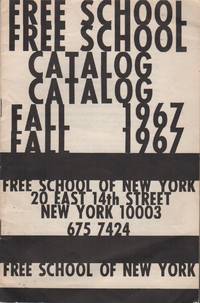
196717647New York: Free School of New York Fall 1967. First Edition. Wraps. Very good. 5.5" x 8.5" approx. saddle-stapled booklet. Touches of toning and wear at corners. Mailing information at rear wrap. Interior clean and bright. Very good. 12pp. <br/><br/>Catalog for the fall 1967 term at the Free School of New York also known as the Free University of New York. Established in 1965 as a reaction to traditional academia FUNY was in the tradition of 1960s protest movements run by committee with open enrollment and granting no degrees. This catalog which lists the school's 24 class offerings demonstrates a focus on the humanities with courses in filmmaking history fine arts and drama. Class offerings were predictably left-leaning with titles like "A Quest for Self" "The Thought of Mao Tse-Tung" and "Black Power and the "Ghetto Uprisings" and the faculty included counterculture figures such as Ed Sanders and Tuli Kupferberg. An ambitious and ephemeral offshoot of the 1960s counterculture movement FUNY closed after only a few years in operation. Free School of New York paperback books
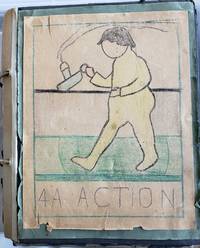
16963Primary School Scrapbook Hand-made 4th grade class yearbook from 1932 at Frank M. School in Johnson City NY. Filled with handwritten personal essays from numerous students and 33 original silver gelatin print photographs 2.75 in x 2 in. Large color drawing in crayon on front cover of a striding figure in profile holding a candlestick. "4A Action" hand-lettered below. 12 x 9 in. Bound with 2 metal rings. Written on first page "Copywright sic by June Moore - Editor / Jack Phillips - Business Manager". "Record of Happy Days / Oh children dear if you will look Within the pages of this book One every leaf you'll find a space Where a paragraph or a poem has been placed." 23 individual photos of students with a short handwritten inscription by their image giving their name and a few short lines on their character. "James is a peppy little fellow And is always quite a joy With his smiling face and happy words to every girl and boy." "Marion is always making fun She is always fooling everyone She is always playing funny games And she sometimes play them when it rains." "Angel is a little Greek boy Who is always full of joy He tries in various places And usually wins the races." "I know a boy and Billy is his name And he's a Dutchman just the same though to him it doesn't matter I wish he was much fatter." Also photographs of beloved teachers and the principal who is described thus: "She is a very loving principal and all the children praise her.My opinion is that everyone should love her."<br/><br/>Several essays note the importance of documenting this fleeting moment of childhood. "When I grown to be old and feeble I will have a clear picture of my class and I.These memories I will keep in my mind until I can't do such things." "Memories' Dreams / From a broad picture in my mind I see my classmates and I having a picture taken on the green lawn east of our Home Library where we spent the latter days of our 4 Grade. We have made this year book so when we become old men and women we can look in this little book and remember in our minds the dreams we used to play. Also we will see our childhood days. As we go on.we enjoyed many various moments in there making small as this little book is. It is the nearest thing to our hearts. Many times when we are alone we will sit and play the games we did long ago wishing that the dreams would come true. So now dear children do not hesitate in making a book such as this for it brings back the memories of our childhood says." Sections labeled in cut out block lettering: Stories and Poems Geography and Arithmetic. 5 photographs of the students in various school events and clubs. Photos of the Boys Club and the Girls Club. "We we get old we will wish we were young to think of the good times we used to have. I wish I could stay in school all my life but I think it is impossible." Entries on updates throughout the school year and a selection of material they studied. "Our class his having a contest. We all made a bird house then we painted it. These four you see in the picture won the prizes. The laughing little boy won the first prize. This boy is now in bed with rheumatic fever." Includes student writing assignments on "My Surprise" "A Robin's Breakfast" "My Dogs" and "An Accident." Some letter writing assignments are dated in April 1932. Many of the essays are written by different students on the same topic such as "Why I shouldn't Interrupt". "The reason I shouldn't interrupt is because it isn't polite. Also the person you are interrupting may have something interesting to say." Section on Geography with several short essays on Chinese culture including tea architecture shoemaking and growing rice. "On my imaginary trip to China we learned how to make rice cakes. Here are a few ideas how to make them. Firs they take rice grains and drop them into a huge bowl.after a while flour is made." Also essays about imaginary trips to Chicago Pittsburgh and Switzerland. First two pages detached. Chipping to edges of some album pages. Few small tears around edges of drawing on front cover. In good to very good condition. unknown books
18602206161860. With Inscription and descriptive text in pencil. 1 vols. 19 x 14 inches 48.3 x 35.6 cm. Framed and glazed. Fine. With Inscription and descriptive text in pencil. 1 vols. 19 x 14 inches 48.3 x 35.6 cm. unknown books